Table Of ContentCATULLUS
EXPANDED
EDITION
H V. B , P D &
ENRY ENDER H
P Y F , P D
HYLLIS OUNG ORSYTH H
Bolchazy-Carducci Publishers, Inc.
Wauconda, Illinois USA
General Editor:
LeaAnn A. Osburn
Cover Design & Typography:
Adam Phillip Velez
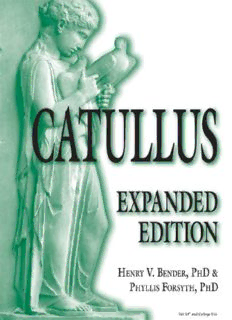
Cover & Title Page Illustration:
Girl with pigeons, fi fth century BC
Courtesy of the Metropolitan Museum of Art, New York
Catullus: Expanded Edition
Henry V. Bender & Phyllis Young Forsyth
© 2005 Bolchazy-Carducci Publishers, Inc.
All rights reserved
Reprinted with corrections 2006
Bolchazy-Carducci Publishers, Inc.
1000 Brown Street, Unit 101
Wauconda, Illinois 60084
www.bolchazy.com
Printed in the United States of America
2006
by United Graphics
ISBN-13: 978-0-86516-603-5
ISBN-10: 0-86516-603-X
———————————————————————————————
Library of Congress Cataloging-in-Publication Data
Catullus, Gaius Valerius.
[Selections. 2005]
Catullus / [edited by] Henry V. Bender & Phyllis Forsyth.-- Expanded ed.
p. cm.
A new and expanded edition of Catullus for the AP: a supplement published in 2004
and the original edition, Catullus: student text published in 1998.
Includes bibliographical references.
ISBN-13: 978-0-86516-603-5
ISBN-10: 0-86516-603-X (pbk. : alk. paper)
1. Latin language--Readers. 2. Love poetry, Latin. 3. Epigrams, Latin. 4. Rome--
Poetry. I. Bender, Henry V., 1945- II. Forsyth, Phyllis Young. III. Title.
PA6274.A25 2005
874’.01--dc22
2005006819
CONTENTS
Preface v
An Introduction to Catullus vii
Advanced Placement Syllabus, Catullus (2005–) xi
Text of the Advanced Placement Poems with Notes and Vocabulary 01
Text Only of the Advanced Placement Poems 77
Appendix I: Additional Poems with Notes and Vocabulary 99
Appendix II: Meters 115
Appendix III: Figures of Speech 119
Glossary: Latin to English Vocabulary 123
PREFACE
Since the publication of our first Catullus text in 1998, over 15,000 copies have been used. The numerous com-
ments we have received from teachers and students who continue to choose our book for their threshold study
of Catullus have informed our construction of the present volume.
The goal of our text remains today what it was at the outset, namely “to assist and encourage the initial
eff orts of upper level high school or intermediate level college readers of Catullus to comprehend the poems
which comprise the Advanced Place ment* syllabus.” Our steadfast aim is to facilitate the student’s mastery of
the grammar, vocabulary, and themes of the poetry.
This new and expanded edition is a fusion of Catullus for the AP*: A Supplement published in 2004 and the
original edition published in 1998. The addition of a text-only section has expanded this edition and provides
the teacher and student with a recitation opportunity by which the poems may each be read in class without
the presence of vocabulary prompts. The presence of such a text also provides easier opportunities for oral or
writt en assessments of a student’s real mastery of the material.
We have also placed the poems from the old syllabus which are not on the new syllabus in Appendix I.
This feature will enable teachers to have easy access to familiar poems which, while not required in the new
syllabus, are still very useful in revealing the personality and spirit of the poet.
The Student Text begins with an introduction on what we know of Catullus’ life and back ground, essentially
the foundation for reading the AP* selections. A brief head note intro duces the text of each poem, which is ac-
companied by notes and a very full vocabulary. Verbs (except for deponents) have their fourth part in -um; all
adjectives are listed with their nominative singular forms fi tt ing the patt erns -us-a-um or -is-e, etc. Our notes are
brief and to the point. They are always aimed at fostering a lucid comprehension of the text under study. Our goal
remains, as it was originally, to bring the text of Catullus to a student with a minimum of two years of Latin.
As in the original edition, meters are identifi ed with full explanation appearing in a separate appendix. A
glossary of fi gures of speech with examples drawn from the poems of Catullus likewise appears as an appendix.
Finally, a general vocabulary appears at the end of the book and is a collection of all the words we glossed.
A new teacher’s manual to accompany this expanded edition will be forthcoming. The teacher’s manuals
from the original edition and the supplement continue to be available and feature, with minor orthographic
changes, the Latin text established by Mynors (Oxford 1958).** The poems in the Teacher’s Manuals are printed
in large type so that they can be made into overhead transparencies for review or sight work in class. Such use
permits fast review, prevents the student from con stant dependence upon vocabulary glosses, and provides an
easy text for testing and poem contrast or analysis.
Literal prose translations of each poem are off ered and tests by which to assess the students’ mastery of
points of grammar, identification, meter, figures of speech, as well as the translation and comprehension of each
poem are included. Essay questions, modeled on those encountered in AP.* Examinations, are also featured in
the Teacher’s Manuals. The format of these tests replicates the format of the AP* examinations. Teachers can
confi gure these sample tests to suit their own needs. A select bibliography completes the teachers’ manuals.
*AP is a registered trademark of the College Entrance Examination Board, which was not involved in the production of, and does not endorse, this product.
**This edition like its predecessors follows Mynors’ text with the following exceptions:14A line 16 we read Salse for False (Mynors); 64 line 73 quo for quo ex
(Mynors); 64 line 89 progignunt for praecingunt (Mynors); 65 line 8 Mynors inserts a period but we use a hyphen; 68 line 11 Manli for Mani (Mynors); 116
line 7 acta for amitha (Mynors)
These textbooks should not be expected to do everything for everybody, but they have been eff ective in
whett ing the appetite of students to go on with their study of Latin, and to achieve a strong toehold in the
syntax and vocabulary of Roman lyric poetry.
I, Henry V. Bender, would like to express my thanks to my many students who worked through this mate-
rial with me over the twenty-nine years I spent at St. Joseph’s Preparatory School and over the past seven years
at The Hill School, as well as to my colleagues at schools who so gener ously have given suggestions and time
to the project as they used various versions of these texts in earlier forms. These schools include the Baldwin
School, Boston College High School, the Lawrenceville School, Mount Saint Joseph Academy, North Penn High
School, Oratory Preparatory School, the Westminster School, and Xavier Preparatory School. I am particularly
grateful to Mr. Michael Dougherty of St. Joseph’s Preparatory School for his astute corrections that appear in
this second printing.
We sincerely hope that our efforts will help foster continued study of Catullus and continued use of the
Advanced Placement* Examinations in Latin. We would like to thank our publisher Dr. Ladislaus Bolchazy
and our editor LeaAnn Osburn for their enthusiastic support of this project. I, Henry V. Bender, extend special
thanks to Professor Blaise Nagy for his guidance through this project, and a particular debt of gratitude to my
wife Jane for her support. I, Phyllis Forsyth, thank my husband Jim for his support.
Henry V. Bender, PhD,
The Hill School and
St. Joseph’s University
Phyllis Young Forsyth, PhD,
The University of Waterloo
*AP is a registered trademark of the College Entrance Examination Board, which was not involved in the production of, and does not endorse, this product.
– vi –
AN INTRODUCTION
TO CATULLUS
Catullus: The Historical Context
Gaius Valerius Catullus (ca. 84–54 bc) lived during one of the most turbulent peri ods in Roman history. The
fi rst century bc (the last century of the Roman Republic) saw a breakdown of government as ambitious and
powerful generals commanded legions more loyal to themselves than to the state. Only about four years before
the birth of the poet, the Roman general Sulla had led his troops in a march on Rome itself, and in 60 bc, when
Catullus was still in his twenties, Julius Caesar, Pompey the Great, and Marcus Crassus formed the First Trium-
virate, an illegal pact designed to take control of the Roman govern ment. As would-be rulers like Caesar and
Pompey usurped the powers of the Roman Sen ate, Republican loyalists like the great orator Cicero could do
litt le to turn back the clock. It was only a matt er of time until Caesar and Pompey would engage in a civil war
that would end in the triumph of the former and the total collapse of the Republican constitution. It was against
this unsett led and violent background that Catullus created the poems that we have today, some of which in
fact allude to the politics and politicians of the day.
The Life of Catullus
Very litt le is actually known about the life of Catullus, although a close reading of his poems off ers some bio-
graphical data. The poems and other ancient sources indicate that he was born in the northern town of Verona,
in what was then known as Cisalpine Gaul, and that his family was prominent enough to associate with Julius
Caesar himself. It is likely that Catullus moved from Verona to Rome as a young man, not to pursue a career
in politics, as might be expected of a scion of an important family, but rather to enjoy the more cosmopoli tan
atmosphere of the capital. In Rome Catullus soon met many people whose names appear in his poems, such as
the lawyer, writer, and orator Cicero, the promising young politician Caelius Rufus, and the lawyer and poet
Licinius Calvus. In short order, Catullus concentrated his att ention on poetry and became a member of the
so-called Neoterics (or “New Poets”), a circle of men who brought to the Roman literature of their time a new
infusion of Greek, or, more specifi cally, Alexandrian (so-called aft er the city of Alexandria in Egypt) poetic prin-
ciples. The Neoterics were especially infl uenced by the Greek Alexandrian poet Callimachus (ca. 310–240 bc),
who had advocated the writing of short, but elegant and very learned poems. It is illustrative of Catullus’ admi-
ration for Callimachus that his Poem 66 is a close translation of a poem by that Alexandrian author. While other
Greek poets also infl uenced the Neoterics (e.g., Poem 51 of Catullus is for the most part a translation of a Greek
poem by the renowned Sappho of Lesbos), none had as great an impact as Callimachus. In the particular case
of Catullus, Callimachus’ great concern for learning and form would become merged with the Roman poet’s
own passion and wit to create a type of poetry unique in Rome. [For an examination of the Neoteric movement
in general, see R. O. A. M. Lyne’s “The Neoteric Poets” in the Classical Quarterly 28 (1978)167–187.]
While Catullus clearly associated with some of the best young poets of the day, by far the most famous
acquaintance he made in Rome was Clodia, a woman of great intelli gence, wit, and beauty who became im-
mortalized in his poems under the pseudonym of “Lesbia” (a name chosen in order to associate Clodia with
the equally unique Sappho of Lesbos, both women being docta, that is, highly cultured and educated). Most
modern schol ars believe that Catullus’ Clodia was the wife of Quintus Metellus Celer, a conservative Roman
aristocrat who had served as governor of Cisalpine Gaul in 62–61 bc; some even theorize that Catullus had fi rst
met Clodia in Cisalpine Gaul and then had followed her to Rome. This worldly woman was a member of a
politically infl uential Roman family, and her brother, Publius Clodius, played a role in the downfall of the Re-
public as an amoral thug-for-hire. Clodia, who was at least ten years older than Catullus, enchanted the young
poet, and their aff air would inspire some of the fi nest poems in the Catullan collection. Catullus even seems to
have looked upon their liaison as a form of marriage, and he may have hoped that, with the death of Metellus
in 59 bc, Clodia would actually marry him. If so, he was to be extremely disappointed, since Clodia not only
did not reciprocate Catullus’ passion, but even took a new lover in the person of Caelius Rufus.
To the everlasting delight of historians, Clodia’s aff air with Caelius came to a disas trous end which was
well documented by Cicero in his Pro Caelio. Caelius must have come to realize that his liaison with Clodia
would not help advance his political career in Rome, and so he seems to have ended their relationship. Clodia,
however, was not a woman to take rejection lightly: in 56 bc she fi led charges against Caelius, accusing him of
the act of vis (that is, extreme political violence) and of att empting to murder her. In response, Caelius turned
to Cicero to defend him. The result was the famous speech Pro Caelio, in which Cicero completely destroyed
the credibility of Clodia. Unfortunately, how Catullus reacted to the scandal surrounding both his friend and
his lover is not clear.
Not surprisingly, discussions of the complex relationship between Catullus and Clodia have been the fo-
cus of much modern secondary literature. Perhaps the most thorough and at the same time most provocative
analysis can be found in T. P. Wiseman’s Catullus and His World: A Reappraisal (Cambridge, 1985). As for Clodia,
an excellent article is that of M. B. Skinner, “Clodia Metelli” in the Transactions of the American Philological As-
sociation 113 (1983) 273–287. See also A. L. Wheeler, Catullus and the Traditions of Ancient Poetry (Berkeley, 1934),
and G. P. Goold, Catullus (London, 1983).
As diffi cult as the loss of Clodia must have been, another great loss also deeply aff ected Catullus: the
unexpected death of his brother in the Troad of Asia Minor ca. 59 bc. One of the best known Catullan poems
(101) refers to this loss, and suggests that the poet eventually went to the Troad to make funerary off erings at
his brother’s grave. Many schol ars have argued that this trip and the ensuing poem date to the period 57–56
bc, when Catullus joined the general staff of Gaius Memmius, the new governor of the eastern prov ince of
Bithynia. On his return home, Catullus seems to have spent some time at his villa at Sirmio in northern Italy
(the modern Lake Garda). Shortly thereaft er Catullus died, prob ably at the relatively young age of thirty. Like
so many other details of Catullus’ life, the cause of his death remains unknown.
The Poems of Catullus
The collection of over 100 poems that forms the Catullan corpus is colored dramati cally by the poems to and
about Lesbia. These poems depict the growth, maturity, and dis solution of a complex relationship, but are
nonetheless far more than spontaneous outbursts of love and/or hate. While Catullus is oft en (and to some
degree rightly) praised for his explosive candor and depth of feeling in the so-called “Lesbia poems,” he was
at all times a consummate artist, conscious of his audience and of literary tradition. The genius of Catullus
indeed lies in the fact that he successfully employed studied artistry in the expression of intense emotions that
still aff ect readers to this day.
It is important to realize that, despite their prominence in the eyes of modern readers, the Lesbia poems
represent only one aspect of a larger collection. Catullus oft en turned his att ention to other subjects, and among
his poems are many which deal in one way or an other with friendship. The poet seems to have expected from
his friends the same kind of loyalty he wished for in vain from Lesbia: those who remained his steadfast
friends, men such as Veranius, Calvus, or Fabullus, fi nd their reward in poems that express genuine aff ection,
while those who betrayed the trust of the poet fi nd themselves the recipients of vilifying poems such as 73. In-
deed, the breaking of trust in general seems to lie behind the harshest invectives to be found in the collection.
Literary themes (e.g., what is good or bad writing) infuse many poems (e.g., 1, 22, 35, 36, 44, 50). A close
reading of these poems reveals Catullus’ deep respect both for the power of the writt en word and for the art
of transforming words into poetry. Poem 50 is especially instructive in providing the reader with a window
into the world of poetic composition: we watch carefully as Catullus and his friend Calvus compete with each
other in the making of poetry. From such poems we gain valuable insight into Catullus as a Neoteric, “Calli-
machean” poet who extols the virtue of quality over quantity and praises substance over image.
– viii –
Other themes of note in the Catullan collection include marriage (especially domi nant in poems 61–68),
travel (e.g., 4, 11, 46), and bad manners or habits (e.g., 10, 12, 84). From the collection as a whole, in fact, we come
to understand the world of Catullus—his likes and dislikes, his friends and enemies, his values, and, not least
in importance, his views on the art of poetry itself.
The “Book” of Catullus
Did Catullus arrange his poems in the order in which we have them today? This question has occupied much
scholarship over the years. The fi rst poem in the collection, the dedication of Catullus’ book to Cornelius Ne-
pos, uses the Latin word libellus, a diminutive form which may simply express humility on the part of the poet,
or which may indeed indicate that only a small collection of poems had been made. For a long time scholars
were convinced that the collection as we have it was the work of a later editor, but more recent scholarship has
suggested that at least parts of the collection do refl ect the ordering in tended by Catullus.
A “minimalist” position takes the view that only poems 1–14 constituted the libellus of Catullus [cf. T. K.
Hubbard, “The Catullan Libellus,” Philologus 127 (1983) 218–237]. At the opposite end of the critical spectrum, T.
P. Wiseman has argued that the entire collection as we have it (1–116) was arranged and published by the poet
himself [cf. T. P. Wiseman, Catullan Questions (Leicester, 1969); see also J. D. Minyard, “The Source of the Catulli
Veronensis Liber,” Classical World 81 (1988) 343–353]. In between these extremes are “moder ates” who see the
libellus as consisting of poems 1–51 [cf. M. B. Skinner, Catullus’ Passer: The Arrangement of the Book of Polymetric
Poems (New York, 1981)], or perhaps of poems 1–60 [cf. Kenneth Quinn, Catullus: The Poems (London, 1970);
also, W. Clausen, “Catulli Veronensis Liber,” Classical Philology 71 (1976) 37–43]. Given the lack of conclusive
evidence, readers of the poems are encouraged to form their own opinions on this matt er.
Whatever Catullus’ original libellus was, the text as we have it today falls clearly into three sections ar-
ranged by meter and length: poems 1–60 (known as the polymetrics) are short pieces composed in a variety of
lyric meters, the most common being the hendecasyllabic; the more expansive poems 61–68 are classifi ed as the
“long poems”; and poems 69–116 are epigrams writt en in the elegiac meter. The very existence of these three
categories demonstrates the versatility of Catullus as a poet: he was not bound to any single type of verse, but
preferred to experiment in several. It is hoped that the selection of poems made here will enable the student
of Catullus to appreciate his genius as a poet who was able to unite artistry with passion in a way few others
have ever achieved.
– ix –
Description:This title is the student version. This new volume, Catullus: Expanded Edition, merges the Latin poems from both earlier versions into one volume. Containing all the poems on the 2005-06 AP* Catullus Examination syllabus. Excellent and convenient resources, the Catullus Teacher's Manual and Catullus