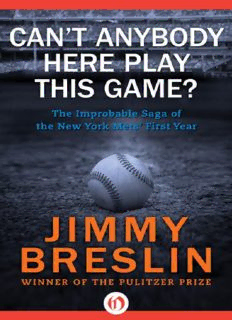
Table Of ContentCan’t Anybody Here Play This
Game?:
The Improbable Saga of the New York Mets’ First
Year
by Jimmy Breslin
Introduction by Bill Veeck
Dedication
To the 922,530 brave souls who paid their way into the Polo Grounds in 1962.
Never has so much misery loved so much company.
Contents
Introduction by Bill Veeck
1. “Just Like the WPA”
2. A Bad Report to the Sponsor
3. 119 or Bust
4. The Nickel Line
5. “They’re Afraid To Come Out”
6. Wait Till Next Year? We’re Fine Now!
7. Appendix I Around the Diamond with the Mets in 1962
8. Appendix II Mets’ Records, 1962
A Biography of Jimmy Breslin
Acknowledgments
Introduction
FROM THE DIMNESS OF the past to our highly illuminated present, each troubadour,
jongleur, and soothsayer, whether from the glittering court of Fernando and
Isabella or the glass and mortar confines of Madison Avenue, has sung his paean
of praise to record for a breathless posterity—or a quick buck— the wondrous
and daring deeds of the mighty. Few are the voices raised in defense of peasant,
peon, or .179 hitter, and these few are soon stilled by the pitchman’s glowing
accounts of another “winner.”
At long last the flood of excellence is dammed. The trend reversed. The
losers have their day. Jimmy Breslin has written a history of the Mets,
preserving for all time a remarkable tale of ineptitude, mediocrity, and abject
failure.
It’s stories like his that are important. They spur the losers of the world to
take heart—to rise and lose again. Without losers, where would the winners be?
So who, in the final analysis, is most entitled to historic memory?
I feel eminently qualified to write the introduction to a history of the Mets. I
operated the St. Louis Browns. It was our image that was toppled from its niche
in the darkest recess of Cooperstown. It was from us that the Mets, with pitiful
ease, wrested the title of The Worst Club in Baseball History.” It was, in truth,
the Brownies who made possible the Mets’ only victory.
I must admit, in fairness, that the Mets deserve the title. They won it fair
and square. They achieved total incompetence in a single year, while the Browns
worked industriously for almost a decade to gain equal proficiency. We
employed Patkin and Price, both professional clowns. They beat us again; they
had Marv Throneberry. We had the help of the American League, they the
wholehearted cooperation of the National, plus the assistance of the league’s
expansion committee, of inestimable advantage in any drive for the bottom.
Here, in clear focus, is the rock being thrown to the sinking swimmer.
Here’s Mrs. Payson, who justifiably emerges as a lady of courage and class,
if not acumen; Casey Stengel, whose reputation needs no burnishing from this
writer; and New York baseball fans, who unquestionably deserved a far better
shake. But the philosophy of baseball, like that of the late Texas Guinan,
precludes fair shakes. In this game when they’re down you tromp ’em—good—
lest they someday get up to annoy the winners. Competition is for professional
football and amateurs. Furthermore, according to Walter O’Malley, it’s
socialistic.
So the Mets started with the worst pitching, backed by the most deplorable
infield and outfield, ever assembled on a single diamond. While “selecting” their
players they didn’t (as the expansion committee professed so loudly to fear)
dilute the talent pool of the major leagues, but dealt almost a death blow to the
Sally.
The caliber of the Mets’ play could easily have earned for them other
honors. That of “Games Played Most Often in Secret,” for instance. In this, as in
almost all else, they failed dismally, ending the season with well over 900,000
paying customers—a tribute to Casey Stengel’s sure knowledge of public
relations and the enduring fanaticism of Giant and Dodger fans. It is unrecorded
how many paid more than once to see baseball—Met style. It is, however, quite
possible that more different individuals saw the National League teams than
wandered from Coogan’s Bluff to watch the more skillful exhibitions in Yankee
Stadium.
It is my understanding that Mrs. Payson, the club’s principal angel, has both
money and real staying power. I hope so. I hope too that both of these equal Mr.
Weiss’s prospective tenure in office. Now, lest the reader feel I am picking
unfairly on the Met general manager, let me explain. I am. Intentionally. Mr.
Weiss took the bows during a long and successful career with the Yankees. I
would be the last to deprive him of equal rights with the Mets. He helped to
conceive them. Why shouldn’t he nurse them along? Boy! What a picture that
makes.
Bill Veeck
The Mets is a very good thing. They give everybody a job. Just like the
WPA.
—BILLY LOES, the only pitcher in the history of baseball to be defeated
in a World Series game because he lost a ground ball in the sun
1
“Just Like the WPA”
THE JOB PROGRESS SHEET in the office says the weather is clear, with a high for
the day of 54 and a low of 40, which is fine to keep work moving along on this
$19,100,000 stadium New York City is having built alongside its World’s Fair
grounds.
Outside, a pale sun washes what is now a latticework of steel, but which
will be, hopefully by summer, a horseshoe-shaped ballpark seating 55,000
people. And crawling over the steel beams on this day is the flower of New
York’s construction trades, a group of 483 tin-hatted workers.
As you watch, you are struck with the immenseness of a construction job
such as this one. Take that guy way up on the top, the one moving along a
solitary white-painted beam that seems to be held up by nothing. His name is
Tommy McLaughlin, and he has a wife and six kids at home. He is over five
hundred feet in the air, without even a rope to hold onto. One strong gust of wind
or one slippery spot on the beam, and that will do it. You’d be surprised how
many times this happens on a construction job. But here he is, walking like a guy
going over to play the jukebox in the neighborhood saloon. And all around the
place there are workers just as high up and taking just as many chances. It makes
you nervous to look at them.
It also would frighten hell out of you to pay them. McLaughlin is on the
clock as an iron worker. At $5.25 an hour. There are steamfitters up there, too,
and they come in at $5.37 an hour. Then there are electricians ($7.63), laborers
($4.94), wire lathers ($5.72), and operating engineers ($5.43). The payroll for
this one day is going to run $15,585.72 by quitting time.
This is only part of the story. The planning and political wrangling that