Table Of ContentEYEWITNESS TO HISTORY * EXCLUSIVE CONTENT
+
, Bringing
if
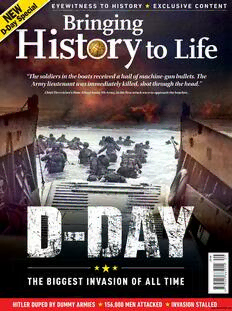
“The soldiers in the boats received a hail of machine-gun bullets. The
Army lieutenant was immediately killed, shot through the head.”
Chief Electrician’s Mate Alfred Sears, US Army, in the first attack wave to approach the beaches.
665014! 29
ies
THE BIGGEST INVASION OF ALL TIME
fa)
it
t
i)
NR
N
9
HITLER DUPED BY DUMMY ARMIES * 156,000 MEN ATTACKED * INVASION STALLED
t 01.00 on 6th June, 1944,
A Private Marcus Heim dropped
from a C-47 transport plane over
Normandy. His mission, along with
three others, was to capture the
strategically important La Fiére
bridge and hold it until the Allies
could advance and cross the River
Merderet. The mission succeeded
and the four men were later
honoured for their efforts. Heim
was just one of 20,000 paratroopers
who dropped behind German lines
the night before D-Day. After them,
in the early hours of the morning,
came more than 100,000 Allied
troops who stormed the five beaches
targeted for invasion. D-Day was
the largest operation in military
history and months of training and
misdirecting the enemy preceded
it. Not all the Allies’ plans held: the
first men on Omaha Beach were
slaughtered by German artillery. In
the end, though, over 156,000 men
succeeded in landing before D-Day
was over. The Third Reich was now
under pressure on all fronts.
i, D-DAY
ile 1942-1944
1, PRELUDE TO D-DAY
Stalin demanded a new front be
opened to lure German forces away from
the Eastern Front, and in 1943 the plans
for Operation Overlord took shape.
2. THE ATLANTIC WALL
Hitler accepted the prospect
of an Allied invasion, believing his
3,800-kilometre-long Atlantic wall
created an impregnable defence.
3. THE GREAT DECEPTION
Double agents, fake tanks and
corpses with false orders misled the
Germans to believe that the invasion
would take place somewhere else.
==
6. NORMANDY LANDINGS
At 06.30 on 6th June all hell
broke loose. Shells rained down, while
boats with a total of 150,000 soldiers
approached five selected beaches.
7. UNIQUE WAR MACHINES
The landings on Normandy’s
beaches needed specialist equipment
such as tanks that could sail, spew fire
or lay reinforced carpets.
mia
ann =
x po ie ‘LIBEM)
7
- SHADOW >
%. OFWAR /
d a
f
&
> 10. DAILY LIFE IN THE
/ SHADOW OF WAR
Civilians in war-torn Europe
tried to live normal ordinary lives despite
bombs, bloody showdowns and hunger.
my
OGISTICS my
‘aed OF WAR
1942-1004
11. LOGISTICS OF WAR
Behind the invasion, engineers,
ground workers, chefs, and nurses
worked to deliver fuel, food and care to
the soldiers at the front.
He FRANCE
REBELS
1940-1944
ieee AZo, i Se Publishing Director: Niels Jespersen
_ Editor-in-chief: Hanne-Luise Danielsen
4, FRANCE REBELS 5. THE NIGHT BEFORE Production: Pernille Aagaard
Cover: ITV/REX/Shutterstock
The French Resistance The night before 6th June, Translators: Lynda Johnson, Nick Peers,
sabotaged phones and railroad lines the first troops were dropped over Toni Baxter, Karen Levell
so that the Germans could neither Normandy to pave the way for their
communicate nor gain reinforcements. comrades who would go ashore at dawn. Bringing History to Life is published by:
Bonnier Publications International AS,
PB 433, Sentrum,
0103 Oslo, Norway.
ISSN: 2445-6659
Printed by: Poligrafijas Grupa
Mukusala, Latvia
Marketing/ Distribution UK and Export:
Marketforce (UK), 2nd Floor, 5 Churchill
Place, Canary Wharf, London E14 5HU
Tel: +44 (0) 20 3787 9001
www.marketforce.co.uk
Licensing and Syndication:
Regina Erak — regina.erak@globalworks.
8. THE DAYS AFTER 9. YOUTH UNDER FIRE GOAL TEL 4H (Q)rrSe Silas
The Allies had come ashore, It took several hours before the All rights reserved. Reproduction in any
and now they needed to occupy the main Germans counterattacked. When they manner or form is strictly prohibited fees
ports and cities. But the advance proved finally did, the 12th SS Panzer Division he prior written consent ot the publisher:
ceLTs4 oc » Whilst every care is taken with the material
not as easy as expected. Hitlerjugend” took the lead.
submitted to this bookazine, no
responsibility can be accepted for loss or
damage. Whilst every effort has been made
to contact all copyright holders, the sources
of some pictures that may be used are
varied and, in many cases, obscure.
The publisher is happy to make good in
future editions any error or omissions
brought to their attention. The publication
of any quotes or illustrations for which
authorisation has not been given is
unintentional.
12. GERMAN DEFEAT IN EAST 13. NEXT STOP: PARIS
The Germans needed to be Over a month after D-Day,
hard-pressed on all fronts, so the Soviet Normandy was finally secured. What
Union launched an offensive in the wake next? Paris or Berlin? An uprising in
of D-Day. The Red Army stormed west. Paris determined the Allies’ choice.
D-Day 5
—
—_ 8 86«C|
4- ¥
1941 // Britain recruits double agents 1942 // Attack on Dieppe ends as a bloody failure
pee
eum AU
(eam
_, a
+4
1943 // Eisenhowers heads up D-Day 1944 // Germans misled
Preparations
DOUBLE AGENTS AT WAR
The British intelligence service, MI5,
secretly hired German agents to
work for the Allies. One of the most
important double agents was the Catalonian Juan
Pujol, codenamed Garbo. From his hideout in Lisbon,
Garbo fed false information to Abwehr (the German
secret service). In order to maintain credibility, he also
provided genuine reports of Allied actions, but these
were always sent just too late for them to be of strategic
use. For example, he revealed the plan to invade
Normandy on the 6th June, when the Allies were
already on the beaches. During the war, 50 individuals
worked in secret as British double agents.
7 6 D-Day
| =
TEHRAN CONFERENCE
The three main Allied leaders —
Soviet premier Joseph Stalin,
British prime minister, Winston
Churchill and US president, Franklin D Roosevelt
—met in Tehran. The objective at the conference, which
was held between 28th November and Ist December,
was to agree a strategy for overcoming Hitler’s
Germany. Stalin, who was being hard pressed on the
Eastern Front, demanded that the Allies open another
front. At the Tehran meeting, his demands were met.
The leaders agreed to attack the Nazis following an
invasion from the west. The offensive would take place
in May 1944 and would be called Operation Overlord.
el om
1943 // Tehran Conference
1944 // Allied paratroopers
ATLANTIC WALL STRENGTHENED
Since 1941, when Hitler first
ordered the construction of a
defensive system along the entire
Atlantic coast from northern Norway to Spain, bunkers
and concrete barricades had sprung up beside the
continent’s western beaches. When Field Marshal
Erwin Rommel took over responsibility for the
defences in November 1943, the Atlantic Wall became
the death-trap defence that Hitler wanted. In the spring
of 1944, Rommel ordered 5-6 million landmines buried
in and around the beaches that fringed the defensive
system. The Germans were resolute that the Atlantic
Wall would stop any attempted Allied invasion.
RESISTANCE IN FRANCE
On the night of 6th June explosions
tore up railway lines at more than a
thousand locations across occupied
France. At the same time, power station generators
failed and telephone lines went dead. German troops
stranded on trains couldn’t contact other units. The
systemic sabotage was the culmination of the French
Resistance’s build up to D-Day. Throughout the war,
rebel groups had secretly protested and fought the
Germans, but in the spring of 1944, resistance efforts
intensified. The British had parachuted over a thousand
tonnes of weapons to French fighters and thus
equipped the resistance movement for the decisive blow.
D-Day 7 ik
= Be
—_ (|
1944 // Paratroopers begin the battle
SOLDIERS DROP FROM THE SKY
Shortly before midnight on 5th
June, hundreds of DC3 Dakota
aircraft took off from runways in
southern England. On board sat over 20,000 Allied
paratroopers who would parachute into France in the
next few hours. Their mission was to confuse the
German occupying forces and take bridges and other
strategic points ahead of the invasion the following
morning. Despite having turned off their lights and
flying low to evade German radars, the planes were still
detected and fired upon by German anti-aircraft
defences. Many died before they reached the ground
but the mission succeeded.
1 8 D-Day
| =
1944 // ‘Cricket’ identifies friend from foe
1944 // Death traps on the beaches
NORMANDY LANDINGS
Since daybreak on 6th June,
German guards at the northern
end of the Normandy coastline
had squinted at an indefinable grey mass out at sea but
as the mist lifted, the outlines became clear: hundreds
of Allied ships heading towards the coast. At 06.30, the
bow of the first landing craft touched the beach, and
hordes of armed soldiers poured into the surf of
Omaha and Utah Beaches. Troops soon followed on
Sword, Juno and Gold Beaches. German defence
positions counterattacked, but the Allies fought across
the beaches. Reinforcements arrived and 150,000 Allied
soldiers were ashore by the end of the day.
1944 // The wounded
te th
HOBART’S FUNNIES IN BATTLE
The Normandy beaches were
packed with mines, the Atlantic
Wall’s concrete barricades towered
over the coastline, while inland deep anti-tank trenches
had been dug to slow down the invasion. Fortunately
for Allied soldiers, engineering troops led by Major-
General Percy Hobart had specially designed tanks
that could overpower such obstacles. One tank was able
to detonate mines under the sand, a second was armed
with a flamethrower with a 100-metre range, and a
third was able to lay a ‘carpet’ on the beach to create a
stable surface for all vehicles. This spectacular
collection of vehicles was known as Hobart’s Funnies.
=
1944 // Allied reinforcements move in
DEATH AT OMAHA BEACH
Inside the landing craft, the US
soldiers heading for Omaha Beach
were so tightly packed that most
could not see the coast in front of them, so they didn’t
know that the air bombardment that was supposed to
ease their way had failed and that the German defences
were intact. The clash between German and US forces
turned the beach into a hell hole. Disembarking
soldiers were hit with a hail of German bullets, and the
wounded were drowned by the rising tide. The ‘lucky
ones’ who made it to shore entered a dense minefield
where each step could lead to instant death. By the end
of D-Day, 3,000 men at Omaha were wounded or dead.
D-Day 9
Tae oS
1944 // The advance begins 1944 // Double agent fools Hitler
2 ~ ~ Oh 6
- - d accel? ton
a . , Paeesly Zo thy
+ a * > N . > = ~ “Whe i eR a
a= 2. * a oe - * ¥
1944 // Fuel shortage 1944 // New attacks on the Eastern Front 1944 // Pipeline links Britain and France
Advance
SOLDIERS MOVE FORWARD PORTS ENSURE SUPPLIES
On 7th June, Allied troops began The Allies had landed ona
their advance into France. The coastline without using any ports,
bridgeheads needed to be and while they had landing craft
expanded and strategic ports and cities captured. tanks that could carry and unload heavy materiel on to
Although German reinforcements were held up by the the beach, the invading army needed ports where they
sabotaged rail network and therefore had great could land supplies. The solution was shipped across
difficulty reaching Normandy, the Allies still faced the English Channel in the wake of the invasion fleet:
fierce opposition. In particular, the Germans who gave two huge mobile port facilities called Mulberries, which
everything to defend Caen, meaning Canadian troops could be sited off the coast. These enabled the Allies to
struggled for weeks before finally taking the city. But it unload 25,000 tonnes of supplies and 6,000 vehicles
wasn't just stubborn panzer divisions that hindered the every day. Even after Allied troops captured the French
advance. The region’s distinctive sunken roads port of Cherbourg on 29th June, supplies continued to
bordered by thick hedges provided shelter for snipers. flow through the Mulberry harbours.
nila 10 = D-Day
|