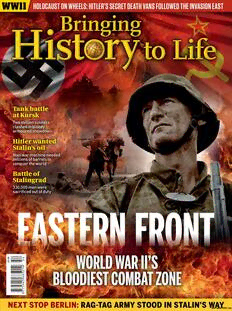
Table Of ContentLLL) HOLOCAUST ON WHEELS: HITLER'S SECRET DEATH VANS FOLLOWED THE INVASION EAST
. Bringing +X
an 1St@ to 0 Tile,
ary
_ Tank battle
~< at Kursk
Two million soldiers Seah) )
clashed in bloody
armoured showdown Widst
Coke wer te
Hitler. wanted)
Stalin’s oil YY
Nazi war machine needed
“= millions of barrels to
conquer the world
Battle of
Stalingrad
330,000 men were
sacrificed out of duty
=} a WORIDWARIS
=} “BLOODIEST COMBAT ZONE
Pen. 3
NEXT STOP BERLIN: RAG-TAG ARMY ——— IN STALIN’S WAY
—
In June 1941, more than three million Axis
troops poured into the Soviet Union as part
of the biggest offensive in history. Within a
few months the Ukrainian capital, Kiev, was
in the Wehrmacht’s sights. Hitler wanted
the city, and the fighting turned bloody. The
Red Army lost over six times as many men as
the Germans, with the added loss of tanks,
weapons and ammunition.
For Soviet civilians, Operation Barbarossa
was a disaster: town after town was burned,
while SS squads specialising in mass
extermination followed in the solders’ wake,
several equipped with death vans capable of
gassing up to 90 people in 15 minutes.
The story of the war on the Eastern Front
is chilling - neither side showed any mercy
to the other, and those living in the western
part of the Soviet Union were subjected to
horrific atrocities. Read on to understand
the whole gruesome story...
Violent fighting set Kiev on fire
Hitler’s secret death vans
Leningrad was starved to death
Convoy through icy hell
Stalin’s oil had to save Hitler
Bloodbath at Rzhev
General Paulus led his army to death
Kursk: History’s largest tank battle
Captives toiled in Stalin’s camps
Stalin’s revenge on Hitler
Rag-tag army held up Stalin
EASTERN FRONT
UKRAINE/1941
In the summer of 1941,
over three million Axis
soldiers cross the
Soviet Union’s
f borders in the
largest offensive in
history. The attack
goes well for the Nazis,
and within a few months,
the German armed forces have
Ukraine’s capital, Kiev, in sight. Hitler
wants to take the city, and his troops
prepare a giant pincer manoeuvre.
@ Kiev
UKRAINE
First, the Germans bombed Kiev, | |
then after the surrender, the
Soviets set off mines in all of |
the city’s central buildings.
EASTERN FRONT
HE 22ND SEPTEMBER 1941 WOULD NEVER END. At
least, that’s how Erich Hager felt. As a soldier in the
German 17th Panzer Division, he was participating
in the Wehrmacht’s large-scale advance towards
the city of Kiev in the Soviet republic of
Ukraine. The Nazis had made ground,
but Soviet tanks were attacking. The
Germans pushed forward again, but
the losses were great. All around Hager,
his comrades were falling to the ground,
bleeding and dying. Hager knew he
couldn’t expect help.
The Germans’ lines of defence were
thin — too thin — and the enemy’s tanks
broke through. Like a fiery monster of
iron and steel, a 52-tonne vehicle
ploughed towards Hager. He glanced
around, then ran. Gasping, with sweat running down his
face, he continued until he reached a village. There he found
Von Kleist’s men
wore the letter
K, Guderian’s
wore G.
eight comrades. All were unharmed, but totally exhausted.
Hager’s experience was not unusual for the soldiers in the
Battle of Kiev. The city offered a strategic location that would
give the Germans access to both large coal deposits and rich
oil fields in the Caucasus. But the invasion was far from easy.
Not only did the Soviet soldiers put up a tougher resistance
than the Germans had expected, but the flat, desolate plains
and the capricious climate were foes in themselves. The road
to Kiev was long and full of dangers. The city was Hitler’s and
his generals’ first serious challenge on the Eastern Front.
Three months earlier, the operation on
the Eastern Front had seemed easy and
straightforward. After subjugating most of
Western Europe using blitzkrieg tactics,
Hitler threw his might at the Soviet Union.
Stalin’s great empire had oil, grain and other
necessities required by Germany’s industry
and citizens. Most importantly, it boasted
vast, uninhabited regions that would be an
ideal place for Germans to settle in the Nazi
new world order that Hitler wanted to usher in after the war.
On 2and June 1941, Germany invaded Poland, Finland and
Romania with no fewer than 3.7 million troops along a
2,900-kilometre front. The Germans hadn’t taken any winter
equipment with them, because Hitler believed the war would
. - | The villages east of Kiev were
” _ ~ cleared of tanks and guns before
German infantrymen advanced
on their way to the city.
‘. ’
~~ ? i Sele,
* . =
se os ~
be short. Not only did he regard Soviet soldiers as racially
inferior to the Germans, but he was also convinced that the
Communist system was unstable.
“You have only to kick in the door and the whole rotten
structure will come crashing down,” the Fiihrer had claimed.
GREAT DISTANCES EXHAUSTED SOLDIERS
At the beginning of the invasion, everything had indicated
that Hitler was correct. In just one week, German troops had
advanced more than 320 kilometres into the country. At the
same time, Nazi forces destroyed almost 4,000 planes and
killed, wounded or captured 600,000 Soviet soldiers. The
invading troops were divided into three army groups — North,
Centre and South — with the immediate goal of occupying
Leningrad, Moscow and Kiev, respectively.
While Army Groups North and Centre advanced rapidly,
Army Group South, under Field Marshal Gerd von Rundstedt,
soon encountered problems on the road to Kiev.
On 26th June, Major Karl Thilo, High Command officer
with responsibility for Army Group South reported that
“Army has gained only very little ground. Heavy casualties on
both sides ... Russians are standing their ground excellently”.
The landscape itself was a hindrance. To get to Kiev, the
soldiers had to drive or march across the flat desolate plains
of western Ukraine for days.
“T sat in my truck, looking out over the tranquil landscape,
trying desperately to fight down an irrational anxiety. I hardly
knew myself. ... [WJ]ith this vast expanse of country, I found
myself gripped by depression — by a sense of utter desolation
and fear — the fear of being trapped,” said officer Erich Kern.
The conditions, which were alternately dry and dusty or
rainy and muddy, contributed to the difficulties.
“The road, if this species of cattle-track may be so
described, is covered with a thick layer of fine dust, which
with every breath of wind rises in dense red clouds.
But in places, where the clayey soil has failed to
absorb the rainwater, or where a stream crosses the
track, the sticky, tenacious mud grips the wheels of
the lorries and the tracks of the tanks, which sink
slowly,” wrote Curzio Malaparte, an Italian
journalist who accompanied Army Group South.
STALIN LINE BLOCKED ROUTE
The landscape and mud were not the only
challenges. On the route east, German
patrols were suddenly and without warning attacked
from seemingly innocent-looking farmhouses along
the road. The first columns that were shelled
believed that the fire came from the Red Army’s
rear guard, on the run from advancing Germans.
Soon, however, it dawned on the Nazis that they
hadn’t encountered enemies on the run. On the
contrary, they had run straight into the Stalin
Line, the Soviet Union’s defence in the west.
The facility was built in the 1920s as a defence
agail stattacks from the capitalist West and stretched all the
way along the USSR’s western border. The line of defence
consisted of bunkers and trench-like concrete ditches, from
at
LS EWALD VON KLEIST
FIELD MARSHAL
TITLE
Officer died in prison camp
Cavalry officer Paul Ludwig Ewald von Kleist
had retired when he was recalled to active
service in 1939 at the age of 58. Von
Kleist was promoted to field marshal in
1943, but was stripped of his title in 1944
for opposing Hitler's orders not to withdraw
his troops. In 1945, von Kleist was captured
by US forces, put on trial by court martial
and sent to a Soviet prison camp.
> Convicted of war crimes.
> Could trace his lineage back to the 13th century.
new weapons. Attacks from the Stalin Line delayed the
advance, and Kiev’s defence needed to be at least as effective.
Here, commissar Nikita Khrushchey, a liaison between Stalin
and the Ukrainian military, had expelled 160,000 civilians.
The result was an impressive 28-kilometre-long defensive
zone of anti-tank trenches as well as 750 brand new
concrete or wooden bunkers reinforced with rows
of barbed wire. Together with the Soviet forces,
the civil defences formed a seemingly
impenetrable wall around Kiev. When German
forces withdrew on 8th August after four days
of fruitless attempts to cross the River Dnieper,
Hitler became concerned. Army Group
South was clearly in trouble and something
had to be done.
HITLER WANTED OIL
During July, Army Group Centre had
advanced so rapidly that the area still
under Soviet control formed a pocket
where Army Groups Centre and South
met. The pocket included Kiev, and
almost the entire Soviet Southwestern
Front, under the command of Marshal
Semyon Budyonny, was trapped inside.
The concentration of Soviet soldiers
Soviet grenade
threatened the German advance, butit was also ith 6o-gram
an opportunity. If German forces could TNT explosive
surround and capure the soldiers in the pocket, — charge.
the victory would not only be a military
triumph, it would also strengthen the men’s morale.
The siege, however, required reinforcements, and
recognising that the army groups could not be in two places
at once, Hitler halted Army Group Centre’s advance against
Moscow. The conquest of Kiev now had priority, he stated in
a letter on 12th August.
The army leadership protested. Moscow was not only the
capital of the Soviet Union and therefore an important
destination in itself, it was also the centre of the country’s
most extensive and advanced industrial facilities — facilities
that could benefit the Germans in future warfare. Hitler, >
EASTERN FRONT —— so ee x
p | | fo} 5° 100 150 200 AD km
Using attacks from the north and south, German forces crossed
the Dnieper and surrounded the Red Army. The advance surprised Panzer group
the Soviets, who didn’t have time to man Kiev’s defences.
SMOLENSK ®
5 Tanks arrive
from the north
16th September: Heinz Guderian’s 2nd
| Panzer Group arrives from the north on -
16th September and meets von Kleist.
The encirclement is complete.
BELARUS
The pincer
closes
26th September: Stalin's last
forces in Kiev surrender.
@ CHERNIHIV
j ites ie i
Half a million Soviet
soldiers are trapped between -
two German forces.
1 German forces
ready for attack
24th August: The Germans control
the area west of the River Dnieper,
but the defence of Kiev is strong.
Half a million Soviet forces are ready.
@ LUBNY
Before the battle, the Eastern
Front largely followed the west
bank of the River Dnieper.
German infantrymen march in a
column along dusty roads towards Kiev.
coe § BY fae
The Luftwaffe’s_ ae df
bombing destroyed dime ==-—e alias a8 ~~
large number of |
Soviet vehicles.
t ’ P ~ees, Loe
a :
@ LOKHVYTSIA
attacks from south
12th September: Building on their
successes, the pincer manoeuvre is
launched. Ewald von Kleist’s 1st
Panzer Group attacks from the south
and quickly defeats the Soviets.
SOVIET UNION
Defence force is
caught off guard
3
10th September: German forces
occupy the city of Romny. The attack
comes from the rear and surprises
the Soviet soldiers before they can
man the defences around Kiev.
y) Vanguard
crosses river
25th August: The German
vanguard crosses the Dnieper
via a pontoon bridge near the
town of Dnepropetrovsk. Soviet
soldiers have destroyed the
original bridge, but German
engineering corps quickly build
a replacement.