Table Of ContentBrill’sCompaniontoAineiasTacticus
Brill’s Companions in
Classical Studies
Thetitlespublishedinthisseriesarelistedatbrill.com/bccs
Brill’s Companion to
Aineias Tacticus
Editedby
MariaPretzler
NickBarley
leiden | boston
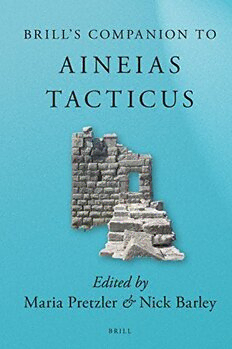
Coverillustration:CitywallsofMessene,photobyMariaPretzler
TheLibraryofCongressCataloging-in-PublicationDataisavailableonlineathttp://catalog.loc.gov
lcrecordavailableathttp://lccn.loc.gov/2017037587
TypefacefortheLatin,Greek,andCyrillicscripts:“Brill”.Seeanddownload:brill.com/brill-typeface.
issn1872-3357
isbn978-90-04-22351-6(hardback)
isbn978-90-04-35285-8(e-book)
Copyright2018byKoninklijkeBrillnv,Leiden,TheNetherlands.
KoninklijkeBrillnvincorporatestheimprintsBrill,BrillHes&DeGraaf,BrillNijhoff,BrillRodopiand
HoteiPublishing.
Allrightsreserved.Nopartofthispublicationmaybereproduced,translated,storedinaretrievalsystem,
ortransmittedinanyformorbyanymeans,electronic,mechanical,photocopying,recordingorotherwise,
withoutpriorwrittenpermissionfromthepublisher.
AuthorizationtophotocopyitemsforinternalorpersonaluseisgrantedbyKoninklijkeBrillnvprovided
thattheappropriatefeesarepaiddirectlytoTheCopyrightClearanceCenter,222RosewoodDrive,
Suite910,Danvers,ma01923,usa.Feesaresubjecttochange.
Thisbookisprintedonacid-freepaperandproducedinasustainablemanner.
Contents
ListofFiguresandPhotos vii
1 Introduction 1
MariaPretzlerandNickBarley
2 ‘TheOtherAineias’ 14
DavidWhitehead
3 AineiastheAuthor:Who,WhereandWhen? 33
RobinLaneFox
4 AineiasTacticusinHisIntellectualContext 49
D.GrahamJ.Shipley
5 AineiasandHistory:ThePurposeandContextofHistoricalNarrative
inthePoliorketika 68
MariaPretzler
6 CreatingKoine:AineiasTacticusintheHistoryoftheGreek
Language 96
JoséVelaTejada
7 WritingandOtherFormsofCommunicationinAineias’
Poliorketika 123
PeterLiddel
8 ThePolisFallingApart:AineiasTacticusandStasis 146
MariaPretzler
9 GreekPoleisandWarfareintheFourthCenturybc:Aineias’
Poliorketika 166
MarcoBettalli
10 LightInfantryandLeadershipinAineias 182
NickBarley
vi contents
11 MercenariesinAineiasTacticus 206
JamesRoy
12 RaidersfromtheSea:TheMaritimeContextofthePoliorketika 214
PhilipdeSouza
13 NotesfromHome:APerspectiveonFourth-CenturyDefencefrom
ArkadianStymphalos 229
BenGourley
14 TechnologyinAineiasTacticus:SimpleandComplex 265
TraceyE.Rihll
15 TheReceptionofAineias’PoliorketikainByzantineMilitary
Literature 290
PhilipRance
Indexlocorum 375
Index 391
List of Figures and Photos
Figures
0.1 PlacesandregionsmentionedinAineias’Poliorketika—seetableonpp.89–
93.Stymphalos,whichisnotmentioned,hasbeenaddedtothe
map. viii
13.1 RegionalmapshowingStymphalosinrelationtootherancientsiteswith
majorcentreshighlighted 236
13.2 Valleymapshowingpositionoftheancientsitewithneighbouringmodern
villagesandancienttransportationroutesoutofthevalleytootherancient
centres 237
13.3 Obliqueelevatedviewofvalleywithareaofancientsitedelineatedwith
dottedline 242
13.4 Siteplan 244
13.5 Towersoneastwall,aerialview 246
13.6 ResistivityPhliousgatewithsurveyofcropmarkfeatures 249
13.7 Westgateresistivityplotshowingwallandgateonleftofimageandinternal
citydivisionstotheright.Scaleisinmetres. 251
13.8 LocationofPheneosGatewithrespecttointernalheroshrineandfountain
house 253
13.9 Reconstructionofwestwalltowerof4thcenturydate 256
13.10 Westwallartillerytower:plan 258
13.11 Westwallaerialphotoshowinglargeartillerytowersurroundingsmaller
rectangulartower 259
13.12 Aerialviewofsouthacropoliswallwithhexagonaltowerandnearby
sanctuaryonacropolisterrace 260
14.1 ReconstructionofAineias’anti-ladderdeviceafterGarlan(1974),
figure2 276
14.2 ReconstructionofAineiasanti-ladderdevice.T.E.Rihll. 278
15.1 TheTransmissionofAineias’PoliorketikainLateAntiqueandByzantine
MilitaryLiterature 359
Photos
14.1 LadderdepictedontheNereidmonument,Xantos390–380bc(British
Museum)PhotographM.Pretzler. 273
14.2 RemainsofthewallsofHerakleiaonLatmos.PhotographT.E.Rihll. 277
figure 0.1 Aineias’World.PlacesandregionsmentionedinAineias’Poliorketika—seetableon
pp.89–93.Stymphalos,whichisnotmentioned,hasbeenaddedtothemap.
chapter 1
Introduction
MariaPretzlerandNickBarley
This volume examines a unique example of classical Greek Literature: the
Poliorketika or How to Survive under Siege by Aineias ‘the Tactician’. Aineias’
solesurvivingworkshowsusanancientGreecefarfromthewell-documented
affairsofAthensorthelegendarysocietyofSparta.Wearetakentoplaceswith
small populations and modest resources which only experience large scale
warfare at the whim of greater powers. Many of these smaller poleis would
not have had much in the line of a grand military tradition or accumulated
military experience, and in an emergency the right person for the job may
simplybewhoevergottherefirst.Aineias’adviceisdirectedtoaGreecewhere
survivalof familyandpoliswasbalancedonaspear-point,whereinnovation
andflexibilityof doctrineandpersonnelwereparamount,andwhereraiders
ontheveryedgeof territoryrepresentednotjustanarmedincursion,butan
existentialthreat.
ThePoliorketikadefiesgenreconventions,evenwithinthefieldof military
writing,sinceitisamanualaboutsiegeswhichbarelytalksaboutsiegesaswe
would usually understand the term, and which focuses on the one universal
weaknessofanypolis,itspeople,aswellaspresentinguswithadazzlingarray
of vignettes illustrating the everyday life of a fourth-century polis. Aineias’
perspectiveoftheGreekworlddoesnotmatchtheviewpointsweareusedto
seeinginclassicalliterature,somethingemphasisedbythefactthatalthough
itisaclassicalGreektext,itisnotwrittenintheusualclassical(Attic)Greek
literarylanguage.Inshort,Aineias’Poliorketikaisanexceptionalworkwhich
rewards repeated reading. It offers a perspective on the Greek world that,
armed as we are with our knowledge of the other great writers of the time,
maybeconsideredunusual,butwhich,oncloserinspection,revealsthelives
of citizens of ‘everyday’ states in all their chaotic glory. Further revisiting of
thetextraisesmanyquestionsandrevealsafrustratingdiscrepancybetween
whatAineiasistellingusandwhatwewoulddearlyliketoknow,butintensive
studyofthetextrevealsanauthorwithakeen,inquisitivemind,acuriosityfor
innovation,anunsentimentalpragmatism,astutepsychologicalinsightanda
greatgiftforobservation.
Here is a classical author, a close contemporary of Xenophon, Plato and
Isocrates,whoseemstobequitedeterminedtoremindusof‘theotherGreece’,
© koninklijkebrillnv,leiden,2018 | doi:10.1163/9789004352858_002
2 pretzler and barley
of lifeinthemany poleisbeyondthefocusof ourcanonicallyAtticauthors.1
Aineias’ perspective can offer insights into Greek lives and aspects of Greek
culture we can only speculate about when we read the historical accounts
by Thucydides or Xenophon: we rarely even get to wonder what it was like
to live behind the city walls of a small town, hoping to avoid conquest and
massacre,usingwhatwasathand,andrelyingonwhatthesmallcommunity
couldmusterintermsofmanpower,resourcesandingenuity.Hereisadifferent
voice,standingonitsownintermsofgenre,viewpointandapproach.Aineias
supplies a human scale to the grand narrative of classical Greek history: he
homesinontheall-too-humanfailuresandeverydayproblemsfoundinany
community,andregardshisfellowGreekswithaneyebothsoberlypragmatic
and attuned to what one might be able to ask of ‘normal’ people faced with
real existential threats. Finally, and despite the serious subject matter, the
text is simply great fun toread, rewarding newcomersand returningvisitors
alikewithanentertaininginsightintothepsycheofaClassicalGreekcityand
(someof)itspopulation;whilewewouldnotdaresayittohisface,theeditors
findAineias’textcharminglyengaging,andfeelthathisworkisallthemore
importantbecauseofthis.
We know very little about the author of this unusual military work. The
manuscript tradition identifies the work as “Aelian’s tactical treatise on how
tosurviveundersiege”,withascribalnoteattheendof theworksuggesting
that the name of the author is actually Aineias.2 A further hint is contained
in the work itself, where the author uses the name ‘Aineias’ in his explana-
tionof acomplexmethodtoencryptmessages.3Thedateof theworkhasto
be determined from the historical episodes mentioned to illustrate Aineias’
advice:thosestorieswhichcanbedatedclusterinthe370sand360s,withthe
latestepisodeprobablyin360bc.4Acompositionof theworkinthe350sbc
thereforeseemsverylikely.Thiswasaveryturbulenttime,afterthefinalcol-
lapseofthedominanceofAthensandSparta,andthefailureofThebestoassert
lastinginfluenceoveraareaswellbeyonditsaccustomedsphereofinfluencein
andaroundBoiotia;inMacedonia,Philipiihadstartedtobuildhisempire,but
theimpactofMacedonianinfluenceonthesouthernmainlandofGreecewas
notyetwidelyrecognised.Oldallianceshadbecomeobsolete,andformany,
1 E.g.Whitehead(1990)2–4,Hansen(2007).
2 Whitehead(1990)5–6.
3 Aineias 33.18, the sequence of letters is in turn based on a conjecture, Haase (1835), cf.
Whitehead(1990)7–8.
4 Whitehead(1990)8–10,HunterandHandford(1927)xxxiv–xxxvii;latestepisodeprobably
24.3–14,IlioncapturedbyCharidemos.