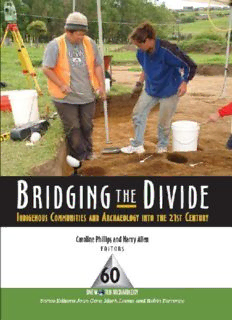
Table Of ContentBridging the Divide
One World Archaeology Series
Sponsored by the World Archaeological Congress
Series Editors: Joan Gero, Mark Leone, and Robin Torrence
One World Archaeology volumes contain carefully edited selections of the exem-
plary papers presented at the World Archaeology Congress (WAC), held every
four years, and intercongress meetings. WAC gives place to considerations of
power and politics in framing archaeological questions and results. The organi-
zation also gives place and privilege to minorities who have often been silenced
or regarded as beyond capable of making mainline contributions to the field. All
royalties from the series are used to help the wider work of the organization. The
series is published by Left Coast Press, Inc., beginning with volume 48. Previous
volumes are available from Routledge.
60 Bridging the Divide, Caroline Phillips and Harry Allen (eds.)
59 Archaeologies of Placemaking, Patricia E. Rubertone (ed.)
58 Managing Archaeological Resources, Francis P. McManamon, Andrew Stout, and Jodi
A. Barnes (eds.)
57 Landscapes of Clearance, Angèle Smith and Amy Gazin-Schwartz (eds.)
56 Underwater and Maritime Archaeology in Latin America and the Caribbean, Margaret
E. Leshikar-Denton and Pilar Luna Erreguerena (eds.)
55 Archaeologies of Art, Inés Domingo Sanz, Dánae Fiore, and Sally K. May (eds.)
54 Archaeology and Capitalism, Yannis Hamilakis and Philip Duke (eds.)
53 Living Under the Shadow, John Grattan and Robin Torrence (eds.)
52 Envisioning Landscapes, Dan Hicks, Laura McAtackney, and Graham Fairclough (eds.)
51 Rethinking Agriculture, Timothy P. Denham, José Iriarte, and Luc Vrydaghs (eds.)
50 A Fearsome Heritage, John Schofield and Wayne Cocroft (eds.)
49 Archaeology to Delight and Instruct, Heather Burke and Claire Smith (eds.)
48 African Re-Genesis, Jay B. Haviser and Kevin C. MacDonald (eds.)
Bridging the Divide
Indigenous Communities and Archaeology into
the 21st Century
Editors
Caroline Phillips
Harry Allen
Walnut Creek, California
LEFTCOAST PRESS, INC.
1630 North Main Street, #400
Walnut Creek, CA 94596
http://www.LCoastPress.com
Copyright © 2010 by Left Coast Press, Inc.
All rights reserved. No part of this publication may be reproduced,
stored in a retrieval system, or transmitted in any form or by any
means, electronic, mechanical, photocopying, recording, or otherwise,
without the prior permission of the publisher.
ISBN 978-1-59874-392-0 hardcover
The illustration on the title and chapter opening pages is Kopinga Marae, built to rees-
tablish a central base on Rekohu in which Moriori could meet, celebrate, debate and just
be together. The design symbolises the hopo, the albatross with outspread wings, a sacred
bird of the Moriori. The marae’s name—Kopinga—tells us of the ancient gathering place
of Moriori amongst the groves of kopi trees on the island. (Based on a photo from the
Hokotehi Moriori Trust.)
Library of Congress Cataloging-in-Publication Data:
Bridging the divide : indigenous communities and archaeology into the 21st century /
Caroline Phillips, Harry Allen, editors.
p. cm. — (One world archaeology series ; 60)
Papers from the 2nd Indigenous WAC Inter-Congress, held Nov. 8–12, 2005, at Waipapa
Marae, University of Auckland in Tamaki Makaurau/Auckland, Aotearoa/New Zealand.
Includes bibliographical references and index.
ISBN 978-1-59874-392-0 (hardcover : alk. paper)
1. Archaeology—Social aspects—Congresses. 2. Archaeology—Political aspects—
Congresses. 3. Ethnoarchaeology—Congresses. 4. Cultural property—Protection—
Congresses. 5. Indigenous peoples—Social conditions—Congresses. 6. Indigenous
peoples—Politics and government—Congresses. 7. Intercultural communication—Con-
gresses. 8. Archaeologists—Congresses. I. Phillips, Caroline. II. Allen, Harry, 1944- III.
World Archaeological Congress (Organization). Indigenous Inter-Congress (2nd : 2005 :
University of Auckland)
CC175.B75 2010
930.1—dc22
2010010039
Printed in the United States of America
∞ ™ The paper used in this publication meets the minimum requirements of American
National Standard for Information Sciences—Permanence of Paper for Printed Library
Materials, ANSI/NISO Z39.48–1992.
To the late Roger Curtis Green,
Emeritus Professor University of Auckland,
and Adjunct Professor Te Whare Wananga Awanuiarangi,
who predicted that
the archaeology of the first part of the 21st century in the Pacific will have
to do with the anthropology of long-term history where the construction
of the past are multi-faceted, the perspectives multi-ethnic, and the players
multi-cultural and multi-disciplinary. (2000:135)
We hope that this forms part of the bridge that links some of the play-
ers in the discipline he devoted his life to.
Green, R. C. 2000. Trigger’s holistic archaeology and Pacific cul-
ture history. In M. Boyd, J. C. Erwin and M. Hendrickson (eds.), The
Entangled Past: Integrated History and Archaeology, pp. 127–137.
Proceedings of the 30th Annual Chacmool Archaeological Conference,
Calgary, Alberta. Calgary: The Archaeological Association of the
University of Calgary.
Contents
List of Illustrations 9
Preface 13
1. Maintaining the Dialogue: Archaeology, Cultural 17
Heritage and Indigenous Communities
Harry Allen and Caroline Phillips
2. “Wake Up! Repatriation Is Not the Only Indigenous 49
Issue in Archaeology!”
Joe Watkins
3. Agency and Archaeological Material Culture: 61
Willing a Suspension of Disbelief?
Bridget Mosley
4. Part of the Conversation: Archaeology and Locality 81
Alejandro Haber, Wilhelm Londoño, Ernestina Mamaní
and Laura Roda
5. Taíno as a Romantic Term: Notes on the 93
Representation of the Indigenous in Puerto
Rican Archaeology and Ethnohistory
Gabriel De La Luz-Rodríguez
6. Defining Cultural Heritage at Gummingurru, 107
Queensland, Australia
Anne Ross
7. Working Together? Maori and Archaeologists in 129
Aotearoa/New Zealand Today
Caroline Phillips
8. The Crisis in 21st Century Archaeological Heritage 157
Management
Harry Allen
9. The Indigenous Peoples’ Views of Archaeology in 181
Solomon Islands
Lawrence A. Foana’ota
7
10. Archaeology and Indigeneity in 197
Aotearoa/New Zealand: Why Do Maori Not
Engage with Archaeology?
Margaret Rika-Heke
11. Indigenous Archaeology: A Moriori Case Study 213
Maui Solomon and Susan Forbes
12. Seeking the End of Indigenous Archaeology 233
George P. Nicholas
Appendix 1 W orld Archaeological Congress, First 253
Code of Ethics
Appendix 2 W orld Archaeological Congress, 255
The Vermillion Accord on Human
Remains
Appendix 3 W orld Archaeological Congress, 257
The Tamaki Makau-rau Accord on the
Display of Human Remains and Sacred
Objects
Appendix 4 T he Mataatua Declaration on 259
Cultural and Intellectual Property
Rights of Indigenous Peoples
Appendix 5 W hat Are the Relationships between 265
Archaeologists, Teaching Institutions,
Heritage Organisations and Maori?
Glossary and List of Abbreviations 271
List of Heritage Legislation, Documents and Organisations 275
Index 277
About the Authors 287
List of Illustrations
Figures
Figure P.1 Delegates in front of Tane-nui-a-Rangi, the Maori 14
meeting house at Waipapa Marae, Auckland
University, that was the venue for the 2nd
Indigenous WAC Inter-Congress in 2005.
Figure P.2 Authors and conference organisers identified. 15
Figure 1.1 Harry Allen describing the findings of a joint 25
University of Auckland and Ngati Mutunga
research project.
Figure 1.2 Taking a pollen core from a wet site in North 26
Taranaki, New Zealand.
Figure 1.3 George Nicholas and Harry Allen working on a 33
salvage archaeological excavation at Athenree.
Figure 1.4 Caroline Phillips and Kate Hill excavating 34
the edge of a former stream that contained
evidence of Maori occupation, now buried under
Richmond Street, Thames.
Figure 2.1 The author. 51
Figure 3.1 The road to Mutawintji National Park in western 62
New South Wales.
Figure 3.2 The Mutawintji Cultural Centre at the 70
Mutawintji Historic Site, where the Aboriginal
stone artefact collection is presently stored.
Figure 3.3 Gerald Quayle, Baarkindji traditional custodian, 71
identifies a stone artefact in situ to a tour group at
Mutawintji National Park.
Figure 3.4 Continuing long-term relationships with the 75
land at Mutawintji into the present day: Gerald
Quayle at the gorge.
Figure 4.1 Santos Claudia Vázquez showing how to work 86
with the stone spade from the museum.
9
Description:The collected essays in this volume address contemporary issues regarding the relationship between Indigenous groups and archaeologists, including the challenges of dialogue, colonialism, the difficulties of working within legislative and institutional frameworks, and NAGPRA and similar legislation.