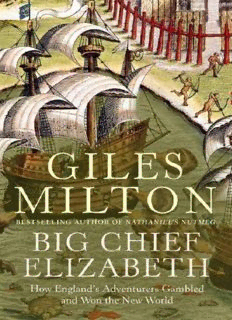
Table Of ContentFOR MY FATHER
Table of Contents Title Page
1 - Savages Among the Icebergs
2 - Sir Humfrey and the Cannibals
3 - The Jolly Tribesman
4 - Harriot’s Devils
5 - Storms, Sprites, and Goblins
6 - Governor Lane’s Sandcastle
7 - Enter Sir Francis
8 - Smoke into Gold
9 - The Unfortunate Master Coffin
10 - Arise, Lord Manteo
11 - Sounding a Trumpet
12 - One Bess for Another
13 - A Miracle Among Savages
14 - The King’s Dearest Daughter
15 - Mr. and Mrs. Rolfe Go to England
EPILOGUE
ACKNOWLEDGEMENTS
ALSO BY GILES MILTON
BIBLIOGRAPHY
INDEX
Notes
Copyright Page
1
Savages Among the Icebergs
The half-timbered mansion disappeared long ago, and the paved thoroughfare
lies buried beneath the dust of centuries. The Great Fire tore the heart out of this
corner of Elizabethan London, devouring books, buildings, and streets. One of
the few things to survive is a small, insignificant-looking map—crinkled, faded,
but still bearing the proud mark of its owner.
This was once the treasured possession of Sir Humfrey Gilbert, a flamboyant
adventurer, who suffered such adversity in the aftermath of his disastrous 1578
expedition to North America that even Queen Elizabeth I noted drily that he was
a man “of not good hap.” But in the summer of 1582, after four years of virtual
bankruptcy, Gilbert’s misfortunes appeared to be over. As he unrolled his newly
acquired map, he allowed himself a rare and self-satisfied smile. It provided the
most detailed record to date of America’s wild, barbarous shores, and contained
a treasure trove of priceless and hitherto unknown information. Such was Sir
Humfrey’s pride in adding it to his collection that he reached for his quill and
inscribed it with the words “Humfray Gylbert, knight, his charte.”
This circular sheet of parchment depicted the entirety of North America as if
viewed from high above the mid-Atlantic, and its inky squiggles confirmed what
Gilbert had believed all along: that America was cut in two by a wide channel,
and that the interior of the continent was not land at all, but a vast inland sea.
More discerning observers might have expressed concern that the map’s
provenance was uncertain and that it contained glaring errors. One of the few
parts of America that was well charted, the triangular island of Newfoundland,
was shown as four separate lumps of rock, while the eastern seaboard appeared
to be little more than a topographical flight of fancy. But to Sir Humfrey, any
such objection would have been a mere trifle. This map was to be the key to the
crowning achievement of his life: a voyage to America, with the audacious goal
of founding the first English colony on the shores of this mighty continent.
Gilbert had not been the first Englishman to be fascinated by the North
American continent. After its discovery by John Cabot in 1497—just five years
after Christopher Columbus had made his historic landfall in the Bahamas—
England claimed possession of the whole of North America by virtue of the fact
that her flag was the first to be planted on American soil. Ever since, a handful
of dreamers and adventurers had toyed with the idea of visiting those distant
shores across the ocean. A few of Bristol’s more enterprising merchants had
quickly launched expeditions in the wake of Cabot’s voyage, hoping to make
their fortunes in trade with the “savages.” John Thomas, Hugh Elyot, and
Thomas Assehurst all sailed into the sunset with high hopes, only to return in
bitter disappointment. The scantily clad Indians had showed no interest in
English woollens and broadcloths—the country’s most important export—and
even less desire to truss themselves up in slashed doublets and taffeta bonnets.
Nor did they have anything of substance to offer the merchants. Their bows and
arrows fetched a reasonable price as collectors’ items; hawks were in some
demand among Tudor courtiers, and “cattes of the montaign”—lynx—made
fanciful pets for their noble lordships. But a trade based solely on exotica was
never going to be profitable; after five or six years of failure, the Bristol
merchants abandoned their enterprise.
In 1517 there had been a brief flurry of enthusiasm when a London bookseller
named John Rastell startled his customers by announcing his intention of
founding a colony in America. It was an eccentric idea, even by his own
standards, yet he was so confident of success that he refused to allow anyone to
deflect him from heading off into the sunset. He gathered “thirty or forty
soldiers” and bought “tools for masons and carpenters,” but his dream of
building a dwelling in America was not to be. The mission ended in farce when
two captains refused to set sail and Rastell’s expedition got no further than
Falmouth harbour. He ended his days lamenting his failure in verse:
O what a thynge had be than
Yf they that be Englysshe men
Myght have be the furst of all
That there shulde have take possessyon
And made furst buyldynge and habytacion
A memory perpetuall.
Most of these early expeditions had suffered from poor leadership, and all had
been jeopardised by a lack of resources. But in 1536—exactly forty years before
Sir Humfrey first began toying with his colonial project—an expedition to
America got under way that seemed to overcome both of these hurdles. It was
the brainchild of Richard Hore, a wealthy London leather seller who had grown
weary of his endless trading voyages to and from the Canary Islands. To his
friends he was “a man of goodly stature and of great courage, and given to the
studie of cosmographie,” but his business contacts knew a less savoury side to
his character. Hore wanted to be rich and was forever dreaming up schemes
which combined money making with adventure.
In 1535 he had been struck by an idea of such sparkling originality that he
knew it could not fail to make him wealthy. In that year, the Plymouth
adventurer William Hawkins had successfully returned from his voyage to South
America, carrying with him “one of the savage kings of the countrey of Brasill.”
This unfortunate captive caused a sensation in Tudor London, especially when
he was ushered into the commanding presence of King Henry VIII. At the sight
of him, “the king and all the nobilitie did not a little marveile, and not without
cause: for in his cheekes were holes made accordinge to their savage manner,
and therein small bones were planted, standing an inche out from the said holes,
which in his own countrey was reputed for a great braverie.” As the king and
courtiers prodded the chieftain, they discovered that “he had also another hole in
his nether lippe, wherein was set a precious stone about the bignesse of a pease:
all his apparell, behaviour and gesture were very strange to the beholders.”
The sight of this savage astonished the court and was a cause of such
excitement in the capital that Hore realised it presented a fine opportunity to
make money. He decided to launch an expedition to North America with the
intention of capturing one of King Henry VIII’s more primitive subjects. He
could then be paraded around the capital and displayed—for a fee, of course—to
curious Londoners.
The dangers of such a voyage were considerable. Tudor vessels, not built to
withstand the powerful Atlantic swells, were fearsomely top-heavy, and there
was a very real danger of them foundering in the vastness of the ocean. Only a
few English ships had ever crossed the Atlantic, and the land on the far side was
as mysterious and barbarous as the fabled Orient. But Hore remained optimistic
about the chances of success; a brilliant self-publicist, he realised that hunting
for savages was certain to excite London’s gentlemen adventurers.
No sooner had word of his expedition been leaked to the court than dozens of
courtiers began to approach him, begging that they might have a place on his
voyage. When news reached the ears of King Henry, who was still enthralled by
his South American captive, he thought it such a splendid project that he gave it
his unconditional blessing and support. Hore was “assisted by the king’s favour
and good countenance,” and began to sign up men for the greatest adventure of
their lives. “His perswasions tooke such effect that within a short space, many
gentlemen of the Innes of Court, and of the Chancerie, and divers others of good
worship, desirous to see the strange things of the world, very willingly entred
into the action with him.” Thirty “gentlemen” signed up for the voyage, many of
them from rich and distinguished families. Armigil Wade was a close
acquaintance of the king; Thomas Buts was a son of the wealthy Sir William
Buts; William Wade was Clerk of the Counsel, and Master Weekes was “a
gentleman of the West Countrey of five hundred markes by the yeere.” All of
these men, the cream of Tudor society, were delighted to be taking part in such
an historical adventure. Reckless, fearless, and foolhardy, they eschewed the
comfort of their gabled manors for a place on a unique expedition whose
purpose was as swashbuckling as it was daring: to capture one of the “savages”
of North America. They willingly poured money into the venture; by February
1536, Richard Hore had raised enough capital to begin negotiations to hire two
small ships, the William and the Trinity.
If Hore had given as much attention to the voyage as he had to publicising the
venture, he might have realised that he was placing himself and his companions
in the gravest danger. He did not think to carry out even a cursory check on the
seaworthiness of the vessels, nor did he have the foresight to calculate the
quantity of dried victuals needed to feed 120 sailors for an expedition that was
certain to last three months and possibly many more. Relying on the trusty
formula of good wind and good luck, he took his men to receive the sacrament in
Gravesend Church and, with the breezes urging them to get under way, “they
embarked themselves in the ende of Aprill, 1536.”
The two vessels made a splendid sight as they cruised majestically down the
Thames estuary, their foremasts decked with bunting and their mainmasts flying
the George. The adventurers were dressed in such finery that onlookers could
have been forgiven for supposing them to be en route to a royal wedding: some
wore silk-brimmed hats adorned with ostrich plumes, gaudy popinjay waistcoats,
and square-toed shoes slashed with velvet. But scarcely had the men entered the
turbulent waters of the English Channel than they realised that their cosseted
backgrounds had done little to prepare them for the hardships of life at sea.
“From the time of their setting out from Gravesend, they were very long at sea
… above two moneths, and never touched any land.” So reads the account of
Thomas Buts, one of the two men who would later tell their stories to Richard
Hakluyt, author of The Principall Navigations. Both accounts are full of
inconsistencies, for by the time the men were quizzed about their suffering their
minds were addled with old age. But they allow a partial reconstruction of an
audacious voyage that would later inspire the champion of American
colonisation, Sir Walter Raleghs.1
The men caught their first glimpse of land in the first week of July, by which
time food supplies were perilously low. Believing themselves to have reached
Cape Breton, the northeastern tip of Nova Scotia, they steered their ship north to
“the Island of Penguin”—the outlying Funk Island—which was a landmark for
the few mariners who fished these lonely waters. It was “full of great foules,
white and grey, as big as geese, and they saw infinite numbers of their egges.”
This strange bird was the flightless great auk, which was unafraid of man and
proved easy to catch. “They drave a great number of the foules into their boates
upon their sayles,” and began to pluck them, a tiresome business, for “their
skinnes were very like honycombes [and] full of holes.” The men were so
hungry that they declared them “very good and nourishing meat.”
After resting up at Penguin Island, the two ships went their separate ways. The
William, manned by seadogs and fisherfolk, headed to the Newfoundland Banks,
where cod was plentiful. The Trinity, meanwhile, was to carry the gentlemen
adventurers into unknown and uncharted waters in the hope of capturing a
savage. The men were poorly equipped for such latitudes and totally unprepared
for the rigours of exploration. “They were so farre northwards that they sawe
mighty islands of yce in the sommer season, on which were haukes and other
foules to rest themselves, being weary of flying over farre from the maine.”
They shot at polar bears that had drifted south on icebergs and caught brown
bears on the mainland; in this way they supplemented their meagre diet.
It was as they coasted the remote and bleak shores of Labrador that they first
sighted the “savages.” One of the adventurers, Master Oliver Dawbeny, was
standing on the foredeck of the William when he noticed a strange object far off
in the water. He strained his eyes in staring at the horizon and realised with a
start that he had certainly not been deceived. It was “a boat with savages of those
partes, rowing downe the bay toward them, to gaze upon the ship and our
people.”
He called to the mariners below decks and “willed them to come up if they
would see the natural people of the countrey that they had so long and so much
desired to see.” The men on deck “tooke viewe of the savages rowing toward
them and their shipp, and upon the viewe they manned out a shipp boat to meet
them and to take them.” There was not a moment to be lost, for they might never
be presented with this opportunity again. They pushed off their boat and set out
in hot pursuit.
Description:A riveting historical mystery of Colonial America by the author of Nathaniel's NutmegIn April, 1586, Queen Elizabeth I acquired a new and exotic title. A tribe of Native Americans, "savages," had made her their weroanza-a word that meant "big chief." The news was received with great joy, both by the