Table Of ContentBashō
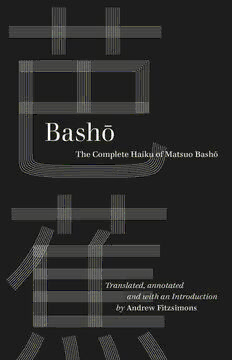
Bashō
The Complete Haiku of Matsuo Bashō
Translated, Annotated, and with an
Introduction by Andrew Fitzsimons
UNIVERSITY OF CALIFORNIA PRESS
University of California Press
Oakland, California
© 2022 by Andrew Fitzsimons
Library of Congress Cataloging-in-Publication Data
Names: Matsuo, Bashō, 1644–1694, author. | Fitzsimons, Andrew, translator,
annotator, writer of introduction.
Title: Bashō: the complete Haiku of Matsuo Bashō / translated, annotated,
and with an introduction by Andrew Fitzsimons.
Other titles: Poems. English
Description: Oakland, California : University of California Press, [2023] |
Includes bibliographical references and index.
Identifiers: lccn 2022001045 (print) | lccn 2022001046 (ebook) |
isbn 9780520385580 (paperback) | isbn 9780520385597 (ebook)
Classification: lcc pl794.4 .a2 2023 (print) | lcc pl794.4 (ebook) |
ddc 895.61/32—dc23/eng/20220511
LC record available at https://lccn.loc.gov/2022001045
LC ebook record available at https://lccn.loc.gov/2022001046
Manufactured in the United States of America
28 27 26 25 24 23 22
10 9 8 7 6 5 4 3 2 1
i.m. Gerard Fanning (1952–2017)
In the afterwards
of the moon’s setting the four
corners of his desk
contents
Bashō Chronology ix
Introduction xiii
the poems 1
Acknowledgments 361
Glossary 363
Bibliography 369
Index of Poems in Japanese (Romaji) 381
Index of First Lines in Poems in English 403
Index of Names 415
bashō chronology
Except where specified, dates refer to the Gregorian calendar.
1644 Matsuo Kinsaku (Bashō) born at or near Ueno, in the Province of Iga
(Mie Prefecture), into a family of samurai descent.
1656 His father, Matsuo Yozaemon, dies.
1663 Earliest extant poem. Bashō in the service of Tōdō Yoshitada, a young
relative of the feudal lord of Iga. Assumes the haigō (poetic pen name)
Sōbō.
1666 Death of Tōdō Yoshitada, at twenty-five. No records of Bashō’s life at
this time. Some poems from this period identify him as “Sōbō of
Ueno in Iga Province.”
1672 Publishes Kai Ōi (“The Seashell Game”). The book contains his
comments on a poetry contest, as well as two of his hokku. Moves to
Edo (Tokyo).
1675 Under a new pen name, Tōsei (“green peach”), participates in a
linked-verse gathering with Nishiyama Sōin, founder of the Danrin
school. Begins to gather students, including Sugiyama Sanpū and
Takarai Kikaku.
1676 Participates in two Danrin-style linked-verse sequences, with
Yamaguchi Sodō, published as Edo Ryōgin Shū (“Collection of Two
Edo Poets”). Visits Iga in the summer; returns to Edo with his
sixteen-year-old nephew, Tōin, in his care.
ix
x bashō chronology
1677 Begins to work at the waterworks department in Edo; achieves
distinction in the poetry contest Roppyakuban Haikai Hokku Awase
(“The Six Hundred Round Hokku Contest”).
1678 Distributes his first Saitanchō (New Year’s verses), a mark of his status
as a haikai master. In the spring, ten thousand verses are composed by
a gathering of poets to mark his professional independence.
1679 Shaves his head and becomes a lay monk.
1680 Bashō’s circle publishes two major collections: Tōsei Montei Dokugin
Nijikkasen and Haikai Awase, moving away from the Danrin style
toward Chinese-influenced poetry. In the winter, moves from central
Edo into a hut on the eastern outskirts, in the Fukagawa district.
1681 A disciple, Rika, transplants a bashō plant as a gift for Bashō’s new
home. The hut becomes known as Bashō-an (“the bashō hut”) and
the poet as “Master Bashō.” He practices Zen under Butchō; Zen and
Chinese Daoism become influential in his poetry.
1683 On January 25, the Bashō-an destroyed in the Tenna no Taika (“The
Great Fire of the Tenna period”). Homeless, Bashō accepts an
invitation to Kai Province. In early summer, returns to Edo to oversee
the anthology Minashiguri. In August his mother dies. In the winter,
moves into a new Bashō-an in Fukagawa.
1684 In September, begins the journey that will result in Nozarashi Kikō,
his first travel journal. In Nagoya, leads five linked-verse sequences
that later form the book Fuyu no Hi, the first major anthology of the
Shōmon, the “Bashō School.”
1685 Visits Iga, to celebrate the lunar New Year. Stays almost two months.
His return journey to Edo is marked by haikai gatherings, including
at Ōtsu, Atsuta, and Narumi. He arrives in Edo in the summer, after
taking the mountainous route through Kai Province.
1686 In January, Bashō and fifteen students compose a sequence of one
hundred verses in honor of Kikaku, to mark his new status as a haikai
master. Bashō contributes six verses; later, after a request, begins
annotating each verse. The comments, published in 1763 as Hatsukai-
shi Hyōchū, are a key source for Bashō’s developing views on poetry.
1687 In September, travels with Sora and Sōha to Kashima Shrine to see
the harvest moon, a trip recounted in Kashima Kikō. Publishes
Atsume Ku (“Collected Verses”). In late November, sets off on
another long journey to the west, recounted in Oi no Kobumi.
1688 Celebrates the lunar New Year in Iga again. After visits to Ise and the
Futami Coast, returns to Iga for the thirty-third anniversary of his