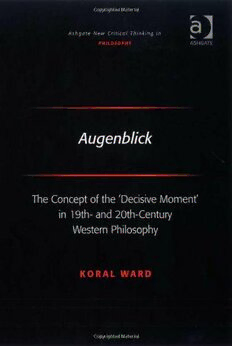
Table Of ContentAugenblick
Augenblick, meaning literally ‘in the blink of an eye’, describes a ‘decisive moment’
in time that is both .eeting yet momentously eventful, even epoch-makingly
significant. In this book Koral Ward investigates the development of the concept
into one of the core ideas in Western existential philosophy alongside such concepts
as anxiety and individual freedom.
Ward examines the whole extent of the idea of the ‘decisive moment’, in which an
individual’s entire life-project is open to a radical reorientation. From its inception
in Kierkegaard’s works to the writings of Jaspers and Heidegger, she draws on a
vast array of sources beyond just the standard figures of 19th- and 20th-century
Continental philosophy, finding ideas and examples in photography, cinema, music,
art, and the modern novel.
This page has been left blank intentionally
Augenblick
The Concept of the ‘Decisive Moment’ in 19th- and
20th-Century Western Philosophy
Koral War D
Murdoch university, Western Australia
© Koral Ward 2008
all rights reserved. No part of this publication may be reproduced, stored in a retrieval system
or transmitted in any form or by any means, electronic, mechanical, photocopying, recording
or otherwise without the prior permission of the publisher.
Koral Ward has asserted her moral right under the Copyright, Designs and Patents act, 1988,
to be identified as the author of this work.
Published by
ashgate Publishing limited ashgate Publishing Company
Gower House Suite 420
Croft r oad 101 Cherry Street
aldershot Burlington, VT 05401-4405
Hampshire GU11 3Hr USa
England
ashgate website: http://www.ashgate.com
British Library Cataloguing in Publication Data
Ward, Koral
augenblick : the concept of the ‘decisive moment’ in 19th- and 20th-century western
philosophy. – (ashgate new critical thinking in philosophy)
1. Philosophy, Modern – 19th century 2. Philosophy, Modern – 20th century
I. Title
190.9034
Library of Congress Cataloging-in-Publication Data
Ward, Koral, 1958–
augenblick : the concept of the “decisive moment” in 19th and 20th century western
philosophy / Koral Ward.
p. cm. – (ashgate new critical thinking in philosophy)
Includes bibliographical references.
ISBN 978-0-7546-6097-2 (hardcover : alk. paper) 1. Time–Philosophy. 2. Continental
philosophy. I. Title.
BD638.W358 2007
115–dc22
2007007970
ISBN: 978-0-7546-6097-2 (hbk)
ISBN: 978-0-7546-9945-3 (ebk.V)
Printed and bound in Great Britain by TJ International ltd, Padstow, Cornwall.
Contents
Preface and Acknowledgements vii
Foreword xi
1 ooff TTiimmee aanndd TThhee ��tteerrnnaall,, SS��rreenn KKiieerrkkeeggaaaarrdd’’ss MMoommeenntt ��Øieblik] 1
2 TThhee GGaatteewwaayy nnaammeedd Augenblick: its place in Friedrich Nietzsche’s
concept of �ternal r eturn 35
3 KKaarrll JJaassppeerrss’’ ‘‘ppuurree eeyyee’’ ooff tthhee ‘‘flfleeeettiinngg mmoommeenntt’’ 669
4 MMaarrttiinn HHeeiiddeeggggeerr’’ss Augenblick as ‘moment of vision’, and the
r edemption of Being 97
5 Henri Cartier-Bresson’s images à la Sauvette �Images on the r un],
and the Image as Still 125
6 a Decisive �poch and the ‘�xistential Moment’ �der
Augenblick der existenz] in art 149
Conclusion 175
bibliography 181
index 187
This page has been left blank intentionally
Preface and a cknowledgements
one of the common meanings of Augenblick or ‘moment’ is a stage in a progression
of something. In hindsight I can see that my progress in considering the moment
began long before the process of the PhD thesis from which this book has developed.
Notebooks reveal an interest going back twenty-five years, but there was no definite
philosophy behind the early thought, just a vague feeling that it was significant,
meaningful and beautiful. It appealed to me, and I took notice of it.
It was Dr. Paul MacDonald of Murdoch University in Western australia, in one
of his lectures in �xistentialism, who put the Augenblick as a philosophical concept
in my path. The discovery of this ‘moment’ was timely and decisive, and the concept
struck me immediately as ‘mine’: �ureka! – ‘I have (found) it!’ I am most grateful
to Dr. MacDonald for his outstanding scholarly guidance throughout the process of
limiting and defining the concept, curbing my natural tendency to get sidetracked by
other related and fascinating ideas, of which I discovered many. r educing its broad
scope, however, did not restrict but rather allowed its deeper significances to emerge.
Dr. MacDonald reassured me of the value of pursuing what sometimes seemed like
minutiae in the texts of the various philosophers.
While lost in a comparison between two differing translations of a key text of
Kierkegaard I began to doubt the usefulnesss of such laborious and detailed work.
Dr. MacDonald was quick to reassure me of the benefit of such deep endeavours
and as a result many fine nuances of the concept were unearthed. The influence
of Zoroastrianism was evident in Nietzsche’s Thus Spoke Zarathustra and Dr.
MacDonald persuaded me that a deeper look into its influence on Nietzsche’s work
was worth taking. We discovered that the influence on the imagery of Thus Spoke
Zarathustra is strongly Zoroastrian rather than Christian. This endeavour proved
very fruitful for extending the metaphor of the gateway named ‘Augenblick’ and
revealed new aspects of the concept.
The process of comparing translations of texts sparked a curiosity about how the
translation from a philosopher’s native language can affect the nuances of an idea.
By returning to the original I was able to pinpoint the departure point �ansatzpunct]
for myself, having no facility with Kierkegaard’s Danish and only a small amount of
German, made this a labourious but engrossing process. I was brought to an impasse,
however, when I found a substantial text of Karl Jaspers’, crucial to my investigations,
which remained untranslated from the German. With no �nglish version at all to
refer to I became quite stuck. I thank �meritus Professor Horst r uthrof for coming
to my rescue, his enthusiasm for my project and his very generous help in translating
this important text into �nglish enabled me to maintain the progression of the
development of the concept, it also alerted me to further important ways in which it
could be considered.
at Murdoch University I was privileged to have other outstanding tutors and
lecturers in literature, writing and thinking, and I am grateful to them as well as to
viii Augenblick
the supportive administration staff of the humanities division and the staff of Inter-
l ibrary l oans who were dogged in their attempts to acquire texts for me – even
managing to acquire one technically too old and fragile for loan. I had the opportunity
to present parts of this work in its stages of development in formal seminars run
jointly with Murdoch and the University of Western australia, and at the Walter’s
Café Work-in-Progress Group at Murdoch where I was able to read and discuss
work in a more informal atmosphere. I am grateful to all who took part in those
enlightening sessions of academic discussion, for their invaluable comments and
suggestions and for their collegial support. I was grateful also, during this period, for
an australian Postgraduate award scholarship.
Chapter Four on the ‘moment of vision’ of Martin Heidegger would not have
found its apocalyptic depths if not for a conference at the University of adelaide,
from which emerged a book: ‘Messianism, apocalypse and r edemption in 20th
century German Thought’ in which a good deal of what appears in this text has
already appeared. I am grateful to those conference organisers and to aTF Press
(australian Theological Forum), for permission to reuse that material here. I want
to thank Professor David �. Cooper for his book ‘�xistentialism, a r econstruction’,
which first introduced me to this area of philosophy, for his sound advice in
regard to improving the text of this work as a whole, and finally for his valuable
recommendation of the work to this publisher.
The idea of the moment has broad appeal. Many people have pointed out to me
the centrality of the moment in �astern philosophy �‘one of our years is as a blink of
an eye to Brahma’], and particularly in Zen Buddhism there are distinct counterparts
in certain aspects of the moment, but I have confined my discussion to Western
philosophy. Many have mentioned other Western philosophers who have spoken
of the moment in some way, but I deliberately began with S�ren Kierkegaard and
Friedrich Nietzsche as the beginnings of existentialism lie with them, and as I traced
the development of the concept into the existentialism of the 20th century I came to
consider the moment to be one of its core concepts.
at dinner, with friends, I would attempt to explain my project, that there may be
something which can be called a ‘moment’, a ‘decisive moment’. ‘Doesn’t everyone
know that?’ was the response. at first this seemed a dispiriting comment, but I came to
see that the very ubiquity of the idea points to its importance; if it was not significant
to human experience it would not be represented by such a beautiful expression, nor
have been used so often and have gathered so many rich nuances to itself. I adopted
Kierkegaard’s apologia from his preface to Philosophical Fragments:
There you have my project. But I think I hear someone say: ‘This is the most ridiculous
of all projects; or, rather, you are of all projectors of hypotheses the most ridiculous. You
behave like a lazzarone who takes money for exhibiting premises open to everybody’s
inspection; you are like the man who collected a fee for exhibiting a ram in the market
place in the afternoon, which in the forenoon could be seen, gratis, grazing in the open
field. ...’ Perhaps this is so; I hide my head in Shame.
I was in good company with my doubts, after all, as Kierkegaard says ‘all
philosophy begins in doubt’ and so, taking his advice, I became ‘obstinate’ in my
enquiries as a ‘cure’. I have been guilty of neglecting many friends as I withdrew
Preface and Acknowledgements ix
further and further into my ‘cure’ over the last few years and I thank them sincerely
for their patience and also for their obvious delight and pride in my accomplishing
an ‘end’ to the task. Special thanks I give to my partner Stripe for his enduring
support and love, his confidence in me and for his catering.
It is not surprising that with the ubiquitous nature of the ‘moment’ I should be
hounded by the very word. It became a ‘genius loci’ – a ‘pervading spirit’. When
we begin to look out for something it suddenly seems to appear everywhere; since
noticing it and turning my attention to it, it has come at me from all sides. Many
people with whom I have discussed the moment have had some event of moment of
their own to speak of. These individual stories, interesting as they were and nicely
descriptive of various aspects of the concept, were not included in this book, but
it does point to the pervasiveness of the idea. almost every weekend newspaper
colour magazine has a ‘moment’: great moments in sport, of the year just ending, of
the twentieth century. Insurance agents urge us to protect ourselves against sudden
and devastating events of life, an advertisement assures us that the acquisition of a
certain car can change our life ‘in the blink of an eye’. These are superficial examples
of a deeper concept, one which manifests itself in many works both in literature and
in art, some I have utilised as illustrations of various aspects of the concept, though
there were many more than I could have mentioned in this book. Perhaps, then, the
Augenblick will stay with me; in thinking of the moment as a process, I can consider
it as something always present, always still in progress.