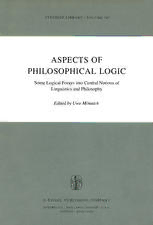
Table Of ContentASPECTS OF PHILOSOPHICAL LOGIC
SYNTHESE LIBRARY
STUDIES IN EPISTEMOLOGY,
LOGIC, METHODOLOGY, AND PHILOSOPHY OF SCIENCE
Managing Editor:
JAAKKO HINTIKKA, Florida State University
Editors:
DONALD DA VIDSON, University of Chicago
GABRIEL NUCHELMANS, University of Leyden
WESLEY C. SALMON, University of Arizona
VOLUME 147
ASPECTS OF
PHILOSOPHICAL LOGIC
Some Logical Forays into Central Notions of
Linguistics and Philosophy
Edited by
UWE MONNICH
Seminar for English Philology, University of Tubingen
D. REIDEL PUBLISHING COMPANY
DORDRECHT : HOLLAND / BOSTON: U.S.A.
LONDON: ENGLAND
Library of Congress Cataloging in Publication Data
Main entry under title:
Aspects of philosophical logic.
(Synthese library ; v. 147)
"Proceedings of a workshop on formal semantics of natural languages
which was held in Tiibingen from the I st to the 3rd of December 1977" -Pref.
Includes bibliographies and index.
I. Logic-Congresses. 2. Philosophy-Congresses. 3. Tense (Logic)-
Congresses. 4. Languages-Philosophy-Congresses. 5. Semantics
(Philosophy) -Congresses.
I. Miinnich, Uwe, 1939-
BC51.A85 160 81-7358
ISBN-13: 978-94-009-8386-1 e-ISBN-13: 978-94-009-8384-7
DOl: 10.1 007/978-94-009-8384-7
Published by D. Reidel Publishing Company,
P.O. Box 17, 3300 AA Dordrecht, Holland
Sold and distributed in the U.S.A. and Canada
by Kluwer Boston Inc.,
190 Old Derby Street, Hingham, MA 02043, U.S.A.
In all other countries, sold and distributed
by Kluwer Academic Publishers Group,
P.O. Box 322, 3300 AH Dordrecht, Holland
D. Reidel Publishing Company is a member of the Kluwer Group
All Rights Reserved
Copyright © 1981 by D. Reidel Publishing Company, Dordrecht, Holland
Softcover reprint of the hardcover 1st edition 1981
No part of the material protected by this copyright notice may be reproduced or
utilized in any form or by any means, electronic or mechanical,
including photocopying, recording or by any information storage and
retrieval system, without written permission from the copyright owner
TABLE OF CONTENTS
PREFACE VO
J. F. A. K. VAN BENTHEM I Tense Logic, Second-Order Logic and
Natural Language
ALDO BRESSAN I Extensions of the Modal Calculi Me and MCXJ.
Comparison of Them with Similar Calculi Endowed with
Different Semantics. Application to Probability Theory 21
DOV M. GABBAY IAn Irreflexivity Lemma with Applications to
Axiomatizations of Conditions on Tense Frames 67
DOV M. G ABBA Y I Expressive Functional Completeness in Tense
Logic (Preliminary Report) 91
ROBER T GOLDBLA IT I "Locally-at" as a Topological
Quantifier-Former 119
RICHARD SMABY I Ambiguity of Pronouns: A Simple Case 129
ARNIM VON STECHOW I Presupposition and Context 157
HANS KAMP I The Paradox of the Heap 225
INDEX 279
PREFACE
This volume constitutes the Proceedings of a workshop on formal seman
tics of natural languages which was held in Tiibingen from the 1st to the
3rd of December 1977. Its main body consists of revised versions of most
of the papers presented on that occasion. Three supplementary papers
(those by Gabbay and Sma by) are included because they seem to be of
particular interest in their respective fields.
The area covered by the work of scholars engaged in philosophical
logic and the formal analysis of natural languages testifies to the live
liness in those disciplines. It would have been impossible to aim at a
complete documentation of relevant research within the limits imposed
by a short conference whereas concentration on a single topic would
have conveyed the false impression of uniformity foreign to a young and
active field. It is hoped that the essays collected in this volume strike a
reasonable balance between the two extremes. The topics discussed here
certainly belong to the most important ones enjoying the attention of
linguists and philosophers alike: the analysis of tense in formal and natural
languages (van Benthem, Gabbay), the quickly expanding domain of
generalized quantifiers (Goldblatt), the problem of vagueness (Kamp),
the connected areas of pronominal reference (Smaby) and presupposition
(von Stechow) and, last but not least, modal logic as a sort of all-embracing
theoretical framework (Bressan).
The workshop which led to this collection formed part of the activities
celebrating the 500th anniversary of Tiibingen University. The organizing
committee of the workshop, which consisted of Hans-Bernhard Drubig,
Franz Guenthner, David A. Reibel and myself, here records its warmest
thanks to the President of Tiibingen University, Adolf Theis, for the
financial support which made the meeting possible. It is a pleasure to
acknowledge further valuable financial support received from the Neu
philologische FakuWit of Tiibingen University. I would like to express
the gratitude of the conference participants and my appreciation of assis
tance provided by Mss. Barbara Bredigkeit and Gisa Briese-Neumann
in preparing the meeting and in editing the manuscripts.
U. MONNICH
Vll
J. F. A. K. V AN BENTHEM
TENSE LOGIC, SECOND-ORDER LOGIC AND
NATURAL LANGUAGE
l. INTRODUCTION
The subject of time may be approached from many points of view. Some
of these are concerned with its nature; e.g., philosophy (Kant's Trans
zendentale Asthetik), mathematics (Zeno's Paradoxes) or physics (Theory
of Relativity). Others are more methodological, so to speak, being con
cerned with the role of reference to time in statements or arguments.
Thus, in this perspective, logic and linguistics are on the same side of the
fence. (Which they have been from the time when logic turned from
ontology to language.) In fact, a subject like tense logic may be considered
to be an enterprise common to logicians and linguists. (Cf. [18J, [12J
and [17].) Still, there remains a clear difference of interest, as will be seen
below.
In section 2 of this paper, a brief survey will be given of some topics
in tense logic which are of central interest to a logician. Most of these
turn out to be connected, in one way or another, with the difference
betweenf irst-order and second-order logic. This difference will be treated
somewhat more generally in section 3. It will be argued that its technical
aspects (the vital ones, logically speaking) are of doubtful significance
for the semantics of natural language. This conclusion inspires a short
discussion of the role of logic in the study of natural language (section 4).
This paper presupposes some knowledge of Priorean tense logic as
well as of ordinary predicate logic (cr., e.g., [4J).
2. TENSE LOGIC AS A SYSTEM OF LOGIC
The formal language to be considered here is that of ordinary proposi
tional logic (symbols: I for "not", /\ for "and", v for "or", --+ for "if ...
then ... " and +-+ for "if and only if") together with tense operators P (it
has been the case at least once that) and F (it will be the case at least
once that). The latter two embody the sole primitive concepts involving
time to be used here. (The important additions made in [12J, [24J and [1 J
are irrelevant to the present purpose, which consists in explaining some
U. Monnich (ed.), Aspects of Philosophical Logic, 1-20
Copyright © 1981 by D. Reidel Publishing Company
2 1. F. A. K. VAN BENTHEM
logical points. For the same reason, tensed predicate logic is not consi
dered.) Two more tense operators are introduced by definition, viz.
H = iPi (it has always been the case that) and G = iFi (it is always
going to be the case that).
2.1 Axiomatics
Using the axiomatic method, one approaches the subject of valid tense
logical argument as follows. Intuition (or common prejudice) reveals
that certain principles are evidently true; e.g.,
(1) G(¢ -> t/J) -> (G¢ -> Gt/J)
(2) ¢ -> HF¢.
One then constructs a theory of deduction on the basis of these by adding
ruIes of inference. An example is the so-called minimal tense logic K
t
obtained by taking some propositional axioms complete for propositional
logic with Modus Ponens as its sole rule of inference, and adding the
following tense-logical superstructure.
AXIOMS: (1), (2) as above,
(3) H(¢ - 1/1) - (H ¢ - HI/I)
(4) ¢ -+ GP¢,
RULES OF INFERENCE: from ¢ infer G¢
from ¢ infer H ¢
Intuition may reveal more than this, however; witness the following
remark of McTaggart's (cf. [15J):
"If one of the determinations past, present and future can ever be
applied ... [to an event]. .. then one of them has always been and always
will be applicable, though of course not always the same one."
This yield additional axioms .
(5) P¢ -+ H(F¢ v ¢ v P¢)
(6) P¢ -+ GP¢
(7) F¢ -+ G(P¢ v ¢ v F¢)
(8) F¢ -+ HF¢.
The result is a deductive theory McT. (By the way, either of (6), (8) is
derivable from the other, given K,.)
LOGIC AND NATURAL LANGUAGE 3
2.2 Semantics
During several decades much effort was invested in the development of
these and similar axiomatic theories. The semantical approach, due mainly
to the work of S. A. Kripke, came relatively late. (At least for the related
subject of modal logic, there is an explanation for this phenomenon. A
semantical approach was tried in the thirties already, but - being a
generalization of the truth table semantics for propositional logic-it
took the wrong track. Only in recent years a more fruitful revival of this
"algebraic semantics" has taken place. Cf. [23].) The main seman tical
notions are the following.
<
A frame F is an ordered couple T, < ), where T is a non-empty set
(of "moments") and < a binary relation on T ("precedence", "earlier than").
A model M is a couple <F, V), where F is a frame and Va valuation on F
taking proposition letters p to subsets V(p) of T (the "times when p holds").
For a model M = <F, V), a tense-logical formula ¢ and a moment tET,
the basic truth df!finition is as follows.
M ~ ¢ [t J (¢ holds in M at t) is defined by recursion:
(i) M~p[tJ iff tEV(p)
(ii) M~I¢[tJ iff not M ~¢[tJ
(iii) M~¢ ----> ljJ[tJ iff if M ~ ¢ [t J, then M ~ IjJ [t J
(iv) M~P¢[tJ iff for some t' < t,M ~ ¢ [tfJ
(v) M~F¢[tJ iff for some t' > t, M ~ ¢ [t'J.
Some derived notions are: M ~ ¢ (for all tE T, M F= ¢ [tJ) and, for a set
L of tense-logical formulas, M ~ L (for all ¢EL, M F= ¢).
If one is interested in only those principles which are true solely in
virtue of the structure of time, then one has to abstract from the particular
valuation V.
F F= ¢ [tJ (¢ holds in Fat t) is defined by:
for all valuations VonF,<F,V)~¢[t].
F F= ¢ and F F= L are then defined in an analogous fashion. Moreover, for
I
a class y{' of frames, Thr (ff) = {¢ for all FE:f{', F ~ ¢}.
2.3 Correspondence
Note how in the definition of M F= ¢ [t J, tense-logical formulas ¢ are
treated as first-order formulas, obtainable through the following standard
translation ST (cf. [23J) taking ¢ to a formula ST(¢) with one free (mo-
4 J. F. A. K. VAN BENTHEM
ment) variable x:
(i) ST(p) = Px (where P is a unary predicate letter corres-
ponding to the proposition letter p)
(ii) ST(i4» = iST(4))
(iii) ST(4) --> t/J) = ST(4)) --> ST(t/J)
(iv) ST(P4» = 3x'(Bx'x /\ ST(4))(x'))
(where x' does not occur in ST (4)) - whence
it can safely be substituted for x - and B
("before") is a fixed binary predicate letter
denoting ~ .)
(v) ST(F4» = 3x'(Bxx' /\ ST(4))(x')).
Thus, tense-logical formulas may be considered to be formulas of a first
order language with a single binary predicate letter B and unary predicate
letters P corresponding to the proposition letters p. Models are nothing
but structures for this first-order language. This simple observation yields
at once the usual first-order meta-theorems: completeness (the set of
universally valid tense-logical formulas - i.e., {4> I for all M,M F= 4>} - is
recursively axiomatizable), compactness (if, for any .finite ~o <::::; ~ there
exist M and t such that M F= 1:0 [tJ, then there exist M and t such that
M F= 1: [t J) and Lowenheim-Skolem (if, for any M and t, M F= ~ [t], then,
for some M with a countable domain T and for some t, M F= ~ [t J.)
The notion of "truth in a frame" turns out to require second-order
formulas, however:
Let 4> contain the proposition letters PI'''' ,p,,' Then F F 4> [t] if and
only if FF= VP I '" VP ,,ST(4))[t]; where the frame F now also serves as a
structure for a second-order language with one binary predicate constant
B and unary predicate quantifiers V Pi ("for all subsets Pi of T").
For an important class of tense-logical formulas an equivalent .first
order formula (containing Band = ) may be found instead of the just
mentioned second-order formula. E.g. for all F and t, the following
equivalences hold:
FF=Pp --> H(Fp v p v Pp)[t] iff
F F= Vy(Byx --> Vz (Bzx --> (Bzy v Byz v Y = z))) [t],
F F= Pp --> GPp [t] iff
F F= Vy(Byx --> Vz (Bxz --> Byz)) [t J.