Table Of ContentArts in Health
Arts in Health
Designing and
Researching
Interventions
By Daisy Fancourt
1
1
Great Clarendon Street, Oxford, OX2 6DP,
United Kingdom
Oxford University Press is a department of the University of Oxford.
It furthers the University’s objective of excellence in research, scholarship,
and education by publishing worldwide. Oxford is a registered trade mark of
Oxford University Press in the UK and in certain other countries
© Oxford University Press 2017
The moral rights of the authors have been asserted
First Edition Published in 2017
Impression: 1
All rights reserved. No part of this publication may be reproduced, stored in
a retrieval system, or transmitted, in any form or by any means, without the
prior permission in writing of Oxford University Press, or as expressly permitted
by law, by licence or under terms agreed with the appropriate reprographics
rights organization. Enquiries concerning reproduction outside the scope of the
above should be sent to the Rights Department, Oxford University Press, at the
address above
You must not circulate this work in any other form
and you must impose this same condition on any acquirer
Published in the United States of America by Oxford University Press
198 Madison Avenue, New York, NY 10016, United States of America
British Library Cataloguing in Publication Data
Data available
Library of Congress Control Number: 2017935042
ISBN 978– 0– 19– 879207– 9
Printed and bound by
CPI Group (UK) Ltd, Croydon, CR0 4YY
Oxford University Press makes no representation, express or implied, that the
drug dosages in this book are correct. Readers must therefore always check
the product information and clinical procedures with the most up-t o- date
published product information and data sheets provided by the manufacturers
and the most recent codes of conduct and safety regulations. The authors and
the publishers do not accept responsibility or legal liability for any errors in the
text or for the misuse or misapplication of material in this work. Except where
otherwise stated, drug dosages and recommendations are for the non- pregnant
adult who is not breast- feeding
Links to third party websites are provided by Oxford in good faith and
for information only. Oxford disclaims any responsibility for the materials
contained in any third party website referenced in this work.
Acknowledgements
I should like to thank Martin Baum from Oxford University Press for commis-
sioning this book and Charlotte Holloway for her support during its writing.
I would also like to acknowledge Aaron Williamon for encouraging me to write
this book in the first place and Rosie Perkins who has been my closest collabor-
ator over the last few years in carrying out research in this field.
My own involvement in arts in health was sparked by Singing Medicine; a
programme run by Ex Cathedra bringing music interventions to children at
Birmingham Children’s Hospital. I’m profoundly grateful for the training and
experience of working on their programme all those years ago and to Oxford
University for working with Ex Cathedra to make the experience possible. Since
then, I’ve been fortunate to work with many inspiring hospitals, universities
and arts organizations. There are too many to name them all, but I’d particu-
larly like to acknowledge Action for Young Carers and the Carers Federation,
Arts Council England, Breathe Arts Health Research, Chelsea and Westminster
NHS Foundation Trust, CW+, Imperial College London, the Royal College of
Music, Tenovus Cancer Care, and University College London.
I am grateful to the following people for their expert advice on chapters of the
book and their support with proofreading: Michael Brown, Paul Camic, Helen
Chatterjee, Yvonne Farquharson, Adam Ockelford, Tim Osborn, Rosie Perkins,
and George Waddell. I’d also like to acknowledge the support of Annabelle
Lucas who helped in compiling the resources for the fact file in Part IV. I’m
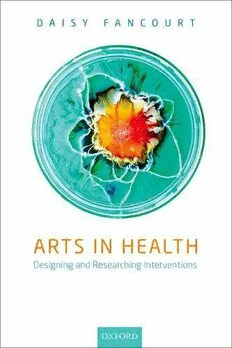
delighted that the front cover of this book features the beautiful artwork of Klari
Reis. From her series ‘A Daily Dish’, the image is a photograph of paint in a petri
dish and is inspired by work Reis carried out in London hospitals observing
the way that blood responds to different pharmaceuticals in petri dishes: an
epitome of the fusion of art and health. This book and the research I have been
involved in over the last few years would not have been possible without the
generous support of Clive Marks. I am privileged to have worked with him. In
writing this book, I’ve also been fortunate to be able to draw on so many won-
derful examples of research and practice. I’d like to thank the people involved
in these projects and to credit their work, which has helped to build this field.
Finally, I would like to thank my parents Howard and Val, my sister Millie
and my partner Tom for their support through all my years of involvement in
this field of work.
Daisy Fancourt
London, 2016
Contents
Introduction ix
Part I The context for arts in health interventions
1 A history of the use of arts in health 3
2 The theoretical background to arts in health 23
3 The political background to arts in health 51
4 Defining arts in health 68
Part II Designing and delivering
arts in health interventions
5 Conceptualizing and planning interventions 101
6 Implementing and evaluating interventions 125
7 Partnerships and funding 147
8 Working in healthcare 169
Part III Researching arts in health interventions
9 An introduction to research 191
10 A step- by- step approach to the research process 208
11 Writing a research protocol 237
12 Research ethics 259
Part IV Fact file of arts in health research and practice
Introduction 281
1 Critical care and emergency medicine 283
2 Dentistry 286
3 Geriatric medicine 289
4 Healthcare staff 292
5 Neurology 294
6 Obstetrics, gynaecology, and neonatology 297
viii Contents
7 Oncology 300
8 Paediatrics 303
9 Palliative care 306
10 Public health 309
11 Psychiatry 312
12 Rehabilitation medicine 315
13 Surgery 318
Index 321
Introduction
Over the past few decades, the use of the arts in health has blossomed. What, for
many centuries, was seen as a fringe activity is now being recognized as a field
that has enormous potential for having a positive impact on both individuals
and societies. However, despite this surge in interest and activity, there is still
limited support available for people working in the field. Although the number
of practical training courses for artists is growing and more universities are
establishing research groups, most training activity occurs in either practice
or research; there are relatively few opportunities to gain parallel experience in
both. Yet arts in health is an inherently inter-d isciplinary field. Researchers are
often involved in the conceptualization and implementation of the interven-
tions they are researching, and practitioners are increasingly becoming involved
in research. Consequently, the aim of this book is to provide a complete over-
view of how to go about designing and researching arts in health interventions.
Part I explores the context for arts in health interventions. In Chapter 1, we
trace the origins of the use of arts in health, considering the place of the arts in
medicine and medical philosophy across the last 40,000 years and the evolution
of theory and practice in the field. Chapter 2 looks back at developments over the
past 200 years in the concepts of health and medicine, exploring the emergence
of models of health such as the biomedical model and biopsychosocial model,
and identifying myriad ways in which the arts have been shown to impact on
health and wellbeing in relation to these models. Chapter 3 identifies recent
health policies and national arts agendas that have made space for arts in health
and considers the opportunities these have presented for research and practice.
In Chapter 4, we consider what arts in health today actually is: which activities
are included within the field, how they have developed, and how the field as
a whole relates to other fields such as medical humanities. Each area of activity
is illustrated with case studies of projects and sources of further information.
Part II looks more closely at how to go about designing and delivering arts
in health interventions. In Chapter 5, we look at how to conceptualize and plan
an intervention, moving through a step- by- step process assisted by reputable
business models and other healthcare frameworks that are being implemented
in healthcare systems around the world to help develop targeted and effective
health innovations. In Chapter 6, we move onto the practicalities of imple-
menting an intervention, evaluating its success and planning for its long-t erm