Table Of ContentBLUMEA 39 (1994) 321-340
Are the genera Halleaand Mitragyna (Rubiaceae-
Coptosapelteae) pollen morphologicallydistinct?
S. Huysmans E. Robbrecht & E.Smets
Summary
Recentliteratureis controversial as regardsthe segregationofHallea andMitragyna, and pretends
thatthetwo generashow pollenmorphologicaldifferences. In thepresentstudythepollenmorphol-
ogyofall tenspecies ofthecomplexis describedonthe basis oflight andscanning electronmicro-
scopy (includingexamination ofbroken grains,which were obtained with atechniqueneverapplied
inpalynology,viz.shakingwith glassbeads).
Thetwogenera have3-zonocolporategrainswithcompoundapertures(endoaperturesarealways
H-shaped,sometimes incompletelyso). While Hallea showedtobe stenopalynous(sexinealways
tectate-perforate),Mitragynaismorevariable (sexinemicroreticulate ortectate-perforate),andseveral
ofitsspecieshave pollensimilar tothat ofHallea.
Numerical analysiswasused to evaluate thepalynologicalobservationsin thelight ofthemacro-
morphologicalvariation in the complex. Itis concluded that both Halleaand Mitragynadeserve
genericrecognition,but arenotfullydistinctpollenmorphologically.
Introduction
Mitragyna (s.l.)is amedium-sizedpalaeotropical genusoccurring inAfrica(4 spp.)
and Asia(6 spp.,from IndiaandSriLankato Vietnamandsouthwards through the
Malay Archipelago toNew Guinea); itis absentfromMadagascar. Mitragyna is one
oftherubiaceousgeneraoncetransferredto theNaucleaceae, whichare characterized
by congested, spherical,head-likeinflorescences;thisfamily is nowgenerally accept-
edtobe polyphyletic andincludedintheRubiaceaein all present-day systems (see
Robbrecht, 1993a:20). Mitragyna (s.l.)placed in thesubtribeMitragyninae Havil.
was transferredto the tribeCinchoneaeby Ridsdale (1978). Andersson& Persson
(1991) emendedtheold concepts ofthetribeCinchoneaeplacing theMitragyninae
and some other generainthe tribe Coptosapelteae Bremek. ex Darwin emendL.
Anderss. & C.Perss. For comments on this delimitationoftheCoptosapelteae, see
Robbrecht(1993b: 175).
Recently, the genusMitragyna hasreceived considerableattention.Leroy (1975)
segregated thegenusHallea, including threeofthefourAfricanspecies. However,
he was not followedby Ridsdale (1978), who made a worldwiderevision ofthe
group,interaliabecausethevariationwithintherelatedgenus Uncariaisgreaterthan
thedifferencesbetweenHalleaandMitragyna s.s. In 1985Leroy defendedagain the
L LaboratoryofPlant Systematics, Katholieke UniversiteitLeuven, Kardinaal Mercierlaan 92,
B-3001 Heverlee,Belgium.
2) Nationale Plantentuin vanBelgie,Domein vanBouchout,B-1860Meise,Belgium.
322 BLUMEA Vol. 39, No. 1/2, 1994
generic statusofHallea,mainly on tree architecturalcriteria.Afew yearslater, Hallea
was adopted intheRubiaceaeinstalmentinthe 'FloraoftropicalEastAfrica' (Verd-
court, 1988:447), because"the separation ofHalleaon rathersmall but constant
floralcharactersis supported by palynology, woodand leafanatomy, andinflores-
cence development", andbecause "therearealso some differencesinthespectrum of
alkaloids." The palynological evidencewas basedon alight andscanning electron
microscopic study byLeroy (1975) ofonly two species: theAfricanspecies Mitra-
gynainermisandHalleaciliata(=H. ledermannii).
When thefirstofus decidedto undertakea global palynological investigation of
theCoptosapelteae (sensu Andersson&Persson, 1991),basedon anexaminationof
representative species ofall thegeneraofthis tribe,theMitragyna/Hallea problem
was consideredinteresting enough foraprofound palynological study including all
ten species.
Thepresent paperintendsto give afull pollen morphological documentationof
thespecies ofMitragynas.s. andHallea. Thetaxonomicvalueof thesedatais then
assessedby anumericalanalysis inwhichpalynological dataarecombinedwithmacro-
morphological features.
MATERIALAND METHODS
Thepresentpollen morphological study isbasedonherbariummaterialofall tenspe-
cies ofMitragyna s.l. Thecollectionsexaminedare listed below,with reference to
theillustrations.Thesynonymy given isrestricted tonames underHalleaandMitra-
gyna,except forHallea ledermannii; H. ledermanniipublished by Leroy (1985), a
fewmonths before Verdcourt's combination(1985), is notvalidbecause ofincom-
plete basionym reference.For fullsynonymy, seeRidsdale(1978).
Hallea ledermannii(K.Krause) Verde. [AdinaledermanniiK.Krause; Mitragyna
ledermannii(K.Krause)Ridsd.; Halleaciliata (Aubrev. &Pellegr.)Leroy; Mitra-
gynaciliataAubrev. &Pellegr.]: Liberia, Bos2645(BR) (Fig. le);Ivory Coast,
Leeuwenberg 2639 (L)(Figs. Id, f, g; 6a; 7a).
Hallearubrostipulata (K. Schum.) Leroy [Mitragyna rubrostipulata (K.Schum.)
Havil.]: Rwanda,Bridson 185 (BR)(Figs, la, b; 7b).
Halleastipulosa (DC.)Leroy [Mitragyna stipulosa (DC.) Kuntze]: Zaire, Breyne
4660(BR) (Fig. lc).
Mitragyna diversifolia (Wall, ex G.Don) Havil.: Thailand, Maxwell 85-827(L)
(Figs. 2a-c; 6b).
Mitragyna hirsuta Havil.:Thailand,Smitinand10887BKF 6243 (L)(Figs.2d-f;
6d; 7c).
Mitragyna inermis(Willd.)Kuntze: Togo, Warnecke247(BR) (Figs. 3a-c; 6e;7d).
Mitragyna parvifolia (Roxb.) Korth.: India, collector unknown(L) (Figs. 3d-f;
6f).
Mitragyna rotundifolia (Roxb.) Kuntze: Thailand, Maxwell 88-1145(L) (Figs.
4a-c; 6g).
Mitragyna speciosa (Korth.) Havil.: Borneo, Kostermans 7693 (L) (Figs. 4d-f;
7e).
Mitragyna tubulosaHavil.: South India, Ridsdale 110(L) (Figs. 5a-d; 6c; 7f).
S.Huysmans, E.Robbrecht &E.Smets:Pollen morphologyofHallea andMitragyna 323
Fig. 1.Hallea(a,b: H. rubrostipulata;c: H. stipulosa;d—g:H. ledermannii).—a, c: polar view;
b, f:ectocolpus; d:equatorialview; e, g:apocolpium.—Scalebar ona=5µm; scale baron b =
2µm, also fore—g; scale bar onc =5µm, also for d.
All samples were acetolysed according toReitsma's (1969) 'wetting agent' method.
Pollendescriptions arebasedon lightmicroscopy (LM) andscanning electronmicro-
scopy (SEM). Theglycerine jellyslideshavebeenobservedwithaLeitzDialux 20.
Acetolysed grains forSEMhavebeen suspended in ethanol,air driedon astub and
coated with gold, using a Balzers SCD 020 sputter coater, and observed with a
Philips SEM501.
Measurementsofthe length of the polar (P) and equatorial axis (E) were made
in aboutten fully developed grains perspecimen underoil immersionat a x 1000
magnification. All othermeasurements were madeon scanning electronmicrographs.
324 BLUMEA Vol. 39, No. 1/2, 1994
Fig. 2.Mitragyna(a—c:M. diversifolia; d—f:M. hirsuta).—a, d:polar view; b, e:mesocolpium
c, f:ectocolpus. —Scale bar ona=5µm, also ford;scalebaronb =2µm,also forc,e,f.
Inour opinion, characters attheinnersurfaceoftheexinehave, atleastinRubia-
ceae,a greatsystematic value.For thisreason brokenpollengrainsofallinvestigated
species wereobserved with SEM. To obtainbrokengrains we applied atechnique
that, as farasweknow,was never describedinpalynological literature, viz. shaking
apollen suspension withglass beads(Huysmans etal., 1993): 0.4mlpollen suspen-
sionin acetone andc. 0.5ml glass beads(1 mmin diameter)were agitatedtogetherin
asmalltesttube by aVortex; 50to70secondsofshaking wasfound tobeeffective.
S.Huysmans, E.Robbrecht & E.Smets: Pollen morphologyofHalleaandMitragyna 325
Afterchecking thenumberofbroken grains with LM, afew dropsofthesuspension
were brought onastub forSEMobservation.
Forthepalynological terminologywereferto Puntetal.(1994); shape classes in
equatorial view are adopted fromErdtman(1971). Theinterpretation oftheapertural
system followsLobreau-Callen(1978).
Fig. 3.Mitragyna(a—c:M.inermis;d—f:M.parvifolia).—a, d:polarview;b:ectocolpus;e:apocol-
pium; c,f:mesocolpium.— Scalebarona=5µm,also ford;scalebar onb =2µm, also forc,e,f.
326 BLUMEA Vol. 39, No. 1/2, 1994
Fig. 4.Mitragyna (a—c: M. rotundifolia;d—f:M. speciosa). —a: polar view; b: mesocolpium;
c,f:ectocolpus; d:apocolpium;e: equatorialview. —Scale bar ona=5µm,also fore;scalebar
onb =2µm,also forc,d,f.
Macromorphological datawere gathered in thefirst place from the keys and de-
scriptions by Ridsdale (1978); inthis revision, however, only fourout oftheten
species were described.Additionalinformationwas obtained fromprotologues and
floristicliterature(Haviland, 1897;Koorders& Valeton, 1902;Pitard, 1922; Halle,
1966; Leroy, 1975;Verdcourt, 1988)as wellas frompersonal observations (dissec-
tionsofBR specimens).
S.Huysmans,E.Robbrecht & E.Smels: Pollen morphologyofHallea and Mitragyna 327
The data,bothpalynological and macromorphological, wereencodedestimatingfre-
quenciesofcharacterstates,andsubmittedtoanumericalanalysis (SYSTAT hierar-
chicalclustering withaveragelinkage andPearson'scorrelationcoefficient; Wilkin-
son, 1988).The acronymsusedfortheOTU's in tablesandfiguresare the firstthree
lettersofthe generic namecombinedwiththefirstthreeletters ofthespecific name.
PALYNOLOGICAL CHARACTERS
General morphology
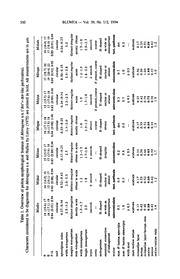
Mitragyna s.l. has small, isopolar andradially symmetrical pollen grains. The
polar axis rangesfrom 14to 22 pm,theequatorial axis from 15to 25pm. In equa-
torialview, theshape of thegrains variesfrom suboblatetoprolate-spheroidal (P/E
0.75 to 1.06).The outlinein polar view(- amb) is mostly circular; Halleastipulosa
hasasubtriangularoutlinewithconvex sides.
Theaperture system is always 3-zonocolporate; thecompound apertures consist
ofthreeparts which are locatedindifferentwalllayers. The ectoapertureis awide
colpus witha granular, slightly sunken membraneand distinctmargins which areof-
ten irregular. Theendsofthecolpi areacute,obtuse or intermediate;theapocolpium
Fig. 5.Mitragyna(M. tubulosa).—a: apocolpium; b:ectocolpus; c: equatorialview;d;mesocol-
pium. — Scale bar ona=2µm, alsoforb, d;scale bar onc= 5µm.
328 BLUMEA Vol. 39, No. 1/2, 1994
Fig. 6.Broken grainstoshowH-shapedendoaperturesandinnersurface ofnexine. —a:Hallea leder-
mannii,b: Mitragynadiversifolia; c:M. tubulosa;d:M. hirsuta;e:M. inermis; f:M.parvifolia;
g:M. rotundifolia.— Scalebar ona= 5µm;scale baronb =2µm, also forc—g.
indexvariesfrom 0.17to0.42.Themesoapertureis a lolongateporus, mostly sur-
roundedby a± smoothaspis. Theterm 'aspis' is preferred abovethemore general
'annulus'because thedifferentiatedarea surrounding theporeis always a thickening
oftheexine. Acosta(thickening ofthenexine) surrounding themesoaperture atthe
insideofthe grain occurs in six species. All species show aH-shaped cut-away of
S.Huysmans, E.Robbrecht & E.Smets: Pollen morphologyofHallea andMitragyna 329
thenexine whichis theendoaperture. Thedownstrokesofthe Hare parallel withthe
ectocolpus; in somespecies, theHmaybeincomplete, i.e. thehorizontal,equatorial
connectionmay beweak (diffuse margins) or even absent.In Mitragyna parvifolia
e.g.,the equatorial connectionis missing. The H-shaped endoaperture isreducedto
akidney-shaped cut-away atbothsidesofthemesoaperture,±3 times aslong as the
diameterofthemesoporus.Thesurfaceoftheendoapertures isoften morecoarsely
scabratethantherest oftheinnersideof thenexine.
The sexineis tectate-perforate tomicroreticulatewithshortcolumellae(observed
in thecentreof themesocolpium). Theluminaorperforations tendto belarger inthe
centre ofthemesocolpium and decrease indiametertowards thepoles and theecto-
Fig. 7. Details ofbroken grains toshow structureofexine and innersurface ofnexine. —a:Hallea
ledermannii;b: H rubrostipulata,c:Mitragyna hirsuta;d: M.inermis;e:M. speciosa; f: M.tubu-
losa. —Scale barona=1 µm,also for b—f.
330 BLUMEA Vol. 39, No. 1/2, 1994
0.94
µm. 17 19 distinct-irregularobtuse as -perforate
Mittub (16.4)(18.0)(0.91) circular 0.24-0.27 3.2 1.3-1.8 2.5-2.7 smooth coarse H-shaped wide mesoaperture dot 0.2 — scabrate 0.170.33 0.520.50 0.42 1.2
in
are 1617 mostly as tect.
0.89
measurements
2022 0.95 coarse
distinct-regular or microreticulate
perforation). Mitspe (18.7)(20.4)(0.92) circular 0.30-0.35 2.5-2.8 acute 1.2-1.3 1.8-2.3 smooth present, H-shaped unclearabsent 0.7 1.0 0±.5 scabrate 0.500.50 1.00 1.000.333.0
All 1719 0.86 ±
if
bold.
dot-like 1719 0.94 coarse
in distinct-regular or microreticulate
Mitrot (15.7)(17.6)(0.89) circular 0.24-0.32 2.3-2.5 acute 1.5 1.7-1.8 smooth H-shaped unclearabsent 0.3 0.7 0.3 scabrate 0.330.42 0.790.75 0.50 1.5
printed present,
±
(‘dot’=
1517 0.83
if
are
s.s.
1.06
(1975) 1818 obtuse -perforate
distinct-regular
Mitragyna Mitpar (17.1)(17.5)(0.98) circular 0.23-0.25 1.3-2.0 1.0 1.3-1.5 absent coarse H-shaped absent dot 0.3 — scabrate 0.170.33 0.520.50 0.33 1.5
mostly
Leroy 1616 0.94 tect.
of
by
features Hallea 1718 0.94 acute
Mitine (15.9)(17.9)(0.89) circular 0.17-0.23 2.5 distinct-regular to 1.2-1.3 1.7-1.8 smooth — H-shaped irregular microreticulate 0.2 0.8 0.3 scabrate 0.330.50 0.660.83 0.50 1.7
±
and 15 17 obtuse ±
morphological 0.83
s.s.
0.94
Mitragyna 15 17 acute
distinct-irregular or tect.-perforate
pollen Mithir (14.2)(16.1)(0.88) circular 0.32-0.42 2.0-2.5 to 1.2 1.8 smooth — H-shaped unclearabsent 0.3 0.3 — scabrate 0.170.33 0.520.50 0.42 1.2
obtuse
for 14150.82 ±
of
diagnostic
Overview 0.94
Mitdiv (1157.6)(1179.1)(0.91) circular 0.27-0.30 2.5-3.2 distinct-irregular acute 1.3-1.7 2.3 smooth — shaped waidse mesoaperture reticulate 0.5 1.0 0.3 scabrate 0.170.42 0.400.59 0.42 1.4
1. tboe 14 16 0.84 mostly H- as micro ±
Table
ratio
considered
mesocolpia
apocolpia
layer/tectum
index ectoaperture ectoaperture ectoaperture mesoaperture mesoaperture connectionendoaperture nexine layer ratio
lumina lumina
Characters surface sexine/nexine
apocolpium endoaperture equatorial 0 0 muri columellae columellae
P/E amb width margins ends width height aspis costa of sexine max. max. width inner tectum sexine nexine
p E