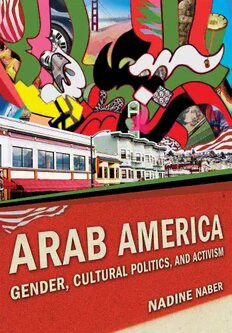
Table Of ContentArab America
NATION OF NEWCOMERS: Immigrant History as American History
General Editors
Matthew Jacobson and Werner Sollors
Beyond the Shadow of Camptown: Immigrant Rights in the
Korean Military Brides in America Shadows of Citizenship
Ji-Yeon Yuh Edited by Rachel Ida Buff
Feeling Italian: The Art of Rough Writing: Ethnic Authorship
Ethnicity in America in Theodore Roosevelt’s America
Thomas J. Ferraro Aviva F. Taubenfeld
Constructing Black Selves: The Third Asiatic Invasion: Empire and
Caribbean American Narratives Migration in Filipino America, 1898-1946
and the Second Generation Rick Baldoz
Lisa D. McGill
Race for Citizenship: Black Orientalism
Transnational Adoption: A Cultural and Asian Uplift from Pre-Emancipation
Economy of Race, Gender, and Kinship to Neoliberal America
Sara K. Dorow Helen Heran Jun
Immigration and American Popular Entitled to Nothing: The Struggle
Culture: An Introduction for Immigrant Health Care in
Jeffrey Melnick and Rachel Rubin the Age of Welfare Reform
Lisa Sun-Hee Park
From Arrival to Incorporation:
Migrants to the U.S. in a Global Era The Slums of Aspen: The War against
Edited by Elliott R. Barkan, Hasia Immigrants in America’s Eden
Diner, and Alan M. Kraut Lisa Sun-Hee Park and David Naguib Pellow
Migrant Imaginaries: Latino Cultural Arab America: Gender, Cultural
Politics in the U.S.-Mexico Borderlands Politics, and Activism
Alicia Schmidt Camacho Nadine Naber
The Force of Domesticity: Filipina
Migrants and Globalization
Rhacel Salazar Parreñas
Arab America
Gender, Cultural Politics, and Activism
Nadine Naber
a
NEW YORK UNIVERSITY PRESS
New York and London
NEW YORK UNIVERSITY PRESS
New York and London
www.nyupress.org
© 2012 by New York University
All rights reserved
References to Internet Websites (URLs) were accurate at the time of writing.
Neither the author nor New York University Press is responsible for URLs that
may have expired or changed since the manuscript was prepared.
Library of Congress Cataloging-in-Publication Data
Naber, Nadine Christine.
Arab America : gender, cultural politics, and activism / Nadine Naber.
p. cm. — (Nation of newcomers : immigrant history as American history)
Includes bibliographical references and index.
ISBN 978-0-8147-5886-1 (cl : alk. paper)
ISBN 978-0-8147-5887-8 (pb : alk. paper)
ISBN 978-0-8147-5888-5 (ebook)
ISBN 978-0-8147-5920-2 (ebook)
1. Arab Americans—Social conditions. 2. Arab American women—Social conditions.
3. Arab Americans—Ethnic identity. 4. Arab Americans—Politics and government. 5. Sex
role—United States. 6. Feminist theory. I. Title.
E184.A65N335 2012
305.892’7073—dc23 2012009401
New York University Press books are printed on acid-free paper,
and their binding materials are chosen for strength and durability.
We strive to use environmentally responsible suppliers and materials
to the greatest extent possible in publishing our books.
Manufactured in the United States of America
c 10 9 8 7 6 5 4 3 2 1
p 10 9 8 7 6 5 4 3 2 1
Contents
Acknowledgments vii
Introduction: Articulating Arabness 1
1. From Model Minority to Problem Minority 25
2. The Politics of Cultural Authenticity 63
3. Muslim First, Arab Second 111
4. Dirty Laundry 159
5. Diasporic Feminist Anti-Imperialism 203
Conclusion: Toward a Diasporic Feminist Critique 247
Notes 255
Bibliography 273
Index 293
About the Author 310
>> v
This page intentionally left blank
Acknowledgments
This book was born collectively, through ongoing relations with friends, col-
leagues, and activists. Yet ultimately, I take full responsibility for the con-
tent and any errors on the pages that follow. First and foremost, I acknowl-
edge with deep respect and gratitude each person who participated in my
research. You shared your stories with me and trusted me to write them.
This book began at the University of California–Davis in the 1990s. I was
fortunate to work with Suad Joseph. She is a model of the feminist principle
“lift while you climb.” She opened up many doors for me. Also at UC–Davis,
I had the privilege to learn from Kent Ono, who always saw the best in me
and encouraged me to publish my work. At UC–Davis I was met with col-
leagues, friends, and mentors with whom I developed the early foundations
of an interdisciplinary, ethnic studies–based feminist ethnography: Shagufta
Bidiwalla, Adrianna Clay, Rosa Linda Fregoso, Ileana Labergere, Smadar
Lavie, Donald Moore, Sarah Projansky, Ella Maria Ray, and Zeina Zaatari.
Arab and Arab American scholars, friends, and activists in California pro-
vided me with a sense of collective power throughout the process of research
>> vii
viii << acknowledgments
and writing. I am grateful to these community elders who supported my
research whether or not we shared the same ideas or political commitments:
Darwish Addassi, Kamel Ayoub, Bishara Kubein, Jamal Dajani, Manuel
Dudum, Fouad Malouf, Salem Mufarrah, Alice Nashashibi, and Abeer Rafidi.
Notably, my mother’s childhood classmate and long-time activist, commu-
nity builder, and pathbreaker, Nabila Mango, assisted me all along the way. I
am deeply indebted to the many friends living in the San Francisco Bay Area
who were consistently available to discuss or assist me with research matters,
answer questions, or offer their homes. Among them are Marwan Abderraz-
zaq, Maad Abughazalah, Dena Al-Adeeb, Janaan Attia, Hatem Bazian, Lina
Baroudi, Lillian Boctor, Youmna Chlala, Eman Desouky, Ron Dudum, Sema
Dudum, Manal Elkarra, Noura Erakat, Laura Farha, Nadine Ghammache,
Jess Ghannam, Monadel Herzallah, Emily Katz-Kishawi, Senan Khairie, Eyad
Kishawi, Huda Jadallah, Manal Jamal, Chis Lymbertos, Ghada Saliba Malouf,
Heba Nimr, Mona Odeh, Osama Qasem, Fadwa Rashid, Elias Rashmawi,
Michel Shehadeh, Linda Sherif, and Mona Sousou. In the 1990s, I witnessed
these scholars who came before me rupture the boundaries of Middle East
area studies and open up new possibilities for diasporic Middle East feminist
studies: Amal Amireh, Nada Elia, Joe Kadi, Lisa Suhair Majaj, Minoo Moal-
lem, Therese Saliba, and Ella Shohat. Their work shapes this book and helped
to make it possible. As I expanded this project, these generous colleagues
challenged me in the most profound ways, offered me their time and energy,
and provided invaluable feedback: Evelyn Alsutany, Maylei Blackwell, Piya
Chatterjee, Lara Deeb, Vince Diaz, Dena Goodman, Rebecca Hardin, San-
dra Gunning, Sondra Hale, Scott Kurashige, Jayati Lal, David Lloyd, Minoo
Moallem, Susan Najita, Julia Paley, Elizabeth Roberts, Sarita See, Ella Shohat,
Andrea Smith, Miriam Ticktin, Valerie Traub, and Ruth Tsoffar. I am deeply
grateful to these colleagues for their ongoing feedback and for reading indi-
vidual book chapters: Dina Alkasim, Paul Amar, Paola Bacchetta, Marc Baer,
Yvette Floretz-Ortiz, Sondra Hale, Charles Hirschkind, Amira Jarmakani,
Karen Leonard, Saba Mahmood, Damani Patridge, Martina Reiker, Nayan
Shah, and Kate Wahl.
I am truly fortunate to receive ongoing support, insight, and inspiration
from these colleagues and friends: Rabab Abdulhadi, Kali Akuno, Debo-
rah Alkamano, Amal Amireh, Anjali Arondeker, Kathryn Babayan, Eliza-
beth Betita Martinez, Alisa Bierra, Adrienne Marie Brown, Linda Burn-
ham, Lucy Burns, Louise Cainkar, Tina Delisle, Philip Deloria, Gregory
Dowd, Derethia Duval, Nada Elia, Holly Fincke, Simmi Gandhi, Reem
Gibriel, Gayatri Gopinath, Elaine Hagopian, Sondra Hale, Frances Hasso,
Rima Hassouneh, Ilana Invincible, Mervat Hatem, Randa Jarrar, Jodi Kim,
acknowledgments >> ix
Larry Lafontaine Stolkes, Emily Lawsin, Jeannette Lee, Sunnina Maira,
Khaled Mattawa, Tiya Miles, Huli Milanese, Joe Namy, Dahlia Petrus, Eric
Quesada, Andrea Ritchie, Dylan Rodriguez, Damon Salesa, Jenny Salesa,
Therese Saliba, May Seikaly, Setsu Shigematsu, Andrew Shryock, Bill Sorro,
and Cindy Weisner.
My involvement in these organizations provided me with a sense of home
and powerfully shaped the analyses and methods that frame this book:
American Arab Anti-Discrimination Committee, San Francisco Chapter
(ADC SF); Arab Movement of Women Arising for Justice (AMWAJ); Arab
Resource and Organizing Center (AROC); Arab Women’s Solidarity Asso-
ciation, San Francisco (AWSA SF); Center for Political Education (CPE);
Cyber AWSA; INCITE! Women of Color against Violence; Radical Arab
Women’s Activist Network (RAWAN); and the Women of Color Resource
Center (WCRC).
Affiliations with Arab American communities in Ann Arbor and greater
Detroit and with these organizations in Michigan sustained me during the
writing process: Allied Media Project; American Arab Anti-Discrimination
Committee (ADC, Michigan); Arab American National Museum (AANM);
Arab Community Center for Economic and Social Services (ACCESS);
Detroit Summer; and Palestine Office.
More than ever, I owe deep thanks to Andrew McBride, Matthew Stif-
fler, and Lee Ann Wang, who extended themselves way beyond the call of
duty as research assistants. I also thank Paul Abowd, Rabia Belt, Chris Finley,
Angela Parker, and Kiri Sailiata. I am deeply indebted to Eman Desouky and
Layla Feghali, who worked as assistants and interlocutors. Graduate student
Mejdulene Shomali provided invaluable insight as I worked through the sig-
nificance of queer studies to this project.
My heartfelt appreciation goes to David Lobenstein for editing my work
with exceptional precision and splendor and with deep respect for the stories
I wanted to tell and the integrity of my ideas. I also thank these editors: Jane
Cavolina, Christopher Hebert, and Heidi Newman.
These individuals with NYU Press have made the process of publishing
as efficient and enjoyable as it could ever be: Eric Zinner, editorial direc-
tor; series editors Matthew Jacobson and Werner Sollers; and editor Ciara
McLaughlin.
At the University of Michigan, I am grateful to the staff from the Depart-
ment of Women’s Studies and the Program in American Culture. Research
and writing were aided by these grants: Ford Foundation Post-Doctoral
Fellowship, University of Michigan Vice Provost for Research Award, Uni-
versity of California Humanities Research Institute Fellowship, University