Table Of ContentPALGRAVE STUDIES IN PLAY, PERFORMANCE,
LEARNING, AND DEVELOPMENT
Applied Theatre and
Intercultural Dialogue
Playfully Approaching Difference
Elliot Leffler
Palgrave Studies In Play, Performance, Learning,
and Development
Series Editor
Lois Holzman
East Side Institute for Group
and Short Term Psychotherapy
New York, NY, USA
This series showcases research, theory and practice linking play and perfor-
mance to learning and development across the life span. Bringing the
concerns of play theorists and performance practitioners together with
those of educational and developmental psychologists and counsellors
coincides with the increasing professional and public recognition that
changing times require a reconceptualization of what it means to develop,
to learn and to teach. In particular, outside of school and informal learning,
the arts, and creativity are coming to be understood as essential in order
to address school failure and isolation. Drawing upon existing expertise
within and across disciplinary and geographical borders and theoretical
perspectives, the series features collaborative projects and theoretical
crossovers in the work of theatre artists, youth workers and scholars in
educational, developmental, clinical and community psychology, social
work and medicine—providing real world evidence of play and theatrical-
type performance as powerful catalysts for social-emotional-cognitive
growth and successful learning.
Advisory Board:
Patch Adams, Founder, Gesundheit Institute, USA
Natalia Gajdamaschko, Simon Fraser University, Canada
Kenneth Gergen, Professor, Swarthmore College, USA and Tilburg
University, the Netherlands
Artin Gonçu, Professor, University of Illinois at Chicago, USA
James Johnson, Professor, Pennsylvania State University, USA
Fernanda Liberali, Professor, Pontific Catholic University of São
Paulo, Brazil
Yuji Moro, Professor, University of Tsukuba, Japan
Alex Sutherland, Professor, Rhodes University, South Africa
Jill Vialet, Founder and CEO, Playworks, USA
Elliot Leffler
Applied Theatre and
Intercultural Dialogue
Playfully Approaching Difference
Elliot Leffler
Toronto, ON, Canada
Palgrave Studies In Play, Performance, Learning, and Development
ISBN 978-3-030-98514-1 ISBN 978-3-030-98515-8 (eBook)
https://doi.org/10.1007/978-3-030-98515-8
© The Editor(s) (if applicable) and The Author(s) 2022
This work is subject to copyright. All rights are solely and exclusively licensed by the
Publisher, whether the whole or part of the material is concerned, specifically the rights of
translation, reprinting, reuse of illustrations, recitation, broadcasting, reproduction on
microfilms or in any other physical way, and transmission or information storage and retrieval,
electronic adaptation, computer software, or by similar or dissimilar methodology now
known or hereafter developed.
The use of general descriptive names, registered names, trademarks, service marks, etc. in this
publication does not imply, even in the absence of a specific statement, that such names are
exempt from the relevant protective laws and regulations and therefore free for general use.
The publisher, the authors, and the editors are safe to assume that the advice and information
in this book are believed to be true and accurate at the date of publication. Neither the
publisher nor the authors or the editors give a warranty, expressed or implied, with respect
to the material contained herein or for any errors or omissions that may have been made.
The publisher remains neutral with regard to jurisdictional claims in published maps and
institutional affiliations.
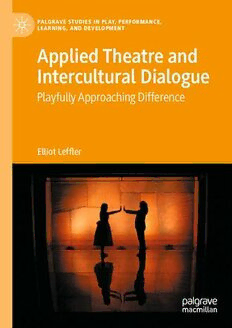
Cover image courtesy of Albany Park Theatre Project, featuring their production of
Remember me Like This and the performers Stephany Perez and Ana Ovando. Taken by Amy
Braswell.
This Palgrave Macmillan imprint is published by the registered company Springer Nature
Switzerland AG.
The registered company address is: Gewerbestrasse 11, 6330 Cham, Switzerland
To my parents and my sister, who first taught me to play,
To Nava and Razia, who inspire me with their play,
And to Nomi, whose playful spirit lifts everyone around her.
A
cknowledgments
A book like this one cannot be written in solitude. One person’s name
goes on the cover, but countless others make it possible.
The book is informed by four distinct sites of applied theatre, and at
each of those sites, I learned about theatre-making and intercultural dia-
logue from those with whom I had the great joy to work and play. At the
Global Youth Village (GYV), I had the opportunity to lead groups of
thoughtful, engaged, courageous teens from across the globe, including
dozens from across Iraq. The senior staff of GYV generously supported
that work and this research. I’m grateful to the teens, and the leadership,
and always eager to continue the dialogue with them. At Pollsmoor Prison,
I worked with about twenty young men, all who trusted me as a director,
and who trusted one another as creative partners. They taught me so
much—about applied theatre, about South Africa, and about their lives.
The staff of Hope Ministry (in particular, Reverend Jonathan Clayton and
Burt Elliott) facilitated the process, and I couldn’t be more grateful to
them for their trust in me and their belief in the young men in the prison
system. I am similarly grateful for the cooperation of Pollsmoor Prison
staff, particularly Christopher Malgas. Jan Mandell, at Central High
School, welcomed me into her Minnesota drama classroom, and her stu-
dents greeted me with warmth and eager curiosity. I’m so appreciative to
have been a part of their creative processes, both as an observer and, at
times, as a more active participant. And finally, in Evanston, IL, I had the
great honor of working with the congregants and the leadership of Second
Baptist Church and Beth Emet Synagogue. Rabbi Andrea London, Pastor
vii
viii ACKNOWLEDGMENTS
Mark Dennis, and Pastor Karen Mosby were all champions and facilitators
of the process. My facilitation partner in that creative project, Rev. Brian
Smith, is among the most generous and positive people with whom I’ve
ever had the pleasure of working. And the congregants who joined us for
that artistic exploration, both from the church and from the synagogue,
were supportive not only of each other, but also of me and of this research.
Many of them even continued to meet with me for a full year after the
project was complete, to consult with me throughout the initial phases of
writing about it.
I’m similarly grateful to the community groups I’ve worked with that
have helped me learn more about intercultural dialogue, outside of the
theatre-making processes that take the spotlight in this book. They, too,
have informed this study, even if sometimes less directly. Chief among
these have been the staff and participants of the Sankofa project I profile
in the book’s epilogue. To Rev. Velda Love, Rabbi Andrea London, Jerane
Ransom, Yoni Siden, Taurean Webb, Emily Nidenberg, Rachel Hudgens,
and all the participants, I owe a great debt of thanks. I’m also fortunate to
have worked with, and learned from, Eyal Rabionvich, Melissa Weintraub,
and Daniel Silberbush at Resetting the Table. This organization is doing
remarkable work bringing people together across cultural divides, and
while my particular focus on theatre often spins me in a different direction
than the one in which they’re moving, they have taught me a tremendous
amount about this work. I’m so appreciative of those who have trained me
in that context, in addition to those who have trained alongside me, and
those who have participated in those programs. And finally, I’m lucky to
have worked with the leadership, staff, and participants of Nesiya, where
intercultural dialogue always flourished along multiple axes, where artistic
work of all kinds was welcomed as a potential stimulus to that dialogue,
and where shallow platitudes were never welcome.
My gratitude extends to the many theatre companies whose work has
inspired my interest in how theatre-making facilitates intercultural encoun-
ters. There are too many companies to list here, but Albany Park Theatre
Project (APTP) warrants a special mention. Based in a neighborhood of
Chicago with a very high concentration of immigrant families (especially
from Latin America, Eastern Europe, the Middle East, and Southeast
Asia), APTP brings together young people to dramatize their own stories
and those of their neighbors. The narratives they stage are of the utmost
importance, the staging is captivating, and the young people’s engage-
ment with one another—across lines of cultural difference—is inspiring. I
ACKNOWLEDGMENTS ix
became aware of their work when they were only a few years old and have
followed them for over two decades, seeing many of their shows, when
I’m in Chicago, and wishing I could see others, when I’m not. Their 2009
play, Remember Me Like This, is featured on the cover of this book—a
testament both to their generosity and to the profound influence they
have had on me.
It is impossible to express the depth of my thanks to Sonja Kuftinec, my
former dissertation advisor and my perpetual mentor. Sonja is wise, gener-
ous, rigorous, curious, tireless, and incredibly kind. Everyone in her orbit
is lucky to be there. My analysis of applied theatre and intercultural dia-
logue has benefited immeasurably from her sharp eye, her associative leaps,
her encouragement, and her critique.
Many other colleagues, professional mentors, and professional organi-
zations have also supported the trajectory this book has taken, in a variety
of ways. I am particularly grateful to Gay Morris, Michael Rohd, David
Grant, David Downs, Dani Snyder-Young, Katharine Low, Rita
Kompelmakher, Mike Mellas, Kate Duffly, Kate Bredeson, Tim Lensmire,
Teresa Gowan, Cindy García, and Margaret Werry, each of whom have
helped to nurture this project and develop the ideas herein. Also, my col-
leagues at the University of Toronto, where I have had the good fortune
to work while writing most of this book, have been tremendously gener-
ous and helpful; I have received vital support and encouragement from
Barry Freeman, Kathleen Gallagher, Andrea Charise, Trisha Lamie, Carla
Melo, Thy Phu, Tamara Trojanowksa, Xing Fan, Seika Boye, Antje Budde,
Jill Carter, Nikki Cesare Schotzko, Nancy Copeland, Doug Eacho, Jacob
Gallagher-Ross, Djanet Sears, Nicole Kaniki, Kevin Wright, Colin Harris,
Manaal Hussain, and too many others to mention. I’m also grateful for
conferences that provided opportunities to workshop the ideas herein;
these have included The Association for Theatre in Higher Education
(ATHE), the American Society of Theatre Research (ASTR), and Pedagogy
and Theatre of the Oppressed (PTO). Another professional organization,
The National Center for Faculty Development and Diversity (NCFDD),
gave me the framework and the tools to actually sit and write a manu-
script, amid all the other work academics must do. To that organization,
to my mentor Patricia Farnese, and to the other scholars who went through
that program with me, I’m in debt.
But I’m actually not literally in debt, because my participation in that
program was generously paid for by the Department of Arts, Culture, and
Media at the University of Toronto—Scarborough, in partnership with
x ACKNOWLEDGMENTS
the Dean’s Office of the University of Toronto—Scarborough. Other
institutions that have financially supported this work have included the
University of Minnesota; Reed College; and the “Flourish: Community-
Engaged Arts and Social Wellness” research cluster at the University of
Toronto—Scarborough.
One additional source of funding warrants special emphasis. In 2007, I
was awarded a Rotary Ambassadorial Scholarship from The Rotary
Foundation, which funded me to pursue an MA in Applied Drama at the
University of Cape Town. While in Cape Town, I was fortunate enough to
be hosted by the Rotary Club of Table Bay. The men and women of that
club welcomed me in with warmth and care, and introduced me to the
Hope Prison Ministry, which facilitated my work at Pollsmoor Prison (see
Chap. 3). I am tremendously grateful to Rotary, both for the funding that
the foundation provided and for the tactical and personal support that the
members of the Table Bay club provided.
Finally, I want to thank my family. First, my appreciation goes out to
my parents, who are a constant wellspring of encouragement, enthusiasm,
and support. For forty-three years, they have been teaching me how to
thrive as an academic by example—but much more importantly, they have
been teaching me what it is to be a citizen in pursuit of greater justice, a
member of a community, a good listener, and an empathetic person. Their
values and concerns run deep through this book, and I recognize those
values and concerns as my own with great gratitude. I also want to thank
Naomi, who is the most encouraging, supportive, patient, and loving part-
ner that I could imagine. My career could not have taken the trajectory it
has, and the book would not be here at all, if it were not for her generosity,
her encouragement, or her thoughtful engagement. Throughout the
twists and turns of this book’s evolution, and indeed my career’s evolu-
tion, Naomi has shared in the exciting moments of realization and possi-
bility alongside the humbling moments of self-doubt, and she has helped
me to nurture and develop these ideas into the form they take today. And
last, I want to thank my children, Nava and Razia. Nobody makes me step
away from my work like they do—and that, too, is crucial for a book’s
development.