Table Of ContentMassachusetts institute of Technology
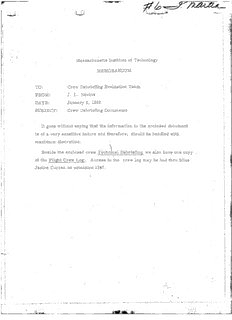
MEMORANDUM
TO: (cid:9) Crew Debriefing Evaluation Team
FROM: (cid:9) J. L. Nevins
DATE: (cid:9) January 8, 1968
SUBJECT: (cid:9) Crew Debriefing Documents
It goes without saying that the information in the enclosed document
is of a very sensitive nature and therefore, should be handled with
maximum discretion.
(cid:127) (cid:9) \
Beside the enclosed crew Technical Debriefing we also have one copy .
of the Flight Crew Log. Access to the crew log may be had thru Miss
Janice Curran on extension 1347.
let AIL (cid:127)-tig'.
C.ONFIDENTIAL
Lr 121
NATIONAL AERONAUTICS AND SPACE ADMINISTRATION
.
APOLLO (cid:9)
.
CA
Q)
Prepared by:
MISSION PERATI9NS BRANCH
FLIGHT CREW SUPPORT DIVISION
GROUP 4
AT I V.A. 1171,VALS
IlECLA..1r-{e0 nrTER la VL.nrts
TH1(cid:127) (cid:9) Ar (cid:127) e CI,na
0./
T.0 ..Ennina (cid:9) Toic es.104,3[
TITLE lo. u.(cid:127) , v t a (cid:9) r
ming,u.n(cid:9) inLITn.EOV(cid:127) IFSILCO.,rniot(cid:127) .4 (cid:9).CM .I... I(cid:9)CH 14 .A1.N7.,0
MANNED SPACECRAFT CENTER
HOUSTON,TEXAS
JANUARY 2, 1969
0 N,[5040.
......................
CONFIDENTIAL
f k
CONTENTS 6. (cid:9) 6 6 5' (cid:9) /2- 1(!;,4.i1 -6 (
Section Page
1.0 (cid:9) INGRESS AND STATUS CHECKS 1
1.13 Distinction of Sounds - Sequence D.C. to
L/0 (cid:9) 1
1.14 Vehicle Sway Prior to Ignition (cid:9)
2.0 (cid:9) POWERED FLIGHT (cid:9) 2
2.1 (cid:9) S-1C Ignition (cid:9) 2
2.2 (cid:9) Lift-Off (cid:9) 2
2.16 S-1C/S-II Separation (cid:9) 4
2.17 S-lI Engine Ignition (cid:9) 4
2.21 LET & BPC Jettison (cid:9) 5
2.22 Guidance - Initiate (cid:9) 5
3.0 (cid:9) FLIGHT OPERATIONS (cid:9) 6
3.1 (cid:9) Postinsertion TO TLI (cid:9) 6
3.2 (cid:9) Pre-TLI (cid:9) 8
3.3 (cid:9) TLI To LOT (cid:9) 8
3.4 (cid:9) LOI to TEl (cid:9) 32
3.5 (cid:9) TEI to Reentry (cid:9) 6o
3.6 (cid:9) Reentry (cid:9) 68
4.0 , (cid:9) LANDING AND RECOVERY (cid:9) 72
4.1 (cid:9) Touchdown (cid:9) 72
4.2 (cid:9) Postlandi (cid:9) Checklist (cid:9) 73
4.3 (cid:9) Communications (cid:9) 73
CO FIDENTIAL
CONFIDENTIAL (cid:9)
ii
2oct7on (cid:9) Page
4.5 (cid:9) Battery Power 73
4.6 (cid:9) Postlanding EC: System (cid:9) 74
4.7 (cid:9) Ventilation (cid:9) 74
4.14 (cid:9) Egress (cid:9) 74
5.0 (cid:9) SYSTEMS OPERATION (cid:9) 76
5.1 (cid:9) Guidance and Navigation (cid:9) 76.
5.2 (cid:9) Stabilization and Control System (cid:9) 86
5.3 (cid:9) Service Propulsion System (cid:9) 88
5.4 . (cid:9) Reaction Control System (cid:9) 89
5.5 (cid:9) Electrical Power (cid:9) 89
5.6 (cid:9) Environmental Control (cid:9) 91
5.7 (cid:9) Telecommunications (cid:9) 96
5.8 (cid:9) Miscellaneous Systems, GTOr s and GFE (cid:9) 102
6.0 (cid:9) VISUAL SIGHTINGS (cid:9) 125
6.3 (cid:9) Earth Orbit (cid:9) 125
6.4 (cid:9) Translunar Flight (cid:9) 126
6.5 (cid:9) Lunar Orbit (cid:9) 126
7.0 (cid:9) PREMISSION PLANNING (cid:9) 129
7.1 (cid:9) Mission Plan (cid:9) 129
7.2 (cid:9) Flight Plan (cid:9) 129
7,3 (cid:9) Spacecraft Changes (cid:9) 132
7.4 (cid:9) Mission Rules (cid:9) 133
CONFIDENTIAL
(cid:9)
CONFIDENTIAL
iii
(cid:9)
.section Page
8.0 (cid:9) MISSION CONTROL (cid:9) 134
8.1 (cid:9) GO/NO-GO's (cid:9) 134
8.3 (cid:9) Consumables (cid:9) 134
9.0 (cid:9) TRAINING (cid:9) 135
CMS (cid:9) 135
9.2 (cid:9) DCPS (cid:9) 137
9.3 (cid:9) CMPS (cid:127) (cid:9) 138
9.4 (cid:9) NR Evaluator (cid:9) 138
9.5 (cid:9) Egress Training (cid:9) 139
9.6 (cid:9) Centrifuge (cid:9) 140
9.7 (cid:9) Planetarium (cid:9) 140
9.8 (cid:9) MIT (cid:9) 141
9.9 (cid:9) Systems Briefings (cid:9) 142
9.10 (cid:9) Spacecraft Systems Tests (cid:9) 144
9.114 (cid:9) Moclirps and Stowage Training Equipment (cid:9) 144
9.15 Photo Tcaining (cid:9) 145
9.16 Sextant Training Equipment (cid:9) 145
9.17 General Support (cid:9) 146
9.18 Planning of Traininp,- and Training Program (cid:9) 147
10.0 (cid:9) CONCLUDING CMIENTS (cid:9) 148
. CONFIDENTIAL
CONFIDENTIAL (cid:9) 1
APOLLO 8 TECHNICAL DEBRIEFING
1.0 INGRESS AND STATUS CHECKS
1.13 Distinction of Sounds - Se.uence D.C. to L/0
BORM.AN There are no comments until we get to the dis-
tinctions of sounds and sequence prior the
vehicle checks just prior to ignition. There
were no significant sounds, valve openings, or
gimbaling that would lead to concern on the part
of the crew prior to ignition.
1.14 Vehicle Sway Prior to Ignition
BORMAN (cid:9) No vehicle sway was noticed after the swing arm
was retracted.
(
CONFIDENTIAL
(cid:9) CO \IFIDE\ITIAL
2
.0 POWERED FLIGHT
.;-10 Ignition
BORMAN The 5-1 ignition sequence starts at T minus
9 se.-..onds; however, the crcw noticed no indica-
tion of ignition until about T minus 3 seconds,
7
.'lean the noise level reaches the cockpit.
,
2.2 Lift-Off
There was no reason for co,'.ern on lift-off.
Thc::e was vibration until the hold-down arm's
re]ease, and then at lift-off, you got an ac-
cLieration similar to the Titan.
LOVELL Tha.'s right, except it appeared that the sense
slOwed down a little bit after it got off the
g(cid:127)ound, and I was watching the altimeter and
it didn't seem to go. up as rapidly as the initial
UM-off did.
ANDERS (cid:9) It was my recollection that the vibration con-
tinued until slightly past "tower clear" call.
(cid:9)
BORMAN After the vehicle was released, the noise in
the cockpit got very loud and effective crew
co.m,unication was impossible. The last call
COkFIDENTIAL
CONFIDENTIAL
that I heard was a faint "tower clear" call by
the TOM. Did you hear it very well, Bill? You
heard it, Jim. All three of us heard that call;
however, it was really in the background.- The
noise was loud, but the flight was smooth until
we went through MAX Q or Mach 1. After that it
smoothed out and the S--1C gave a very stable,
smooth ride.
LOVELL I don't think that the vibrations were any
greater than they were in the Titan. Although
there were a lot of small separate vibrations
and a lot of noise, T think the flight itself
was very smooth.
ANDERS The thing that impressed me about the early
stages of lift-off was the very positive control
during the gimbaling of the S-1C engines. It
was very positive.
BOBJvLA1 All the items on the Crew Debriefing Guide
2.1 to 2.15 were all exactly nominal and were
very well simulated by the DCPS. As a matter
of fact, the runs were very similar in every
way to a nominal run on the DCPS, except the
CONFIDENTIAL
r
CONFIDENTIAL
S-1C noise level was higher.
Al DERS T. thought the sideways oscillations during the
early part of lift-off were a little bit greater
than the DCPS. In fact, it felt to me on the
first stage ride like an old freight train going
down a bad track.
2.16 S-1C/S-II 5enaration
BnRMAN (cid:9) The S-1C/S-II separatiOn was nominal; the crew
was thrown forward in their seat, as you would
expect in a staging. Then the g load was shifted
from 4 to about 1. Consequently, you noticed
the change in thrust quite distinctly.
2.11 S-II Engine Ignition
BORIviAN 1114e early stages of the S-Il flight were nomi-
1
nal - very smooth and very quiet. However,
toward the end of the S-II flight, we did pick
up a POGO'oscillation. I would estimate the.
freouency to be on the order of 12 cps, and
probably plus or minus 0.25g. Quite frankly,
it concerned me for a while, and I was glad
to see S-II staging. It never gave any
indication of going undamped. It was a
noticeable oscillation.
CONFIDENTIAL
CONFIDENTIAL
2.21 LET & BPC Jettison
The LET & BPC jettison was nominal. The windows
were clear when the tower jettisoned. We had no
effect of retrorocket exhaust fumes on any of
the windows.
ANDERS These conditions are noted in the crew log book.
BORMAN There was some indication of light flash at
staging through the hatch window. It was
noticeable, in fact, through the left-hand
window. S.-II/S-IVB staging again was nominal.
The booster performed perfectly.
2.22 Guidance - Initiate
(cid:9)
BORMAN The guidance initiate was just as simulated on
the DCPS. a noticed about a 20-degree pitch-
down; the g-level dropped off again, and there
was a smooth flight on the S-IVB.
CONFIDENTIAL
Description:Massachusetts institute of Technology MEMORANDUM TO: Crew Debriefing Evaluation Team FROM: J. L. Nevins DATE: January 8, 1968 SUBJECT: Crew Debriefing Documents