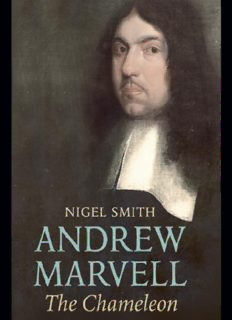
Table Of ContentANDREW MARVELL
ANDREW MARVELL
The Chameleon
NIGEL SMITH
YALE UNIVERSITY PRESS
NEW HAVEN AND LONDON
Copyright © 2010 Nigel Smith
All rights reserved. This book may not be reproduced in whole or in part, in any form (beyond that copying
permitted by Sections 107 and 108 of the U.S. Copyright Law and except by reviewers for the public press)
without written permission from the publishers.
For information about this and other Yale University Press publications, please contact:
U.S. Office: [email protected] www.yalebooks.com
Europe Office: [email protected] www.yaleup.co.uk
Set in Minion Pro by IDSUK (DataConnection) Ltd Printed in Great Britain by MPG Books, Bodmin,
Cornwall
Library of Congress Cataloging-in-Publication Data Smith, Nigel, 1958– Andrew Marvell: the chameleon /
Nigel Smith.
p. cm.
Includes bibliographical references.
ISBN 978–0–300–11221–4 (alk. paper) 1. Marvell, Andrew, 1621–1678. 2. Poets, English–Early modern,
1500–1700–Biography. 3. Legislators–Great Britain–Biography. 4. Marvell, Andrew, 1621–1678–Political
and social views. 5. Politics and literature–Great Britain–History–17th century. 6. Great Britain–Politics
and government–1660–1688. I. Title.
PR3546.S65 2010
821'.4–dc22
2010009130
A catalogue record for this book is available from the British Library.
10 9 8 7 6 5 4 3 2 1
CONTENTS
Cover
Title
Copyright
List of Illustrations
Preface and Acknowledgements
Chapter 1 Introduction: The Problem of Andrew Marvell
Chapter 2 Roots
Chapter 3 A Decade of Crises
Chapter 4 Poetry and Revolution
Chapter 5 The Tutor
Chapter 6 Civil Service
Chapter 7 Cavalier Revenge
Chapter 8 The Painter and the Poet Dare
Chapter 9 Cabal Days
Chapter 10 Indulgence and Rehearsal
Chapter 11 Brute Divines
Chapter 12 Arbitrary Power
Chapter 13 Afterlife and Revelation
List of Abbreviations
Notes
Index
ILLUSTRATIONS
PLATES
1 St German's Church, Winestead (photo: Alan Blackshaw).
2 Holy Trinity Church, Hull (© English Heritage/photo: Bob Skingle).
3 Wenceslaus Hollar, ‘Kyngeston vpon Hull’ (1640) (Thomas Fisher Rare Book
Library, University of Toronto).
4 Henry Hawkins, Partheneia Sacra ([Rouen], 1633), sig. [Aviv]) (courtesy of
the Firestone Library, Princeton University, NJ).
5 Map of Clerkenwell, Smithfield and environs (1654) (detail) by Thomas Porter
(The British Library).
6 Gian Lorenzo Bernini, Apollo and Daphne (1622–5) (Borghese Gallery,
Rome)
7 Sixteenth-century representation of the statue of Pasquino from Antoine
Lafréry, Speculum Romanae Magnificentiae (1575) (Marquand Library of Art
and Archaeology, Princeton University, NJ).
8 Attributed to Jusepe Leonarde, Palace of the Buen Retiro in 1636–7 (detail)
(Palacio Real de El Pardo, Madrid).
9 Samuel Cooper, Oliver Cromwell (1649) (© National Portrait Gallery,
London).
10 Unattributed, portrait of Robert Overton (1652–4) (© National Portrait
Gallery, London).
11 William Faithorne, after Robert Walker, Thomas Fairfax, 3rd Baron Fairfax
of Cameron (© National Portrait Gallery, London).
12 Daniel King, Appleton House (c. 1655–60), Ms Gough Maps 1 (Bodleian
Library, Oxford).
13 Pieter Nason, Oliver St John (1651) (© National Portrait Gallery, London).
14 Pieter Nason, Walter Strickland (1651) (© National Portrait Gallery,
London).
15 Robert Walker, Oliver Cromwell (1653) (by courtesy of His Grace, the Duke
of Grafton).
16 After Franz Cleyn, John Dutton, Lodge Park, Gloucestershire (© National
Trust Photo Library/John Hammond).
17 Lodge Park, Gloucestershire (© National Trust Photo Library/Nick Meers).
18 Unattributed, ‘Nettleton’ portrait of Andrew Marvell (c. 1657) (© National
Portrait Gallery, London).
19 Samuel Cooper, Oliver Cromwell (c. 1655) (© National Portrait Gallery,
London).
20 Unattributed, Richard Cromwell (c. 1650–5) (© National Portrait Gallery,
London).
21 Copy of the Seal of the Parliament of the Commonwealth of 1659, imitating
the Great Seal of 1651, from George Vertue, Medals, Coins, Great-Seals,
Impressions, from the elaborate works of Thomas Simon (1780) (The British
Library).
22 Engraved frontispiece and title page of Andrew Marvell, Miscellaneous
Poems (1681) (courtesy of the Firestone Library, Princeton University, NJ).
23 William Faithorne, John Milton (1670) (courtesy of the Firestone Library,
Princeton University, NJ).
24 William Faithorne, Charles Howard, 1st Earl of Carlisle. From Guy Miège,
A Relation of Three Embassies (1669), frontispiece (courtesy of the Firestone
Library, Princeton University, NJ).
MAPS
Marvell's Yorkshire
Marvell's London and surrounds
Marvell's travels in Russia
PREFACE AND ACKNOWLEDGEMENTS
This biography was researched and written in the years following the publication
in 2003 of my edition of Andrew Marvell's poems in the Longman Annotated
English Poets series. The initial research, which grew out of the work for the
poetry edition, but which had far more detailed recourse to the kinds of archive
in which life records are contained, took place from 2004 to 2006, followed by a
sustained period of further research, reflection and writing. During the last three
decades, and especially during the last fifteen years, Marvell has ceased to be
regarded merely as an interesting literary figure who straddled the worlds of
poetry and politics, and who wrote a handful of important poems, but has
become the focus of such attention as befits an author of high literary quality:
one whose peculiar greatness brings him into the first division of seventeenth-
century authors, second only to Milton, and in the company of Jonson, Donne
and Dryden. In addition to recent scholarly editions of the poetry, there is now
also a full and properly annotated edition of Marvell's prose (edited by Annabel
Patterson, Martin Dzelzainis and N.H. Keeble 2 vols, 2003), the first time
Marvell's prose has been published in complete form for more than a hundred
years. In the years after the appearance of these editions academic interest in
Marvell blossomed to the extent that there is now an international society
dedicated to the study of Marvell in addition to a noticeable increase in scholarly
gatherings and publications on him and his writings.
Modern biography of Marvell is understandably scarce. Augustine Birrell's
study of 1905 was succeeded by Pierre Legouis's remarkable thèse of 1928, the
first extensively documented work that brought together the double career of
politician and poet. Legouis's findings were published in English, compressed
and revised, in 1965, and a new life, taking account of scholarly discovery from
the 1960s to the 1990s, was published in 1999 by Nicholas Murray. The purpose
of my own biography is to make Marvell known to the widest possible
readership, in the light of the most recent editions and scholarly work, much of
which was unknown to Murray. I offer my own interpretation of events,
circumstances and writings, but I am deeply indebted to Birrell, Legouis and
Murray and to all of Marvell's biographers, from Thomas Cooke to Hilton
Kelliher, the author of Marvell's life in the recent Oxford Dictionary of National
Biography, for helping to represent the life of a man who preferred to be
secretive, and for thinking it was a life worth shaping as biography.
My greatest debt in these pages is to Nicholas von Maltzahn, whose
monumental chronology of Marvell's life records (2005) establishes the new
standard to which all Marvell study must rise and whose authority on Marvell's
life records is now unsurpassed. I am deeply grateful for all of his help, his
willingness to share information, his patience and the astute judgement displayed
when reading my manuscript. As a result the exposition is sharper, and he has
saved me from many errors. I must also thank two other leading Marvell
scholars whose knowledge, insight and close friendship have been just as
valuable in the construction of this life: Annabel Patterson (our greatest critical
advocate of seventeenth-century political literature) and Martin Dzelzainis.
These three are my touchstones of judgement. Other Marvellians who have
directly helped me in research and writing include Warren Chernaik, Alastair
Fowler, Vitaly Eyber, Estelle Haan, Paul Hammond, Derek Hirst, Edward
Holberton, Art Kavanagh, N.H. Keeble, George Klawitter, Sean McDowell, Paul
Mathole, Ian Parker, Timothy Raylor, Gilles Sambras and Steven Zwicker. A
longer list of Renaissance and seventeenth-century experts who have helped with
discussions sometimes dating back many years includes Sharon Achinstein, John
Barnard, Maureen Bell, Tom Corns, John Creaser, Ariel Hessayon, Ann Hughes,
John Kerrigan, Timothy Kircher, Charles-Edouard Levillain, Rhodri Lewis,
David Loewenstein, Sarah Mortimer, David Norbrook, William Poole, Steve
Pincus, Diane Purkiss, John Rogers, Peter Rudnytsky, George Southcombe, Phil
Withington, Blair Worden and the two anonymous readers for the publisher.
But in fact my debts of gratitude in encountering Marvell are even older. Like
Marvell's father, I am a southerner who went to live in the north. I bought my
first (of many) copies of Elizabeth Story Donno's Penguin edition of Marvell's
poems on a weekend trip to Cambridge in the summer of 1977; but it was as an
undergraduate that I first encountered a discussion of Marvell in his home town
of Hull in 1978, the year of the tercentenary of Marvell's death, celebrated by an
important series of lectures in the university there (none of which I attended). I
am deeply grateful to the inspiration and guiding hands of F. John Hoyles and
Arthur Pollard, my two tutors in English, deeply opposed in many of their views,
but united by a critical evangelism that still drives me. H.A. Lloyd in the Hull
History Department made me begin to understand the work of the historian, and
made me think hard about tying together literature and history, which has turned
out to be my life's furrow. I sat at the feet of J.P. Kenyon and I spent many hours
Description:The seventeenth-century poet Andrew Marvell (1621–1678) is one of the most intriguing figures in English literature. A noted civil servant under Cromwell’s Protectorate, he has been variously identified as a patriot, spy, conspirator, concealed homosexual, father to the liberal tradition, and in