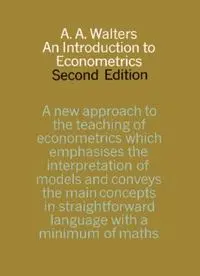
Table Of ContentAn Introduction to
Econometrics
By the same author
GROWTH WITHOUT DEVELOPMENT
with R. W. Clower, G. Dalton and M. Harwitz
(Northwestern University Press, 1967)
INTEGRATION IN FREIGHT TRANSPORT
(Institute of Economic Affairs, 1968)
An Introduction to
Econometrics
A. A. WALTERS
CASSEL PROFESSOR OF ECONOMICS
LONDON SCHOOL OF ECONOMICS
SECOND EDITION
Palgrave Macmillan
© A. A. Walters 1968, 1970
So ftc over reprint of the hardcover 2nd edition 1970
All rights reserved. No part of this publication
may be reproduced or transmitted, in any form
or by any means, without permission.
First edition 1968
Second edition 1970
Published by
MACMILLAN AND CO LTD
London and Basingstoke
Associated companies in New York Toronto
Dublin Melbourne Johannesburg and Madras
SBN (boards) 333 08848 4
(paper) 333 02567 9
ISBN 978-0-333-02567-3 ISBN 978-1-349-15277-3 (eBook)
DOI 10.1007/978-1-349-15277-3
The Papermac edition of this book is sold subject to the condition
that it shall not, by way of trade or otherwise, be lent, resold, hired
out, or otherwise circulated without the publisher's prior consent,
in any form of binding or cover other than that in which it is
published and without a similar condition including this condition
being imposed on the subsequent purchaser.
To Audrey
Contents
Preface to the Second Edition 8
Pr~face to the First Edition 9
Part I METHODOLOGY, PROBABILITY AND SAMPLING
I The Methodology ofE conometrics
2 Probability 22
3 Statistical Inference
Part II REGRESSION AND CORRELATION
4 Relations between Variables 8I
5 MultipleRegression I20
6 Sampling- Correlation and Regression I45
Part III ECONOMETRIC MODELS
7 Identification
8 Equation SysteiDS
Part IV APPLICATIONS
g Consumer Expenditure 207
I o Econometric Studies of Production 269
1 I Linear Programming - an Economic and Accounting
Interpretation 34I
Select Bibliograpl!J 370
Index 375
Preface to the Second Edition
In this edition I have taken the opportunity to correct a number of
errors that appeared in the first edition. I am particularly grateful
to S. Chakrabarti and another reader who went through the manu-
script in detail and caught many errors and slips. Many students have
pointed out certain weaknesses in the exposition and I have tried to put
these right. Some new explanations and material have been inserted,
particularly in statistical inference in Chapter 3, in the discussion of
multiple regression in Chapter 5, and in Chapters 7 (Identification)
and 8 (Equation Systems).
I am surprised at the publishers' forbearance in putting up with
such an awkward author.
20 March 1970 A. A. WALTERS
Preface to the First Edition
This book is meant to serve as an introduction to statistics and econo-
metrics for the student who wishes to acquire some working knowledge
of the subject as an aid in applied economics. It is not intended for the
student who wishes to become a mathematical statistician, or an
econometric theorist; nor will it serve the purpose of those who want an
introduction to 'economic statistics' (such as index number techniques
and ·practices, etc.). The text is primarily directed to those non-
specialists w4o will use simple econometric techniques in undertaking
econometrictesearch.
I hope that this book will convey the ideas and principles that lie
behind the quantitative analysis of economic phenomena. The close and
intimate connection that exists, or should exist, between the economic
theory on the one hand and the organisation and evaluation of statistical
material is one of the themes of this book. (The reader must note,
however, that there is no attempt made here to teach efficient com-
putational methods; the student will find many excellent texts that
describe modern computational methods.)
It is assumed that students reading this book will begin with some
knowledge of the concepts of mean and standard deviation, and with
some experience with representing frequency distributions. In the first
three parts of this text the student can manage without a knowledge of
calculus - and even in Part IV most of the chapters can be assimilated
without recourse to calculus. But the student should be adept at using
summation and subscript notations, and should be at least conversant
with the elements ofs chool algebra.
Tqis book grew out of a series of lectures I have given since the mid-
1950s at the University of Birmingham to second-year non-specialist
students. I suspect that the original idea of a course of this kind was due
largely to my colleagues W. M. Gorman and John Wise. Teaching at
Birmingham during the 1950s was a most enjoyable social process, but
at this stage I find it quite impossible to identify who was primarily
responsible for the pedagogic ideas that gradually emerged. As the
book took shape in typescript, several colleagues read and commented
A2 W.I.E.
10 PREFACE TO THE FIRST EDITION
on parts of the text, including T. W. Hutchinson, Zmira Prais, Gordon
Fisher, Noel Kavanagh and Esra Bennathan. My deepest debt is,
however, to Peter Fisk of the University of Edinburgh. He saved me
from making many errors in the partly finished text.
The manuscript notes have been used extensively on many short
courses for 'mature' students - notably at the Graduate Centre for
Management Studies in Birmingham and at the International Bank
for Reconstruction and Development in Washington, D.C. I am
particularly grateful to Mr H. G. van der Tak of the Bank for helping
me improve the text at several critical points. But of course I must claim
the responsibility for obscurities and errors that remain in the text.
It is inevitable that a book that attempts to present modem ideas
in statistics and econometrics should involve a large element of personal
interpretation. Although I have often indicated the state of debate on
several controversial topics, I have tried to avoid fence-sitting. One
must make up one's mind. (The critical reader will note that I have
often set up imaginary Aunt Sallys - such as the rather bigoted
'classical statistician' in Chapter 3· But these serve some pedagogic
purpose.)
The one abiding hope of any writer of textbooks is that he will not
give the student too much to unlearn at a later stage of his studies.
Stimulating a student's imagination inevitably runs the risk that he will
go off down the wrong trail. And too many warning words may result in
either paralysis of purpose or deafness. I do not know whether I have
struck the right balance in this book; the reader only can judge that.
Birmingham A. A. WALTERS
October 1967