
Download An introduction to computational learning theory PDF Free - Full Version
Download An introduction to computational learning theory by Michael J. Kearns, Umesh Virkumar Vazirani in PDF format completely FREE. No registration required, no payment needed. Get instant access to this valuable resource on PDFdrive.to!
About An introduction to computational learning theory
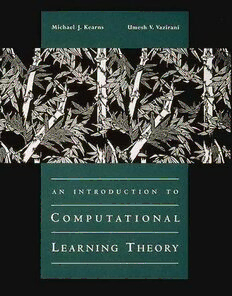
Emphasizing issues of computational efficiency, Michael Kearns and Umesh Vazirani introduce a number of central topics in computational learning theory for researchers and students in artificial intelligence, neural networks, theoretical computer science, and statistics.Computational learning theory is a new and rapidly expanding area of research that examines formal models of induction with the goals of discovering the common methods underlying efficient learning algorithms and identifying the computational impediments to learning.Each topic in the book has been chosen to elucidate a general principle, which is explored in a precise formal setting. Intuition has been emphasized in the presentation to make the material accessible to the nontheoretician while still providing precise arguments for the specialist. This balance is the result of new proofs of established theorems, and new presentations of the standard proofs.The topics covered include the motivation, definitions, and fundamental results, both positive and negative, for the widely studied L. G. Valiant model of Probably Approximately Correct Learning; Occam's Razor, which formalizes a relationship between learning and data compression; the Vapnik-Chervonenkis dimension; the equivalence of weak and strong learning; efficient learning in the presence of noise by the method of statistical queries; relationships between learning and cryptography, and the resulting computational limitations on efficient learning; reducibility between learning problems; and algorithms for learning finite automata from active experimentation.
Detailed Information
| Author: | Michael J. Kearns, Umesh Virkumar Vazirani |
|---|---|
| Publication Year: | 1994 |
| ISBN: | 9780262111935 |
| Language: | English |
| File Size: | 1.172 |
| Format: | |
| Price: | FREE |
Safe & Secure Download - No registration required
Why Choose PDFdrive for Your Free An introduction to computational learning theory Download?
- 100% Free: No hidden fees or subscriptions required for one book every day.
- No Registration: Immediate access is available without creating accounts for one book every day.
- Safe and Secure: Clean downloads without malware or viruses
- Multiple Formats: PDF, MOBI, Mpub,... optimized for all devices
- Educational Resource: Supporting knowledge sharing and learning
Frequently Asked Questions
Is it really free to download An introduction to computational learning theory PDF?
Yes, on https://PDFdrive.to you can download An introduction to computational learning theory by Michael J. Kearns, Umesh Virkumar Vazirani completely free. We don't require any payment, subscription, or registration to access this PDF file. For 3 books every day.
How can I read An introduction to computational learning theory on my mobile device?
After downloading An introduction to computational learning theory PDF, you can open it with any PDF reader app on your phone or tablet. We recommend using Adobe Acrobat Reader, Apple Books, or Google Play Books for the best reading experience.
Is this the full version of An introduction to computational learning theory?
Yes, this is the complete PDF version of An introduction to computational learning theory by Michael J. Kearns, Umesh Virkumar Vazirani. You will be able to read the entire content as in the printed version without missing any pages.
Is it legal to download An introduction to computational learning theory PDF for free?
https://PDFdrive.to provides links to free educational resources available online. We do not store any files on our servers. Please be aware of copyright laws in your country before downloading.
The materials shared are intended for research, educational, and personal use in accordance with fair use principles.

