Table Of ContentAAnn AAxx ttoo
UUnniitteedd SSttaatteess
DDeeppaarrttmmeenntt ooff
AAggrriiccuullttuurree
GGrriinndd
FFoorreesstt SSeerrvviiccee
TTeecchhnnoollooggyy &&
DDeevveellooppmmeenntt
PPrrooggrraamm AA PPrraaccttiiccaall
22330000 RReeccrreeaattiioonn
JJuullyy 11999999 AAxx MMaannuuaall
9923-2823P-MTDC
A
bout the Author
Bernie Weisgerber is a historic preservation specialist
for the USDA Forest Service. He has been in charge of
the Northern Region’s Historic Preservation Team,
headquartered in Missoula, MT, since 1991. He
worked for the National Park Service’s Historic
Preservation Training Center before coming to
work for the Forest Service.
Bernie and his crew of skilled craftsmen
restore historic Federal buildings, often at
remote sites, using traditional technologies
and materials. The team’s projects often provide training opportunities for
other Federal employees and the general public, as part of the Forest
Service’s Passport in Time and Heritage Expeditions programs. Weisgerber
has twice been a guest craftsman on National Public Broadcasting’s This
Old House television series.
My Favorite Ax
Passport in Time and Heritage
Expeditions are part of the USDA
Forest Service’s Heritage Program
that allows the public to explore the
past on their national forests.
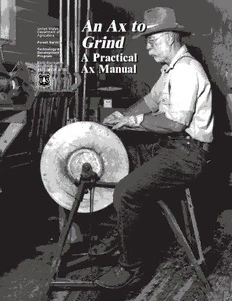
An Ax to
Grind
A Practical
Ax Manual
Bernie Weisgerber
Author
Brian Vachowski
Project Leader
USDA Forest Service
Technology and Development Program
Missoula, MT
8E82A42—Ax Manual/Video for Heritage
Site Restoration
July 1999
The Forest Service, United States Department of Agriculture, has developed this information for the guidance of its employees, its
contractors, and its cooperating Federal and State agencies, and is not responsible for the interpretation or use of this information by
anyone except its own employees. The use of trade, firm, or corporation names in this publication is for the information and convenience
of the reader, and does not constitute an endorsement by the Department of any product or service to the exclusion of others that may be
suitable. The United States Department of Agriculture (USDA) prohibits discrimination in all its programs and activities on the basis of
race, color, national origin, sex, religion, age, disability, political beliefs, sexual orientation, or marital or family status. (Not all prohibited
bases apply to all programs.) Persons with disabilities who require alternative means for communication of program information (Braille,
large print, audiotape, etc.) should contact USDA’s TARGET Center at (202) 720–2600 (voice and TDD). To file a complaint of discrimination,
write: USDA, Director, Office of Civil Rights, Room 326-W, Whitten Building, 1400 Independence Avenue SW, Washington, D.C. 20250-
9410, or call (202) 720–5964 (voice and TDD). USDA is an equal opportunity provider and employer.
T able of Contents
Acknowledgments___________________________________________________________________ v
Brief History of the Ax _____________________________________________________________ 1
Evolution of the Ax in America_____________________________________________________________ 1
Ax Types, Patterns, and Uses ______________________________________________________________ 4
American Felling Ax________________________________________________________________________ 7
Double-Bit Ax ______________________________________________________________________________ 8
Broad Ax___________________________________________________________________________________ 9
Other Axes and Hatchets__________________________________________________________________ 10
Adzes_____________________________________________________________________________________ 13
Decline of the American Ax _______________________________________________________________ 14
Getting the Hang of It_____________________________________________________________17
Basics of Handle Selection ________________________________________________________________ 19
Hanging Procedure _______________________________________________________________________ 21
Sharpening _______________________________________________________________________________ 27
Using Axes _________________________________________________________________________33
A Most Versatile Tool _____________________________________________________________________ 33
Using an Ax Safely ________________________________________________________________________ 33
Chopping Technique______________________________________________________________________ 35
Felling Trees______________________________________________________________________________ 38
Limbing __________________________________________________________________________________ 41
Cutting Pinned-Down Saplings____________________________________________________________ 42
Bucking __________________________________________________________________________________ 42
Splitting __________________________________________________________________________________ 44
Hewing ___________________________________________________________________________________ 45
Buying an Ax_______________________________________________________________________51
New and Used Axes _______________________________________________________________________ 51
Manufacturers____________________________________________________________________________ 51
Distributors ______________________________________________________________________________ 53
Organizations_____________________________________________________________________________ 55
Selected References _______________________________________________________________57
ii
A cknowledgments
F
rom the time this manuscript began as a series of audio tapes, An
Ax to Grind: A Practical Ax Manual has benefited from a lot of
assistance. I would like to thank the following Missoula Technology and
Development Center staff and other Forest Service employees for their
major contributions.
John Alley (Northern Region) Printing
Bob Beckley Photography
Michelle Beneitone Text processing
Ted J. Cote Design and layout
Gary Hoshide Review
Jim Kautz Photography
Bert Lindler Editing
David Michael (Apache-Sitgreaves National Forest) Review
Brian Vachowski Project Leader,
research, writing,
editing
Gloria Weisgerber (Northern Region) Review
Mark Wiggins Photography
Jerry Taylor Wolf Research, editing
I would also invite you to look at the companion video program, An Ax
to Grind. Parts 1 and 2 of the program are each 30 minutes long. Copies
are available from MTDC at the address on the inside of the back cover.
Many of the photographs are of axes from Bernie Weisgerber’s personal
collection. Many of the illustrations were drawn by Frederic H. Kock for
Bernard S. Mason’s book, Woodsmanship (1954). The illustrations are
used here by permission of Mrs. Frederic H. Kock.
iii
iv
B rief History of the Ax
II ’ve always had a passion for axes. I received
my first ax—a toy—when I was 8 years old,
and my first real ax not long afterwards.
Since that time, for over 45 years, I’ve used and
collected all kinds of axes and adzes in my
professional work restoring historic buildings
Figure 1
and structures.
48%
We cannot explore everything there is to know
about axes in this publication. What I would
3 3/8 x 4 7/16
like to share with you is a brief background on
the development of axes, the hanging and 7 x 9 1/4
sharpening of axes, how to use an ax, and
detailed information on certain ax patterns. I’ve
Print to Outside Edge of Borders
tried to place the discussion within the context
PPPPPRRRRRIIIIINNNNNTTTTT Borders
of working with axes today and from a
historical perspective of their use within the
USDA Forest Service.
In An Ax to Grind: A Practical Ax Manual, you’ll
find:
(cid:127) A brief look at the history of the ax,
especially its evolution in America
(cid:127) Types and patterns of axes and adzes,
showcasing some examples from my
personal collection and some from old
catalogs
Figure 1—The video program, An Ax to Grind (99-01-MTDC),
is a companion to this manual. The video is available from
(cid:127) How to hang and sharpen an ax, two
Missoula Technology and Development Center.
essential skills for anyone using an ax
(cid:127) Various examples of using axes,
incorporating historical material
(cid:127) Where to buy a good ax Evolution of
(cid:127) Some other good references about axes that the Ax in America
you may find useful.
This manual is intended to be a companion to
...having an ax to grind
my video program, An Ax to Grind (99-01-
Getting even for a perceived
MTDC). The video (Figure 1) was produced by wrongdoing.
the Missoula Technology and Development
Center (MTDC). Copies are available from the ...barking your knuckles
center. I hope you’ll take a look at it. Scraping your knuckles on the side of
a log while hewing it.
...can’t get the hang of it
Can’t get it right, originally referring
to the way an ax handle was mounted
to the ax head.
iv 1
Brief History of the Ax
Although we still make references to axes in
Parts of the Axe
our daily speech, most Americans have a
limited knowledge about them (Figure 2),
including how to use and properly maintain
them. But the ax, in one form or another, has
been around for over 10,000 years—even longer
if you consider some of the crude stone tools
used as axes by early man.
Figure 2
68%
2 7/32 x 3 3/16
5 x 4 3/4
Figure 3—Parts of the ax. (Courtesy of Gränsfors Bruks AB,
Print to Outside Edge of Borders
Sweden.)
PPPPPRRRRRIIIIINNNNNTTTTT Borders
ries. As a matter of fact, the object was
really a European-American axe. Because
iron, unlike wood, is similar regardless of
Figure 2—Barking your knuckles comes with the territory the place it was made, the essential sub-
when you choose to hew logs with a broad ax. stance of an axe does not help to identify
its origin. Short of some identifiable
maker’s mark, the manufacturers of most of
While the ax has gone through transformations our early axes must remain anonymous.
from stone, copper, bronze, and iron to steel,
its overall shape and function have remained It seems certain that most of the first axes
consistent (Figure 3). The ax was the first real made in North America were made and used
woodworking tool, one of only a few available on the Atlantic seaboard, a few exceptions
for a long period. For centuries the ax was one occurring when trading companies brought
of mankind’s most useful tools. in blacksmiths to their centers of exchange
to repair and resharpen axes. As settlers
The early iron and steel axes used in America moved westward and southward, their
had European roots. Henry J. Kauffman, in his needs were supplied by smiths who went
introduction to American Axes (1994), wrote: with them and were responsive to indi-
vidual needs. This procedure was the begin-
Part of the problem of focusing attention on ning of very high specialization in the
the American axe arises from the fact that forms of axes, a differentiation which was
the earliest ones used here were made in picked up by the big manufacturers in the
Europe, and certainly the first ones made nineteenth century. The axes were mostly of
here were European in character. Thus, in the felling variety, but there were other
the earliest colonial times a dividing line purposes for which an axe was needed.
could not be drawn between the two catego-
2 1
Brief History of the Ax
The pace of specialization increased; as Figure 6—
evidence of this trend, one manufacturer An 18th-
century Figure 6
informed the writer that at one time the
mortising
company manufactured about three hun- 32%
ax or
dred different types. The president of the twibil
Mann Edge Tool Company, in Lewistown, gives an 2 3/4 x 2 1/2
Pennsylvania, reported that in 1969 they idea of the
8 5/8 x 7 7/8
special-
were producing seventy different patterns;
ization
however, the bulk of their production in-
apparent
Print to Outside Edge of
volved only about twenty. even in
early axes. Borders
The ax became quite specialized in Europe Length, PPPPPRRRRRIIIIINNNNNTTTTT Borders
4 feet.
during the Middle Ages and afterward. When
European colonists dispersed throughout the
New World, they brought their tools and their
knowledge with them. It is not surprising to see Figure 7
the appearance of trade axes (Figures 4 and 5) 28% Figure 7—An
and Germanic goose-wing hewing axes. We also 18th-century
see examples of older European-style shingling
2 1/4 x 2 1/4 hatchet is
specialized axes (Figures 6, 7, and 8) in
another
8 x 8
America.
specialized ax.
Ax head is 51/
2
Figure 4— A 17th- Print to Outside Edge inches long by
century trade ax, 4 inches wide.
of Borders
typically made in
Figure 4 northern Spain PPPPPRRRRRIIIIINNNNNTTTTT Borders
32% and traded by the
French with
American Indians.
2 x 2 5/8
Figure 8
6 1/4 x 8 3/16
36%
Print to Outside 3 3/8x 1 3/4
Edge of Borders 9 7/16 x 4 7/8
PPPPPRRRRRIIIIINNNNNTTTTT Borders
Print to Outside Edge of Borders
PPPPPRRRRRIIIIINNNNNTTTTT Borders
Figure 8—An 18th-century splitting ax, with straight handle
Figure 5(a) typical of early axes.
35%
Americans modified European axes for two
3 3/8 x 1 3/4
principal reasons (Kauffman 1994). First, the
9 5/8 x 5
European axes were not as well suited to the
virgin stands of huge trees found in America as
Print to Outside Edge of Borders
they were for the smaller timber stands of
PPPPPRRRRRIIIIINNNNNTTTTT Borders
Europe. The European axes were good tools for
hewing, but less adequate for felling. The
Figure 5—An early 20th-century Collins ax manufactured for second reason, Kauffman suggests, is that many
the South American market. Note the similarity in design of of the Europeans who left their homelands for
the two axes.
an uncertain future in America were prepared
3
iv
Brief History of the Ax
to adapt to survive. Their pioneering spirit bred Ax Types, Patterns, and Uses
ingenuity.
During the 19th century, America’s agrarian
The need for a better felling ax, the need to society was not as mobile as our society is
process huge amounts of timber during today. People lived their lives in relatively small
America’s settlement, and American ingenuity geographic areas. This is one explanation of the
made development of the American felling ax hundreds of different ax-head patterns that
inevitable. developed over the last 150 years.
The individual skills of local blacksmiths and
their view of what an ax needed were important
We no sooner got started on this factors in the development of ax-head patterns.
book than confusion over Ax patterns became a matter of regional
terminology set in. The simplest term preference.
to decide was “ax” instead of “axe.”
Although most historical sources go Around the turn of the 19th century, more than
with axe, we chose ax because that 300 different ax-head patterns were being
spelling is preferred in the manufactured in the United States. Many were
Government’s style manual. More nearly identical. To simplify identification and
problematic was the correct term for eliminate unnecessary or duplicate patterns,
a single-bit ax. We found single-bit the Ax Manufacturers’ Association agreed to set
axes described as a single-bit ax, a standard, which resulted in a standard chart
felling ax, American ax, and pole ax. of ax patterns (Figure 9).
Although woods workers commonly
refer to a single-bit ax as a pole ax, Certain ax patterns become popular within a
dictionaries refer to the pole ax as a given geographic area, such as the Jersey (my
medieval battle ax, an ax that’s quite a particular favorite), the Michigan, the Dayton,
bit different than the axes we are and the Kentucky (Figure 10). At times, ax head
writing about. Pole ax probably refers patterns included a name that related to their
to the poll (steel counterweight) on use. For example, the rafting ax pattern
the back of the head of a modern originated in the day when logs were rafted
single-bit ax. The trade axes that down rivers.
preceded the single-bit ax did not
have a poll. The American ax and Ax-head patterns were also adapted to the
felling ax have slightly different timber that was available in the local area. The
meanings to me, so we compromised double-bit ax was originally developed in
on single-bit ax throughout most of Pennsylvania (Figure 11). But the double-bit
the text. Whether or not single-bit axes with a long, narrow, heavy ax head and a
axes should be hyphenated is yet long handle, were developed for cutting large
another story. We chose to rely on a trees in the Pacific Northwest. Some of the
modern dictionary for the spelling. patterns from this area were the Puget Sound,
the Young’s felling pattern, the Redwood
pattern, and the Humboldt pattern.
4
1