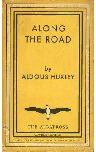
Table Of ContentALONG
THE ROAD
by
ALDOUS HUXLEY
By ALDOUS HUXLEY
J.Vo'vcls
Cr!O:\!E "i'EllOW
A:-TIC HAY
THOSE BAIUtES' LEAVES
*
POf~T COL"~'TER POIST
BR.A\.E !-i'EW WORLD
EYELESS IS GAZA
AFTER MA:-iY A SUM~!ER
Tl~IE ~l<'ST HAVE A STO?
S/:ort Stories
UMBO*
~IORTAL COILS
LITTLE MEXlCA.'i
TWO OR TiiREE GR.'i.CES
BRIEF CA...,DLES
Biography
,
GREY EMI1""ENCE
Essays and Belles Lettru
ON THE MARGIN*
ALO:SG TiiE ROAD
PROPER STt."DIES
DO WHAT YOU WILL
MUSIC AT NIGHT &
\"ULGARITY IN UTERATURE
TEXTS A:-iD PRETEXTS (Anthology)
THE OLIVE TREE*
E:-.os A...,D MEANS (An Enquiry
into the Nature of Ideals) *
THE ART OF SEEING
TiiE PERE!'.'NIAL PHILOSOPHY
SCIENCE, LIBERTY A."lo"D PEACE
Travel
JESTING PILATE (Illustrated) *
BEYO:-1D THE MEXIQt/E BAY (Illustrated)
Poetry and Drama
~"ERSES AND A COMEDY*
(including early poems, Leda, The Cicadas
and The World of Light, a Comedy)
* Issued in this Collected Edition
2
ALDOUS HUXLEY
.A.long the F\.oaci
<....__.J
Notes and Essays of
a Tourist
1948
Chatto & Windus
LONDON
PUBLISHED BY
Chatto & Windus
L0:-00::-l.
*
Oxford University Press
TORO:-.TO
A;:plications regarding translation rights in any
v:ork by Aldous Huxley should he addressed
to Chatto & Windus, 40 William IV Street,
London, W.C. 2
----~=-----
,/4 ~e,?7
----~-------··
No F S"
FIRST PL'BLISHED 1925
FIRST ISSUED IN THIS COLLECTED
EDITION 1948
PRINTED IN GREAT BRITAIN
ALL RIGHTS RESERVED
CONTENTS
un
PA RT I
TRAVEL IN GENERAL
Why not Stay at Home ? p. 3
Wander-'Birds 15
'Ihe Traveller's-Eye //iew 25
Guide-'Books 37
Spectacles 49
The Country 54
'Books for the Journey 64
PAR.T 11
PLACES
Montesenario 75
Patinir's River 81
Portoferraio 84
'Ihe Palio at,$iSQ,a 88
Views of Holland 104
Sabhioneta II6
PART III
WORK'S OF ART
CSreughel 133
Rimini and Alberti 153
Conxolus 166
The 'Best Picture 177
The Pierian Spring 190
vu
ALOl\'G THE RO:\D
PART IV
BY THE WAY
A Xight at Pietramala
JVr;rk and Leisure
Popular Jl1usic
'The .J1ystery of the 'Theatre
viii
Part I
TRAVEL IN GENERAL
WHY NOT STAY AT HOME?
SoME people travel on busin_ess, some in search
of health. But it is neither the sickly nor the
"
men of affairs who fill the Grand Hotels. and
the pockets of their proprietors. It is those
who travel ' for pleasure,' as the phrase goes.
What Epicurus, who never travelled except
when he was banished, sought in his own gar
den, our tourists seek abroad. And do they find
their happiness? Those who frequent the places
where they resort must often find this question,
with. a tentative answer in the negative, fairly
forced upon them. For tourists are, in the main,
a very gloomy-looking tribe. I have seen much
brighter faces at a funeral than in the Piazza of
St. Mark's. Only when they ~n band together
and pretend, for a brief, precarious hour, that
they are at home, do the majority of tourists look
really happy. One wonders why they come
abroad.
The fact is that very few travellers really like
travelling. If they go to the trouble and expense
of travelling, it is not so much from curiosity,
for fun, or because they like ~o see things beauti
ful and strange, as out of a kind of snobbery.
People travel for the same reason as they coll~
3
ALONG THE ROAD
works of art: because the best people do it. To
have been to certain spots on the earth's surface
is socially correct; and having been there, one
is superior to those who have not. Moreover,
travelling gives one something to talk about when
one gets home. The subjects of conversation are
not so numerous that one can neglect an oppor
tunity of adding to one's store.
To justify this snobbery, a series of myths has
gradually been elaborated. The places which
it is socially smart to have visited are aureoled
with glamour, till they are made to appear, for
those who have not been there, like so many
fabled Babylons or Bagdads. Those who have
travelled have a personal interest in cultivating
and disseminating these fables. For if Paris and
Monte Carlo are really so marvellous as it is
generally supposed, by the inhabitants of Bradford
or Milwaukee, ofTomsk and Bergen, that they
are--why, then, the merit of the travellers who
have actually visited these places is the greii:ter,
and their superiority over the stay-at-homes the
more enormous. It is for this reason (and be
cause they pay the hotel proprietors and ·the
steamship companies) that the fables are studi
ously kept alive.
Few things are more pathetic than the ·spec-
4
WHY NOT STAY AT HOME?
tacle of inexperienced travellers, brought up on
these myths, desperately doing their best to make
external reality square with fable. It is for the
sake of the myths and, less consciously, in the
name of snobbery that they left their homes ; to
admit disappointment in the reality would be to
admit thei'i· own foolishness in having believed
the fables and would detract from their merit
in having undertaken the pilgrimage. Out of
the hundreds of thousands of Anglo-Saxons who
frequent the night-clubs and dancing-saloons of
Paris, there are a good many, no doubt, who
genuinely like that sort of thing. But there are
also very many who do not. In their hearts,
secretly, they are bored and a little iiisgusted.
But they have been brought up to beHeve in a
fabulous 'Gay Paree,' where everything is de
liriously exciting and where alone it is possible to
see what is technically known as Life. Con
scientiously, therefore, they strive, when they
come to Paris, to be gay. Night after night
the dance halls and the bordellos are thronged
by serious young compatriots of Emerson and
Matthew Arnold, earnestly engaged in trying to
see life, neither very steadily nor whole, through
the ever-thickening mists of Heidsieck and
Roederer.
5