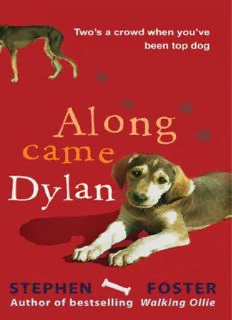
Table Of ContentAlong Came Dylan
STEPHEN FOSTER
For T.A., once more, with love
Contents
Title Page
Dedication
THE SILVER GRIZZLE LEAVES HOME
BORN TO RUN
TEETHING TROUBLES
WALKIES
TEETHING TROUBLES II: THE EVE OF DESTRUCTION
HAPPY DAYS
THE DAYS GET SHORTER FOR STAN, MURPHY, TOM, TESS, HOLLY,
BONNIE, JASPER, CASPER AND ALL THE REST …
PHILIP AND DIDDLEY
SQUIRRELS, FOXES, NATURE, AND OTHER HAZARDS
SAND HOUNDS
NO-GO ZONES
PHILIP, DENMAN, AND THE COPS
THE GUARDIAN ANGEL
THE INCIDENT OF THE KITE IN THE FIELD
DYLAN AND THE FISHMONGERS
THE EPIC
THE MINI EPIC: LUCK IN SPADES
THE AGE OF ANXIETY
THE INCIDENT OF THE PIG’S EAR
THE AGE OF ANXIETY – CONTINUED
OH DEAR OLLIE, WHAT HAVE YOU BEEN UP TO NOW?
IDENTITY CRISIS
EXTRA-CURRICULAR ACTIVITY
WHO’S THAT LADY?
OLD STOKIE COMES TO TOWN
THE FIGHT
DENMAN GOES FOR GOLD
SICKNOTES
VOGUE, STRIKE A POSE
A Note on the Cyclists one Encounters on
Two Exceptional Honourable Mentions
End Note
About the Author
Also by the author:
Copyright
THE SILVER GRIZZLE LEAVES HOME
‘D’you know what, I think he’s thrown a litter of smooths!’ says the
breeder, Karen, as she rearranges half a dozen two-week-old pups,
manoeuvering each of them into the optimum feeding position. Every time she
moves one she looks closely at its minute ears to see if there’s any sign of the
feathering that distinguishes the ears of their mother, Tareefa. It seems there is
not. Tareefa is behaving impeccably, lying on her side, quietly sanguine, while
six mouths work away ferociously at her nipples. I’ve never seen pups this
young at their feed before. They are no bigger than gerbils, their eyes are closed,
the only way they express personality is by being the hungriest. This is a keenly
fought event, in which the competition is intense, and a winner is difficult to
find, though the shy one is easy to spot.
By ‘he’ Karen means the proud father, Farid. It was the sight of Farid with his
beautiful grey coat and his unfeathered, smooth ears, and with his relaxed and
thoughtful attitude to go with the good looks, that inspired me to pursue an idea.
The idea was one I’d been worrying at for a while. The idea was to get a second
dog.
I’d had it in my mind for some time, that since Ollie (the subject of Walking
Ollie) had become more or less normal, then what he really needed – to
encourage and promote the normality – was a companion. Because I could
already see him backsliding. Where, pre-normality, he used to be vaguely
psychotic, post-normality he was beginning to show signs of going the other
way, of becoming moody and withdrawn. I was not principally looking for a
new dog for us, I was looking for a perk-me-up friend and companion for him.
It is not as straightforward as all that, though.
When Trezza, my partner, and I discovered Ollie in a rescue centre five years
ago, I knew nothing about dogs. While I am still no expert, I am more
experienced than I was then. The long and short of Walking Ollie is that Ollie
was a very awkward animal, one that I often wished could be sent back whence
he came. However (the big however), I could never find it in me to load him into
the car, turn the key, and drive him off in order to return him as if he were a
faulty television. Dogs are not like that. Dogs get under your skin. After you
have cared for one for a while (and you do have to care for them, they are not
into looking after themselves) you find that, quite unconsciously, you have
become absorbed into a cult: the Cult of the Dog Owner. In this way, it has to be
conceded, you, too, have become slightly cultish – which is surely another word
for mad – just like all the rest of them.
This is how, and why, you begin to think along these lines, the lines along
which I had been thinking. Even without Ollie’s incipient personality change
into ‘the loner’, it had been crossing my mind that since he no longer runs away
when he catches sight of me, since he sometimes returns to the call of his name,
since he is less fearful of plastic bags and flies than he used to be, then what
must happen next is a matter of inevitability.
Each time the thought appeared, I pushed it away because it was a thought
that would, in all probability, make life much more unnecessarily difficult than
needs be. Keeping two dogs will not be any less trouble than keeping one, will
it? And it’s unlikely that it will turn out to be just double the trouble, either. No,
without pausing to recollect those incidents you have witnessed, or been part of,
or have started – incidents involving a pair of dogs simultaneously going missing
in opposite directions – without bothering to recall moments of that sort, it’s still
easy enough to guess that two dogs will be trouble multiplied and squared.
But (the big but, bigger than the big however).
But: I looked at Ollie lying in his basket, bored and fed up, fed up and bored,
filled with ennui and actually sighing. I looked at him day after day, and the
more I looked at him, the more I convinced myself that the cause of his apathy
was the lack of a playmate. He has me, he has Trezza, he has Jack, my teenage
son, who sometimes comes round, and he has Jack’s mates who also sometimes
come round. He is not particularly interested in any of this group of individuals.
At least he sees the great outdoors twice a day, in fields and on beaches and
round lakes. Here he has a number of friends (and enemies) to meet and greet (or
not). Here he can normally be relied upon to be fairly lively. It is only all the
many hours that he spends indoors, like a bored teenager who has nothing to do,
that seem difficult for him. I can keep putting off the search for a companion for
him for as long as this remains the case. The rational part of me is capable of
thinking of it in these terms: ‘Tough shit, Ollie, here you are in the warm and dry
being loved and fed and everything, what a hardship.’
It’s when he starts to become surly, withdrawn and lethargic in the great
outdoors that I really start to believe that something needs to be done.
***
I surfed the internet, looking at the rescue sites. I saw numerous deserving cases,
some of which I considered at length, repeatedly revisiting the relevant web
page, downloading the picture to my desktop, emailing it on to Trezza’s
computer downstairs, but in truth I was never going to acquire a companion for
Ollie from these sources because here were animals who could turn out to be
even more trouble than he was. And this matter crossed my mind too: Ollie
might not appreciate a rival in the special needs stakes. What I was looking for
was a pup, someone that Ollie could train into his ways. I did the mental
checklist. Which breeds does Ollie most like; who does he play with? There is
no definitive answer to this. He is selective; he has one Doberman he loves, a
couple of terriers that he is always delighted to see, a pair of 57 varieties that he
rates highly, and a continental sparring partner, an Italian Spinone (an engaging
animal, but one that is the embodiment of the Who album title Meaty Beaty Big
and Bouncy). So: not an Italian Spinone, at any event.
Ollie is a lurcher, a crossbreed, half Saluki, half greyhound. Such greyhounds
as we regularly encounter are, in the main, quiet, retired animals who do very
little. Ollie will occasionally have a run with one of these, but only occasionally,
because nine times out of ten the greyhounds can’t be bothered. It’s probable, in
fact, that it’s his greyhound side that is responsible for the incipient lethargy. I
looked around my neighbourhood. In a (single sample) proof of this theory I
noted that the one greyhound we saw every day was an idler who slouched along
behind his Master, a curmudgeon who walks with a stoop and who is never
without a roll up that he spends most of his life relighting. To the best of my
knowledge we had never, on any of our walks, met the other side of Ollie, a pure
Saluki. Salukis are of Bedouin origin, they are somewhat greyhound-like to look
at, but they differ considerably in temperament: people tell me that Bedouin
tribesmen have two words for canines, one is dog, the other is Saluki. So far as
Bedouin tribesmen are concerned, the Saluki is in some way distinct from the
rest of its kind.
One way in which Salukis are distinct is that they are high maintenance, in
the way that supermodels are high maintenance: the price to be paid for their
aesthetic beauty comes in ludicrous demands and self-centredness. But though
everything must be five-star in their world, they are not remotely fastidious: like
Kate Moss, they will, as we shall discover, put more or less anything into their
bodies, and like Naomi Campbell, they are martyrs to their unpredictable
temperaments.
Though we have met no pure-bred Salukis, Ollie has frequently bumped into
his fellow travellers from the world of Saluki-crosses. These almost always
originate from a rescue centre, like Ollie himself. Without this source of supply,
and short of breeding your own, I don’t know where you’d find one. Gypsies and
travellers use and abuse them for poaching: that is how so many of them end up
in rescue. It was this ‘poacher-abandoned’ category that was responsible for
throwing up so many of the deserving cases that I had been looking at online.
Ollie’s view of his fellow Saluki-crosses is that he likes them more than most.
They have a way of playing that is all their own, one that begins with bouncing
on the hind legs combined with a zigzag scissor-action and much standing-off
and shadow-boxing before anything actually happens. It’s a kind of canine t’ai
chi on fast forward.
So. I put two and two together, come up with five, and switch my search to
Saluki websites.
It is here that I see the picture of Farid. I send a link to Trezza’s computer.
The picture of Farid is of a pose whereby his legs are splayed forward and his
backside is stuck up in the air, a position that Ollie goes in for in moments of joy
or happiness, or sometimes for no reason at all. Trezza is up to my office like a
flash. My word, she says, he looks a nice boy, doesn’t he.
‘Are there any plans for this Farid to become a dad?’ I ask the website via
email.
A day or two later the reply bounces back. ‘There may be.’
They’re a cagey lot, breeders, particularly of the more marginal dog types.
‘Who’s asking?’ That’s the first thing they want to know.‘Are you thinking of
getting into the breed and winning certificates in shows, certificates that belong
to me? Or, worse, are you an agent for a rival, some scoundrel who is already in
the breed and who is trying to pull a fast one.’
That’s what they’re thinking. Or at least, that’s what I think they’re thinking.
***
We drive a hundred miles to where Farid lives, to meet him and Karen. I go
along wearing my most innocent demeanour, I am just a regular punter looking
for a pup, that’s all. We are greeted warmly, with a complete absence of any of
the suspicions that I have invented. There are five or six Salukis at the house,
and really, it is they who interview us. ‘Are you fit people to own a dog from our
noble lineage?’ This is what their expressions say. If they were feline, rather
than canine, they would be the Aristocats. At some point during this interview,
Farid climbs up and sits next to Trezza on a sofa. While we are drinking tea and
being given smoked salmon sandwiches and talking with Karen, Farid secretly
removes the scrunchy from Trezza’s hair using the ‘stealthy teeth’ method. We
are won over. A couple of weeks later we return, this time with Ollie
accompanying us. The plan is for Farid and Ollie to go out for a walk. I feel I
have to apply this test, because, though he generally likes other running dogs,
there are exceptions, and I want to make sure that Farid is not one of these. He is
not. In fact, Ollie bosses him about a bit, which is perfect; I want him to be
slightly dominant: I can’t have a kid coming into the house and usurping him
because that would have catastrophic consequences for the delicate Ollie psyche.
Now, I feel that I have carried out as many safeguards as I can think of without
applying a proper measure of common sense and abandoning the idea altogether.
‘Yes,’ I say on the phone a few days later. ‘Yes: we would like a pup from the
noble lineage of Farid.’
So here we are… leaning over the whelping box, looking at the litter of six,
wondering which one to choose. Half the decision is made for us: three are
bitches, and they are already spoken for. Of the dogs, two are a more traditional
black with cream highlights (similar to Doberman markings), the remaining one
is a grey like Farid.
He is a ‘silver grizzle’, says Karen, giving me the technical term.
He is a greedy little silver grizzle too; he is going for the Suckler of the Week
Award, and he is definitely going to win it. He is also the one we fancy. Can we
have him?
As it turns out, we can. The bitches are all black and cream too. Our boy is
the exceptional one, colour wise. I feel quite elated. Trust me, breeders have it
all planned out in advance, and I can only assume that it is because we were on
the scene so early – before Farid had even got intimate with Tareefa – that we
have been honoured by being allowed to purchase, for a healthy fee, the dog that
we actually want.
We make a return to see ‘Ghali’ (his ‘kennel name’) who we have by now
decided will be known as Dylan (I cannot stand in the park shouting,‘Ghali!
Description:Ollie was just about cured of his basketcase habits;: the neurotic lurcher at last appeared to have his paws planted firmly on the ground (well, almost). But did Stephen Foster take a well-earned rest? Not. He decided one thing was missing from Ollie's life, someone who could really understand him,