Table Of ContentTHE SACRED
MUSHROOM
AND THE
CROSS
A study of the nature and origins
of Christianity within the fertility cults of the ancient Near East by
John M. Allegro
DOUBLEDAY & COMPANY, INC.
GARDEN CITY, NEW YORK
Piracy notice:
In order to keep this information available to the public, this
book has been pirated!
A message to those who’ve taken this book out of print. This book will forever circulate. You
will never be able to remove it from the public light, as you, the Vatican and Anheuser Busch
attempted to do.
In such a case as 2000 years of intellectual hijacking, this book will now remain forever free
online.
Though Allegro’s theories seemed extreme at the time, philology today knows he was right. See a
publication by Piotr Michalowski in “Cambridge Encyclopedia of the World's Ancient
Languages”, edited by Roger D. Woodard.
To the reader, enjoy a once banned book.
To the suppressors, Fuck you!
ORIGINAL CHARACTERS OF SUMERIAN CUNEIFORM AND
OTHER HIEROGLIPHIC CHARACTERS WERE LOST BY THE
CHARACTER RECOGNITION SOFTWARE USED IN THE PIRACY
OF THIS BOOK. PLEASE SEEK AN ORIGINAL COPY OF “THE
SACRED MUSHROOM AND THE CROSS” TO REFERENCE
MISSING LETTERS AND OTHER POSIBLE ERRORS MADE BY
THE RECOGNITION SOFTWARE.
150 pages of reference notes at the back of the book have been
omitted. Footnote numbers have (for the most part) been left
intact. Some Zeros (0) and ones (1) were not recognized.
Primary errors made by Allegro are HIGHLIGHTED IN RED
Allegro did NOT understand the growth cycle, effects and "bitterness" of the Amanita
muscaria. Allegro overlooked some references to both A. pantherina and P. cubensis, and
wrongfully classified Rue as an "abortifacient", not recognizing Acacia and Rue as an
Ayahuasca analogue. Allegro also wrongfully assumed that the mushrooms, and not
religion and government themselves, were the cause of the shaman to protest against their
suppression by the churches and governments. With that said, Allegro was a pioneer in
the field of ethnomycology, and founded many of the ideas many researchers use today
(though most deny it).
Enjoy your read!
Author’s Note
This book is the first published statement of the fruits of some years’ work of a largely
philological nature. It presents a new appreciation of the relationship of the languages of the
ancient world and the implication of this advance for our understanding of the Bible and of the
origins of Christianity. It will be appreciated that such a statement has to be furnished with the
technical data, even though much of it must be outside the scope of the general reader, for whom
the book is primarily intended. In order to leave the text as unencumbered as possible, these notes
have been gathered in a body at the end of the book, and the numbered references within the text
may be safely ignored by the non-specialist.
Acknowledgements
Quotations from the Revised Standard Version of the Bible, copyrighted 1952 and 1956, are used
by permission.
Quotations from the Homeric Hymns, Pliny’s Natural History, and
Josephus’ Jewish Wars and Antiquities are used by permission of the
Loeb Classical Library.
The frontispiece photograph is used by permission of Rex Lowden.
The photograph facing page 74 is used by permission of Photographe
Thuillier.
Contents
Introduction page xi
I In the Beginning God Created... i
II Sumer and the Beginnings of History 8
III The Names of the Gods 19
IV Plants and Drugs 29
V Plant Names and the Mysteries of the Fungus 36
VI The Key of the Kingdom 44
VII The Man-child Born of a Virgin 54
VIII Woman’s part in the Creative Process 63
IX The Sacred Prostitute 76
X Religious Lamentation 83
XI The Mushroom “Egg” and Birds of Mythology 91
XII The Heavenly Twins 97
XIII Star of the Morning 109
XIV Colour and Consistency 118
XV Mushroom Cosmography 133
XVI David, Egypt, and the Census 141
XVII Death and Resurrection 151
XVIII The Garden of Adonis, Eden and Delight;
Zealots and Mus1im 177
XIX The Bible as a Book of Morals 191
Notes 207
Indices 308
Illustrations
Colour Plates
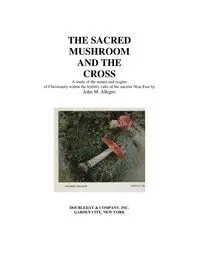
Amanita muscaria frontispiece
A Christian fresco showing the Amanita muscaria as Facing page
the tree of good and evil in the Garden of Eden 74
Figures page
1 The Near East
2 Sumer and Accad 10
3 Section through the calyx and fruit of Henbane 58
4 Diagrammatic section of (i) a volva before “birth” 92
(ii) a mature mushroom 92
5 Zion, and the valleys of Kidron and Hinnom 136
6 Jerusalem to the Dead Sea 138
Introduction
No one religion in the ancient Near East can be studied in isolation. All stem from man’s first
questioning about the origin of life and how to ensure his own survival. He has always been
acutely conscious of his insufficiency. However much he progressed technically, making clothes,
shelter, conserving food and water supplies, and so on, the forces of nature were always greater
than he. The winds would blow away his shelter, the sun parch his crops, wild beasts prey on his
animals: he was always on the defensive in a losing battle. Out of this sense of dependency and
frustration, religion was born.
Somehow man had to establish communications with the source of the world’s fertility, and
thereafter maintain a right relationship with it. Over the course of time he built up a body of
experiential knowledge of rituals that he or his representatives could perform, or words to recite,
which were reckoned to have the greatest influence on this fertility deity. At first they were
largely imitative. If rain in the desert lands was the source of life, then the moisture from heaven
must be only a more abundant kind of spermatozoa. If the male organ ejaculated this precious
fluid and made life in the woman, then above the skies the source of nature’s semen must be a
mighty penis, as the earth which bore its offspring was the womb. It followed therefore that to
induce the heavenly phallus to complete its orgasm, man must stimulate it by sexual means, by
singing, dancing, orgiastic displays and, above all, by the performance of the copulatory act itself:
However &r man progressed in his control of the world about him there remained a large gap
between what he wanted at any one time and what he could achieve on his own account. There
was always some unscalable mountain, some branch of knowledge which remained unpenetrable,
some disease with no known cure. It seemed to him that if he had managed painstakingly to grope
his way to a knowledge and dexterity so far above the animals, then in some mysterious way his
INTRODUCTION
thinkers and artisans must have been tapping a source of wisdom no less real than the rain that
fructified the ground. The heavenly penis, then, was not only the source of life-giving semen, it
was the origin of knowledge. The seed of God was the Word of God.
The dream of man is to become God. Then he would be omnipotent; no longer fearful of the
snows in winter or the sun in summer, or the drought that killed his cattle and made his children’s
bellies swell grotesquely. The penis in the skies would rise and spurt its vital juice when man
commanded, and the earth below would open its vulva and gestate its young as man required.
Above all, man would learn the secrets of the universe not piecemeal, painfully by trial and fatal
error, but by a sudden, wonderful illumination from within.
But God is jealous of his power and his knowledge. He brooks no rivals in heavenly places. If, in
his mercy, he will allow just a very few of his chosen mortals to share his divinity, it is but for a
fleeting moment. Under very special circumstances he will permit men to rise to the throne of
heaven and glimpse the beauty and the glory of omniscience and omnipotence. For those who are
so privileged there has seemed no greater or more worthwhile experience. The colours are
brighter, the sounds more penetrating, every sensation is magnified, every natural force
exaggerated.
For such a glimpse of heaven men have died. In the pursuit of this goal great religions have been
born, shone as a beacon to men struggling still in their unequal battle with nature, and then too
have died, stifled by their own attempts to perpetuate, codify, and evangelize the mystic vision.
Our present concern is to show that Judaism and Christianity are such cultic expressions of this
endless pursuit by man to discover instant power and knowledge. Granted the first proposition
that the vital forces of nature are controlled by an extra—terrestrial intelligence, these religions
are logical developments from the older, cruder fertility cults. With the advance of technical
proficiency the aims of religious ritual became less to influence the weather and the crops than to
attain wisdom and the knowledge of the future. The Word that seeped through the labia of the
earth’s womb became to the mystic of less importance than the Logos which he believed his
religion enabled him to apprehend and enthuse him with divine omniscience. But the source was
the same vital power of the universe and the cultic practice differed little.
INTRODUCTION
To raise the crops the farmer copulated with his wife in the fields. To seek the drug that would
send his soul winging to the seventh heaven and back, the initiates into the religious mysteries
had their priestesses seduce the god and draw him into their grasp as a woman fascinates her
partner’s penis to erection.
For the way to God and the fleeting view of heaven was through plants more plentifully endued
with the sperm of God than any other. These were the drug-herbs, the science of whose
cultivation and use had been accumulated over centuries of observation and dangerous
experiment. Those who had this secret wisdom of the plants were the chosen of their god; to them
alone had he vouchsafed the privilege of access to the heavenly throne. And if he was jealous of
his power, no less were those who served him in the cultic mysteries. Theirs was no gospel to be
shouted from the rooftops: Paradise was for none but the favoured few. The incantations and rites
by which they conjured forth their drug plants, and the details of the bodily and mental
preparations undergone before they could ingest their god, were the secrets of the cult to which
none but the initiate bound by fearful oaths, had access.
Very rarely, and then only for urgent practical purposes, were those secrets ever committed to
writing. Normally they would be passed from the priest to the initiate by word of mouth;
dependent for their accurate transmission on the trained memories of men dedicated to the
learning and recitation of their “scriptures”. But if for some drastic reason like the disruption of
their cultic centres by war or persecution, it became necessary to write down the precious names
of the herbs and the manner of their use and accompanying incantations, it would be in some
esoteric form comprehensible only to those within their dispersed communities.
Such an occasion, we believe, was the Jewish Revolt of Al) 66. Instigated probably by members
of the cult, swayed by their drug-induced madness to believe God ad called them to master the
world in his name, they provoked the mighty power of Rome to swift and terrible action.
Jerusalem was ravaged, her temple destroyed. Judaism was disrupted, and her people driven to
seek refuge with communities already established around the Mediterranean coastlands. The
mystery cults found themselves without their central fount of authority, with many of their priests
killed in the abortive rebellion or driven into the desert. The secrets, if they were not to be lost for
ever, had to be committed to
INTRODUCTION
writing, and yet, if found, the documents must give nothing away or betray those who still dared
defy the Roman authorities and continue their religious practices.
The means of conveying the information were at hand, and had been for thousands of years. The
folk-tales of the ancients had from the earliest times contained myths based upon the
personification of plants and trees. They were invested with human faculties and qualities and
their names and physical characteristics were applied to the heroes and heroines of the stories.
Some of these were just tales spun for entertainment, others were political parables like Jotham’s
fable about the trees in the Old Testament, while others were means of remembering and
transmitting therapeutic folk-lore. The names of the plants were spun out to make the basis of the
stories, whereby the creatures of fantasy were identified, dressed, and made to enact their parts.
Here, then, was the literary device to spread occult knowledge to the faithful. To tell the story of a
rabbi called Jesus, and invest him with the power and names of the magic drug. To have him live
before the terrible events that had disrupted their lives, to preach a love between men, extending
even to the hated Romans. Thus, reading such a tale, should it fall into Roman hands, even their
mortal enemies might be deceived and not probe farther into the activities of the cells of the
mystery cults within their territories.
The ruse failed. Christians, hated and despised, were hauled forth and slain in their thousands.
The cult well nigh perished. What eventually took its place was a travesty of the real thing, a
mockery of the power that could raise men to heaven and give them the glimpse of God for which
they gladly died. The story of the rabbi crucified at the instigation of the Jews became an
historical peg upon which the new cult’s authority was founded. What began as a hoax, became a
trap even to those who believed themselves to be the spiritual heirs of the mystery religion and
took to themselves the name of “Christian”. Above all they forgot, or purged from the cult and
their memories, the one supreme secret on which their whole religious and ecstatic experience
depended:
the names and identity of the source of the drug, the key to heaven — the sacred mushroom.
The fungus recognized today as the Amanita muscaria, or Fly—Agaric,
had been known from the beginning of history. Beneath the skin of its
characteristic red— and white-spotted cap, there is concealed a powerful
xiv
INTRODUCTION XV
hallucinatory poison. Its religious use among certain Siberian peoples and others has been the
subject of study in recent years, and its exhilarating and depressive effects have been clinically
examined. These include the stimulation of the perceptive faculties so that the subject sees objects
much greater or much smaller than they really are, colours and sounds are much enhanced, and
there is a general sense of power, both physical and mental quite outside the normal range of
human experience.
The mushroom has always been a thing of mystery. The ancients were puzzled by its manner of
growth without seed, the speed with which it made its appearance after rain, and its as rapid
disappearance. Born from a volva or “egg” it appears like a small penis, raising itself like the
human organ sexually aroused, and when it spread wide its canopy the old botanists saw it as a
phallus bearing the “burden” of a woman’s groin. Every aspect of the mushroom’s existence was
fraught
with sexual allusions, and in its phallic form the ancients saw a replica of the fertility god himself.
It was the “son of God”, its drug was a purer form of the god’s own spermatozoa than that
discoverable in any other form of living matter. It was, in fact, God himself, manifest on earth. To
the mystic it was the divinely given means of entering heaven; God had come down in the flesh to
show the way to himself, by himself To pluck such a precious herb was attended at every point
with peril. The time — before sunrise, the words to be uttered — the name of the guardian angel,
were vital to the operation, but more was needed. Some form of substitution was necessary, to
make an atonement to the earth robbed of her offspring. Yet such was the divine nature of the
Holy Plant, as it was called, only the god could make the necessary sacrifice. To redeem the Son,
the Father had to supply even the “price of redemption”. These are all phrases used of the sacred
mushroom, as they are of
the Jesus of Christian theology.
Our present study has much to do with names and titles. Only when we can discover the
nomenclature of the sacred fungus within and without the cult, can we begin to understand its
function and theology. The main factor that has made these new discoveries possible has been the
realization that many of the most secret names of the mushroom go back to ancient Sumerian, the
oldest written language known to us, witnessed by cuneiform texts dating from the fourth
millennium BC. Furthermore, it now appears that this ancient tongue provides a bridge between
the Indo-European languages (which include Greek, Latin, and
INTR0DUCTION
our own tongue) and the Semitic group, which includes the languages of the Old Testament,
Hebrew and Aramaic. For the first time, it becomes possible to decipher the names of gods,
mythological characters, classical and biblical, and plant names. Thus their place in the cubic
systems and their functions in the old fertility religions can be determined.
The great barriers that have hitherto seemed to divide the ancient world, classical and biblical,
have at last been crossed and at a more significant level than has previously been possible by
merely comparing their respective mythologies. Stories and characters which seem quite different
in the way they are presented in various locations and at widely separated points in history can
now be shown often to have the same central theme. Even gods as different as Zeus and Yahweh
embody the same fundamental conception of the fertility deity, for their names in origin are
precisely the same. A common tongue overrides physical and racial boundaries. Even languages
so apparently different as Greek and Hebrew, when they can be shown to derive from a common
fount, point to a communality of culture at some early stage. Comparisons can therefore be made
on a scientific, philological level which might have appeared unthinkable before now. Suddenly,
almost overnight, the ancient world has shrunk. All roads in the Near East lead back to the
Mesopotamian basin, to ancient Sumer. Similarly, the most important of the religions and
mythologies of that area, and probably far beyond, are reaching back to the mushroom cult of
Sumer and her successors.
In biblical studies, the old divisions between Old and New Testament areas of research, never
very meaningful except to the Christian theologian, become even less valid. As far as the origins
of Christianity are concerned, we must look not just to intertestamental literature, the Apocrypha
and Pseudepigrapha, and the newly discovered writings from the Dead Sea, nor even merely to
the Old Testament and other Semitic works, but we have to bring into consideration Sumerian
religious and mythological texts and the classical writings of Asia Minor, Greece, and Rome. The
Christian Easter is as firmly linked to the Bacchic Anthesteria as the Jewish Passover. Above all,
it is the philologian who must be the spearhead of the new enquiry. It is primarily a study in
words.
A written word is more than a symbol: it is an expression of an idea. To penetrate to its inner
meaning is to look into the mind of the man who wrote it. Later generations may give different
meanings to that symbol,
INTRODUCTION
extending its range of reference far beyond the original intention, but if we can trace the original
significance then it should be possible to follow the trail by which it developed. In doing so, it is
sometimes possible even to outline the progress of man’s mental, technical or religious
development.
The earliest writing was by means of pictures, crudely incised diagrams on stone and clay.
However lacking such symbols may be in grammatical or syntactical refinement, they do convey,
in an instant, the one feature which seemed to the ancient scribe the most significant aspect of the
object or action he is trying to represent. “Love” he shows as a flaming torch m a womb, a
foreign country as a hill (because he lived on a plain), and so on. As the art of writing developed
further, we can begin to recognize the first statements of ideas which came later to have
tremendous philosophical importance, “life”, “god”, “priest”, “temple”, “grace”, “sin”, and so on.
To seek their later meanings in religious literature like the Bible we must first discover their basic
meaning and follow their development through as far as extant writings will allow.
For example, as we may now understand, “sin” for Jew and Christian had to do with the emission
to waste of human sperm, a blasphemy against the god who was identified with the precious
liquid. If to discover this understanding of “sin” seems today of only limited academic interest, it
is worth recalling that it is this same principle that lies at the root of modern Catholic strictures
against the use of the “Pill”.
As far as the main burden of our present enquiry is concerned, our new-found ability to penetrate
to the beginnings of language means that we can set the later mystery cults, as those of Judaism,
of the Dionysiac religion and Christianity, into their much wider context, to discover the first
principles from which they developed, probe the mysteries of their cultic names and invocations,
and, in the case of Christianity at least, appreciate something of the opposition they encountered
among governing authorities and the measures taken to transmit their secrets under cover of
ancient mythologies in modern dress.
Our study, then, begins at the beginning, with an appreciation of religion in terms of a stimulation
of the god to procreation and the provision of life. Armed with our new understanding of the
language relationships of the ancient Near East, we can tackle the major problems involved in
botanical nomenclature and discover those features of the
xvii
Xviii INTRODUCTION
more god-endued plants which attracted the attention of the old medicine men and prophets. The
isolation of the names and epithets of the sacred mushroom opens the door into the secret
chambers of the mystery cults which depended for their mystic hallucinatory experiences on the
drugs found in the fungus. At long last identification of the main characters of many of the old
classical and biblical mythologies is possible, since we can now decipher their names. Above all,
those mushroom epithets and holy invocations that the Christian cryptographers wove into their
stories of the man Jesus and his companions can now be recognized, and the main features of the
Christian cult laid bare.
The isolation of the mushroom cult and the real, hidden meaning of the New Testament writings
drives a wedge between the moral teachings of the Gospels and their quite amoral religious
setting. The new discoveries must thus raise more acutely the question of the validity of Christian
“ethics” for the present time. If the Jewish rabbi to whom they have hitherto been attributed turns
out to have been no more substantial than the mushroom, the authority of his homilies must stand
or fall on the assent they can command on their own merit.
What follows in this book is, as has been said, primarily a study in words. To a reader brought up
to believe in the essential historicity of the Bible narratives some of the attitudes displayed in our
approach to the texts may seem at first strange. We appear to be more interested with the words
than with the events they seem to record; more concerned, say, in the meaning of Moses’ name
than his supposed role as Israel’s first great political leader. Similarly, a century or so ago, it must
have seemed strange to the average Bible student to understand the approach of a “modernist” of
the day who was more interested in the ideas underlying the Creation story of Genesis and their
sources, than to date, locate, and identify the real Garden of Eden, and to solve the problem of
whence came Cain’s wife. Then, it took a revolution in man’s appreciation of his development
from lower forms of life and a clearer understanding of the age of this planet to force the
theologian to abandon the historicity of Genesis.
Now we face a new revolution in thought which must make us reconsider the validity of the New
Testament story. The break-through here is not in the field of history but in philology. Our fresh
doubts about the historicity of Jesus and his friends stem not from new discoveries about the land
and people of Palestine of the first century, but
INTRODUCTION
about the nature and origin of the languages they spoke and the origins of their religious cults.
What the student of Christian origins is primarily concerned with is, what manner of writing is
this book we call the New Testament, and in particular just what are the narratives called the
Gospels trying to convey? Is it history? This is certainly a possibility, but only one of many. The
fact that for nearly two thousand years one religious body has pinned its faith upon not only the
existence of the man Jesus, but even upon his spiritual nature and the historicity of certain
unnatural events called miracles, is not really relevant to the enquiry. A hundred years ago this
same body of opinion was equally adamant that the whole of the human race could trace its origin
to two people living in the middle of Mesopotamia, and that the earth had come into existence in
the year 4004 BC.
The enquirer has to begin with his only real source of knowledge, the written word. As far as
Judaism and Christianity are concerned, this means the Bible. There is precious little else that can
give us details about what the Israelite believed about his god and the world about him, or about
the real nature of Christianity. The sparse references to one “Christus” or “Chrestus” in the works
of contemporary non-Christian historians, tell us nothing about the nature of the man, and only
very dubiously, despite the claims often made for them, do they support his historicity. They
simply bear witness to the fact, never in dispute, that the stories of the Gospels were in circulation
soon after AD 70. If we want to know more about early Christianity we must look to our only real
source, the written words of the New Testament. Thus, as we have said, the enquiry is primarily
philological.
The New Testament is full of problems. They confront the critical enquirer on every side:
chronological, topographical, historical, religious, and philological. It is not until the language
problems have been resolved that the rest can be realistically appraised. When, in the last century,
a mass of papyrological material became available from the ancient world and cast new light
upon the nature of the Greek used in the New Testament, scholars felt that most of the major
obstacles to a complete understanding of the texts would be removed. But, in fact, to the
philologian the thorny questions remain firmly embedded in the stories, and they have nothing to
do with the plot of the narratives, or the day-to-day details which add colour to the action. The
most intransigent concern the foreign, presumed Aramaic transliterations in the
INTRODUCTION
text, coupled often with a “translation” which does not seem to offer a rendering of the original,
like the nickname “Boanerges”, supposed to mean, “Sons of Thunder”, or the name “Barnabas”,
said to represent “Son of Consolation”. Try as they will, the commentators cannot see how the
“translations” fit the “names”.
To the general reader, and particularly to the Christian seeking moral or spiritual enlightenment
from the New Testament, such trivia have meant little. To many scholars, too, details like these
are of less importance than the theological import of Jesus’ teaching. It has been assumed that
somewhere along the line of transmission some textual corruption occurred in the “names”, or
that the “translations” were added by later hands unfamiliar with the original language used by
the Master and his companions.
As we can now appreciate, these aberrations of the proper names and their pseudo—translations
are of crucial importance. They provide us with a clue to the nature of original Christianity.
Concealed within are secret names for the sacred fungus, the sect’s “Christ”. The deliberately
deceptive nature of their mistranslations put the lie to the whole of the “cover—story” of the man
Jesus and his activities. Once the ruse is penetrated, then research can go ahead fast with fitting
the Christian phenomenon more firmly into the cultic patterns of the ancient Near East. Many
apparently quite unrelated facts about the ubiquitous mystery cults of the area and their related
mythologies suddenly begin to come together into an intellectually satisfying whole.
In any study of the sources and development of a particular religion, ideas are the vital factor.
History takes second place. Even time is relatively unimportant. This is not to underestimate the
importance of political and sociological influences in the fashioning of a cult and its ideology; but
the prime materials of the philosophy stem from a fundamental conception of the universe and the
source of life. Certain highly imaginative or “inspired” men may appear from time to time in a
people’s history and affect the beliefs and manner of life of their. contemporaries and successors.
They adapt or develop what they find and give it a new impetus or direction. But the clay they are
freshly modeling was there already and forms the main object of enquiry for the student of the
cult’s development.
We are, throughout this book, mainly interested in this “clay” and
the very strange shapes it assumed in the mystery religions of which we
xx
INTRODUCTION Xxi
may now recognize Christianity as an important example. Of course, history now and again
forces itself on our attention. Did Abraham, Isaac, and Jacob ever exist as real people? Was there
ever a sojourn in Egypt of the Chosen People, or a political leader called Moses? Was the
theologically powerful conception of the Exodus ever historical fact? These and many other such
questions are raised afresh by our studies, but it is our contention that they are not of prime
importance. Far more urgent is the main import of the myths in which these names are found. If
ware right in finding their real relevance in the age-old cult of the sacred mushroom, then the
nature of the oldest Israelite religion has to be reassessed, and it matters comparatively little
whether these characters are historical or not.
In the case of Christianity, the historical questions are perhaps more acute. If the New Testament
story is not what it seems, then when and how did the Christian Church come to take it at its face
value and make the worship of a single man Jesus, crucified and miraculously brought back to
life, the central theme of its religious philosophy? The question is bound up with the nature of the
“heresies” that the Church drove out into the desert. Unfortunately we just have not sufficient
material to enable us to identify all these sects and know their secrets. The Church destroyed
everything it considered heretical, and what we know of such movements derives largely from the
refutations of the early Fathers of their beliefs. But at least we no longer have to squeeze such
“aberrations” into a century or two after AD 30. “Christianity” under its various names had been
thriving for centuries before that. As we may now appreciate, it was the more original cult that
was driven underground by the combined efforts of the Roman, Jewish, and ecclesiastical
authorities; it was the supreme “heresy” which came on, made terms with the secular powers, and
became the Church of today.
We are, then, dealing with ideas rather than people. We cannot name the chief characters of our
story. Doubtless there were real leaders exercising considerable power over their fellows, but in
the mystery cults they were never named to the outsider. We cannot, like the Christian pietist,
conjure for ourselves a picture of a young man working at his father’s carpentry bench, taking
little children in his arms, or talking earnestly with a Mary while her sister did the housework. In
this respect, our study is not an easy one. There is no one simple answer to the problems of the
New Testament discoverable b anyone just reshuffling the
INTRODUCTION
Gospel narratives to produce yet another picture of the man Jesus. Ours is a study of words, and
through them of ideas. At the end we have to test the validity of our conclusions not against
comparative history, least of all against the beliefs of the Church, past or present, but against the
overall pattern of religious thought as it can now be traced through the ancient Near East from the
earliest times. The question we have to ask is, does the Christianity as now revealed for the first
time fit adequately into what went before the first century, not what came after in its name?
I
In the Beginning God Created...
Religion is part of growing up. The reasoning that taught man that he was cleverer than the
animals made him also aware of his own deficiencies. He could catch and kill beasts stronger and
fleeter than himself because he could plan ahead, seek out their paths, and construct booby- traps.
Later that same foresight led him to the art of farming and conserving his food supplies against
the seasonal dearths. In the lands of marginal rainfall he learnt eventually the technique of
digging and lining cisterns, and civilization began. Nevertheless, vast areas of natural resources
were outside man’s control. If the animals did not breed there was no hunting. If the rain did not
fall the furrowed earth remained barren. Clearly there was a power in the universe that was
greater than man, a seemingly arbitrary control of Nature which could make a mockery of man’s
hunting and farming skills. His very existence depended upon maintaining a right relationship
with that power, that is, on religion.
Interesting as it is to speculate on the precise forms prehistoric religious thought and ritual may
have taken, we have in fact very little direct evidence. The cave drawings found in France, Spain,
and Italy tell us little more than that man, some ten to twenty thousand years ago was a hunter,
and that he may have enacted some kind of sympathetic ritual of slaughter to aid him in the hunt.
This practical use of the graphic arts is paralleled today by Australian aborigines who accompany
their symbolic portraiture with ritual mime, dancing, and recitation of traditional epics. Doubtless
primitive man of the Paleolithic periods did much the same, but the oral part of his rituals, which
alone could adequately explain the drawings, is lost for ever. The relics of his plastic arts, relief
carving, and clay modeling emphasize his interest in fecundity. The Gravettian culture, extending
widely over South Russia and central Europe, and spreading to Italy, France, and Spain, abounds
in
THE SACRED MUSHROOM AND THE CROSS
examples of the so-called “mother goddess” figurines. These clay models of women with
pendulous breasts, huge buttocks, and distended beffies have obvious sexual and reproductive
allusions, as do their male counterparts. 1
Doubtless all these had magical or religious purposes, but it is not until man has learnt the art of
writing that he can communicate with a later age. Only then can we with any real assurance begin
to read his mind and thoughts about God. Unfortunately, this only happened comparatively late in
his development, in terms of evolutionary time, barely a minute or two ago. By then he was by no
means “primitive”. The first known attempts at connected writing were crude affairs, registering
no more than lists of objects and numbers. But theiçvery existence points to an advanced stage of
economic administration, ‘*hich is amply supported by archaeology. The wonder is that man had
been able to progress so far without writing, the one facility we should have thought essential for
social progress. How, we are inclined to ask in our “jotting—pad” age, was it possible to
administer a region, farm out temple lands, collect revenues, fight wars, and maintain
communications over long distances without easy means of documentation? We are apt to forget
that in those days they still had memories. The kind of superhuman results promised the modern
subscriber to correspondence courses in memory-training must have been commonplace among
intelligent people six thousand years ago. Even today it is not uncommon to find a Muslim who
can recite the whole of the Qur’an (Koran), or a Jew who knows long sections of the Bible and
Talmud by heart.
The first books, then, were the brain’s memory cells, the first pen was the tongue. It was the
ability of Homo sapiens to communicate with his fellows, to organize community life, and
transmit hard-earned skills from father to son that raised man far above the animals. It was this
same means of communication that brought him in touch with his god, to flatter, cajole, even
threaten to obtain the means of life. Experience showed that, as in his human relationships, some
words and actions were more effective than others, and there arose a body of uniform ritual and
liturgy whose memorizing and enactment was the responsibility of the “holy men” of the
community.
When, around 2500 BC, the first great religious poems and epics of the Near East came to be
written down, they had behind them already a long history of oral transmission. The fundamental
religious concept-
IN THE BEGINNING GOD CREATED
tions they express go back thousands of years. Yet there were still another fifteen hundred years
to go before the earliest text of the Old Testament was composed. It is not, therefore, sufficient to
look for the origins of Christianity only within the previous thousand years of Old Testament
writing, nor to start the history of Judaism with a supposed dating of the patriarchs around 1750
BC. The origins of both cults go back into Near Eastern prehistory. The problem is how to relate
specific details of these comparatively late religions with the earliest ideas about god. Our way
into the mind of ancient man can only be through his writings, and this is the province of
philology, the science of words. We have to seek in the symbols by which he represented his
spoken utterances clues to his thinking. The limitations of such study are obvious. The first is the
insufficiency of the early writing to express abstract ideas. Even when the philologist has
collected all the texts available, compiled his grammars and dictionaries, and is confident of his
decipherment, there still remains the inadequacy of any written word, even of the most advanced
languages, to express thought. Even direct speech can fail to convey our meaning, and has to be
accompanied with gesture and facial expression. A sign imprinted on wet clay, or even the
flourish of the pen on paper, can leave much uncommunicated to the reader, as every poet and
lover knows.
Nevertheless, the written word is a symbol of thought; behind it lies an attitude of mind, an
emotion, a reasoned hypothesis, to which the reader can to some extent penetrate. It is with words
and their meanings that this book is largely concerned. The study of the relationship between
words and the thoughts they express is called “etymology” since it seeks the “true” (Greek
etumos) meaning of the word. The etymologist looks for the “root” of the word, that is the inner
core which expresses its fundamental or “radical” concept.
For example, if we were to seek the root of a modern barbarism like “de-escalate”, we should
immediately remove the “de—” and the verbal appendage “—ate”, slice off the initial “e—” as a
recognizable prefix, and be left with “scal—” for further study. The Latin scala means “ladder”
and we are clearly on the right track. But at this stage the etymologist will look out for possible
vocalic changes occurring between dialects. One of the more common is between 1 and n, and we
are not surprised to find that an early form of the root has n in place of I, so that Sanskrit,
3
THE SACRED MUSHROOM AND THE CROSS
one of the earliest dialects of Indo-European, has a root skan- with the idea of “going up”.
Sibilants can interchange, also, such as s and z, and short vowels can drop out in speech between
consonants, like i between s and c. In fact, we can break down our Indo-European root scan-,
“ascend”, still further into two Sumerian syllables, ZIG, “rise”, and AN, “up”. 1a
Or again, should we wish to track down the root of our word “rule”, meaning “control, guide,
exercise influence over”, etc., we should find that our etymological dictionaries will refer us
through an adaptation of Old French back to the Latin regulo, “direct”, connected with regno,
“reign”, rex, “king”, and so on. The root here is plain reg— or the like, and its ultimate source we
can now discover by taking our search back another three or four thousand years to the earliest
known writing of all, that of ancient Sumer in the Mesopotamian basin. There we find a root
RIG,2 meaning “shepherd”, and, by breaking the word down even further, we can discover the
idea behind “shepherd”, that of ensuring the fecundity of the flocks in his charge. This explains
the very common concept that the king was a “shepherd” to his people, since his task was
primarily that of looking after the well-being and enrichment of the land and its people.
Here etymology has done more than discover the root-meaning of a particular word: it has opened
a window on prehistoric philosophic thought. The idea of the shepherd-king’s role in the
community did not begin with the invention of writing. The written word merely expresses a
long-held conception. If; then, in our search for the origins of religious cults and mythologies, we
can trace their ideas back to the earliest known written texts we can use etymological methods to
probe even further into the minds that gave them literary form.
Having arrived back at the primitive meaning of a root, the philologist has then to work his way
forward again, tracing the way in which writers at different times use that root to express related
concepts. For, of course, the meanings of words change; the more often they are used the wider
becomes their reference. Today, with faster and easier means of communication, it is becoming
increasingly difficult to maintain control over the meanings of words, and this at a time when the
need for understanding each other is most crucial. In antiquity, people and ideas did not move
quite so fast. Travel was not easy; remote areas would stay remote over generations and their
languages would pre-
4
IN THE BEGINNING GOD CREATED
serve old words and linguistic forms long lost in places more open to foreign influence.
Religious terminology, which is the special interest of this work, is least susceptible to change.
Even though day-to-day words must develop their meanings to accord with social conditions and
the invention of new crafts, communication with the god required a precise unchanging liturgy
whose accurate transmission was the first responsibility of the priesthood. In the study of ancient
literatures the scholar has to bear in mind that the language of the hymns and epics may well
differ considerably from the common tongue of the same period. One of the problems facing the
student of Old Testament Hebrew is the probability that the classical tongue of the Bible does not
accurately represent the spoken language of the ancient Israelites. Certainly the vocabulary of the
Bible is far too limited in extent to tell us much about the workaday world of ancient Canaan.
When it comes to analyzing the linguistic and phonetic structure of biblical Hebrew in terms of
actual speech, the conviction grows that what we have is not the spoken dialect of any one
community living in a single place at one time, but a kind of mixed, artificial language, composed
perhaps of a number of dialects and used specifically
r religious purposes. The importance of a liturgical language from our immediate point of view is
that it will have been essentially conservative. It is in such writing that we can expect to find
words used in their most primitive sense.
If religious terminology in general tends to resist change, this is
wen more the case with proper names, particularly those of the gods and
epic heroes. It now appears that in many cases these have survived unfaltered over centuries,
even millennia, of oral as well as written transmission. In this one category of words ies the
greatest scope for present and future researches into the nature and meaning of the old
mythologies. To be able to decipher the name of the god will tell us his prime function and thus
the meaning of the prayers and rituals by which he was worshipped.
The difficulty in this study has always been that the names are often very much older than the
literature in which they occur, and are in- decipherable in that language. So often the
commentator on some Greek myth, for example, has to confess that the hero’s name is “pre-
Hellenic”, of uncertain origin and meaning. All that he can do in such cases is to gather together
all the references he can find ta that character and see
5
THE SACRED MUSHROOM AND THE CROSS
if there is some common denominator in the stories or epithets which will give a clue on the
meaning of his name. Anyone who has tried this procedure on his own account, or studied in
detail the efforts of others, will know too well that the results are often at best tenuous, and the
exercise, to say the least, frustrating. One problem is that the same god or hero is differently
described in different places. Zeus merits distinctive epithets and worship in Athens and in Crete,
for example. What you expect of your god depends on your physical and spiritual needs in the
immediate situation, and the stories you make up about him will reflect the social and ethnic
conditions of your own time and place. Clearly, the mythologist can best estimate these local and
temporal factors in his material if he knows the god’s original place in the order of nature, that is,
if he knows the source and meaning of his name.
The dramatic step forward that is now possible in our researches into the origin of Near Eastern
cults and mythologies arises from our ability to make these decipherments. We can now break
down god-names like Zeus and Yahweh/Jehovah, and hero-names like Dionysus and Jesus,
because it is possible to penetrate the linguistic barriers imposed by the different languages in
which their respective literatures have reached us. We can reach back beyond the Greek of the
classics and the New Testament and the Hebrew of the Old Testament to a linguistic source
common to all.
Furthermore, as might be expected in such a limited geographical area as the Near East, we find
that not only have the names a common derivation but many of the religious ideas variously
expressed by the different cultures stem from the same basic ideas. The forms of worship, as far
as we can reconstruct them from our limited literary and archaeological evidence, may appear
quite unrelated, and the stories that circulated about the gods and heroes may reflect different
social and ethnic backgrounds, but the underlying themes are turning out often to be the same.