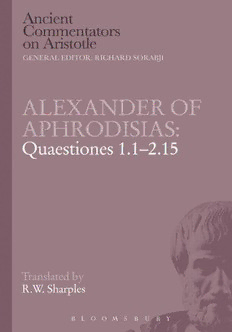
Table Of ContentAlexander of Aphrodisias
Quaestiones 1.1-2.15
This page intentionally left blank
Alexander of
Aphrodisias
Quaestiones 1.1-2.15
Translated by
R. W. Sharpies
B L O O MS B U RY
LONDON • NEW DELHI • NEW YORK • SYDNEY
Bloomsbury Academic
An imprint of Bloomsbury Publishing Pic
50 Bedford Square 175 Fifth Avenue
London NewYork
WC1B3DP NY 10010
UK USA
www.bloomsbury.com
Bloomsbury is a registered trade mark of Bloomsbury Publishing Pic
First published in 1992 by Gerald Duckworth & Co. Ltd.
Paperback edition first published 2014
© R.W. Sharpies, 1992
R.W. Sharpies has asserted his right under the Copyright, Designs and
Patents Act, 1988, to be identified as Author of this work.
All rights reserved. No part of this publication may be reproduced or transmitted in
any form or by any means, electronic or mechanical, including photocopying,
recording, or any information storage or retrieval system, without prior
permission in writing from the publishers.
No responsibility for loss caused to any individual or organization acting on or
refraining from action as a result of the material in this publication can be
accepted by Bloomsbury Academic or the author.
British Library Cataloguing-in-Publication Data
A catalogue record for this book is available from the British Library.
ISBN HB: 978-0-7156-2372-5
PB: 978-1-7809-3456-3
ePDF: 978-1-7809-3457-0
Library of Congress Cataloging-in-Publication Data
A catalog record for this book is available from the Library of Congress.
Acknowledgements
The present translations have been made possible by generous and imaginative funding
from the following resources: the National Endowment for the Humanities, Division
of Research Programs, an independent federal agency of the USA; the Leverhulme
Trust; the British Academy; the Jowett Copyright Trustees; the Royal Society (UK);
Centra Internazionale A. Beltrame di Storia della Spazio e del Tempo (Padua); Mario
Mignucci; Liverpool University. The editor wishes to thank Ian Crystal, John Ellis,
Eric Lewis and Paul Opperman for their help in preparing the volume for press.
Typeset by Derek Doyle &Associates, Mold, Clwyd.
Printed and bound in Great Britain
Contents
Introduction 1
Alexander and the Quaestiones 1
The present translation 7
Translation 11
Notes on the Text 120
Bibliography 127
Appendix: the commentators 132
English-Greek Glossary 142
Greek-English Index 152
Index of Passages Cited 175
Subject Index 178
To Grace and Elizabeth
Introduction
Alexander and the Quaestiones
The Quaestiones attributed to the Aristotelian commentator
Alexander of Aphrodisias, known by later generations as the
commentator on Aristotle,1 who lived in the latter part of the
second and the first part of the third century AD,2 have been
the subject of increasing study in recent years. The present
volume and its successor will, however, to the best of my
knowledge, form the first translation of the whole collection
into English or into any other modern language. Like the
other minor works attributed to Alexander,3 these texts have
their apparent origin in discussion and debate of Aristotle's
works and thought by Alexander himself and his associates or
pupils. They thus throw light, even if a dimmer and more
fitful light than we might wish, on the functioning of a
philosophical 'school' in the early years of the third century
AD;4 and, in their concern to remove apparent contradictions
and anomalies, they exemplify an aspect of the process by
which Aristotle's thought was, over the centuries, organised
and formulated into Aristotelianism. They also, in varying
1 cf. SimpliciusmP/iys. 707,33; 1170,2; 1176,32; Philoponus in An. Pr. 136,20.
2 He was appointed as a public teacher of Aristotelian philosophy, possibly in
Athens, between 198 and 209 AD. The dates of his teachers, and other evidence for his
possible intellectual contacts, suggest that he was already philosophically active in
the latter part of the second century, as his appointment would in any case lead one to
expect. Cf. Todd (1976) 1 n. 3, Sharpies (1987) 1177-8, (1990,1) 83-4,92-4, and further
references there, (For works cited by author's name and date only, see the
Bibliography, p. 127.)
3 In Greek, the de Anima Libri Mantissa and the Ethical Problems; other texts
survive in Arabic. See further below, and for a general survey cf. Sharpies (1987)
1189-95. The texts that survive in Greek were edited, along with the more substantial
treatises On the Soul, On Fate and On Mixture, by Bruns (1887) and (1892), on which
edition the present translation is based.
4 I have endeavoured to say more about the evidence the minor works attributed to
Alexander can give us for the functioning of his 'school' in Sharpies (1990,1).
1
2 Introduction
degrees, show how the interpretation of Aristotle was
influenced, consciously or unconsciously, by familiarity with
the doctrines of Hellenistic philosophy. The direct or indirect
influence of Aristotle and of those who have sought to
interpret him extends to a great part of European thought;
and these quaestiones are important documents in the history
of that influence.
Their interest for the student of Aristotle is not however
purely historical. Of the many topics with which they deal,
some are of more interest to us today than others;
nevertheless, many of these texts can still be of use to us in
our own attempts to interpret Aristotle's views on such
questions as the problem of universals and the relation
between form and matter, whether we find the interpreta-
tions advanced here plausible or whether we are provoked to
new insights by our reactions against them. In a very real
sense we who try to interpret Aristotle now are engaged on
the same enterprise as Alexander and his associates. And,
given the importance of Aristotle in the history of thought,
these texts should be of interest to all those who share a belief
that reasoned consideration and argument are the best
methods of advancing the eudaimonia of mankind at large.
Nor is the interest of these texts confined to the student of
European thought. Versions of some of them were translated,
with more or less alteration, into Arabic, and in some cases
from Arabic into Latin; they thus have a part in the history of
the transmission of ancient Greek philosophy to the Islamic
world and thence to the medieval Latin West. In the present
translation account is taken of Arabic versions of the texts
preserved in Greek where these have been accessible, but a
complete edition and translation of all the Arabic texts so far
discovered, both those that are parallel to surviving Greek
texts and those that are not, is much to be desired.5
Most of the minor texts attributed to Alexander that
survive in Greek are arranged in collections apparently made
5 The Arabic texts are listed by Dietrich, supplemented by Van Ess; cf. Sharpies
(1987) 1187-8 and 1192-4, and the Bibliography to the present volume under Badawi,
Gatje, Ruland and Zimmermann. The Arabic texts are sometimes close to the Greek,
sometimes less so; passages are on occasion omitted or transposed, and in some cases
even the relation between the texts is disputed. See the notes to individual
quaestiones in the present volume.
Introduction 3
in antiquity. Three books of these collected discussions are
entitled phusikai skholikai aporiai kai luseis, 'School-
discussion problems and solutions on nature' (often cited in
modern literature as Alexander's Quaestiones); it is with
these that the present volume and its sequel will be
concerned. A fourth book is titled 'Problems on Ethics' but
sub-titled, no doubt in imitation of the preceding three books
when it was united with them,6 skholikai ethikai aporiai kai
luseis, 'school-discussion problems and solutions on ethics'.7 A
further collection was transmitted as the second book of
Alexander's treatise On the Soul, and labelled mantissa or
'makeweight' by the Berlin editor Bruns. Other texts
essentially similar to those in these collections survive, some
in Greek8 and some only in Arabic; and there is evidence that
there were other collections now lost.9 The circumstances in
which these collections were put together are unclear; it was
not always expertly done, and while some of the titles
attached to particular pieces seem to preserve valuable
additional information,10 others are inept or unhelpful.11 Nor
is it clear at what date the collections were assembled.12 In a
6 So Bruns (1892) v. The Ethical Problems are thus sometimes cited as 'Quaestiones
book 4', a title that has no MSS authority. The Quaestiones and Ethical Problems
should be distinguished from the (spurious) Medical Puzzles and Physical Problems
also attributed to Alexander and edited by J.L. Ideler, Physici et Medici Graeci
Minores, Berlin 1841, and H. Usener, Alexandri Aphrodisiensis quae feruntur
Problematorum libri 3 et 4, Berlin 1859. Cf. Sharpies (1987) 1198.
7 This collection is translated into English by Sharpies (1990,2).
8 Notably the two edited by G. Vitelli, 'Due Frammenti di Alessandro di Afrodisia',
in Festschrift Theodor Gomperz, Vienna 1902, 90-3. It is hoped to include these as an
appendix to Quaestiones book 3 in the present series of translations.
9 'Scholia logica' are referred to in what may be a gloss at Alexander in An. Pr.
250,2; and an 'Explanation and summary of certain passages from (Aristotle's) de
Sensu', which Moraux suggests may have been a similar collection, is referred to by a
scholion on Quaest. 1.2. Cf. Moraux (1942) 24; Sharpies (1987) 1196.
10 cf. Quaest. 1.13 n. 155,2.13 n. 367.
11 cf. the discussion at Bruns (1892) xi, and in the present volume see especially
Quaest. 1.10 n. 116,1.14 n. 164,1.21 n. 220,1.25 n. 255, 1.26 n. 185, 2.6 n. 327, 2.9 n.
342,2.14 n. 377.
12 Alexander's commentary on the de Sensu cites not only the lost de Anima
commentary (167,21) but also a section of the Mantissa (in Sens. 31,29, citing
Mantissa 127-30; cf. P. Wendland, preface to CAG 3.1, v; Moraux [1978] 297 n. 71).
Boethius seems to know both Alexander's de Fato and the last section of the Mantissa
(in Int. editio secunda 196,19ff. and 236,11-16; Sharpies [1978] 257-9). See also below,
n. 126 to Quaest. 1.11. But it is one thing to show that some of these texts were known
at a given date, another to show that the collections existed in their present form.
Whether any inference should be drawn from the fact that the translations into
Arabic are apparently of isolated texts, with no reference to the arrangement of the
collections in the Greek, is doubtful.