
Download Advanced Characterization Techniques for Thin Film Solar Cells PDF Free - Full Version
Download Advanced Characterization Techniques for Thin Film Solar Cells by Uwe Rau, Daniel Abou-Ras, Thomas Kirchartz in PDF format completely FREE. No registration required, no payment needed. Get instant access to this valuable resource on PDFdrive.to!
About Advanced Characterization Techniques for Thin Film Solar Cells
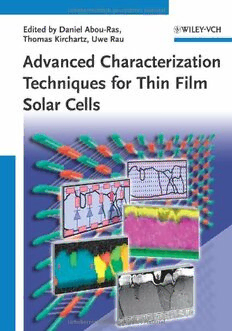
Written by scientists from leading institutes in Germany, USA and Spain who use these techniques as the core of their scientific work and who have a precise idea of what is relevant for photovoltaic devices, this text contains concise and comprehensive lecture-like chapters on specific research methods.They focus on emerging, specialized techniques that are new to the field of photovoltaics yet have a proven relevance. However, since new methods need to be judged according to their implications for photovoltaic devices, a clear introductory chapter describes the basic physics of thin-film solar cells and modules, providing a guide to the specific advantages that are offered by each individual method.The choice of subjects is a representative cross-section of those methods enjoying a high degree of visibility in recent scientific literature. Furthermore, they deal with specific device-related topics and include a selection of material and surface/interface analysis methods that have recently proven their relevance. Finally, simulation techniques are presented that are used for ab-initio calculations of relevant semiconductors and for device simulations in 1D and 2D.For students in physics, solid state physicists, materials scientists, PhD students in material sciences, materials institutes, semiconductor physicists, and those working in the semiconductor industry, as well as being suitable as supplementary reading in related courses.
Detailed Information
| Author: | Uwe Rau, Daniel Abou-Ras, Thomas Kirchartz |
|---|---|
| Publication Year: | 2011 |
| ISBN: | 9783527410033 |
| Pages: | 564 |
| Language: | English |
| File Size: | 9.262 |
| Format: | |
| Price: | FREE |
Safe & Secure Download - No registration required
Why Choose PDFdrive for Your Free Advanced Characterization Techniques for Thin Film Solar Cells Download?
- 100% Free: No hidden fees or subscriptions required for one book every day.
- No Registration: Immediate access is available without creating accounts for one book every day.
- Safe and Secure: Clean downloads without malware or viruses
- Multiple Formats: PDF, MOBI, Mpub,... optimized for all devices
- Educational Resource: Supporting knowledge sharing and learning
Frequently Asked Questions
Is it really free to download Advanced Characterization Techniques for Thin Film Solar Cells PDF?
Yes, on https://PDFdrive.to you can download Advanced Characterization Techniques for Thin Film Solar Cells by Uwe Rau, Daniel Abou-Ras, Thomas Kirchartz completely free. We don't require any payment, subscription, or registration to access this PDF file. For 3 books every day.
How can I read Advanced Characterization Techniques for Thin Film Solar Cells on my mobile device?
After downloading Advanced Characterization Techniques for Thin Film Solar Cells PDF, you can open it with any PDF reader app on your phone or tablet. We recommend using Adobe Acrobat Reader, Apple Books, or Google Play Books for the best reading experience.
Is this the full version of Advanced Characterization Techniques for Thin Film Solar Cells?
Yes, this is the complete PDF version of Advanced Characterization Techniques for Thin Film Solar Cells by Uwe Rau, Daniel Abou-Ras, Thomas Kirchartz. You will be able to read the entire content as in the printed version without missing any pages.
Is it legal to download Advanced Characterization Techniques for Thin Film Solar Cells PDF for free?
https://PDFdrive.to provides links to free educational resources available online. We do not store any files on our servers. Please be aware of copyright laws in your country before downloading.
The materials shared are intended for research, educational, and personal use in accordance with fair use principles.

