
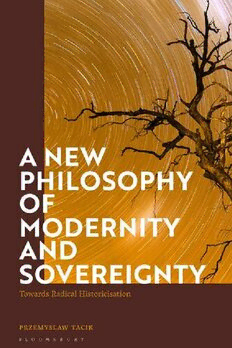
Download A New Philosophy of Modernity and Sovereignty: Towards Radical Historicization PDF Free - Full Version
Download A New Philosophy of Modernity and Sovereignty: Towards Radical Historicization by Przemysław Tacik in PDF format completely FREE. No registration required, no payment needed. Get instant access to this valuable resource on PDFdrive.to!
About A New Philosophy of Modernity and Sovereignty: Towards Radical Historicization
Tackling important philosophical questions on modernity – what it is, where it begins and when it ends – Przemyslaw Tacik challenges the idea that modernity marks a particular epoch, and historicises its conception to offer a radical critique of it. His deconstruction-informed critique collects and assesses reflections on modernity from major philosophers including Hegel, Heidegger, Lacan, Arendt, Agamben, and Žižek.This analysis progresses a new understanding of modernity intrinsically connected to the growth of sovereignty as an organising principle of contemporary life. He argues that it is the idea of ‘modernity’, as a taken-for-granted era, which is positioned as the essential condition for making linear history possible, when it should instead be history, in and of itself, which dictates the existence of a particular period. Using Hegel’s notion of ‘spirit’ to trace the importance of sovereignty to the conception of the modern epoch within German idealism, Tacik traces Hegel’s influence on Heidegger through reference to the ‘star’ in his late philosophy which represents the hope of overcoming the metaphysical poverty of modernity. This line of thought reveals the necessity of a paradigm shift in our understanding of modernity that speaks to contemporary continental philosophy, theories of modernity, political theory, and critical re-assessments of Marxism.
Detailed Information
| Author: | Przemysław Tacik |
|---|---|
| Publication Year: | 2021 |
| ISBN: | 9781350201279 |
| Pages: | 233 |
| Language: | French |
| File Size: | 2.398 |
| Format: | |
| Price: | FREE |
Safe & Secure Download - No registration required
Why Choose PDFdrive for Your Free A New Philosophy of Modernity and Sovereignty: Towards Radical Historicization Download?
- 100% Free: No hidden fees or subscriptions required for one book every day.
- No Registration: Immediate access is available without creating accounts for one book every day.
- Safe and Secure: Clean downloads without malware or viruses
- Multiple Formats: PDF, MOBI, Mpub,... optimized for all devices
- Educational Resource: Supporting knowledge sharing and learning
Frequently Asked Questions
Is it really free to download A New Philosophy of Modernity and Sovereignty: Towards Radical Historicization PDF?
Yes, on https://PDFdrive.to you can download A New Philosophy of Modernity and Sovereignty: Towards Radical Historicization by Przemysław Tacik completely free. We don't require any payment, subscription, or registration to access this PDF file. For 3 books every day.
How can I read A New Philosophy of Modernity and Sovereignty: Towards Radical Historicization on my mobile device?
After downloading A New Philosophy of Modernity and Sovereignty: Towards Radical Historicization PDF, you can open it with any PDF reader app on your phone or tablet. We recommend using Adobe Acrobat Reader, Apple Books, or Google Play Books for the best reading experience.
Is this the full version of A New Philosophy of Modernity and Sovereignty: Towards Radical Historicization?
Yes, this is the complete PDF version of A New Philosophy of Modernity and Sovereignty: Towards Radical Historicization by Przemysław Tacik. You will be able to read the entire content as in the printed version without missing any pages.
Is it legal to download A New Philosophy of Modernity and Sovereignty: Towards Radical Historicization PDF for free?
https://PDFdrive.to provides links to free educational resources available online. We do not store any files on our servers. Please be aware of copyright laws in your country before downloading.
The materials shared are intended for research, educational, and personal use in accordance with fair use principles.

