Table Of ContentA length scale for the superconducting Nernst signal above T in Nb Si
c 0.15 0.85
A. Pourret1, H. Aubin1, J. Lesueur1, C. A. Marrache-Kikuchi2, L. Berg´e2, L. Dumoulin2, K. Behnia1
(1)Laboratoire de Physique Quantique(CNRS), ESPCI, 10 Rue de Vauquelin, 75231 Paris, France
(2)CSNSM, IN2P3-CNRS,Bˆatiment 108, 91405 Orsay, France
(Dated: January 11, 2007)
7
0 Wepresent astudyof theNernsteffect in amorphous superconductingthinfilmsof Nb0.15Si0.85.
0 The field dependence of the Nernst coefficient above Tc displays two distinct regimes separated
2 by a field scale set by the Ginzburg-Landau correlation length. A single function F(ξ), with the
correlation length as its unique argument set either by the zero-field correlation length (in the
n
low magnetic field limit) or by the magnetic length (in the opposite limit), describes the Nernst
a
J coefficient. Weconclude that theNernst signal observed on a wide temperature(30×Tc) and field
(4×B ) range is exclusively generated byshort-lived Cooper pairs.
6 c2
1
PACSnumbers: 74.70.Tx,72.15.Jf,71.27.+a
]
n
o The observation of a finite Nernst signal in the nor-
c mal state of high-T cuprates[1] has revived interest
c
-
in the study of superconducting fluctuations. In low-
r
p temperature conventional superconductors, short-lived
u Cooper pairs above T have been mostly examined
c
s
through the phenomena of paraconductivity[2] and fluc-
.
t
a tuation diamagnetism[3]. Due to a sizeable contribution
m coming fromfree electronsto conductivity and magnetic
susceptibility,thesensitivityoftheseprobestosupercon-
-
d ducting fluctuations is limited to a narrow region close
n to the superconducting transition[4].
o
Because ofa low superfluid density, the superconduct-
c
[ ing state in underdoped cupratesis particularlyvulnera-
bletophasefluctuations[5]. Therefore,long-livedCooper
1
pairs without phase coherence and vortex-like excita-
v
tions associated with them were considered as the main
6
7 source of the anomalous Nernst effect observed in an
3 extended temperature window above Tc in underdoped
1 cuprates[1].
0
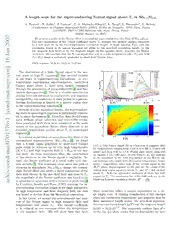
In a recent experimenton amorphousthin films of the
7
conventional superconductor Nb Si [6], we found
0 0.15 0.85
that a Nernst signal generated by short-lived Cooper
/ FIG.1: TheNernstsignal(N)asafunctionofmagneticfield
t pairs could be detected up to very high temperatures
a fortemperaturesrangingfrom0.180Kto0.360K(Upperleft
m (30×Tc) and high magnetic field (4×Bc2) in the nor- panel) and from 0.56 to 4.3 K (Upperright panel) measured
mal state. In these amorphous films, the contribution
- on sample 2 (Tc=380 mK). Above (below) Tc the position
d of free electrons to the Nernst signal is negligible. In- of the maximum in the field dependence of the Nernst sig-
n deed, the Nernst coefficient of a metal scales with elec- nalincreases(decreases)withdecreasingtemperature. Lower
o tron mobility[7]. The extremely short mean free path of panel : Logarithmic color map of the Nernst signal in the
c electrons in amorphous Nb Si damps the normal- (B,T) plane. Superimposed on the plot are the values of the
: 0.15 0.85 ∗
v state Nernst effect and allows a direct comparisonof the critical field (open squares), below Tc, and B ( full circles),
Xi data with theory. In the zero-field limit and close to Tc, above Tc. Note the symmetric evolution of these two with
respecttoT . Thecontinuouslineisthefieldscalesetbythe
the magnitude of the Nernst coefficient was found to be c
r Ginzburg-Landau correlation length, B∗ = φ0 .
a inquantitativeagreementwithatheoreticalprediction[8] 2πξd2
by Ussishkin, Sondhi and Huse, (USH) invoking the su-
perconducting correlationlength as its single parameter.
At high temperature and finite magnetic field, the data these variations reflect a unique dependence on a sin-
was found to deviate from the theoretical expression. gle length scale. A striking visualization of this emerges
In this Letter, we extend our measurements and anal- when one substitutes temperature and magnetic field by
ysis of the Nernst signal to high magnetic field and their associated length scales: the zero-field supercon-
temperatures well above Tc. The Nernst coefficient, ductingcorrelationlengthξd(T)andthemagneticlength
ν, is reduced as one increases either the temperature l (B) = (~/2eB)1/2. The symmetric contour lines of ν
B
or the magnetic field. We will show here that both in the (l , ξ ) plane shows that its dependence on both
B d
2
field and temperature can be described by a single func- [Note that here we use the definition of l (B) =
B
tion with the superconducting correlationlength ξ as its (~/2eB)1/2, which differs by a factor of √2 from what
unique argument. In the low-field limit, the correlation was used in ref.[8] and [6]. This, for obvious reasons to
lengthissetbyξd andinthehigh-fieldlimitbylB. Inthe appear below.] Upon increasing the magnetic field, the
intermediateregime,whenξd lB,thecorrelationlength Nernst signal deviates from this linear field dependence,
≃
isasimplecombinationofthesetwolengths. Thisobser- reaches a maximum at a field scale B and decreases
∗
vationisadditionalproofthattheNernstsignalobserved afterwards to a weakly temperature-dependent magni-
uptohightemperature(30×Tc)andhighmagneticfield tude. In contrastto the superconducting state (T <Tc),
(4 Bc2)inthissystemisexclusivelygeneratedbysuper- the position of the maximum shifts to higher fields with
×
conducting fluctuations – i.e. short-lived Cooper pairs. increasing temperature. The contour plot in the (T,B)
HencethefunctionaldependenceoftheNernstcoefficient plane(lowerpanel)showsthatthesetwofieldscales,B
c2
on the correlation length is empirically determined in a and B , evolve symmetrically with respect to the crit-
∗
wide range extending from the long correlation length ical temperature. One major observation here is that
regime, where the data follows the prediction of USH the magnitude and the temperature dependence of B
∗
theory, to the short correlationlength regime, where the follows the field scale set by the Ginzburg-Landau cor-
Ginzburg-Landauapproximationfails andno theoretical relation length ξ = ξ0d through the relation B = φ0
d √ǫ ∗ 2πξ2
expression is yet available. d
where φ is the flux quantum and ǫ = ln T the reduced
AmorphousthinfilmsofNbxSi1 xwerepreparedinul- 0 Tc
trahigh vacuum by electron beam−co-evaporation of Nb temperature. [This field scale was dubbed “the ghost
critical field” by Kapitulnik and co-workers[13].] The
andSi, withspecialcareoverthe controlandhomogene-
value for the correlation length at zero-temperature ξ
ity of the concentrations. The competition between su- 0d
is determined from the BCS formula in the dirty limit
perconducting, metallic and insulating ground states is
controlled by the Nb concentration, the thickness of the ξ = 0.36 3~vFℓ, where v ℓ = 4.35 10 5 m2s 1 is
0d q2kBTc F × − −
films, or the magnetic field[9, 10, 11]. Two samples of estimatedusingtheknownvaluesofelectricalconductiv-
identical stoichiometry – Nb0.15Si0.85 – but with differ- ity andspecific heat[6]. Thus,the decreaseofthe Nernst
ent thicknesses and T are used in this study. Sample 1
c
(2)was12.5(35)nmthickanditsmidpointT was0.165
c
(0.380) K. The physical properties of these two samples
as well as the experimental set-up were detailed in our
previouscommunication,whichalsopresentedpartofthe
data discussed here[6].
Figure 1 shows the Nernst signal, N = Ey as
a function of magnetic field and temperature(,−f∇oxrTs)am-
ple 2. Below T , the magnetic field dependence shows
c
the characteristic features of vortex-induced Nernst ef-
fect, well known from previous studies on conventional
superconductors[12] and high-T cuprates[1]. For each
c
temperature, the Nernst signal increases steeply when
the vortices become mobile following the melting of the
vortex solid state. It reaches a maximum and decreases
at higher fields when the excess entropy of the vortex
core is reduced. As the temperature decreases the po-
sition of this maximum shifts towards higher magnetic
fields. This is not surprising, since in the superconduct-
ing state, all field scales associatedwith superconductiv-
ityareexpectedtoincreasewithdecreasingtemperature.
In particular, this is the case of the upper critical field,
B , which can be roughly estimated by a linear extrap-
c2
olation of the Nernst signal to zero as it has been done
in cuprates[1].
Above T , the temperature dependence of the char-
c FIG. 2: Logarithmic color map of the Nernst coefficient as
acteristic field scale is reversed. In this regime, at low
a function of the magnetic length l and the zero-field cor-
B
magnetic field, the Nernst signal N = R α in-
square× xy relation length ξd, for sample 1 (upper panel) and sample
creaseslinearlywithfield,asexpectedfromtheUSHthe- 2 (lower panel). Note the symmetry of the Nernst coeffi-
ory where αxy follows the simple expression[8] : cient with respect to the diagonal continuous line (lB = ξ).
Dots lines represents contours for ξ = 15nm with ξ =
1 kBe ξ2 (1/ξd4+1/(c×lB)4)−1/4. c=1.12forsample1andc=0.93
αxy = 3π ~ l 2 (1) for sample 2.
B
3
signal at the field scale B is the consequence of the
∗
reduction of the correlation length when the cyclotron 50 d(nm) 10 6.3
diameter lB becomes shorter than the zero-field correla- K) xy/B (B=0)
tion length ξ , at a given temperature. This phenomena T0.01 F( d)
is well knowndfrom studies of fluctuations diamagnetism A/1E-3 xy/B (USH)
(
in low temperature superconductors[3] and cuprates[14]. B
While in the low field limit, the magnetic susceptibility /1xy E-4
should be independent of the magnetic field – i.e. in the 1E-5
Schmidt limit[15] –,the magnetic susceptibility is exper-
imentally observed to decrease with the magnetic field, 0.02 0.1 -21 4
following the Prange’s formula[16]; which is an exact re- ln(T/Tc) d
sult within the Ginzburg-Landau formalism that takes 100 50 lB (nm) 10
into account the reduction of the correlation length by T=450mK
K)0.01 F(lB)
tahtieonmsaagrneetdicesficerilbd.edInastheivsarneegsicmeen,ttCheooapmerplpitauidrseaflruicsitnug- A/T xy/B (USH)(450mK) F(0.93*lB)
1E-3
fromfreeelectronswithquantizedcyclotronorbits[4]. In B(
our experiment, we can clearly distinguish the low-field /1xyE-4
limit – where the cyclotronlengthis largerthan the cor-
relationlength–fromthe high-fieldlimit, wherethe cor- 1E-5 d(450mK)
relation length has been reduced from its value at zero 0.02 0.1 -2 1 4
field to a shorter value given by the magnetic length. B(T) lB
Figure 2 presents a contour plot (with a logarithmic FIG. 3: Upper panel: The transverse Peltier coefficient αxy
dividedbythemagnetic field B(blacksquares) as afunction
scale of the colors) of the Nernst coefficient ν =N/B in
of the reduced temperature ǫ (bottom axis) and correlation
the (l , ξ ) plane. [Note that in contrast to Figure 1, ν
B d length(topaxis)forsample2onalog-logscale. Atlowǫ,the
andnotN isplottedhere]. Thesegraphsareinstructive.
experimental data are consistent with the USH model(solid
When l >ξ , the contour lines are parallel to the mag-
B d line). The function F(ξ) shown as a red line is a fit to the
neticlengthaxis,meaningthattheNernstcoefficientde-
data. Lower panel : The same function, (dot-line) plotted
pendsonlyonξd. Ontheothersideofthediagonal,when usinglB asitsargument,F(lB),asafunctionofthemagnetic
lB < ξd, the contour lines are parallel to the correlation field(bottomaxis)andlB(topaxis). Notethatitisconsistent
length axis, meaning that the Nernst coefficient depends withthemagnitudeandfielddependenceofthedataacquired
only on lB. Furthermore, in both samples, the contour at high magnetic field. The function F(c×lB) (continuous
lines are almost symmetric with respect to the l = ξ line)describesnicelythedatawhenc=0.93. Atlowmagnetic
line. Inotherwords,the NernstcoefficientappearBsto bde field,whenlB >ξd,thedatadeviatesfromF(c×lB)toreach
thefield-independentvalueF(ξ ).
uniquelydeterminedbythecorrelationlength,nomatter d
whether ξ or l sets it.
d B
Therefore, we are entitled to assume that there exists
ξ ξ when l , and ξ c l when l 0 is
d B B B
a function which links ν to the correlation length. In ≃ → ∞ ≃ × →
given by :
the zero-field limit, the latter is set by ξ , and we can
d
empirically extract from our data a function F(ξ) such 1 1 1
= + (2)
as F(ξ) = αxy/B = Rsqνuare(T,B → 0). This function ξγ ξdγ (c×lB)γ
is shown in figure 3(upper panel). For large ξ, it is pro-
portional to ξ2, in agreement with the USH expression. where the pre-factor c and the exponent γ are to be de-
termined from the experimental data. The pre-factors
For small ξ, however,we find that this function becomes
roughly proportional to ξ4. Now a remarkable observa- c = 1.12 for sample 1 and c = 0.93 for sample 2 are
determined such as F(c l ) gives precisely the field
tionfollows: whenthisfunctionF(ξ)isplottedwiththe × B
dependence of the Nernst coefficient at high magnetic
magnetic length l as argument, as shown in the lower
B
field, shown figure 3. The slight difference between the
panel of figure 3, we find that it almost describes the
pre-factorsfor the two samples is not understood at this
magnitude and the field dependence of the Nernst co-
stage. Itappearstobelargerthantheexperimentalmar-
efficient at high magnetic field. This demonstrate that
ginoferrorandsuggeststhatotherparametersnottaken
in these two opposite limits, (ξ ξ and ξ l ), the
d B
≃ ≃ into account in this analysis may be involved, such as
Nernst coefficient is determined by this single function
the thickness of the samples. To get the value of the
F(ξ) that depends uniquely on the correlation length.
exponent γ, we first note that the curves αxy/B(B,T) ,
obTsehrivsedfuntoctidoens,creixbteratchteeddfartoamatthehizgehromfiaegldnedtaictafiaelndd, for temperature T > 2 Tc, collapse on aαuxyn/iBqu(Be→c0u,rTv)e
×
should also be valid at intermediate field, when ξd lB. when they are plotted as a function of ξd/lB, as shown
Inthisintermediateregion,withthe increasingmag≃netic figure4. Then, using F(ξ) ξ4 – as previouslyobserved
∼
tfioelld,.thAesciomrprelelarteiolantiloenngfothrξprtohgartevsseirviefileysetvhoelvceosnfdriotmionξsd, Ffo(rξ)T/F>(ξ2)×=T[1c+–(anξdd u)γsi]ng4/γeqdueapteionnds2o,nwlyeofinntdhethraat-
B d c×lB −
4
tio ξ /l , and so has the appropriate functional form to givespreciselythe separatrixbetween the curves αxy(B)
d B B
describe the collapsed data. For both samples, the best measuredaboveandbelowT . BelowT ,α /Bjoinsthe
c c xy
fit is obtained when γ =4, as shownFigure 4 for sample function F(c l ) at a critical field B 1.5 T, which
B c2
× ≃
2. Such a value of γ implies that the firstnon-linear cor- is larger than the critical field of the superconductor-
rection to the field dependence of α is proportional to insulator transition, B = 0.91 T, defined as the cross-
xy SI
B2(i.elB−4),inagreementwithanalyticityarguments[18]. ing field of R(B) curves[11].
With these parameters just determined, figure 2 shows The overall consistency of this analysis demonstrates
that the contour lines of equal Nernst coefficient can be that the off-diagonal component of the Peltier tensor,
described by curves of constant correlation length ξ as α , is set by ξ over a wide temperature range. As no-
xy d
given by equation 2. Thus, as shown figure 4, above Tc, ticed previously, when ξd is large, αxy is consistent with
the magnitude of the Nernst coefficient at any tempera- USH expression. However, below a correlation length of
ture and magnetic field is given by this unique function theorderofξ ,itdeviatesdownwardfromtheUSHfor-
F(ξ) = αxy(ξ), determined experimentally at zero field, mula. Such a0ddeviation is actually expected for theories
B
where the correlation length is given by equation 2. basedonthe Ginzburg-Landauformalism, whichare no-
toriously known to overestimate the effect of short-wave
0) length fluctuations[4]. In fluctuations diamagnetism ex-
=
B 1 periments, the data were observed to fall systematically
B, below the Prange’s limit above some scaling field, of the
T=0.64K
/xy T=0.69K order of 0.5 Hc2 in dirty materials, i.e. ξ ξ0d.
× ≃
T=0.82K
)/( T=1.2K Let us conclude by briefly commenting the case of
B T=1.6K cuprates. One crucial issue to address is the existence
/ 0.1
xy T=2K of the “ghost critical field” detected here. We note that
T=3.2K
( 1/(1+(d/0.93*lB)4) such a field scale has not been identified in the analysis
ofthecupratedata[1]. However,oneshallnotforgetthat
0.1 / l 1 2 thenormalstateoftheunderdopedcupratesisnot asim-
d B
ple dirty metal. The contribution of normal electrons to
) 1 310 mK 200 mK
K the Nernst signal is too large to be entirely negligible.
T
A/ 0.1 360 mK F(0.93*lB) This makes any comparison between theory and data
(0.01 less straightforward than the analysis performed here.
/B1xyE-3 548500 mmKK Mscaolree,oTver, i,nfoNrbt0h.1e5Sdie0s.t8r5utchtieorneoisf saupsienrgcloendteumctpiveirtayt.uIrne
640 mK BCS
1E-4 820 mK contrast, the situation in the cuprates may be compli-
1.8 K
2 K cated by the possible existence of two distinct temper-
1E-5 3.2 K BSI BC2 ature scales, the pairing temperature and a Kosterlitz-
0.02 0.1 B (T) 1 4 Thouless-liketemperature leading to a phase-fluctuating
superconductor[17].
FIG. 4: Upper Panel: α /B normalized to its zero-field
xy
value versus ξ /l for sample 2. All the data at tempera- To summarize, in the regime of short-lived Cooper
d b
tures between 430 mK and 3.2 K are shown here to collapse pairs,theNernstcoefficientwasfoundtoonlydependon
on 1+(ξd/01.93∗lB)4 (thickline). Lowerpanel: αxy/Basafunc- thesuperconductingcorrelationlength. Wecouldclearly
tionofBfortemperaturesrangingfrom200mKto3.2Kona distinguishthe regimewherethecorrelationlengthisset
log-logscale. ThefunctionF(ξ)= αBxy(ξd)extractedfromthe by the Ginzburg-Landau correlation length at zero-field
dataatzerofieldisplottedhereasafunctionoflB (thickred from the high-field regime where the correlation length
line). At high magnetic field, all the data, above and below is setby the magnetic length. Inthe intermediateregion
T tendtowardsF(c×l ). NotethatF(c×l )isthesepara-
c B B where ξ l , the correlation length is a simple combi-
d B
trix of the data above and below T . Also shown is F(ξ) for ≃
c nation of these two lengths. These results demonstrate
several values of ξ corresponding to different temperatures,
and plotted as fundction of ξ =(1/ξ4+1/(0.93∗l )4)−1/4. that the Nernst signal observed at high field and tem-
d B perature in amorphous films of Nb Si is generated
0.15 0.85
by superconducting fluctuations characterized by short-
Figure 4 also shows that the magnitude and field de-
lived Cooper pairs, implying both amplitude and phase
pendence of the Nernst signal, measured for tempera-
fluctuations of the superconducting order parameter.
tures T < T and high magnetic field (B > B ), can
c c2
We acknowledge useful discussions with S. Caprara,
alsobedescribedbyF(c l ). Inparticular,weseethat
B
× M.V. Feigelman, M. Grilli, D. Huse, S. Sondhi , I. Us-
the Nernst data measured at a temperature close to T
c
sishkinandA.A.Varlamov. Thisworkwaspartiallysup-
follows closely the curve F(c l ) on a wide magnetic
B
× ported by Agence Nationale de la Recherche and Fonda-
field range; this is expected for the diverging Ginzburg-
tion Langlois through “Prix de la Recherche Jean Lan-
Landau correlation length when approaching T . It is
c
glois”.
remarkable to note that the curve F(ξ), extracted from
the data at zero-field, and plotted as a function of l , ———————————-
B
5
[1] Y.Wang,L.Li,andN.P.Ong,Phys.Rev.B73,024510 [10] H.L.Lee,J.P.Carini,D.V.Baxter,W.Henderson,and
(2006). G. Gruner,Science 287, 633 (2000).
[2] R.E. Glover, Physics Letters A 25, 542 (1967). [11] H. Aubin, C. A. Marrache-Kikuchi, A. Pourret,
[3] J. P. Gollub, M. R. Beasley, R. Callarot, and M. Tin- K.Behnia,L.Berg´e,L.Dumoulin,andJ.Lesueur,Phys.
kham,Physical ReviewB 7, 3039 (1973). Rev. B 73, 094521 (2006).
[4] W. J. Skocpol and M. Tinkham, Reports on Progress in [12] R.P. Huebenerand A.Seher,Physical Review 181, 710
Physics 38, 1049 (1975). (1969).
[5] V.J.EmeryandS.A.Kivelson,Nature374,434(1995). [13] A. P.A. Kapitulnik and G. Deutscher,J. Phys. C: Solid
[6] A. Pourret, H. Aubin, J. Lesueur, C. A. Marrache- State Phys. 18, 1305 (1985).
Kikuchi, L. Berg´e, L. Dumoulin, and K. Behnia, Nature [14] C.Carballeira,J.Mosqueira,A.Revcolevschi,andF.Vi-
Physics 2, 683 (2006). dal, Physical Review Letters 84, 3157 (2000).
[7] K.Behnia,M.Measson,andY.Kopelevich,cond-matp. [15] A. Schmid,Physical Review 180, 527 (1969).
0611136 (2006). [16] R. E. Prange, Physical Review B 1, 2349 (1970).
[8] I. Ussishkin, S. L. Sondhi, and D. A. Huse, Phys. Rev. [17] D. Podolsky, S. Raghu, and A. Vishwanath, cond-
Lett.89, 287001 (2002). mat/0612096 (2006).
[9] S. Marnieros, L. Berg´e, A. Juillard, and L. Dumoulin, [18] M. Feigelman, Private Communication
Physical Review Letters 84, 2469 (2000).