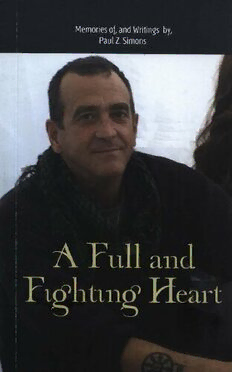
Table Of ContentA Fulaln d
FightiHnega rt
memories of, and writing by,
Paul Z. Simons
aka El Errante
Ardent Press 2018
ardentpress.org
creative commons
@(!)@
in memory
1 LBC - A Full and Fighting Heart
4 Nina - Honoring the Life of Paul Simons
9 Lili - My Piece of Paul
14 Jason - You'll Always Be with Us
Anarchy: A Journal of Desire Armed (AJODA)
21 A True Account of the New Model Army
34 The Paris Commune: a critical history
51 On Form and Content in Elements of Refusal
Modern Slavery
65 John Brown's Body
92 Curtains of Blood: The Grand-Guignol
117 American Uprising review
135 Illegalism
195 Decolonizing Anarchy review
dispatches
203 Rojava
228 Brazil
240 France
257 Greece
et cetera
271 Illegalist Praxis: Notes on a Decade of Crime
275 Waging the War on Christmas
280 Pure Black: An Emerging Consensus
284 The Elephant and the Blind Man
289 In a Moral Universe
293 My Date with Sam Dolgoff
297 Insurgent Tactics - the great emu war
301 An Anarchist Affection for Democracy
A
Full and Fighting Heart
LBC editors
Paul Simons was one of our favorite people. During
the most productive years of our relationship (about
the past eight) we would get a couple visits a year. Our
conversations were usually at quite a clip-PZS was a
fast talker, a fidgeter, and a chain smoker-and started
out with the three or four bullet points reserved for LBC
(as the most active post-left publisher and distributor).
Once these topics were passed from his mental cache, he
would usually deflate and we could then have a more
personal conversation; project work out of the way, it
was time to be human. Love, travel, people in common
were all treated with the same enthusiasm as the proj
ect work but the tone and temperament settled down.
Paul's vision of Black Anarchy was like this.
The Beautiful Idea wrought upon the world under
black flags and all our unmet friends is the passion we
shared with Paul and that he also shared with many
other people who I can't otherwise stand. Paul was a
bridge between those who toil in the intolerant US and
insurgents who live in other, perhaps more fertile, parts
of the world. If there were one person who connected us,
who didn't get bogged down in the bullshit, and whose
heart was big enough to contain multitudes, it was Paul.
This memorial to Paul Z Simons begins with four re
membrances, ours; a piece by his eldest daughter, Nina;
one by his partner at the time of his death, Lili, and fi
nally a political genealogy by Jason McQuinn, long-term
partner and publisher with Paul, through CAL Press.
in memory
This selection of texts by Paul is nowhere near com
prehensive. We decided this volume should stand with
Paul's bigger and more important texts. His contribu
tions to the zine and book Black Eye (Ardent, 2015) are
not included as they are already in book form. A lot of
his work for Anarchy: A Journal of Desire Armed falls un
der the category of minor work, that is, zine and book
reviews that are fewer than a couple hundred words.
During the AJODA period (late 90s) Paul was interest
ed in history. In that section of the book are his pieces
contextualizing the New Model Army and The Paris
Commune for an anarchist audience. In Modern Slavery
(edited by Jason McQuinn over the past five years) is ma
terial that mostly discusses American history, including
pieces about slave uprisings and the Civil War period. In
this section is also what might be Paul's magnum opus,
"Illegalism.," covering material close to the heart of any
anarchist who appreciates criminal anarchy more than
sitting in meetings and developing five-point plans. Fi
nally, that section includes an article about one of Paul's
secret pleasures: horror films.
Over the past several years, writing under the name
El Errante, Paul traveled the globe and gave compelling
stories to a US audience about Rojava, Brazil, Greece,
and France. All of those dispatches are included here.
Finally is everything else. Paul and I shared a dispo
sition towards feuds. Rather than engaging in the scrum
that is internet fighting, he focused by writing a couple
of incisive essays on some of the more significant con
flicts. He defends Hakim Bey and Sam Dolgoff and at
tacks the excesses of antifa (especially of the fascism-is
everything/ everything-is-fascism variety). He tells more
stories of illegalism, King Mob, and anarchists. Most
2
importantly there are two essays in this section that are
required reading for modern anarchists who are closer
to post-left anarchy than to the Spanish Civil War. "Pure
Black: An Emerging Consensus" is Paul's expression of
his recent political development. It is his articulation of
post-left anarchy tweny years later and anarcho-nihil
ism read through an internationalist perspective. "On
Form and Content in Elements of Refusal" is the best re
view and sendup of John Zerzan's book. Say what you
will about John but this book is the correction needed on
the Marxist vision of the world, whether by state com
munists, the ultra-left, or the Situationist International.
It is worth noting that most of the texts in this collec
tion are also available at the URL https:/ / theanarchis
tlibrary.org/ category/ author/ paul-z-simons
Finally, let us end this by saying that we miss Paul
now and always. Authentic bridges are few and far, and
his enthusiasm (with its obligatory opposite, deep sad
ness) and commitment to ideas and people and learning,
are also far too rare.
PS: (It seems rude not to talk to him about this book. ..)
3 in memory
Honoring the Life of Paul Simons
Nina Simons
My dad liked to joke that he was born an illegal, to Gin
ger, an unwed mother in Utah in 1960. He became a
uniquely intelligent writer, traveler, idealist, and a fire
breathing anarchist.
My father was a man of profound conviction to his
ideals and beliefs; he refused to live by anyone else's
rules, he would not be domesticated. He was free in
ways that most people cannot even comprehend, and
even fewer are brave enough to pursue. He believed
that freedom was to live and to demonstrate the truest
expression of oneself; that to live by the expectations of
society or any authority was to relinquish one's freedom.
In this he was uncompromising. In this, he became one
of the most accepting individuals I've ever known. My
father was the kind of person who would never judge
you for living your truth, he was the kind of father who
taught me to wish on stars as a child, and that it doesn't
matter which star, because putting your intentions into
the universe is meaningful and you should never be
afraid to ask. When I was a teenager, struggling to find
acceptance for who I was, he taught me mindfulness
and meditation and also about punk rock. I could tell
him anything; he thought that, regardless of gender, the
first time someone gets laid, they deserve a cake.
As an adult, he taught me to be a global citizen, to
truly listen, to travel with an open heart and an open
mind. He made a conscious effort to see the truth in
the experiences of others, and encouraged boundless
4
desire, play, and the expression of conscience for all he
encountered.
Many fathers believe it is their duty to protect their
children from the harsh realities of the world. My dad
was quite the opposite. He believed in exposing us to
the evils of the world-through film, literature, protest,
and humor-so that we would know them and rage
against them.
My dad always had great timing. The only time in
my life I was hospitalized, he happened to be flying into
town that afternoon. By the evening he was in the ER,
hugging me and telling me everything would be alright.
When I was going to Ecuador and wanted to stay longer
then my group, but had no one to travel with, he didn't
miss a beat; "I'll go with you" and he met me in Banos.
So that summer of 2015 we traveled through Ecuador to
gether, and he exemplified his adventurous spirit to me
time and again. He had a magic about him when he was
traveling. He loved to see the world through the eyes
of others, and show others the world through his eyes.
When he was traveling, he was truly at peace. He was
at his best when he was able to be spontaneous and free.
One of my best memories of that trip was of the
days in Cuenca, a southern colonial town rich with his
torical and modern art. We came upon a small art muse
um called the Center for Prohibited Culture. Admission
was $1. We went inside and found a glorious collection
of gothic and morbid art. We immediately felt right at
home. We got to know the curator-a young man with
one arm named Anamorphosis. He told us the that the
majority of the art was done by his father, who also had
a tattoo shop nearby. We gladly accepted his invitation
to take us there. We weaved through alleys in light rain,
5 in memory