Table Of ContentGod in Three Persons: A Spiritual Odyssey
444
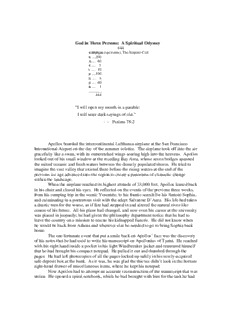
σπειρηµα (speirema), The Serpent-Coil
σ ....200
π .... 80
ε .... 5
ι .... 10
ρ ....100
η .... 8
µ .... 40
α .... 1
_______
444
“I will open my mouth in a parable:
I will utter dark sayings of old.”
- - Psalms 78:2
Apollos boarded the intercontinental Lufthansa airplane at the San Francisco
International Airport on the day of the summer solstice. The airplane took off into the air
gracefully like a swan, with its outstretched wings soaring high into the heavens. Apollos
looked out of his small window at the receding Bay Area, whose seven bridges spanned
the mixed oceanic and fresh waters between the densely populated shores. He tried to
imagine the vast valley that existed there before the rising waters at the end of the
previous ice age advanced into the region to create a panorama of climactic change
within the landscape.
When the airplane reached its highest altitude of 33,000 feet, Apollos leaned back
in his chair and closed his eyes. He reflected on the events of the previous three weeks,
from his camping trip in the scenic Yosemite, to his frantic search for his fiancée Sophia,
and culminating in a portentous visit with the adept Salvatore D’Aura. His life had taken
a drastic turn for the worse, as if fate had stepped in and altered the natural river-like
course of his future. All his plans had changed, and now even his career at the university
was placed in jeopardy; he had given the philosophy department notice that he had to
leave the country on a mission to rescue his kidnapped fiancée. He did not know when
he would be back from Athens and wherever else he needed to go to bring Sophia back
home.
The one fortunate event that put a smile back on Apollos’ face was the discovery
of his notes that he had used to write his manuscript on Apollonius of Tyana. He reached
with his right hand inside a pocket in his light Windbreaker jacket and reassured himself
that he had brought his compact notepad. He pulled it out and thumbed through the
pages. He had left photocopies of all the pages locked up safely in his newly-acquired
safe deposit box at the bank. As it was, he was glad the thieves didn’t look in the bottom
right-hand drawer of miscellaneous items, where he kept his notepad.
Now Apollos had to attempt an accurate reconstruction of the manuscript that was
stolen. He opened a spiral notebook, which he had brought with him for the task he had
set for himself while flying to his destination, and he began to write what he had written
before:
The Life of Apollonius of Tyana, which was published in the year 217 A.D.
by a Greek sophist (professor) named Flavius Philostratus, relates the story of an
ascetic Greek philosopher, who lived during the first century of the common Christian
era. The biography of this renowned teacher and world-traveler was written to prove
to the world that Apollonius was not a sorcerer or wizard, but a divinely-inspired sage
and reformer.
However, the wisdom-seeking philosopher, who conformed himself to the
precepts of the sage Pythagoras by following a vegetarian diet and a chaste life, was
later compared by a writer named Hierocles with the Christian savior. That’s when
the ecclesiastical bishop Eusebius wrote an apologetical treatise in which he refuted the
allegation that the Christians modeled their savior on the life of Apollonius, the
miracle-worker. Ever since then, the undercurrent of rivalry between the Christian
savior and the Pythagorean philosopher has caused reasoning minds to look at both
stories more closely, and unreasoning minds to dismiss one or the other as a wizard or
magician, or worse yet, as a fake or fabrication.
This dissertation will explore the possibilities that the stories of the Christian
savior, known as Jesus the Christ, and the philosopher Apollonius of Tyana are
intertwined, and that a third character provides clues and answers on how the entire
biblical story of the first century A.D. (Anno Domini, “in the year of the Lord”)
was constructed and composed as a mystery drama. That third character is the
dualistic Saul/Paul of Tarsus, who is credited with being the apostle of Christianity,
and yet his life and travels parallel the life and travels of Apollonius almost step by
step.
The story of the life of Apollonius begins with his birth in the Greek city of
Tyana, Cappadocia near the city of Nigde, which is in the present-day Central
Anatolia Region of Turkey. According to legend, an apparition of the ancient sea-
god Proteus appeared to his mother just prior to his birth and announced that the child
would be an incarnation of the ever-changing, prophetic sea divinity. A t the hour of
the auspicious delivery, a flock of swans danced and sang in the meadow around the
sleeping mother, and a thunderbolt from Zeus was said to have descended and
ascended without falling to earth. The precise date of birth depends on which source
one relies on: those who link the birth of Apollonius with Jesus give the date as 4
B.C. (Dr. Raymond Bernard gives this date); those who link the birth of
Apollonius with Saul/Paul of Tarsus give the date as 2 A.D. (or in the year of
Rome 756, which is 756 years “ab urbe condita” , i.e. since the founding of
Rome.); one source pinpoints the date as February 16, 2 A.D. (Antiquity
Unveiled, by J.M. Roberts).
As a young student, Apollonius was brought to Tarsus at the age of 14 to
study rhetoric and general literature and philosophy. Afterwards, he transferred to
the city of Aegae to study medicine and the art of healing at the Temple of Asclepius.
He also learned the philosophy of Plato and Epicurus, but he was inclined to follow
the Pythagorean system. So at the age of 16 he adopted the life-style of Pythagoras
by following a vegetarian diet in order to purge his interior from illness, and to
sharpen his mind; and he renounced the use of wine because he sought to maintain
mental balance and to purify the ether in his soul. At this time in his life he also
chose to wear only linen clothes, refusing all animal products, and to let his hair and
beard grow long. [Note: Tarsus in Cilicia is the alleged birthplace and home of
Saul/Paul of Tarsus. Coincidentally, Saul left Tarsus at the age of 14 to pursue
Talmudic studies in Jerusalem with Rabbi Gamaliel. This would mean that Saul
left Tarsus shortly after, or simultaneously as, Apollonius arrived there.]
The fame of Apollonius grew as his work at the Temple of Asclepius produced
cures of the sick. He cured a drunk who suffered from dropsy by teaching him how to
dry up his malady; even the god of healing, Asclepius, referred patients to consult the
wise Apollonius. He wisely dispensed justice to petitioning patients by refusing the
wealthy sacrifices of the wicked and accepting those who came with a clear conscience;
to demonstrate the wisdom of the gods, he taught the following prayer: “O ye gods,
grant unto me that which I deserve.” (Book1, Chapter 11).
At the age of 20, when his father died, he personally buried him beside his
mother’s grave, and then he divided the property with his older brother. Apollonius
bestowed his share of the property on relatives who were in need and left himself only a
small amount, which he later used to pay for his travel expenses. This was a turning
point in his life, for Apollonius decided to remain unmarried for the rest of his life,
even though he was distinguished for his beauty and intelligence. At six feet tall and
weighing approximately 180 pounds, his body displayed a firm and strong
masculinity. [Note: The marital status of Saul/Paul is recorded as being
unmarried. 1Corinthians 7:8.]
At the age of 21, Apollonius committed himself to the great task (stipulated by
the Pythagorean discipline) of observing a five years spell of absolute silence in order
to learn how to restrain the tongue, control the emotions, and improve the memory.
Observing such a prolonged period of silence was a prerequisite for initiation into the
mysteries of mind and soul, which the sage Pythagoras advanced at the school which
he established in Crotona in Southern Italy almost five centuries before Apollonius.
Throughout the five years of silence, during which time he lived mostly in the
Roman provinces of Pamphylia and Cilicia (Mediterranean region of Turkey),
Apollonius communicated mainly through signs of his hands and head or through
writing. At the end of his term of silence, he traveled to Antioch (in the province of
Syria), where he visited the Temple of Apollo, and he talked with the priests about
the traditional forms of the sacred rites and suggested reforms where he thought they
were needed. It was here in Antioch that he taught the duty of the philosopher (or
seeker of wisdom), which was to rise at sunrise to converse with the gods and then
speak with authority of the truths that were communicated to the mind. It was also in
Antioch where he made many converts, who would follow him and converse with him
as with an oracle who knew of what he spoke. [Note: Antioch becomes the place in
the New Testament where the disciples or believers were first called Christians (Acts
11:26), although it’s a word which is used only three times in the Bible. Antioch is
also the base from which the biblical Paul makes his “missionary” journeys.]
At the age of 27, Apollonius made up his mind to follow in the footsteps of his
spiritual mentor, Pythagoras, and he set out for India, where “wisdom and the gods
lead me.” (Book 1, Chapter 18) On the way through Babylon, in the ancient city
of Nineveh, he found a life-long companion named Damis, who became a faithful
fellow-traveler and writer of the memoirs of Apollonius. [Note: In the biblical
version, Demas, which strongly sounds like Damis by transposing the position of the
vowels, is a fellow-laborer who forsakes Paul in the end. 2 Timothy 4:10] As
Apollonius is heading toward India in quest of wisdom, Saul/Paul as a religious
zealot is heading for Damascus to persecute the church, which historically refers to the
Essenes and other pre-Christian sects.
In Babylon, Apollonius met with the Magi and was initiated by them into
the Chaldean mysteries, which pertained to the sacred fire of the inner nature of the
initiate, by which at-one-moment the soul becomes a receptacle of a fiery body of
light. The wisdom of the Magi, with the magic of the stars and the divination of
magical properties in plants, minerals, and animals, was imparted to Apollonius in
order to add to his storehouse of knowledge of the natural forces at work in the universe.
Apollonius was provided camels and a guide by the King of Babylon, who befriended
the wise man and even tried to bestow gifts on him. But the king, Vardanes, soon
found out the significance of Apollonius’ frequent prayer: “O ye gods, grant unto me
to have little and to want nothing.” (Book 1, Ch. 33) So in the summer of the year
31 A.D., Apollonius and Damis approached the borders of India as they headed
over the Hindu Kush Mountains. At the age of 29, he crossed the Indus River and
arrived at Taxila (near the modern city of Rawalpindi), the city of King Phraotes.
Apollos heard the announcement of the pilot that the airplane was getting ready to
descend to Frankfurt in Germany, where he would transfer to a flight to Athens, Greece.
Apollos put his notes and notepad away and watched as the modern-day swan landed on
the runway. At the airport he boarded the Olympic Airways 737; he noticed the logo of
six interlaced Olympic-type rings on the tail of the aircraft. Although there were actually
five interconnected Olympic rings on the Olympic flag, Olympic Airways had six rings
of different colors to represent the six continents to which the airlines flew (the five
Olympic rings represented five continents, counting the Americas as one continent).
After the airplane ascended into the heavens, Apollos closed his weary eyes and
imagined the long-anticipated reunion with Sophia. He visualized her beautiful face, and
he stared into the dark eyes, which were full of love and wisdom. He tried to send her a
mental message: “We will soon be together, again.” And then he drifted off to sleep.
Apollos felt his astral body separate from its earthly mooring and soar into the
heavens – into the realm of the gods – where his eagle-eye consciousness was capable of
visualizing the worlds below. His mind’s eye was following the journey of Apollonius in
the land beyond the Indus River, in the royal palace of Taxila (an ancient Buddhist seat
of learning), where King Phraotes entertained a fellow-philosopher in a simple moderate
manner, sharing the vegetarian meals and discussing the merits of philosophy, “the
divinest of human attainments.” He watched Apollonius in his sable philosophic cloak
rise in the morning and perform his devotional hour to the rising energizing rays of the
sun, and he listened as the wise men discoursed on the oracular qualities of the sober
mind that drank only pure water in order to maintain a rational vehicle for divination.
Apollos hovered over the developing scenery as Apollonius left the city of Taxila,
which was divided into narrow streets in an irregular manner like in Athens. A new
landscape unfolded as Apollonius crossed on camel into the Punjab area (“land of five
rivers”), across the plain where Alexander the Great fought Porus and the elephant-
riders. He crossed the Hydraotes River (presently Ravi River), and he came to the altars
of Alexander to the twelve Greek gods and goddesses at the river Hyphasis (presently
Sutlej River), the limit of Alexander’s Empire.
Apollos rose to Olympian heights as he trailed behind the ever-ascending dragon
of wisdom, Apollonius, whose goal was to reach the mysterious castle of the sages in the
region of Kashmir in the Olympus-like Himalaya Mountains. A hill of about the same
height as the Acropolis of Athens was the place where Apollonius was welcomed by the
Indian Brahmans, who levitated above earthly concerns and could make themselves
visible or invisible at will. The prescience or foreknowledge of the god-like masters
spanned the pages of time, for they knew the past-life of Apollonius as well as his present
life, from his being a pilot of an Egyptian vessel to his being a philosopher in quest of the
uppermost regions of existence. The masters imparted to Apollonius their wisdom on the
nature of the Cosmos, including the concept of five elements (earth, water, air, fire,
ether) making up the body of a male-female living universe, and the nature of astronomy
and divination, whereby the souls of the stars interact with the souls of human beings.
Apollos watched and listened as the variegated flora and fauna appeared in his
mind’s consciousness. He watched the sages bathe in a natural spring of water, and he
listened to the masters talk of magical stones with mysterious powers and relate the
legends of mythological animals like the griffin (sacred to the sun) and the phoenix
(symbol of longevity). Apollos continued to navigate his conscious astral body-mind as
Apollonius left the heights of the gods in the Himalayas and descended in a ship down the
Indus River to the ancient Erythraeum (“Red”) Sea (presently the Arabian Sea).
The last image Apollos saw, before his astral body was pulled back into his
physical body like a kite on a string, was the arrival of Apollonius in Greek Ionia
(western coast of Asia Minor on the Aegean Sea), in the city of Ephesus, where he was
welcomed by admirers, who heard of his legendary travels through the mouthpieces of
the oracles. Apollos knew, as he saw the wisps of his lucid-dream fade away, that
Apollonius would be traveling next to Athens, arriving in autumn at the season of the
mysteries. Apollos heard the pilot announce the arrival of Olympic Airways at Athens
International Airport.
Apollos boarded the E95 Syntagma Square express bus at the airport with his
medium-sized suitcase and backpack. He had reserved a room at Hotel Hermes, which
was within walking distance from the Syntagma bus stop. He had originally thought of
reserving a room at the Adonis Hotel, but he thought it would be a bad omen to be
associated with Adonis, the Greek god who was one of the dying and rising saviors of
mythology. So he chose the Hermes instead, because it was the Greek name for Mercury,
god of wisdom, whom Apollos revered as the guiding intuition that would lead him to
Sophia.
He walked to his tourist class hotel in the 80 degree summer heat, with his
suitcase in one hand and a map of Athens in the other. Apollonos Street was several
irregular-shaped blocks from the downtown bus stop. It was in the historic heart of
Athens – in Plaka area – which was the oldest and most picturesque quarter in the city. It
was also within walking distance of the Acropolis, where Apollos hoped to be reunited
with Sophia.
When Apollos arrived at 19 Apollonos Street, he checked in at the registration
desk and then headed to his budget-minded room with two beds on the sixth floor. He
carefully hid his notebook and notes in a false bottom in his suitcase, which he had
purchased for the purpose of the security that it provided. He stepped out on his private
balcony for a limited view of the surrounding neighborhood. Then he ventured up to the
rooftop for a more expansive view of the Plaka area, with its taverns, restaurants,
museums, shops, cathedrals, and residential homes. Apollos turned to the southwest, and
his heart almost stopped as his eyes caught sight of the breathless view of the magnificent
Parthenon on top of the flat-topped limestone rock which rose 512 feet above sea level.
He watched as the setting sun cast its rays on the east-west axis of the 90 meter high rock,
the acropolis or “high city.” Tomorrow, on Midsummer Eve, he hoped to meet Sophia on
top of that sacred site.
Early in the morning, while the sun was preparing to rise and shine its life-giving
solar streams on the city of seven hills, Apollos walked around the 1,000 foot long oval-
shaped tawny rock to the western entrance. He quickly traversed the gradual slope up a
natural pathway and waited at the gate for the ticket office to open. At eight o’clock,
Apollos walked through the Beule Gate, up several flights of rock steps, and up through
the Propylaia, the grand entrance of Doric columns, which opened up to the temple
complex on top of the sacred rock.
As Apollos stepped through the last doorway of the Propylaia and out into the
open, he stood in awe as he was overwhelmed by the majestic temple of white marble
columns to his right – the Parthenon, Temple of the Virgin. His heart pounded in his
chest as he intuitively sensed the momentous occasion that he had envisioned for some
time now – the sight of his beloved fiancée. He approached the western side of the 101
foot wide temple, which had eight Doric columns standing about 34 feet in height; then
he walked along the 228 foot long northern side, which had seventeen columns. He
mentally computed that there were once 46 columns that supported the temple of Athena.
He continued walking around the entire edifice, past the entrance to the temple on the
eastern side and around the southern side until he reassured himself that there were 46
total columns upholding the symmetrical building, which was completed in 15 years in
438 B.C.
Apollos kept an eye open for any sign of Sophia. He glanced to his left and to his
right as he continued to tour the sights of the Acropolis and what used to be a city and
fortress on a hill. He stopped at the ruins of the Erechtheion, which was built to
commemorate the legendary battle of Athena and Poseidon for possession of the city. He
recalled reading that Poseidon had struck his trident in a rock to make sea water flow to
make the city a great maritime city with its nearby seaport of Piraeus, whereas Athena
had grown an olive tree on the site to make olives the agricultural staple for the Greeks.
Athena was chosen as the winner of the contest and as the patron goddess of the city,
which was named Athens in her honor.
The Parthenon beckoned Apollos to enter, and he had a premonition that he might
encounter Sophia within the interior of the 100 x 230 foot architectural marvel. Apollos
tried not to pay attention to the scaffolding that was set up for the extensive restoration of
the temple and its columns, which had been ravaged by time and the elements. He sub-
vocalized a prayer as he walked up seven stone steps and entered the home of Athena
through the eastern entrance: “O, Athena, Queen of the Aegis, shield me from harm and
guide me to my beloved Sophia.”
As Apollos stepped into the cella (central part) of the open-air peripteral temple,
he felt an immense pressure building up in his skull, as if a vortex of energy was swirling
around in his brain. He looked down on the ground, and he saw himself standing in a
shallow rectangular pool of water. An image of a gold and ivory statue loomed in front
of him, with a woman’s head shimmering in the reflective water at his feet. For a split
second he thought he recognized the face of Sophia in the reflective image, but as he
lifted his eyes upwards, he realized that he had been looking at the reflection of a 40-foot
statue of the virgin goddess Athena.
The chryselephantine (made of gold and ivory) statue seemed to be speaking to
him. The ivory face appeared to smile mysteriously at him, as if to say she was happy to
impart the wisdom that he sought. The mythological griffin and sphinx shapes on top of
her helmet looked down on the seeker of hidden worlds. The aegis (breastplate), with its
awe-inspiring snake-encircling Medusa’s head, protected the unspeakable mysteries from
the profane and imparted the secrets of the goddess only to the pure in heart and mind. A
miniature statue of Nike in the outstretched right hand of Athena promised Victory to the
conqueror of the Self. In her left hand Athena held a shield, which rested on the floor in
an upright manner, and within the inner surface of the shield was a coiled serpent.
The snake in the shield looked at Apollos with its hypnotic eyes. Apollos at first
recoiled at the sight of the reptilian form, but then he was charmed by its endless figure-
eight movement. And then he heard the mellow voice of Athena in his mind: “Wisdom is
to be found in the Serpent.”
At that precise moment, Apollos’ head seemed to split open, as if an axe was
thrust into the top of his skull, and he felt his mind soaring into the Olympian heights of
the gods. He sensed himself suspended between heaven and earth, and his eyes looked
directly into the bejeweled blue eyes of the goddess, who embraced Apollos with her
mental acuity and imparted her wisdom to his intellect. He was enraptured by her
eternal fount of wisdom, which seemed to flow from her vast mind to his infinitesimally
minute mind, like cascades of waterfalls from the highest mountains to the lowest valley.
When Apollos recovered from his stupendous vision of Athena, he saw Sophia
facing him from the exact space where he had an eternal moment ago seen the goddess.
- - - - - X X X X X X X - - - - -
Joshua stumbled out of the Church of the Holy Sepulchre in a semi-dazed state of
mind. Images of his soul experience in the Chapel of Adam bombarded his inner being,
causing him to become disoriented. All he knew at the moment was that he needed to get
away from his tour group and go to a place where he could be alone.
He found himself walking down the Via Dolorosa in an easterly direction, past the
traditional Stations of the Cross in reverse order. He walked with head lowered past the
column at the entrance to a Coptic Monastery where the Son of Man fell down for the
third time. His thoughts were still centered on his own failures in the past as he
maneuvered past the oncoming pilgrims, who were moving in a steady procession past
the Greek Orthodox Monastery where an equal-sided cross with the inscribed letters
ICXCNIKA were carved on the wall, declaring Iesous Christos as the Conqueror. The
question of man’s destiny weighed hard on his soul as he passed the second place where
the Man of Sorrows fell down under the weight of the cross he had to bear: ‘How many
times must a man fall down before he is liberated from the wheel of birth and rebirth?’ he
thought to himself. He glanced up momentarily at the Greek Catholic Church, where the
legendary story of Veronica’s silk veil preserved the memory and imprint of the savior’s
face. He continued left as the Way of the Cross turned and twisted towards the Muslim
Quarter. He pondered the significance of the inscription of the name Simoni Cyrenaeo,
the cross-bearer, on the architrave of a door of a Franciscan Chapel; he wondered if
anyone could lighten the burden he felt. At the small oratory where the Son encountered
the Mother, he breathed a prayer for divine assistance. He passed the Armenian Catholic
Patriarchate Chapel, where the Son of Man fell the first time, and he turned right to the
place where the remains of a Roman arch commemorated the humanistic utterance of
Pilate, “Behold the Man.” When Joshua finally arrived at the Monastery of the
Flagellation, where the infamous Fortress Antonio once stood, he couldn’t bear the pain
anymore. He broke down and cried.
By the time Joshua exited the Old City of Jerusalem through St. Stephen’s Gate,
his face was drenched. He was totally immersed in the humiliation he had suffered at the
hands of his countrymen in his past-life. The stones kept pelting his conscious mind, and
for the first time in his present life, Joshua realized that it was not a good thing to
remember past-lives.
“Yeshua, why are you crying?” a still small voice spoke in the inner recesses of
Joshua’s mind.
“Binah, my dear angel,” spoke Joshua through his tears and his sobs. “I’m trying
to make sense of the pain and suffering that mankind is inflicted with life after life.”
“Trials and tribulations are like the storms of life, after which come the rainbow
and the promise of a better life in the sunshine,” said Binah in her reassuring voice.
“But why must the pain hurt so much, and why must the suffering go on life after
life?” asked Joshua. His face was twisted with an anguish that reflected his soul’s
torment.
“Let me take you on a pilgrimage up the sacred Mount of Olives,” said Binah.
“You have some lessons to learn, and you need to distinguish between the fleeting
sensations of the ephemeral body and the immortal essence of the soul.”
Joshua followed Binah’s promptings across Jericho Road to the foot of the Mount
of Olives. On the other side of the road, Joshua walked to the fork in the road which
veered left to the Tomb of the Virgin Mary. As he descended the forty-eight steps to the
dark interior of a cave-like church, he felt as if he were descending into the underworld,
the dark and mysterious world of Sheol.
“You are now entering into the womb of Mother Nature,” softly breathed Binah
into Joshua’s inner ear. “Mary, like the original Eve, is the conduit through which the
physical world comes into being; she is the sacred vessel through whom intelligent life is
born.”
Joshua thought he was a child being led to its origins. He slowly stepped to the
right through the darkened church to a sarcophagus that stood under a dome of rock. He
looked inside the sarcophagus and saw that it was open, and there was nothing inside.
“There is no one body which can contain the expansive nature of the Mother,”
explained Binah. “Even though she gives birth to all physical life, giving of herself, she
remains empty. That’s why she remains a Virgin.”
Joshua wasn’t sure that he understood Binah’s explanation. The whole issue
remained a mystery to him. He walked out of the Greek Orthodox Church of the
Assumption thinking of the paradox of life and death, and of life after life.
He walked up Jericho Road, in through a gate to a garden of eight ancient olive
trees, and towards the Church of the Agony, set in the biblical Garden of Gethsemane.
“Your body is the garden in which a tree of life is located, and the tree produces
an oil which moves throughout the nervous system, anointing your entire body with light-
substance,” said Binah, her impressions filling his mind with images. He imagined olive
branches with silvery green leaves making his body a veritable promised land of olive oil
and honey.
He approached the three-arched entrance to the church and looked up at the
colorful mosaic within the triangular area over the grand portal (tympanum). His eyes
were drawn to the image of the Ancient of Days, whose right hand offered peace and left
hand held a stone tablet inscribed with the Greek letters ΑΩ (Alpha and Omega –
beginning and end); below the tablet was the Son of God symbolically connecting the
Triune Supreme Being and humanity. He tried to read the Latin inscription beneath the
mosaic: “PRECES SUPPLICATIONESQUE SUM CLAMORE VALIDO ET
LACRIMIS OFFERENS EXAUDITUS EST PRO SUA REVERENTIA.” A voice in his
inner ear resounded with the memorable words: “Offering up prayers and supplications
with a strong cry and tears, he was heard because of his reverence.”
“Go ahead inside,” said Binah, whose voice he had learned to obey.
Joshua entered the violet-colored semi-dark interior and immediately felt as if the
day had turned into night. The sadness that he had experienced earlier in the day on the
Via Dolorosa returned to his soul as he looked up at the somber blue star-studded ceiling,
which was built in the shape of twelve domes. A cold lonely feeling descended on him,
and he no longer sensed the warm presence of his angelic Binah. As he approached the
front of the church, he noticed a rocky mass surrounded by an iron wreath, which was
shaped like a crown of thorns.
“The Rock of my Salvation,” sub-vocalized Joshua, as he recalled the words from
the Song of Moses. A faint glow seemed to radiate from the sacred rock, as if hidden
solar rays extended through the rock, spiritualizing it, and transforming it from crude
matter to the proverbial Rock of Ages, a generative force inherent in nature.
Joshua sensed the significance of the imagery in the mural painted above the altar,
which stood behind the sacred rock: the agony of the Son of Man (kneeling at the foot of
the rock) as he prayed for the cup of earthly experience and suffering to pass over him
represented the same earthly agony that each soul experienced as it encountered the
imprisoning body of matter. Joshua recalled the biblical story of the Son of Man praying
three times for the cup to pass away from him, and three times he found his three
disciples asleep. Joshua felt the tears welling up in his eyes again as his soul
commiserated with the suffering lot of mankind.
“Weep not,” he heard Binah’s sweet angelic voice again. “It’s part of the divine
plan for man to transcend the flesh and its limitations and ascend to divinity, becoming a
Son of God. That’s what the top part of the picture shows, see?” Joshua looked at the
top of the semi-circular mural and saw the Son of Man ascending into the heavens.
Joshua felt refreshed in his mind and soul as he walked out of the Church of the
Nations (Church of the Agony), and out into the light of day. He turned right and
continued his trek up the Mount of Olives.
“You’re in for a pleasant surprise,” said Binah as they approached the Russian
Orthodox Church of St. Mary Magdalene, surmounted by seven gilded onion-shaped
cupolas. “This church conceals one of the mysteries of the esoteric teachings about Mary
of Magdala.”
They entered the incense-filled church reverently, without saying a word. The
only visible light came from oil-filled lamps and candles. Several sisters of the women’s
convent were performing their sacred duties within the ornate interior of the three-storied
building.
“Those are the mystical brides of Christ,” whispered Binah into Joshua’s
receptive consciousness. “They have dedicated their lives in servitude to and in imitation
of the Holy Bride as exemplified by Mary, the original consort of the Lord.”
Joshua let the enchanting words hover above his awe-stricken mind as he stood in
front of the beautifully carved pure white marble iconostasis, the eastern orthodox
Description:The Life of Apollonius of Tyana, which was published in the year 217 A.D. The fame of Apollonius grew as his work at the Temple of Asclepius He could hear the hiss of the snake, which was sooty black with a yellow-orange.