Table Of Contentdd
ee
zz
riri
oo
hh
utut 7 zIy
AA
e e
rr
uu
ss
oo
clcl
DisDis 1f tt- C-Ca a-l-1-b-W-
c c
blibli
uu
PP
@f~t*x-i &fr ,i ftft 1tcr~cr c~ @i2b
S Ttc
dd
ee
zz
riri
oo
hh
utut
AA
e e
rr
uu
ss
oo
clcl
ss
DiDi
c c
blibli 4VP
uu
PP
dd
ee
zz
riri
oo
hh
utut
AA
e e
rr
uu
ss
oo
clcl
ss t;!
DiDi )~ ~ ~ c
c c
ubliubli *~~~~Pki J&2t iI .| k '
PP 4
~ ~ ~ ~ ~~~~~~~~~~~~~~ ~~~~ ~~~~~ - ~ ~ ~
I -
dd
ee
zz
riri
oo
hh
utut
AA
e e
rr
uu
ss
oo
clcl
ss
DiDi
c c
blibli
uu
PP
Environmentally Sustainable Development Series
Proceedings
Culture and Developmenti n Africa:P roceedingso f an InternationalC onference
ESD Proceedings Series no. 1 (Also in French)
Valuing the Environment:P roceedingso f the FirstA nnual InternationalC onference
on EnvironmentallyS ustainableD evelopment
ESD Proceedings Series no. 2
OvercomingG lobalH unger:P roceedingso f a Conferenceo n Actions to ReduceH unger Worldwide
ESD Proceedings Series no. 3
TraditionaKl nowledgea nd SustainableD evelopmentP: roceedingos f a Conference
ESD Proceedings Series no. 4
The Human Faceo f the UrbanE nvironment:A Report to the DevelopmentC ommunity
ESD Proceedings Series no. 5
The Human Faceo f the UrbanE nvironment:P roceedingos f the SecondA nnual WorldB ank Conference
on EnvironmentallyS ustainableD evelopment
ESD Proceedings Series no. 6 (Forthcoming)
The Businesso f SustainableC ities:P ublic-PrivateP artnerships
for CreativeT echnicaal nd Institutional Solutions
ESD Proceedings Series no. 7 (Forthcoming)
EnablingS ustainableC ommunity Development
ESD Proceedings Series no. 8 (Forthcoming)
Studies and Monographs (formerly Occasional Papers)
The Contributiono f People'sP articipationE: videncef rom 121 Rural WaterS upply Projects
ESD Occasional Paper Series no. 1
Making DevelopmentS ustainable:F romC onceptst o Action
ESD Occasional Paper Series no. 2
SociologyA, nthropologya, nd DevelopmentA: n Annotated Bibliography
of WorldB ank Publications1 975-1993
ESD Studies and Monographs Series no. 3
The World Bank'sS trategyf or ReducingP overtya nd Hunger:A Report to the DevelopmentC ommunity
ESD Studies and Monographs Series no. 4
MonitoringE nvironmentalP rogress
ESD Studies and Monographs Series no. 5 (Forthcoming)
ThneC ontribution
of People's Partici'pation
Evidence from 121 Rural Water Supply Projects
Deep a Narayan
ESD
~~~EnvironmentalSlyu stainableD evelopmentO ccasionalP aper SeriesN o. I
ESD ~~~~~W~o~r~l~d~ B~aTnhke, Washington,D .C.
i) 1995 The International Bank
for Reconstruction and Development/THE WORLD BANK
1818 H Street, N.W., Washington, D.C. 20433, U.S.A.
All rights reserved
Manufactured in the United States of America
First printing July 1995
This report has been prepared by the staff of the World Bank. The judgments expressed do
not necessarily reflect the views of the Board of Executive Directors or the governments
they represent.
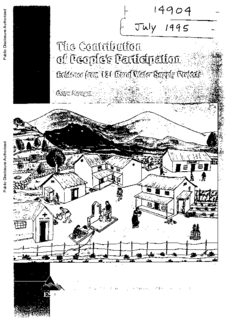
The drawing on the cover was prepared to generate discussion around local water problems. Such
drawings are used to focus members of a community on what their water problems are and to mobilize
them to work together toward solutions. The cover design is by May Eidi.
Deepa Narayan is a social scientist in the Environment Department of the World Bank.
Library of Congress Cataloging-in-Publication Data
Narayan-Parker, Deepa.
The contribution of people's participation: evidence from 121
rural water supply projects / by Deepa Narayan.
p. cm - (Environmentally sustainable development occasional
papers series ; no. 1)
Includes bibliographical references.
ISBN 0-8213-3043-8
1. Water-supply, Rural-Developing countries-Management-Citizen
participation. I. Title. II. Series.
HD1702.N37 1994
331.91'009172'4-dc2O 94-34109
CIP
Contents
Foreword vii
Acknowledgments viii
Executive Summary 1
CHAPTER 1
Introduction 5
CHAPTER 2
The Concept of Participation 7
What Is Participation? 7
Why Participate? 9
Who Participates? 10
How Do People Participate? 10
Inducing Collective Action 11
CHAPTER 3
Research Methodology and Project Descriptions 13
Methodology 13
Measuring Variables 16
CHAPTER 4
Role of Beneficiary Participation in Project Effectiveness 21
Participation and Project Effectiveness 21
Participation and Other Performance Determinants 23
Participation and Other Project Outcomes 25
How Important Is the "Halo Effect"? 28
Proximate Determinants and Participation 29
Project Experience with Beneficiary Participation 33
Policy Lessons 39
iii
iv The Contribution of People's Participation: Evidencefrom 121 Rural Water Supply Projects
CHAPTER5
Factors Affecting Beneficiary Participation 41
Degree and Elements of Participation 41
Determinants of Participation 44
Policy Lessons 62
CHAPTER6
Translating Lessons into Design Features 65
Selection Criteria 65
Demand Assessment 67
Institutional Framework 67
Funds and Financial Flow 69
Technology and Choice of Service Level 71
Approaches to Planning: Master Plan or Learning Process? 71
Monitoring and Evaluation 73
CHAPTER7
Conclusions and Recommendations 75
What Do We Know about Participation? 75
Why Hasn't Participation Occurred on a Large Scale? 76
What Can We Do Differently? 79
APPENDIXES
IA Participation with Other Direct Inputs into Water Project Effectiveness 83
1B Participation with Eighteen Direct and Indirect Inputs (Model 3) into Project Outcomes 84
2 Projects Rated High in Overall Effectiveness 86
3 Summary of Differences between Blueprint and Learning Process Approaches 98
4 Centre for Social Research: Indicators for Sociological Monitoring System-
Karonga Lakeshore Integrated Rural Groundwater Supply Project 99
Notes 101
Bibliography 105
Tables
3.1 Background characteristics of 121 water projects 16
3.2 Measures of performance outcomes and participation 17
3.3 Nonparticipation determinants of outcomes 18
3.4 Determinants of participation 19
4.1 Overall project effectiveness as a function of overall beneficiary participation 23
4.2 Water project performance outcomes as a function of overall beneficiary participation 25
4.3 Relationship of participation to environmental benefits and equality of access 26
4.4 Outcomes not specific to water systems, as a function of overall beneficiary participation 27
4.5 Tests for intercoder "halo effects" in coding project effectiveness and participation 28
4.6 Bivariate correlations between outcomes and proximate determinants 29
4.7 Impact of overall beneficiary participation on the institutional proximate determinants of project
performance 30
4.8 Impact of overall beneficiary participation on the physical outputs related to project
performance 31
4.9 Proximate determinants of water project outcomes as a function of beneficiary participation
in different stages 32
5.1 Correlations of elements of participation with overall beneficiary participation 43
Contents v
5.2 Relationships between demand and participation outcomes and elements 48
5.3 Relationships between beneficiary capacity and participation outcomes and elements 54
5.4 Relationships between client orientation and participation outcomes and elements 62
Figures
3.1 Model of the relationship of participation to outcomes and other factors 19
4.1 Model for testing the relationship of participation to performance outcomes 22
4.2 Cross-tabulation of overall project effectiveness with beneficiary participation by number
of projects 23
5.1 Model of relationships between beneficiary participation and its determinants 42
Boxes
4.1 Impact of nonparticipation factors on outcomes for water projects, the environment,
and equality outcomes 24
4.2 Paraguay: institutional and fiscal reforms 34
4.3 Kenya: community participation with a parastatal agency 35
4.4 Pakistan: community-based rural water systems 36
4.5 Uganda: decentralizing maintenance 37
5.1 Rwanda: government control over community decisionmaking, or a losing proposition? 44
5.2 Indonesia: evolution of a demand-led strategy 47
5.3 Yemen: role of local leaders in community mobilization 50
5.4 Malawi: water committees 51
5.5 Indonesia: the story of Mutis 52
5.6 Nigeria: difficulties in managing incentives 56
5.7 Tanzania: master plan incompatibility with demand orientation 57
5.8 Tunisia: combining local knowledge with Geographic Information Systems 57
5.9 Togo: investing in capacity building 59
5.10 Kenya: community-managed water utilities 61
6.1 Sri Lanka: guidelines on community preparation and community commitment 66
6.2 Nepal: a new funding mechanism 74
Foreword
T
his report is the first of a new series of agency problem was reluctance to give up con-
Occasional Papers to be issued by the trol or to invest in developing the capacity of
Office of the Vice President for Environ- local organizations.
mentally Sustainable Development. Since the The results of this study have profound impli-
essence of sustainable development is helping cations for the way the World Bank supports its
people make their own decisions and take res- partners in planning and implementing develop-
ponsibility for their own welfare, I am pleased to ment programs. Among the lessons gleaned from
launch this series with a report highlighting the the study are these: obtaining local participation
importance of local participation and social orga- in decisionmaking about development is sound
nization in the success of rural water supply pro- business practice, and special measures are need-
grams. This work clearly establishes the need to ed to ensure that the marginalized are reached in
invest in social infrastructure if physical infra- the participatory process. Participation can hap-
structure is to be used effectively. pen only in the right policy environment, in which
The study is based on systematic quantitative user demand is primary. Even when participation
and qualitative analysis of 121 rural water sup- is assured in planning, agencies must listen and
ply projects funded by many different agencies learn as projects are implemented.
in countries throughout the developing world. These principles are clear, and their implica-
The analysis consistently shows that beneficiary tions reach well beyond rural water supply pro-
participation was more significant than any jects. The challenge is to act on these principles
other factor in achieving functioning water sys- and to place people at the center of development.
tems and in building local capacity. The degree
of participation depended on local demand and
organization, and particularly important were Ismsil Serageldin
agency autonomy and the degree to which agen- Vice President
cies accepted and monitored the goal of achiev- Environmentally Sustainable Development
ing local participation. The most common The World Bank
vii
Acknowledgments
T
^ lhis study began in 1991 as part of the con- * PhaseI -Collection of evaluationr eports:D ouglas
tribution of the United Nations Develop- Keh and members of the Program's Regional
ment Programme (UNDP)-World Bank Water and Sanitation Groups, particularly Gunnar
Water and Sanitation Program to the Bank-wide Schultzberg and Sunita Chakravarty.
Participatory Development Learning Group. The * Phase II-Development of coding methodology:
study is a collaborative effort between the United Kurt Finsterbusch, assisted by Warren Van
Nations Development Programme-World Bank Wicklin and Elhum Haghihat. In addition to
Water and Sanitation Program, and the Social undertaking the coding process, Elhum Haghihat
Policy and Resettlement Division of the Environ- performed all the statistical work.
ment Department of the World Bank. It was * PhaseIll-Modelbuildingandmodeltesting:Lant
financed by the Governments of Sweden and Pritchett, with research assistance from Jon Isham,
Norway guided the testing process for the model, using
Particular thanks to John Blaxall, manager of multivariate regression analysis. Lant Pritchett
the UNDP-World Bank Water and Sanitation also helped organize the statistical evidence in
Program, and to Aubrey Williams, coordinator of chapters 4 and 5. Ellen Tynan helped develop the
the Bank-wide Participatory Development matrix included in appendix 2 and provided
Learning Group, for trusting that something use- assistance with analysis of the qualitative aspects
ful would come from the merger of methodolog- of the study
ical tools from economics and sociology. The document benefited from the comments
Several people played important supportive and review of John Blaxall, Norman Uphoff, Lant
roles in the early days of the project, when the Pritchett, Jannik Boesen, Kurt Finsterbusch,
methodology was still evolving: David Beckman, Warren Van Wicklin, and Aubrey Williams. Grace
Michael Cernea, David Howarth, Lawrence Sarin and Lidia Tokuda typed and formatted the
Salmen, and Michael Garn. manuscript. The manuscript was edited by Laurie
The study developed in three phases. I would Edwards and Donna van Lear, under the overall
particularly like to acknowledge the contribu- guidance of Alicia Hetzner, David Kinley, and
tions of the following people who played invalu- Virginia Hitchcock. The publication was desk-
able roles. topped by American Writing Corporation.
viii
Description:Valuing the Environment: Proceedings of the First Annual International Conference Participation and Other Performance Determinants 23 .. orientation through new institutional arrange- World Bank are now moving forward; . Uphoff 1977; Korten 1980; Paul 1987; and Ghai give people a voice-is