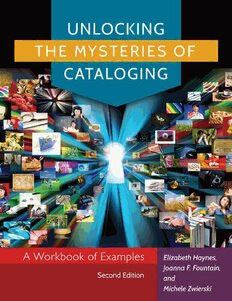
Table Of ContentT H E M Y S T E R I E S OF
I
CATALOGING
A Workbook of txamp~es
Elizabeth Haynes,
joanna F. Fountain,
Second Edition
and
Michele Zwierski
Unlocking the Mysteries of Cataloging
Unlocking the Mysteries of Cataloging
A Workbook of Examples
Second Edition
Elizabeth Haynes, Joanna F. Fountain,
and Michele Zwierski
Copyright©2015byElizabethHaynes,JoannaF.Fountain,andMicheleZwierski
Allrightsreserved.Nopartofthispublicationmaybereproduced,storedinaretrievalsystem,
ortransmitted,inanyformorbyanymeans,electronic,mechanical,photocopying,recording,or
otherwise,exceptfortheinclusionofbriefquotationsinareview,withoutpriorpermissionin
writingfromthepublisher.
LibraryofCongressCataloging-in-PublicationData
Haynes,Elizabeth(DorothyElizabeth)
Unlockingthemysteriesofcataloging:aworkbookofexamples/ElizabethHaynes,JoannaF.Fountain,and
MicheleZwierski.—Secondedition.
pagescm
Includesindexes.
ISBN978–1–61069–569–5(paperback)—ISBN978–1–61069–570–1(ebook) 1. Cataloging—Specimens.
2. Cataloging—Problems,exercises,etc.3. Descriptivecataloging—Problems,exercises,etc.4. Subject
cataloging—Problems,exercises,etc. I.Fountain,JoannaF.II.Zwierski,Michele.III.Title.
Z693.3.S65H39 2015
025.3—dc23 2014046724
ISBN:978–1–61069–569–5
EISBN:978–1–61069–570–1
19 18 17 16 15 1 2 3 4 5
ThisbookisalsoavailableontheWorldWideWebasaneBook.
Visitwww.abc-clio.comfordetails.
LibrariesUnlimited
AnImprintofABC-CLIO,LLC
ABC-CLIO,LLC
130CremonaDrive,P.O.Box1911
SantaBarbara,California93116-1911
Thisbookisprintedonacid-freepaper
ManufacturedintheUnitedStatesofAmerica
This workbook is dedicated:
To the faculty and staff of the School of Library and Information
Science at the University of Southern Mississippi who have been
such a support for me for the past 15 years.
—E. Haynes
To friends, family, and colleagues who have encouraged me in my
efforts to provide aids for new and developing catalogers through-
out my career as a librarian and educator.
—J. Fountain
To my family and colleagues who generously gave of their time
and support.
—M. Zwierski
Contents
Introduction..................................................................................................................................ix
Notes onRDACataloging....................................................................................................x
Informationforthe Instructor..............................................................................................xi
Acknowledgments...............................................................................................................xii
Objectives of Cataloging....................................................................................................xii
Ranganathan’sFiveLaws of LibraryScience....................................................................xv
Keys YouNeedto Get Started:Bibliographyof Cataloging Toolsand Aids...................xvi
About MARC...................................................................................................................xviii
Exercises.......................................................................................................................................1
Appendix A: Selected Genreand FormTerms........................................................................125
Selected English-Language Genre/Form Terms...............................................................126
Selected Spanish-Language Genre/Form Terms..............................................................130
Appendix B: MARCRecords forSelected Exercises..............................................................133
Index to Exercises byNumber.................................................................................................197
Index to Titles in Alphabetical Order.......................................................................................199
Index to Typesof Material.......................................................................................................201
Index to Topics, Themes, etc....................................................................................................203
vii
Introduction
In your hands you have a compilation of 100 examples of books and other materials found in
today’s libraries. These have been carefully chosen to illustrate some of the interesting elements that
are reflected in library catalogs—details that have come to seem so commonplace that many people
believethey can be magically found simply by searching on “keywords,” which are loosely defined as
anyform of aname or titleor subject.
Ittakesonlyafewminutesforacataloger,orinfactanypersonwhowishestodescribeanitemora
work,torealizethatthetaskisfarmorecomplexandchallengingthanasearcherattheotherendofthe
processmightimagine!Aperson’snamemaybespelledvariouswaysormayhavechanged.Atitlemay
appearindifferentformsindifferentplaces,languages,andlists.Subjectscanbesovariouslydescribed
thatwholecareershavebeenbuiltontryingtopindownandestablishpredictableforms—anobjectiveas
elusive as theproverbial “herding cats”—regardlessof the complexity of thesubjectmatter.
Thefirsteditionoftheworkbookcontainedmanymorebooksthanothertypesofmaterials,andthis
was a reflection of most libraries’ collections at that time. The current edition changes that proportion,
and adds records for graphic “novels” and manga as well as more exercises focusing on other types of
materials: sound recordings, videos, and computer-based selections. All the graphics reflect real-world
exemplars. Where therewere details necessary for cataloging, but not easily reproduced directly, these
have been provided as “additional information”for thestudent, instructor,or practicingcataloger.
We have provided a Student Resources page that shows the graphics for all the materials in color
and in enlargeable formats at http://www.abc-clio.com/LibrariesUnlimited/product.aspx?pc=A4251P.
This,and all otherlinks, were currentas of the publicationof this workbook.
Inaddition,thebookincludes“answer”recordsformanyoftheexamples;therestareavailablefor
classroomandindividualpractice,andinstructorshaveaccesstotheanswerrecordsforthose.Students
andcatalogersalikewhoareseekingfurtherpracticeorguidanceshouldstudythesecarefully,asdetails
that seem unimportant to the eyeare often crucial to the searcher using the sophisticated software used
bylibraries fortheir catalogs.
Instructors are able to receive special additional materials that contain all the answer records.
Commentsfrom all usersof theworkbookand its related sites will be mostwelcome!
Answer records are provided in two styles. The first record is an updated record similar to those
providedinthefirsteditionandisbasedonwhatwilllikelybethelastversionofAACR2R(therevised
Anglo-American Cataloguing Rules), which in turn replaced earlier standards in various countries.
The second record for each example follows the most recent style suggested by the RDA (Resource
Descriptionand Access) code (see furthernotesbelow).
Both records are presented in a standard display of a simulated MARC (MAchine-Readable
Cataloging) record. Note that the fields used are not identical in the two records, due to the differences
betweenthe two standards.
However, all English-language entries in both types of records—names, series and uniform titles,
and subject entries—have been taken from the Library of Congress Authorities Web site, http://
authorities.loc.gov/, which includes terms used in the records that include the “lcgft” source code.
These also include the “LC Genre/Form Thesaurus” terms and “LC Subject Headings and Annotated
Card Program” headings, which are used in catalogs especially designed for use by juvenile and youth
in all typesof libraries.
ix