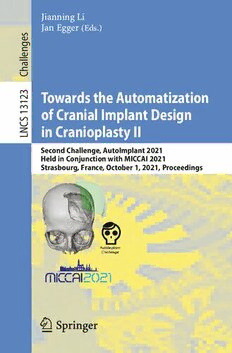
Table Of ContentJianning Li
Jan Egger (Eds.)
s
e
g
n
e
l
l
a
h
C
3 Towards the Automatization
2
1
3
of Cranial Implant Design
1
S
C
in Cranioplasty II
N
L
Second Challenge, AutoImplant 2021
Held in Conjunction with MICCAI 2021
Strasbourg, France, October 1, 2021, Proceedings
Lecture Notes in Computer Science 13123
FoundingEditors
GerhardGoos
KarlsruheInstituteofTechnology,Karlsruhe,Germany
JurisHartmanis
CornellUniversity,Ithaca,NY,USA
EditorialBoardMembers
ElisaBertino
PurdueUniversity,WestLafayette,IN,USA
WenGao
PekingUniversity,Beijing,China
BernhardSteffen
TUDortmundUniversity,Dortmund,Germany
GerhardWoeginger
RWTHAachen,Aachen,Germany
MotiYung
ColumbiaUniversity,NewYork,NY,USA
Moreinformationaboutthissubseriesathttps://link.springer.com/bookseries/7412
·
Jianning Li Jan Egger (Eds.)
Towards the Automatization
of Cranial Implant Design
in Cranioplasty II
Second Challenge, AutoImplant 2021
Held in Conjunction with MICCAI 2021
Strasbourg, France, October 1, 2021
Proceedings
Editors
JianningLi JanEgger
GrazUniversityofTechnology GrazUniversityofTechnology
Graz,Austria Graz,Austria
UniversityHospitalEssen UniversityHospitalEssen
Essen,Germany Essen,Germany
ISSN 0302-9743 ISSN 1611-3349 (electronic)
LectureNotesinComputerScience
ISBN 978-3-030-92651-9 ISBN 978-3-030-92652-6 (eBook)
https://doi.org/10.1007/978-3-030-92652-6
LNCSSublibrary:SL6–ImageProcessing,ComputerVision,PatternRecognition,andGraphics
©SpringerNatureSwitzerlandAG2021
Thisworkissubjecttocopyright.AllrightsarereservedbythePublisher,whetherthewholeorpartofthe
material is concerned, specifically the rights of translation, reprinting, reuse of illustrations, recitation,
broadcasting, reproduction on microfilms or in any other physical way, and transmission or information
storageandretrieval,electronicadaptation,computersoftware,orbysimilarordissimilarmethodologynow
knownorhereafterdeveloped.
Theuseofgeneraldescriptivenames,registerednames,trademarks,servicemarks,etc.inthispublication
doesnotimply,evenintheabsenceofaspecificstatement,thatsuchnamesareexemptfromtherelevant
protectivelawsandregulationsandthereforefreeforgeneraluse.
Thepublisher,theauthorsandtheeditorsaresafetoassumethattheadviceandinformationinthisbookare
believedtobetrueandaccurateatthedateofpublication.Neitherthepublishernortheauthorsortheeditors
give a warranty, expressed or implied, with respect to the material contained herein or for any errors or
omissionsthatmayhavebeenmade.Thepublisherremainsneutralwithregardtojurisdictionalclaimsin
publishedmapsandinstitutionalaffiliations.
ThisSpringerimprintispublishedbytheregisteredcompanySpringerNatureSwitzerlandAG
Theregisteredcompanyaddressis:Gewerbestrasse11,6330Cham,Switzerland
Preface
Different countries can have difference clinical practices of cranioplasty - a surgical
proceduretorepaircranialdefects.Forsomecountriesandclinicalinstitutes,acranial
implant is the primary choice for the repairment of cranial defects. However, the
designandmanufacturingofcranialimplants,especiallypatient-specificimplants(PSIs),
remains time-consuming and expensive. Hence, current workflows of cranioplasty
demandimprovements.
The second AutoImplant cranial implant design challenge (AutoImplant 2021,
https://autoimplant2021.grand-challenge.org/) was organized as a satellite event of
the Medical Image Computing and Computer Assisted Interventions (MICCAI 2021)
conference,focusingspecificallyontheclinicalusabilityoftheautomaticcranialimplant
designalgorithms.Thus,threetasktrackswerecreatedforAutoImplant2021;Task1
and Task 3 focused on the generalization ability of the algorithms on varied synthetic
defectpatterns,asweobservedfromtheprioreditionofthechallengethatimproving
thegeneralizationabilityisnon-trivial,yetessentialfortheproblemofautomaticcranial
implant design. Task 2 provided 11 pre-cranioplasty skulls with real defects from the
clinicalroutineforaclinicalevaluationofthealgorithms.Clinicalexpertswereinvited
tomanuallyassesstheclinicalusabilityofthepredictionsforTask2basedonascoring
system ranging from 1 point (not usable) to 5 points (flawless). The conference was
held virtually on October 1, 2021, and featured 11 talks, including two invited talks
fromGermanandAmericanneurosurgeonswhospecializeincranioplastyandcranial
implantdesign.
Thechallengeproceedingsarecomprisedof10papers(8–18pageslong),including
oneinvitedpaperfromclinicalexpertsaboutcranioplastymanagement.Adescriptorfor
thecreationoftheTask1datasetwasalsoprovidedbytheorganizingteammembers.
Clinicalexperts’evaluationsfortheTask2submissionswerecompiledasanindependent
paper,aswebelievethequalitativeevaluationcriteriausedbyclinicalexpertsarevaluable
tothe(automatic)cranialimplantdesigncommunitysincegeneralquantitativemetrics
alonearenotcloselycorrelativeoftheactualpracticalusabilityofthecranialimplants.
Thechallengepaperswerereviewedinasingle-blindmannerandeachchallengepaper
receivedthreetofourreviews.Itwasrequiredthat,forthecamera-readyversionofthe
acceptedpapers,thereviewers’commentsmustbeaddressedandincorporated.There
isonepaperthatgotacceptedafteramajorrevision.
Wearegratefultotheorganizingteammembers,theauthors,andthespeakersfor
makingourconferenceasuccess,andforcontributingtotheadvancementofautomatic
cranialimplantdesign.
October2021 JianningLi
JanEgger
Organization
GeneralChairs
JianningLi Graz University of Technology and Medical University of
Graz,AustriaandUniversityHospitalEssen,Germany
JanEgger Graz University of Technology and Medical University of
Graz,AustriaandUniversityHospitalEssen,Germany
ChallengeCommitteeandCo-organizers
MicheleR.Aizenberg UniversityofNebraskaMedicalCenter,USA
VictorAlves UniversityofMinho,Portugal
DavidG.Ellis UniversityofNebraskaMedicalCenter,USA
OldˇrichKodym BrnoUniversityofTechnology,CzechRepublic
KarinPistracher MedicalUniversityofGraz,Austria
MichalŠpaneˇl BrnoUniversityofTechnology,CzechRepublic
GordvonCampe MedicalUniversityofGraz,Austria
Sponsors
TESCAN3DIMJointVenture(https://www.tescan3dim.com/)
CAMed:Clinicaladditivemanufacturingformedicalapplications
(https://www.medunigraz.at/camed/)
viii Organization
Acknowledgements
The challenge received the support of CAMed - Clinical additive manufacturing for
medical applications (COMET K-Project 871132), which is funded by the Austrian
Federal Ministry of Transport, Innovation and Technology (BMVIT), the Austrian
FederalMinistryforDigitalandEconomicAffairs(BMDW),andtheStyrianBusiness
PromotionAgency(SFG).Furthermore,thechallengehadthesupportoftheAustrian
ScienceFund(FWF)KLI678-B31:“enFaced:VirtualandAugmentedRealityTraining
and Navigation Module for 3D-Printed Facial Defect Reconstructions”. We also want
to thank the Computer Algorithms for Medicine Laboratory (https://cafe-lab.org/)
members and the paper reviewers. Finally, we thank Zhaodi Deng for the design of
theoriginalchallengelogo.
Contents
PersonalizedCalvarialReconstructioninNeurosurgery ..................... 1
LaurèlRauschenbach,ChristophRieß,UlrichSure,andKarstenH.Wrede
QualitativeCriteriaforFeasibleCranialImplantDesigns .................... 8
DavidG.Ellis,CarlosM.Alvarez,andMicheleR.Aizenberg
SegmentationofDefectiveSkullsfromCTDataforTissueModelling ......... 19
OldrˇichKodym,MichalŠpaneˇl,andAdamHerout
Improving the Automatic Cranial Implant Design in Cranioplasty
byLinkingDifferentDatasets ........................................... 29
MarekWodzinski,MateuszDaniol,andDariaHemmerling
LearningtoRearrangeVoxelsinBinarySegmentationMasksforSmooth
ManifoldTriangulation ................................................. 45
JianningLi,AntonioPepe,ChristinaGsaxner,YuanJin,andJanEgger
AU-NetBasedSystemforCranialImplantDesignwithPre-processing
andLearnedImplantFiltering ........................................... 63
HamzaMahdi, AllisonClement, EvanKim, ZacharyFishman,
CariM.Whyne,JamesG.Mainprize,andMichaelR.Hardisty
SparseConvolutionalNeuralNetworkforSkullReconstruction .............. 80
ArtemKroviakov,JianningLi,andJanEgger
CranialImplantPredictionbyLearninganEnsembleofSlice-BasedSkull
CompletionNetworks .................................................. 95
BokaiYang,KeFang,andXingyuLi
PCA-Skull: 3D Skull Shape Modelling Using Principal Component
Analysis ............................................................. 105
LeiYu,JianningLi,andJanEgger
Cranial Implant Design Using V-Net Based Region of Interest
Reconstruction ........................................................ 116
ShashwatPathak,ChitimireddySindhura,RamaKrishnaSaiS.Gorthi,
DegalaVenkataKiran,andSubrahmanyamGorthi
AuthorIndex ......................................................... 129
Personalized Calvarial Reconstruction
in Neurosurgery
B
LaurèlRauschenbach( ),ChristophRieß,UlrichSure,andKarstenH.Wrede
DepartmentofNeurosurgeryandSpineSurgery,UniversityHospitalEssen,Hufelandstrasse55,
45147Essen,Germany
[email protected]
Abstract. Neurosurgical procedures often involve local skull bone removal to
combatspecificpathologies.Defectcoveringismandatoryinmostcasesandusu-
ally requires the application of bespoke and synthetically engineered implants.
Sincemanufacturingmanagementfacesseveralbarriersinthedesign,fabrication,
andapplicationprocess,thereisanunmetneedforimprovement.Inthisarticle,
theauthorsreviewthebackgroundofskullboneremovalandcalvarialreconstruc-
tion techniques, highlight the challenges on the horizon, and investigate future
pathways.
Keywords: Craniectomy·Cranioplasty·Personalizedmedicine·Implant·
Neurosurgery
1 IndicationsforCraniectomy
Craniectomyisthesurgicalremovalofbonefromtheskull.Inmostcases,livingwith
a cranial bone defect is temporary. In a follow-up surgery, the removed bone flap can
either be reimplanted or the defect can be covered using synthetically manufactured
implants[1,2].Thereasonsforcraniectomyaremanifold,involvingnumerousdifferent
pathologies.
Mostcommonly,craniectomyaimstodecompress,relievingthemasseffectofbrain
swellinganddecreasingelevatedintracranialpressure.Brainswellingconstitutesalife-
threateningemergencyandisoftentheresultofbleedingoredemaderivingfrominfarc-
tion,traumaticbraininjury,cerebralhypoxia,intracerebralhemorrhage,cerebralvenous
thrombosis, or encephalitis [3, 4]. Notably, the idea of decompressive craniectomy is
notnew.Centuriesago,AlexanderMonroandGeorgeKelliefirstdescribedtherelation-
shipbetweenintracranialcontentandintracranialpressure.Afterseveralrevisions,this
conceptlaterbecameknownastheMonro-Kelliedoctrine[5].Thisprinciplestatesthat
thesumofbrainvolume,intracranialcerebrospinalfluid,andintracranialbloodmustbe
constanttoensureanequilibriumofphysiologicalintracranialpressure.Anincreasein
onevolumeshouldcauseareciprocaldecreaseintheremainingcomponents;Otherwise,
theintracranialpressurewillrise.Thus,brainswellingalwaysdisplacescerebrospinal
fluid and blood out of the skull to create space. However, given the small volume of
intracranial cerebrospinal fluid and blood, these compliance mechanisms are usually
©SpringerNatureSwitzerlandAG2021
J.LiandJ.Egger(Eds.):AutoImplant2021,LNCS13123,pp.1–7,2021.
https://doi.org/10.1007/978-3-030-92652-6_1