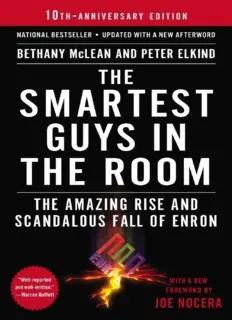
Table Of ContentPORTFOLIO / PENGUIN
THE SMARTEST GUYS IN THE ROOM
Bethany McLean and Peter Elkind were Fortune senior writers when this book
was originally published in 2003.
McLean’s March 2001 article in Fortune, “Is Enron Overpriced?” was the
first in a national publication to openly question the company’s dealings. She
now lives in Chicago with her husband, Sean Berkowitz, who was the head of
the Enron Task Force when they met in 2006. McLean is a contributing editor at
Vanity Fair and a columnist at Reuters.
Elkind, an award-winning investigative reporter, is the author of The Death
Shift and Client 9: The Rise and Fall of Eliot Spitzer. A former editor of the
Dallas Observer, he has been an associate editor at Texas Monthly and written
for The New York Times Magazine and The Washington Post. Now editor-at-
large at Fortune, he lives in Fort Worth, Texas.
For Chris
—B.M.
For Laura
—P.E.
PORTFOLIO / PENGUIN
Published by the Penguin Group Penguin Group (USA) LLC
375 Hudson Street
New York, New York 10014
USA | Canada | UK | Ireland | Australia | New Zealand | India | South Africa | China penguin.com
A Penguin Random House Company First published in the United States of America by Portfolio, a member of Penguin Group (USA)
Inc., 2003
Updated paperback edition published 2004
This edition with a new foreword and afterword published 2013
Copyright © 2003, 2004 by Fortune, a division of Time, Inc.
Foreword copyright © 2013 by Joe Nocera Afterword copyright © 2013 by Bethany McLean and Peter Elkind Penguin supports
copyright. Copyright fuels creativity, encourages diverse voices, promotes free speech, and creates a vibrant culture. Thank you for
buying an authorized edition of this book and for complying with copyright laws by not reproducing, scanning, or distributing any part
of it in any form without permission. You are supporting writers and allowing Penguin to continue to publish books for every reader.
Grateful acknowledgment is made for permission to reprint the following copyrighted works: “Hotel Kenneth Laya” by James A.
Hecker, © 1995 James A. Hecker. Used with permission; “Perfect Day” by Tim James and Antonina Armato, © 2001 WB Music
Corp., Out of the Desert Music, and Tom Sturges Music o/b/o Antonina Songs. All rights reserved. Used by permission of Warner
Bros. Publications U.S. Inc. and Tom Sturges Music.
THE LIBRARY OF CONGRESS HAS CATALOGED THE HARDCOVER EDITION AS FOLLOWS: McLean, Bethany.
The smartest guys in the room : the amazing rise and scandalous fall of Enron / Bethany
McLean and Peter Elkind.
p. cm.
Includes index.
ISBN 978-1-59184-008-4 (hc.) ISBN 978-1-59184-660-4 (pbk.) ISBN 978-0-69815882-5 (eBook) l. Enron Corp.—History. 2. Energy
industries—Corrupt practices—United States. 3. Business failures—United States—Case studies. I. Elkind, Peter. II. Title.
HD9502.U54E5763 2003
333.79'0973—dc21
Version_1
FOREWORD
In February 2001, as the editorial director of Fortune magazine, I helped edit a
short, rigorous story—just four pages long—by a young writer named Bethany
McLean, who had joined the magazine some six years earlier from Goldman
Sachs and quickly become one of Fortune’s brightest stars. Her story was
entitled, simply, “Is Enron Overpriced?”
At its core, Bethany’s article asked one very straightforward question: How
does Enron make its money? For years the company had been a Wall Street
darling, its stock moving steadily upward with each new quarter’s rising profits.
It was seen as the paradigmatic example of a company that had transformed
itself from an old-economy stalwart—operating pipelines that moved natural gas
—to a new-economy marvel, creating dazzling efficiencies and hedging risks
(like the weather!) that no one had ever thought to hedge before. Just a month
before Bethany’s story ran, Businessweek had put Enron’s chief executive,
Jeffrey Skilling, on its cover, posing with what appeared to be harnessed
electricity in his hand, with the cover line “Power Broker.”
But Bethany had been poring through Enron’s financial documents, and what
she realized was not just that they were complicated (most big companies have
complicated financials) but that they were incomprehensible, even
indecipherable. She started calling around to the Wall Street analysts who were
so bullish on Enron, asking her simple question.
Some of them told her that Enron was a company you just had to trust. One
analyst admitted to her that the company’s earnings were “a black box.” When
she reached Skilling himself, the Enron CEO first complained that she “didn’t
get it,” something he often said to people who questioned Enron. Then he hung
up the phone on her. The Enron public-relations department insisted that if she
would just come to Houston and visit the company’s headquarters, the fog would
soon lift. But with our deadline fast approaching, the Enron PR department
decided that if Mohammed wouldn’t come to the mountain, they would have to
visit Fortune. The company sent a small contingent to New York to meet with
Bethany and her editors, including me. Andy Fastow, the company’s chief
financial officer, led the Enron team.
It would later be blindingly obvious that Fastow had not told us the truth—
how could he, given that much of Enron’s earnings were the result of accounting
manipulations that created the illusion of profitability? But even in the moment it
was clear that Fastow’s goal was pretty much the same as those financials
Bethany had been poring through: to obfuscate and confuse. I can’t remember all
the details, but I vividly recall Bethany asking sharp, pointed questions about the
company’s business model and Fastow responding with lengthy, nearly
unintelligible answers about how Enron was like Toyota, how it should be
thought of as a logistics company, etc., etc.—even though Enron’s main business
wasn’t actually moving anything from place to place, but rather trading.
And then something happened that Bethany and I would never forget. As the
meeting was drawing to a close and the Enron executives were putting on their
coats, Fastow turned to Bethany and said, “I don’t care what you say about
Enron. Just don’t make me look bad.”
It was such a jarring thing for him to say on the eve of what was clearly
going to be an unflattering article about his company. In retrospect, it was a tip-
off—to the mentality of the people running Enron and to the fact that there was
indeed something fishy about those financial statements—Fastow was, after all,
Enron’s CFO. It was a real signal that Bethany—whose story wound up raising
all the right questions, even if she didn’t yet have all the answers—was on to
something.
Some articles drop like bombshells. Bethany’s wasn’t like that. Instead, it
slowly seeped into the consciousness of Wall Street. Enron’s stock had been in
the 70s when Bethany’s story was published, not far from its all-time high. Ever
so steadily, it began to sink. In April, Skilling was questioned on a conference
call by an investor who asked his own tough questions. “Asshole,” Skilling
muttered under his breath. In August, Skilling suddenly and unexpectedly quit as
chief executive—a move that was all the more stunning because he had taken
over as CEO just six months earlier from Enron founder Ken Lay. Though
Skilling had effectively been running the company for years, everyone knew
how much he had wanted the actual title of chief executive. His resignation
triggered a flurry of skeptical stories and questions.
And then came October. With the stock having fallen into the high 30s—and
Lay, back as CEO, trying to persuade a now-skeptical Wall Street that
everything was fine—the Wall Street Journal revealed that Fastow had made
tens of millions on the side running a pair of limited partnerships that had done
business with Enron. That story helped accelerate the feeding frenzy that was
already developing, both in the press and on Wall Street, around Enron. By
November, Fastow was gone, sacrificed by Lay as he desperately tried to keep
Enron afloat. But like any company that trades for a living—just like Lehman
Brothers or Bear Stearns seven years later—once Enron had lost the confidence
of its trading partners, it was toast. On December 2, 2001, the company filed for
bankruptcy.
Even then, though, nobody knew the full story of what had brought down
Enron. Fastow’s LJM partnerships got the immediate blame—both inside and
outside of Enron—but one of the main points of The Smartest Guys in the Room
is that Fastow wasn’t actually the one who brought down Enron. His chicanery
—which he’d later testify was approved by Skilling—was actually what was
propping up Enron. The real story was that Enron’s businesses weren’t making
much money, and that much of their profits were phony. The whole point of
Fastow’s dealings, from Enron’s point of view, was to make it appear that the
company was a profit machine that it clearly wasn’t. (And if Fastow skimmed a
little on the side, well, what can you do?) Enron’s aura had been such that
nobody had ever bothered looking into the internal strife, the macho posing, the
rampant greed—and the dysfunction in the company’s executive suite, starting
with the out-to-lunch Lay and the emotionally unstable Skilling.
Right after Enron filed for bankruptcy, Bethany wrote a terrific cover story
about the company’s decline and fall in which she touched on some of these
larger themes. In editing the article I realized how well-sourced she was, but I
could also clearly see that there was a much bigger, more important story here
than simply a crooked CFO who was lining his pockets. Her story made it
obvious that the rise and fall of Enron would make a terrific book.
So I went to my bosses and suggested that we—Fortune magazine—take
advantage of Bethany’s Enron reporting and write a book about what had
happened. Because there was so much to unravel, I suggested she team up with
Peter Elkind, a Texas-based Fortune writer who had written a series of fabulous
investigative sagas for the magazine. Happily, everyone agreed. In 2003,
Portfolio published the first edition of The Smartest Guys in the Room. I am
biased, of course, but I contend that it remains the single most authoritative
account of this landmark event.
It is far more than that, though. The Smartest Guys in the Room is an almost
anthropological examination of the nature of corporate scandal. Why do values
go awry? What happens when the wrong person gets a big job? Why is it so
tempting to post false profits instead of telling the truth? How distorting is the
prospect of stock market riches?
In the immediate aftermath of Enron, there were at least a half-dozen other
big corporate blowups: WorldCom turned out to be cooking its books, and CEO
Bernie Ebbers went to jail. Tyco became embroiled in scandal, and its chief,
Dennis Kozlowski, also went to prison. But none of these disasters have
resonated like Enron. At many business schools, studying Enron is part of the
curriculum. Just recently, Andy Fastow, who was released from prison in 2011,
gave an unpaid speech in Las Vegas at a conference of fraud examiners. He
drew a full-house crowd of 2,500 people. Afterward, some of the fraud
examiners and convention staffers asked to have their pictures taken with him.
Explained one: “He’s part of history.”
Enron remains the defining scandal of the 21st century. None of those other
scandals had the staying power—or the canary-in-the-coal-mine quality—of
Enron. This was partly because no other modern-day company, prior to the
financial crisis of 2008, had Enron’s vaunted reputation. But it is also because
almost everything we later found out about how Enron operated was a harbinger
of scandals yet to come. Off-balance-sheet vehicles. Banks doing things they
shouldn’t to generate fees. Ratings agencies giving safe ratings to investments
that were clearly doomed to fail. Corporate executives using every means
possible to maximize short-term revenues—and boost their own multimillion-
dollar bonuses—even when those means were, at best, unethical.
Congress held hearings in the wake of the Enron bankruptcy; it even passed a
law, Sarbanes-Oxley, that was intended to prevent future scandals. (Among
other provisions, the law calls for the CEO and CFO of a publicly traded
company to sign a document attesting to the validity of its numbers. Despite
numerous instances of post-Enron fraud, the power of that document has never
been tested in court.) Newspapers and magazines wrote dozens of articles about
how to prevent future Enrons. Jeffrey Skilling and Kenneth Lay were tried and
given lengthy sentences (Lay, of course, died of a heart attack before he ever
spent a day in jail). And then we all moved on.
No one can say for sure whether a more rigorous Washington response to
Enron might have prevented the financial crisis of 2008. But I tend to think so.
Both Enron and the financial crisis were the products of the same deregulatory
impulse that seized Washington in the 1990s. Enron had exposed the deep,
systemic flaws of the ratings agencies. The off-balance-sheet vehicles Enron
used were the same kind of vehicles banks used to hold their collateralized debt
obligations—the so-called toxic assets that did so much damage to the financial
system when they collapsed. And they existed for the same reason: to hide debt.
On one level, the Enron scandal, as told in the pages that follow, is simply a
great, rollicking tale. When Bethany and Peter set out to write The Smartest
Guys in the Room, telling that story is all they were really trying to do. But it is
impossible to read this book today, a decade after it was first published, and not
wonder what might have been—if everyone had been willing to pay just a little
more attention.
Joe Nocera
July 2013
Op-Ed columnist
The New York Times