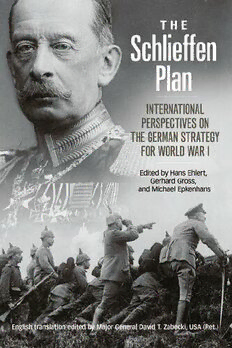
Table Of ContentThe Schlieffen Plan
Foreign Military Studies
History is replete with examples of notable military campaigns and
exceptional military leaders and theorists. Military professionals and
students of the art and science of war cannot afford to ignore these sources
of knowledge or limit their studies to the history of the U.S. armed forces.
This series features original works, translations, and reprints of classics
outside the American canon that promote a deeper understanding of
international military theory and practice.
Series editor: Roger Cirillo
An AUSA Book
The
Schlieffen
Plan
InTernaTIonal PerSPecTIveS
on The German STraTeGy
for World War I
Edited by
Hans Ehlert, Michael Epkenhans,
and Gerhard P. Gross
English translation edited by
Major General David T. Zabecki, USA (Ret.)
Copyright © 2014 by Zentrum für Militärgeschichte und Sozialwissenschaften der
Bundeswehr (ZMS)
Published by special arrangement with Zentrum für Militärgeschichte und
Sozialwissenschaften der Bundeswehr (ZMS). The original edition was published
under the title Der Schlieffenplan: Analysen und Dokumente, edited by Hans Ehlert,
Michael Epkenhans, and Gerhard P. Gross (Munich: Odenberg, 2006).
English-language edition published by the University Press of Kentucky
Scholarly publisher for the Commonwealth,
serving Bellarmine University, Berea College, Centre College of Kentucky, Eastern
Kentucky University, The Filson Historical Society, Georgetown College,
Kentucky Historical Society, Kentucky State University, Morehead State University,
Murray State University, Northern Kentucky University, Transylvania University,
University of Kentucky, University of Louisville, and Western Kentucky University.
All rights reserved.
Editorial and Sales Offices: The University Press of Kentucky
663 South Limestone Street, Lexington, Kentucky 40508–4008
www.kentuckypress.com
Cataloging-in-Publication data is available from the Library of Congress.
978-0-8131-4746-8 (hardcover : alk. paper)
978-0-8131-4747-5 (pdf)
This book is printed on acid-free paper meeting the requirements of the American
National Standard for Permanence in Paper for Printed Library Materials.
Manufactured in the United States of America.
Member of the Association of
American University Presses
Contents
Map Key vii
Introduction: The Historiography of Schlieffen and the
Schlieffen Plan 1
Hans Ehlert, Michael Epkenhans, and Gerhard P. Gross
The Sword and the Scepter: The Powers and the European System
before 1914 17
Klaus Hildebrand
The Moltke Plan: A Modified Schlieffen Plan with Identical Aims? 43
Annika Mombauer
The Schlieffen Plan—A War Plan 67
Robert T. Foley
There Was a Schlieffen Plan: New Sources on the History of German
Military Planning 85
Gerhard P. Gross
“This Trench and Fortress Warfare Is Horrible!” The Battles in Lorraine
and the Vosges in the Summer of 1914 137
Dieter Storz
The Military Planning of the Austro-Hungarian Imperial and Royal
Army and the Schlieffen Plan 189
Günther Kronenbitter
French Plan XVII: The Interdependence between Foreign Policy and
Military Planning during the Final Years before the Outbreak of the
Great War 209
Stefan Schmidt
Russian Forces and the German Buildup at the Outbreak of
World War I 247
Jan Kusber
The Southern Envelopment: Switzerland’s Role in the Schlieffen and
Moltke Plans 261
Hans Rudolf Fuhrer and Michael Olsansky
The British Army, Its General Staff, and the Continental Commitment,
1904–1914 293
Hew Strachan
Belgium: Operational Plans and Tactics of a Neutral Country 319
Luc de Vos
Appendix: Deployment Plans, 1893–1914 339
Glossary of German Military Terms and Acronyms 527
List of Contributors 533
Index 539
Photographs follow page 188
General Map Key
General Terms and Notes:
Lagenskizzen Situation Sketches
Aufmarsch Deployment
Alpenjäger Mountain Light Infantry
Grenzschutz Border Security
Ersatz Replacement
Landwehr Territorial Reserve
Bahnfahrt Rail Movement
Stellungen am 10.9. Positions on 10 September
Rückmärsche am: Retrograde March on:
10 Armee Korps Ten Army Corps
6 Ersatz Korps Six Replacement Corps
22. 22nd Mobilization Day
Die mit diesem Pfeil bezeichneten The red arrows indicate the
Verbände wurden in den nächsten French units that were withdrawn
Tagen weggezogen. in the following days.
Cavalry
Fortress
Fortified Position
Examples of Military Unit Designations:
Armee d’Alsace Army of Alsace
6. Armee Sixth Army
G. Guards Corps
G.R. Guards Reserve Corps
XV. XV Army Corps
XIV.R. XIV Reserve Corps
III.b III Bavarian Corps, or…..
III.B. III Bavarian Corps
I.b R. I Bavarian Reserve Corps
2.G.R. 2nd Guards Reserve Division
G.E. Guards Ersatz Division
28. 28th Division
30.R. 30th Reserve Division
6.E. 6th Ersatz Division
2.B.L. 2nd Bavarian Landwehr Division
7th Cavalry Division
7.
60.I.Br. 60th Infantry Brigade
55.E.Br. 55th Ersatz Brigade
60.L.Br. 60th Landwehr Brigade
1.b L.Br. 1st Bavarian Landwehr Brigade
©ZMSBw
07028-02
Introduction
The Historiography of Schlieffen and
the Schlieffen Plan
Hans Ehlert, Michael Epkenhans,
and Gerhard P. Gross
Anniversaries generally provide a good opportunity to commemorate histor-
ical personalities or important events of the past. Such a personality is Field
Marshal Count Alfred von Schlieffen. Despite the fact that he, contrary to his
famous predecessor Field Marshal Count Helmuth von Moltke the Elder, did
not fight a battle or directly conduct or win or lose a war, there is no escaping
him when considering Prussian-German military history in general and the
prehistory of the First World War in particular. Schlieffen and his Denkschrift
für einen Krieg gegen Frankreich (Memorandum for a War against France),
which he wrote more than one hundred years ago during the winter of 1905–
1906, are important elements of the cultural memory that explain the out-
break of the First World War in the summer of 1914. According to the 1998
twentieth edition of the German Brockhaus Encyclopedia, Schlieffen tried “to
meet the requirements of the modern war by establishing the technical troop
requirements. For him the highest form of the operational art was the double
envelopment and the subsequent annihilation of the enemy.” Brockhaus fur-
ther reads: “The basic idea of the Schlieffen Plan of 1905 was the concentra-
tion of the mass of the German field army in the west and a simultaneous
strategic defense in the east.” The operational objective was the annihilation
of the French Army within a few weeks without having a force ratio superi-
ority. “In the case of a war against Russia as well, the intent was to shift the
center of gravity immediately to the east.”1
For decades that interpretation has shaped our knowledge of the prehis-
1