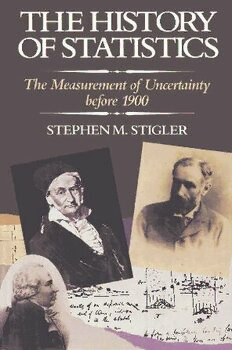
Table Of ContentStephen M. Stigler
THE HISTORY OF STATISTICS
The Measurement of Uncertainty before 1900
THE BELKNAP PRESS OF HARVARD UNIVERSITY PRESS
Cambridge, Massachusetts, and London, England
Copyright© 1986 by the President and Fellows of Harvard College
All rights reserved
Printed in the United States of America
10 9 8 7 6 5 4 3 2
This book is printed on acid-free paper, and its binding materials
have been chosen for strength and durability.
Set in APS-5 Baskerville and designed by Marianne Perlak
Lzbrary of Congress Catalogzng-zn-Publzcatzon Data
Stigler, Stephen M.
The history of statistics.
Bibliography: p.
Includes index.
I. Statistics-History. I. Title.
QA276.15.S75 1986 519.5'09 85-30499
ISBN 0-674-40340-1
To Virginia
Acknowledgments
I
N THE DECADE in which I have worked on this book I have encountered
many remarkable people to whom I owe thanks for intellectual stimula
tion, encouragement, and moral and financial support. Some of the great
est pleasures associated with this project have come from encountering the
likes of De Moivre, Laplace, Quetelet, Galton, Pearson, and Yule. They
have sometimes taken me far afield, as to the Paris Observatory to analyze
the original barometric readings from the 1820s for comparison with
Laplace's figures, or to London to read Francis Galton's mail, trips made
doubly enjoyable by the company of those first-class minds of the past.
These same individuals have also been the sources of occasional frustra
tion, as when Quetelet's evidently hasty and often erroneous calculations
serve to mask his intentions. But even an initial frustration could have a
happy result, as when a confusing derivation by Laplace could be seen to be
a revealing error, or when an inconsistency between Galton's statements
about his procedures and the results of his own calculations cast new light
upon the way he understood a problem. I have attempted to acknowledge
those intellectual debts, and those to more recent writers, in the text and
bibliographical notes, and it remains to express my gratitude to a variety of
unpublished but no less important sources of inspiration and encourage
ment.
I have benefited in ways that are difficult to measure from conversations
and correspondence with George Barnard, Churchill Eisenhart, William
Kruskal, and E. S. Pearson. Without the additional encouragement of
Robert K. Merton, Fred Mosteller, George Stigler, and my colleagues at
the universities of Wisconsin and Chicago, it is doubtful I could have
completed the book in finite time. Lorraine Daston, Arthur Dempster,
William Kruskal, Ted Porter, and George Stigler read portions of the
manuscript, and I hope the final version reflects the high quality of their
suggestions.
I am indebted to many libraries and librarians for assistance beyond the
call of duty, not only to those currently on duty who helped locate periodi
cals and manuscripts from even the barest of descriptions, but also to the
sometimes anonymous cataloguers and collectors of the past. I put particu
lar demands upon the staffs of the University of Chicago libraries, the
viii ACKNOWLEDGMENTS
University of Wisconsin libraries, and the Manuscript Library at U niver
sity College London, and their response was more than equal to those
demands, in terms both oflocating hard-to-find items and of indulging my
extravagant requests for copying. I am also grateful to a host of other hosts
to visiting scholars, including the New York Public Library, the Archives
of the Paris Academy of Sciences, the Manuscript Library of the U niver
sity of Basel, the Library of the Royal Society of London, the John Crerar
Library (in two locations), the Newberry Library, the Calderdale Central
Library, and the libraries of Harvard University, Columbia University,
Cornell University, Stanford University, the University of California at
Berkeley, Iowa State University, the University of Illinois, Yale Univer
sity, Rutgers University, Princeton University, the University of Minne
sota, and the Paris Observatory. I am grateful to the Librarian of U niver
sity College London for permission to reproduce selections from the
correspondence of Francis Galton, Francis Edgeworth, Karl Pearson, and
Udny Yule, to the Librarian of the Royal Society of London for permission
to reprint parts of three letters from the Royal Society Archives, to Martin
Wittek of the Bibliotheque royale Albert I er for permission to reproduce
their picture of Quetelet, to June Rathbone of the Galton Laboratories for
showing me Galton's quincunx, to Elaine Harrington of the Cornell Uni
versity Libraries for information from the Cornell Register, to Sarah Pear
son for permission to reproduce the picture ofher grandfather, and to the
Warden and Fellows of All Souls College, Oxford, for permission to pub
lish their photograph of Edgeworth. In several cases friends provided
bibliothecarial assistance by helping to retrieve items I could not otherwise
have seen; I thank David Butler, Claire Friedland, Charles C. Gillispie,
lvor Grattan-Guinness, David Heilbron, Agnes Herzberg, Bernard Nor
ton, Earl Rolph, Glenn Shafer, Oscar B. Sheynin, David Stigler, and Har
riet Zuckerman. My gratitude to numerous antiquarian booksellers has
already been given written expression in the form of bank drafts.
During the course of this project I have received support from many
sources. The research was begun with the help of a grant from the Na
tional Science Foundation, and this support continued in various forms
throughout the decade. During I 976-77, I was able to make major head
way by virtue of a fellowship from the John Simon Guggenheim Founda
tion, supplemented by funds from the University of Wisconsin Research
Committee. The actual writing was begun during my I 978-79 fellowship
year at the Center for Advanced Study in the Behavioral Sciences, where
both the setting and the administrative support are ideal for undertaking
such projects. The support and encouragement of my family have been no
less important; the carefully rationed but apparently inexhaustible pa
tience of my wife, Virginia, has made possible the completion of a project
ACKNOWLEDGMENTS IX
that might otherwise have been overwhelmed by the exuberant compan
ionship of Andrew, Geoffrey, Margaret, and Elizabeth.
I am indebted to many for their skillful and patient secretarial assistance,
including in particular Anne Sutton, Virginia Stigler, Michelle Schaaf, and
Barbara Boyer, although to none more than to the incomparable Mitzi
Nakatsuka. I thank Richard Askey, R. R. Bahadur, N.J. Cox, R. W.
Farebrother, Oscar B. Sheynin, and David Wallace for calling to my atten
tion a few errors that crept into the first printing. Finally, I am grateful to
Harvard University Press; Michael Aronson's interest in this project has
helped shape it from the beginning, Jodi Simpson's editing helped smooth
the edges, and the final form exhibits the craft of many hands.
Contents
Introduction 1
PART ONE
The Development of Mathematical Statistics in
Astronomy and Geodesy before 1827 9
I. Least Squares and the Combination of Observations 11
Legendre in I805 12
Cotes's Rule 16
Tobias Mayer and the Libration of the Moon 16
Saturn, jupiter, and Euler 25
Laplace's Rescue of the Solar System 31
Roger Boscovich and the Figure of the Earth 39
Laplace and the Method of Situation 50
Legendre and the Invention of Least Squares 55
2. Probabilists and the Measurement o[ Uncertainty 62
Jacob Bernoulli 63
De Moivre and the Expanded Binomial 70
Bernoulli's Failure 77
De Moivre's Approximation 78
De Moivre's Deficiency 85
Simpson and Bayes 88
Simpson's Crucial Step toward Error 88
A Bayesian Critique 94
3. Inverse Probability 99
Laplace and Inverse Probability 100
The Choice of Means 105
The Deduction of a Curve of Errors in I772-I 77 4 109
The Genesis of Inverse Probability 113
Laplace's Memoirs of I777-I 78I 117
The Error Curve of I777 120
Bayes and the Binomial 122
Laplace the Analyst 131
Nonuniform Prior Distributions 13 5
The Central Limit Theorem 136