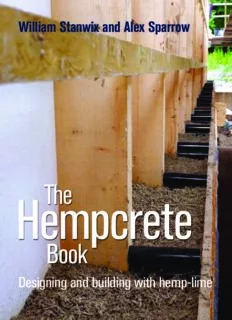
Table Of ContentWilliam Stanwix and Alex Sparrow
The
Hempcrete
Book
Designing and building with hemp-lime
The
Hempcrete
Book
Designing and building with hemp-lime
William Stanwix and Alex Sparrow
Published by
Green Books
An imprint of UIT Cambridge Ltd
www.greenbooks.co.uk
PO Box 145, Cambridge CB4 1GQ, England
+44 (0)1223 302 041
© 2014 William Stanwix and Alex Sparrow
All rights reserved. Subject to statutory exception and to the provisions of
relevant collective licensing agreements, no part of this book may be reproduced
in any manner without the prior written permission of the publisher.
First published 2014
William Stanwix and Alex Sparrow have asserted their moral rights
under the Copyright, Designs and Patents Act 1988
Illustrations © 2014 William Stanwix
Front cover photograph © Alex Sparrow
Back cover photographs: left © Alex Sparrow; middle © Adnams; right © Jørn Tomter
Design by Jayne Jones
All interior photographs © Alex Sparrow, except where otherwise credited. Photographs of
Hemp-LimeConstruct builds on pages 8, 24, 128-9, 130, 230, 244, 247, 249, 288 and 317 are
© Jørn Tomter (www.tomter.net) and on pages 31 (right) and 35 are © Enrique Neyland Quintano.
ISBN: 9780857842244 (hardback)
ISBN: 9780857841209 (paperback)
ISBN: 9780857841223 (ePub)
ISBN: 9780857841216 (pdf)
Also available for Kindle
Disclaimer: The advice herein is believed to be correct at
the time of printing, but the authors and publisher accept
no liability for actions inspired by this book.
Contents
Foreword by Professor Tom Woolley ...............7 14 Shuttering ...................................................169
Introduction ............................................................9 15 Mixing hempcrete .....................................191
16 Placing hempcrete ....................................207
Part One: Principles of building
17 Floors, ceilings and roof insulation ........221
with hempcrete
18 Finishes for hempcrete ............................231
1 History and uses of hemp ..........................15 19 Practicalities on a hempcrete build.......253
2 Hemp in construction .................................23 20 Restoration and retrofit............................267
3 An introduction to lime ...............................41
Focus on self-build 2:
4 Key concepts in sustainable building......53 Hemp Lime House ...........................................282
5 Getting the basics right .............................67
6 Variations on the hemp–lime mix .............79 Part Three: Designing a
7 Performance of hempcrete hempcrete building
in a building ...................................................87
21 Design fundamentals ...............................289
8 Tools and equipment ...............................101
22 Indicative detailing ....................................309
9 Health and safety ......................................109
10 Planning the build ....................................117 Focus on self-build 3:
Bridge End Cottage ........................................342
Focus on self-build 1:
Agan Chy ...........................................................124 23 A look to the future ...................................347
Notes ..................................................................350
Part Two: Hempcrete
Glossary .............................................................352
construction
Resources ..........................................................354
11 The hempcrete wall: an overview ..........131
Bibliography ......................................................357
12 Foundations and plinth ............................147
Index ....................................................................358
13 The structural frame .................................155
This book is for
Jacob John Renbourn
Not only a talented builder but also a true
hemp devotee. He is greatly missed.
Acknowledgements
First and foremost, huge gratitude goes to our Womersley at Womersley’s. The advice and
wives and children for their patience and information they have provided has been
understanding throughout the writing of this invaluable. The responsibility for any misinter-
book (and the rest of the time too!). pretations or mistakes in the finished work lies
solely with the authors.
We are grateful to the folks at the Low-Impact
Living Initiative (LILI); especially to Dave Darby We are indebted to Dave, David, Jules, Eve and
and Elaine Koster for the original spark which everyone else at Scarthin Books in Cromford,
ignited this project and Emma Winfield Tubb where Alex ended up being ‘writer in residence’
for her hard work both at LILI and on-site, and for several weeks, and to Elaine and Mark
her friendship and support. Loydall for the loan of their cottage during the
final stages of this project. A big thank you also
We are indebted to the team at UIT / Green Books, to Pat Gilgrass, who not only lent us her caravan
past and present, for giving us the opportunity during the editing stage, but heated it too!
to write this book, and to Alethea Doran and
Jayne Jones, for their hard work and patient We are grateful to Hemp-LimeConstruct’s
guidance, which have allowed it to become what clients, past and future, without whom none of
it is today. this would be possible; with special thanks going
to Anthony and Penelope, Sarah and Tony, and
We’d like to say a special thank you to Tom Woolley Alexei and Sarah.
of Rachel Bevan Architects, and Graham Durrant
of the Limecrete Company, who read early drafts Last but by no means least, our thanks go to our
of the manuscript and provided helpful, and team: Rob Mohr, Pam Stanwix, Riq Neyland
often entertaining, comments and advice. Quintano and Aniko Hegedus; and to the Hemp-
Lime Construct extended family: Emma Winfield
The following have given generously of their Tubb, Paul Fitzpatrick, Alaric ‘Mighty’ Federlein,
time, expertise and advice during the writing of Sam Thomson, Kris Clarke, Kate Noble, Heather
this book. Mark Patten and Dave Mayle at Lime Miles, and everyone else who has worked or
Technology, Myles Yallop and Graham Durrant volunteered for us over the last six years.
at The Limecrete Company, Nigel Gervis at
Tŷ-Mawr, Neal Holcroft, Nick Voase at K J Voase Massive thanks to www.radiomeuh.com for the
and Son, James Ayres at Lime Green, and Mark background noise.
Foreword
When Rachel Bevan and I did the research that shown to consume more energy in their materials
led to the publication of Hemp Lime Construction and construction (‘embodied energy’) than is
in 2006-7, we had a fairly good idea of the saved in the lifetime of the building.
location of every building containing hempcrete
in the UK and Ireland. Seven years or so later, it Hempcrete, on the other hand, not only has low
is impossible to keep track of the use of this embodied energy but also locks up CO in the
2
remarkable composite building material, as building fabric. It is fireproof, healthy, breathable,
happily its use has become almost commonplace regulates humidity levels and is much more
in the UK – evidence of the widespread accept- thermally efficient than comparable materials.
ance of this excellent sustainable way of building. All of this is explained in detail in this excellent
However, whenever such an innovative form of book. Once you become aware of hempcrete’s
construction quickly gains popularity there is a advantages it is hard to find another way of
risk, if it is used by people who expect it to behave building that can meet the demands of sustain-
like ‘conventional’ materials, of careless and able, healthy and energy-efficient construc tion
poorly supervised construction, detailing and so successfully. Furthermore, since the hemp
specification. For this reason The Hempcrete plant can be grown in so many parts of the world,
Book is most welcome, as it brings up to date the it can be used to insulate buildings in poorer
knowledge and experience gained in recent years developing regions as easily as in Western
and provides clear guidance to those who want countries. Hemp also provides food, oil, clothing,
to apply hemp materials correctly in a range of paper and many other products in addition to
applications. construction materials.
As pressure builds to meet increasingly strenu- The construction and use of buildings are
ous energy-efficiency targets, many weird and responsible for at least 50 per cent of the CO
2
wonderful building techniques and materials emissions from human activity. Therefore using
have appeared on the market. These are often materials with a much lower environmental
embraced with remarkable haste, even if barely impact is crucial to reducing environmental
tried and tested, particularly when backed by damage and resource consumption. Designing
glossy brochures and exaggerated performance and building with hempcrete is a real demon-
claims. Most of these systems involve plastic and stration of a total commitment to ‘saving the
petrochemical-based substances which can planet’ and protecting the health and well-being
sometimes present fire hazards, emit toxic of a building’s occupants. It’s an easy commitment
chemicals and pollute the planet when disposed to make, because hempcrete is affordable, great
of in landfill. They use fossil-fuel resources and fun to build with and is truly sustainable. Thanks
produce significant carbon dioxide emissions, to this book, it will now be even easier to use.
although ironically their use is intended to
reduce such emissions! Many so-called low- Tom Woolley
energy or zero-energy buildings have been County Down, April 2014
Introduction
This is a book about ‘natural building’. An by humans (and other animals!) to provide
increasing number of people across the UK, warmth and shelter. Today, with our growing
and the world, are consciously deciding to awareness of the threats associated with over-
use natural materials when constructing dependence on fossil fuels, and our increasing
new buildings or restoring old ones. People understanding of the negative side-effects of
usually choose natural materials because synthetic building materials mass-produced by
they want a building that is sustain able or highly industrialized processes, has come a
‘low impact’ in terms of eliminating or resurgence of interest in older and more natural
minim izing any lasting negative effect on materials and methods for construction.
the world in which we live. In practice this
means reducing as far as possible the While many techniques from our construction
‘embodied energy’ associated with the history are suitable for use today, others are less
materials and methods used in the construc applicable in the current context and probably
tion of the building; minimizing the amount have limited use in the new buildings of the
of fossil fuels needed by the occupants to future. However, one positive effect of this
power, heat and cool the building through resurgence of interest is that a number of new
its lifetime; and minimizing toxic emiss ions natural materials and techniques, based on old
and any other harm to human society or the technologies but tailored to meet our future
natural world. construction needs, are beginning to emerge.
Hempcrete (a hemp–lime composite construction
People also choose natural materials because they material) is one such new material. Comprising
are increasingly aware of how such materials can the chopped stalk of the industrial hemp plant
not only maintain the structural fabric of the mixed with a lime-based binder, hempcrete
building well but also help to keep humans in provides a natural, healthy, sustainable, local,
good health. In contrast to many synthetic low-embodied-energy building material that can
materials, natural materials contain no harmful truly claim to be better than zero carbon. Carbon
chemicals. They are also vapour permeable (they dioxide taken up by the plant when it was
allow moisture to pass through), which has growing is locked up in its woody fibres, and at
significant implications for the health of both the end of the building’s life the hempcrete can
the building and its occupants. be left to compost and be used as a soil additive
rather than going into landfill. As a highly
There are many natural materials available for insulating material with significant thermal mass,
use in construction: timber, stone, earth, animal hempcrete has excellent thermal performance
hair, straw, hemp, lime, reed and fired clay, to within the structure of a building, and there is
name just some. Many of these materials can be increasing evidence that it actually performs
used in more than one way. They have a long much better in real-life situations than is suggested
pedigree of use over centuries, or even millennia, by steady-state modelling.
Previous: Hempcrete and lime plasters in a listed building.
10 The Hempcrete Book: Introduction
Our company, Hemp-LimeConstruct, was set up exist. We hope that others wanting to build with
when we decided to focus on furthering the use hempcrete will benefit from our six years of
of this exciting new material in building projects experimentation and refining of techniques;
across the UK. We have been building with learning from our mistakes rather than their own.
hempcrete since 2008, on projects ranging from
‘future-proof’ houses to large community build- As the book took shape, we realized the impor-
ings and complete restorations of listed buildings, tance of including discussion of some key topics
and provide a bespoke design-to-build service, and concepts that underpin the successful use of
consultancy and training. At the same time, other hempcrete, and we hope readers will find this
contractors across the UK have been using background interesting and useful. Many people
hempcrete on a much larger scale, in the construc- will want to flick straight to the practical details
tion of housing estates and commercial and contained in Part Two, but we’d urge all our
industrial developments. As the profile of hemp- readers to take the time to ensure they under-
crete within the public continues to grow, there is stand the contextual information and important
an increasing demand for these services. And as under lying concepts discussed in Part One. A
research into hempcrete builds, our understanding firm understanding of these is essential for
of this remarkable material is constantly develop- anyone wishing to become a successful hemp-
ing. From the interest we at Hemp-LimeConstruct crete builder.
get at exhibitions and the frequency of enquiries
we receive, it looks as though hempcrete has Hempcrete is especially attractive to self-builders
caught the nation’s imagination and is here to stay. and community groups, because of the relatively
low-tech nature of the construction method.
When we first sat down to write this book, we Also, owing to the fact that it’s a relatively labour-
intended to write a practical ‘how-to’ manual to intensive construction method, big savings can
introduce people to the method of building with be made by providing your own labour. However,
hempcrete. The reason for this was that we would as our company and others have proved over
have found such a book very useful when we first recent years, hempcrete is also commercially
started working with the material, and it didn’t viable as a construction material in a wide range
of applications. Its cost is comparable to that of
conventional construction methods, but if you
factor in the true cost of the embodied carbon of
conventional building materials, in terms of
environ mental damage, and consider the financial
benefits of the energy savings that hempcrete
delivers through the lifetime of the building, you
could argue that it’s actually a lot cheaper!
We hope that readers will be inspired and encour-
aged by this book to develop their own hempcrete
projects – but first, an important caveat. It is
beyond the scope of this book to show every
possible way of using hempcrete, and in any case
the industry as a whole is still exploring this.
Freshly mixed hempcrete.
Also, it is important to remember that while the
Description:Hempcrete is a building material with excellent properties. It's made from lime and hemp shivs (a waste product from hemp fiber growing); it can be used for walls, floors, and for roof insulation; it's breathable, absorbing and emitting moisture to regulate internal humidity and avoid trapped moistu