Table Of ContentOCTOBER 10TH–16TH 2020
America’s other election drama
Defending Taiwan: harder and costlier
Ant Group and the rise of digital finance
Learning the right lessons from Sweden
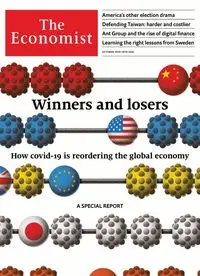
How covid-19 is reordering the global economy
A SPECIAL REPORT
Winners and losers
Join transformational leaders from
around the globe.
Exchange insights, share experiences
and build your community.
Unlocking the
Truth about
Transformation
Thursday
22 October
2020
SAVE 30% WITH CODE ECON50
Selected speakers include
Dr. Janet Yellen
CHAIR, BOARD OF GOVERNORS
FEDERAL RESERVE SYSTEM
(2014–18)
Michelle Stacy
PRESIDENT
KUERIG INC.
(2008-13)
Amin Toufani
FOUNDER
ADAPTABILITY.ORG
Sunil Prashara
PRESIDENT AND CEO
PROJECT MANAGEMENT
INSTITUTE (PMI)
Haiyan Wang
MANAGING PARTNER
CHINA INDIA INSTITUTE
THINKERS50 #25
Efosa Ojomo
SENIOR RESEARCH FELLOW
CLAYTON CHRISTENSEN INSTITUTE
FOR DISRUPTIVE INNOVATION
©Photograph: Laurent Ballesta/Gombessa Project
RAISE AWARENESS,
TRANSMIT OUR PASSION,
HELP PROTECT THE OCEAN
www.blancpain-ocean-commitment.com
COLLECTION
Fifty Fathoms
BEIJING · DUBAI · GENEVA · HONG KONG · KUALA LUMPUR · LAS VEGAS · LONDON · MACAU · MADRID
MANAMA · MOSCOW · MUNICH · NEW YORK · PARIS · SEOUL · SHANGHAI · SINGAPORE · TAIPEI · TOKYO · ZURICH
Banyan Both for good
and for ill, India’s prime
minister is hard at work,
page 50
The Economist October 10th 2020
5
Contents continues overleaf
1
Contents
The world this week
9 A summary of political
and business news
Leaders
13 The world economy
Winners and losers
14 Nagorno-Karabakh
No one in charge
14 American democracy
Don’t rob them, count
them
15 Sweden and covid-19
Land of the mask-free
16 Chinese fintech
On the march
Letters
18 On Mexico, “Cuties”,
democracy, Milton
Friedman, America’s
Supreme Court, Harold
Evans, tanks
Briefing
19 Ant’s jumbo IPO
Queen of the colony
Special report:
The world economy
The perils and the
promise
After page 42
Europe
23 War in the Caucasus
24 Tourists shun Salamis
24 France’s Greens v
Christmas trees
25 Clobbering Polish media
26 Stopping a second wave
in Sweden
28 Charlemagne Foreign-
policy vetoes
Britain
29 Rishi Sunak’s easy rise
30 Dirty money
31 Preparing for the vaccine
Middle East & Africa
33 Iran woos China
34 Israel’s pandemic politics
34 Egyptian road rage
35 Elections in Ivory Coast
36 Fuel subsidies in Nigeria
36 Where calling is a calling
United States
37 Virus in the White House
38 Pence v Harris
39 Voter-suppression
40 Ohio, bellwether again
40 Startup nation
41 A new wave of lay-offs
42 Lexington The battle
in miniature
The Americas
43 Welcome to Queueba
44 Argentina doubles in size
45 Bello The new poor
On the cover
The pandemic has created big
performance disparities
between the world’s
economies. They could get
even larger: leader, page 13.
How covid-19 will accelerate
change: see our special report
after page 42. The number of
new businesses in America is
growing, page 40; as are
lay-offs, page 41
• America’s other election
drama In the midst of the
pandemic, the plague of voter
suppression spreads: leader,
page 14, and analysis, page 39
• Defending Taiwan: harder
and costlier And much bloodier,
page 46
• Ant Group and the rise of
digital finance The blockbuster
listing of the Chinese upstart
shows how fintech is
revolutionising finance: leader,
page 16 and briefing, page 19.
Covid-19 and the fintech
revolution, page 62
We are working hard to
ensure that there is no dis-
ruption to print copies of
The Economist as a result of
the coronavirus. But if you
have digital access as part of
your subscription, then acti-
vating it will ensure that you
can always read the digital
version of the newspaper as
well as all of our daily jour-
nalism. To do so, visit
economist.com/activate
PEFC/04-31-1267
Subscription service
For our full range of subscription offers, including
digital only or print and digital bundled, visit:
Economist.com/offers
If you are experiencing problems when trying
to subscribe, please visit our Help pages at:
www.economist.com/help for troubleshooting
advice.
Published since September 1843
to take part in “a severe contest between
intelligence, which presses forward,
and an unworthy, timid ignorance
obstructing our progress.”
Editorial offices in London and also:
Amsterdam, Beijing, Berlin, Brussels, Cairo,
Chicago, Johannesburg, Madrid, Mexico City,
Moscow, Mumbai, New Delhi, New York, Paris,
San Francisco, São Paulo, Seoul, Shanghai,
Singapore, Tokyo, Washington DC
PEFC certified
This copy of The Economist
is printed on paper sourced
from sustainably managed
forests certified by PEFC
www.pefc.org
Please
The best way to contact our Customer Service
team is via phone or live chat. You can contact us
on +44 (0)20 7576 8448; please check our website
for up to date opening hours.
© 2020 The Economist Newspaper Limited. All rights reserved. Neither this publication nor any part of it may be reproduced, stored in a retrieval system, or transmitted in any form or by any means, electronic, mechanical, photocopying,
recording or otherwise, without the prior permission of The Economist Newspaper Limited. Published every week, except for a year-end double issue, by The Economist Newspaper Limited. The Economist is a registered trademark of The
Economist Newspaper Limited. Printed by Vogel Druck und Medienservice GmbH, Leibnizstraße 5, 97204 Höchberg, Deutschland. France, Numéro Commission Paritaire: 68832 GB. Encart d’abonnement de deux pages situé entre les
folios 10 et 130. Rapp. Italia: IMD srl Via Guido da Velate 1120162 Milano Aut. Trib. MI 272 del 13/04/88 Poste Italiane SpA - Sped Abb Post DL353/2003 (conv. L. 27/2/2004 n.46) art 1comma 1DCB Milano, Dir. Resp. Domenico Tassinari
6
Contents
The Economist October 10th 2020
Volume 437 Number 9215
Asia
46 Defending Taiwan
48 An uprising in Kyrgyzstan
48 Elections in Tajikistan
49 Polio in Pakistan and
Afghanistan
49 A big K-pop IPO
50 Banyan Modi the
multi-tasker
China
51 Strangling Hong Kong
52 Protecting pictographs
International
53 Talking about death
Business
55 Smooth sailing
57 Canada’s ailing oilmen
57 Curtains for cinemas
58 Tech regulators’ ex-antics
59 Bartleby Freeing workers
60 Japanese telecoms
dial down
61 Schumpeter Rio Tinto v
China
Finance & economics
62 The fintech revolution
65 Europe’s furlough schemes
65 Investors and America’s
election
66 Labour and trade
67 Buttonwood Merging
fund managers
68 Free exchange Global
imbalances
Science & technology
69 The Nobel science prizes
71 Living with El Niño
71 A smart new polymer
72 Saving turtles’ nests
Books & arts
73 Corruption
74 Medieval science
76 Lockdown opera
76 Pets and poetry
77 A visionary American
artist
Economic & financial indicators
80 Statistics on 42 economies
Graphic detail
81 Faith in government declines once mobile internet arrives
Obituary
82 Swami Agnivesh, liberator of India’s slaves
Every business has its own vision of success and its own challenges in achieving it. We are here
for those who believe progress is always possible. For those on a mission who have the courage
and perseverance to build for the future, even in uncertain times. We are here for you, applying
our deep sector knowledge and financial expertise to help you look to the future.
do your thing
Visit ingwb.com/doyourthing
Changemakers,
The Economist October 10th 2020 9
For our latest coverage of the
virus and its consequences
please visit economist.com/
coronavirus or download the
Economist app.
The world this week Politics
Donald Trump’s doctors were
keeping a close eye on their
patient, after the 74-year-old
president checked out of hos-
pital just three days after being
admitted for treatment for
covid-19. Around 20 other
people in Mr Trump’s circle
have also tested positive, in-
cluding his wife, Melania,
Stephen Miller, an adviser, and
Chris Christie, a former
governor who helped Mr
Trump prepare for his first
debate. The president de-
scribed catching the virus as a
“blessing from God”. The Com-
mission on Presidential De-
bates said that the next debate
between Mr Trump and Joe
Biden should be held virtually.
Covid-19 featured large in the
vice-presidential debate
between Kamala Harris and
Mike Pence, a more orderly
affair compared with the fire-
works of the Biden-Trump
encounter a week earlier.
The Department of Homeland
Security said that white
supremacists are “the most
persistent and lethal” terrorist
threat to America, as foreign
groups are “constrained” in
their ability to conduct attacks.
Since 2018 white racists have
carried out more lethal as-
saults in the United States than
any other extremist group,
targeting racial and religious
minorities, gay people and
fans of globalisation.
Thirty-nine countries called on
China to respect human rights
in Xinjiang. A similar state-
ment last year gained the
backing of only 23. However, 45
countries said China’s policies
towards Uighurs were just fine.
Human Rights Watch called
the pro-China group a “Who’s
Who of leading rights abusers”.
Parties backing the president
appeared to have swept elec-
tions in Kyrgyzstan. Protesters
said the voting was crooked,
and freed a former president
from jail. The government
offered to hold a new vote and
the prime minister resigned.
Indonesia’s parliament
approved a law to cut red tape
and stimulate investment. The
measure had been champi-
oned by the president, Joko
Widodo. Left-wing activists
fret that it will weaken protec-
tions for workers and the
environment.
Authorities in Vietnam arrest-
ed Pham Doan Trang, a promi-
nent democracy activist, for
“anti-state activities”. Her
arrest came hours after Ameri-
ca and Vietnam concluded a
“human-rights dialogue”.
A British appeals court ruled in
favour of Nicolás Maduro’s
regime in Venezuela in a
dispute over who controls
nearly $2bn-worth of gold
stored at the Bank of England.
The court overturned a deci-
sion by the High Court, which
said that because Britain recog-
nises the leader of the opposi-
tion, Juan Guaidó, as the coun-
try’s interim president, he is in
charge of the gold. The appeals
court said that Britain’s recog-
nition of Mr Guaidó is ambig-
uous and sent the case back to
the High Court for a clearer
ruling on which man is
Venezuela’s president in the
eyes of British law.
Guatemalan security forces
stopped 3,500 Hondurans
from heading towards Ameri-
ca. Guatemala’s president,
Alejandro Giammattei, said
they might spread covid-19.
The group was the first big
migrant caravan to form since
the pandemic began.
Tanzania barred Tundu Lissu,
the opposition leader, from
campaigning for president for
seven days, claiming that his
speeches criticising the gov-
ernment were “unethical”.
Elections are on October 28th.
Opposition offices have been
firebombed.
West Africa’s regional bloc,
ecowas, blinked in its stand-
off with the leaders of a coup in
Mali and lifted sanctions on
the country. It had previously
insisted that power be handed
to a civilian government and
that it would not accept the
appointment as president of
Bah Ndaw, a former defence
minister.
Prince Bandar bin Sultan, a
senior member of the royal
family of Saudi Arabia, ac-
cused Palestinian leaders of
betraying their people, in an
interview on Saudi-owned
television. The comments
were seen as a signal of declin-
ing Saudi support for the Pales-
tinians and a possible first step
towards closer relations be-
tween Israel and the kingdom.
Fighting intensified in and
around the disputed enclave of
Nagorno-Karabakh. At least
200 people have been killed.
Azerbaijan is trying to wrest
back territory seized from it by
neighbouring Armenia after
the collapse of the Soviet Un-
ion. Turkey has armed Azerbai-
jan and encouraged it to break
a fragile peace that has mostly
held since 1994.
The leaders of Golden Dawn, a
neo-fascist Greek political
party, were convicted in Ath-
ens of running a criminal
organisation, after a party
member murdered a rapper in
2013. The party itself has not
been banned, but lengthy
prison terms are now expected
for those who incited violence.
If the British government was
wondering what the next
clanger in its handling of
covid-19 would be, then outdat-
ed software provided the an-
swer. Public Health England’s
developers chose to use an old
version of Microsoft’s Excel
program to collate testing
results, missing some 16,000
over several days. The version
of software used by phe was
superseded over a decade ago
and is not used in any serious
data-gathering exercise. Mean-
while, with infections up
sharply, further restrictions in
England were being mooted.
Coronavirus briefs
The governor of New York
state, Andrew Cuomo, refused
a request from the mayor of
New York City, Bill de Blasio, to
close non-essential businesses
in parts of Brooklyn and
Queens that have become virus
hotspots, but imposed his own
new restrictions.
Bars and cafés in Paris were
ordered to close again, this
time for two weeks.
The Irish government rejected
a plea from senior scientific
advisers to place the country in
a strict lockdown, saying that
the risk to jobs of closing the
economy was too great. Some
restrictions were reimposed;
people were again told to work
remotely.
October 16th was set as the date
for a travel bubble between
Australia and New Zealand to
begin. It will be limited to New
Zealanders at first; New
Zealand recently declared itself
free of coronavirus, for the
second time.
Weekly confirmed cases by area, ’000
To 6am GMT October 8th 2020
Confirmed deaths*
Per 100k
Total
This week
Peru
99.8
32,914
518
Belgium
87.2
10,108
92
Bolivia
70.2
8,192
227
Brazil
69.7
148,228
4,276
Spain
69.6
32,562
771
Chile
68.5
13,090
349
Ecuador
66.6
11,743
388
Mexico
64.2
82,726
5,080
United States 63.8
211,019
4,817
Britain
62.6
42,515
372
Sources: Johns Hopkins University CSSE; UN;
The Economist *Definitions differ by country
600
400
200
0
O
S
A
J
J
M
A
M
US
Latin America
Other
Europe
India
10
The Economist October 10th 2020
The world this week Business
The imf urged governments in
rich countries to step up
spending on investment,
pointing out that, even before
covid-19, public-investment-
to-gdp ratios were declining.
The rates of return from spend-
ing on adaptation to climate
change in particular are often
greater than100%, it said.
Meanwhile, Kristalina Ge-
orgieva, the imf’s managing
director, described the path to
economic recovery after the
pandemic as “the long as-
cent—a difficult climb that will
be long, uneven and uncertain.
And prone to setbacks.”
The covid economy
Jerome Powell, the chairman of
the Federal Reserve, once again
called for more fiscal stimulus
measures. He described the
policy risks of supporting the
American economy as asym-
metric: providing too little
help will be worse than provid-
ing too much. Donald Trump
said he would not agree to a
stimulus package until after
the election. Employers
created 661,000 jobs in Sep-
tember, a much smaller num-
ber than in each of the previous
four months, when firms
rehired as lockdowns eased.
OurCrowd, an investment
platform based in Jerusalem,
struck a partnership with a
business-development com-
pany backed by Al Naboodah
Investments of Dubai. It is the
first big alliance between
investment firms in Israel and
the United Arab Emirates
after the recent normalisation
of relations between the two
countries.
There was more consolidation
in the payments industry with
the announcement that Nexi,
Italy’s biggest provider of
digital payments, would buy
sia, a smaller rival that is
owned by the Italian govern-
ment. Through a development
bank, the government will
retain a 25% stake.
Companies aiming to increase
staff diversity may be drawing
more legal scrutiny from the
American government. Micro-
soft and Wells Fargo, who have
both promised to double their
number of black executives,
were both contacted by the
Department of Labour recently
to inquire whether their plans
comply with laws that forbid
hiring practices based on race.
America’s Supreme Court
heard arguments from Google
and Oracle in a closely watched
case concerning how copyright
law should apply to computer
code. Oracle argues that Google
unlawfully reused parts of
Java, a programming language,
in its Android smartphones.
Google retorts that such reuse
has been common industry
practice for decades, and is
vital for interoperability
between software. A lower
court’s ruling in Oracle’s favour
in 2018 alarmed the rest of the
tech industry, which mostly
takes Google’s side.
A committee in America’s
House of Representatives
accused Amazon, Apple, Face-
book and Google of exploiting
their monopoly power, com-
paring them to oil and railway
tycoons in the 19th century,
and recommended sweeping
reforms to antitrust laws. That
could spell trouble for the tech
giants if the Democrats win
both chambers of Congress
next month.
Boeing’s annual outlook for the
overall aerospace industry
forecast an 11% drop in demand
for commercial planes over the
next decade, compared with
last year’s forecast. Over the
next 20 years, it predicts
passenger-traffic growth will
return to pre-pandemic levels
of 4% a year.
Walmart at last found a buyer
for Asda, a British supermarket
chain that it bought in 1999 and
has been trying to sell for more
than two years. The new owner
in the £6.8bn ($8.7bn) deal is a
consortium led by Zuber and
Mohsin Issa. The brothers run
eg Group, which operates
petrol stations and food
concessions across ten coun-
tries, and owns many Kentucky
Fried Chicken franchises in
Britain.
Bristol-Myers Squibb made
another big acquisition, agree-
ing to pay $13.1bn for
MyoKardia, a clinical-stage
biopharmaceutical company
specialising in treatments for
heart disease. Last year Bristol-
Myers Squibb bought Celgene
for $90bn, one of the largest-
ever deals in the drug industry.
Facebook said it had started to
remove all pages across all its
platforms that are linked to
QAnon, a far-right conspiracy
theory that thinks Donald
Trump is battling a cabal of
Satan-worshipping paedo-
philes. The company had been
criticised for not doing enough
to counter the surge in fake
news from QAnon adherents.
Bond is back (well, next year)
Cineworld decided to close all
its cinemas in America and
Britain until next year, after the
release date of “No Time To
Die”, the next James Bond film,
was again postponed, until
April. Already struggling as
social-distancing keeps the
crowds away from its venues,
Cineworld was banking on
what would have been this
year’s biggest box-office draw.
Other films have been delayed,
some have gone straight to
streaming. Many in the in-
dustry believe lavish block-
busters need to be seen in
cinemas first in order to create
the all-important buzz.