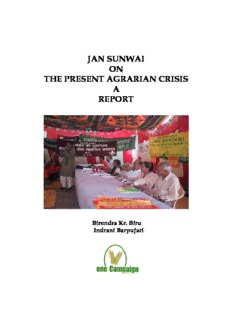
Table Of ContentJAN SUNWAI
ON
THE PRESENT AGRARIAN CRISIS
A
REPORT
Birendra Kr. Biru
Indrani Barpujari
CONTENTS
Page No.
THE AGRARIAN CRISIS IN INDIA- A BRIEF BACKGROUND 1-4
JAN SUNWAI AS A TOOL FOR PUBLIC PARTICIPATION
IN SOLVING PROBLEMS 5-8
CAUSES OF THE AGRARIAN CRISIS 8-38
RECOMMENDATIONS 39
2
THE AGRARIAN CRISIS IN INDIA- A BRIEF BACKGROUND
Twenty first century India has emerged as a major economic power in the world, with the
growth rate of the gross domestic product reaching impressive levels and the poverty ratio
coming down significantly. In the context of such a scenario, it is indeed very incongruous
and difficult to believe that the Indian countryside where the large majority of its people
reside is in the grip of a severe agrarian crisis. In the opinion of Prabhat Patnaik1, this crisis in
Indian agriculture is “unparalleled since independence and reminiscent only of the agrarian
crisis of pre-war and war days”.
According to Sahai2, the most tragic face of India’s agrarian crisis is seen in the increasing
number of farmer suicides, not just in the hotspot areas of Andhra Pradesh and Vidarbha but
in the allegedly prosperous agricultural zones of Punjab and Karnataka as well. Farmers’
suicides are no longer limited to the drought and poverty stricken areas of the country. Now
farmers in the most productive agricultural regions such as Karnataka, Punjab, West Bengal,
Andhra Pradesh, and Maharastra are ending their lives because of their massive indebtedness.
Mishra3 also expresses a similar view when he says that the conventional notion of agrarian
distress being part of the broader landscape of underdeveloped agriculture and backwardness
no longer fits to the emerging evidences from rural India. Manifestations of agrarian distress
in contemporary India is not confined to the pockets of backwardness; even the regions
having a high degree of commercial agriculture, using relatively better technology and having
a relatively diversified cropping pattern have reported high indebtedness and distress of
various kinds.
More than six thousand indebted farmers, mainly cotton farmers, have committed suicide in
Andhra Pradesh alone during the period from 1998 to 2005 as its government which had
entered into a state-level Structural Adjustment Programme with the World Bank, raised
power tariff five times even as cotton price fell by half. In Maharashtra, 644 farmers
committed suicide across three of its six regions between January 2001 and December 2004.
1 Patnaik, P., “The Crisis in India’s Countryside”, http://ccc.uchicago.edu/docs/India/patnaik.pdf , accessed on
May 5, 2007.
2 Sahai, S., “Are Genetically Engineered Crops the Answer to India’s Agrarian Crisis”.
3 Mishra, D.K., (undated), “Behind Agrarian Distress: Interlinked Transactions as Exploitative Mechanisms”, E-
pov ( a newsletter of the Centre for Science and Development),
3
In Karnataka, 49 suicidal deaths occurred between April and October 2003 in the drought-
prone region of Hassan. Over the same period of time, 22 suicides occurred in Mandya, the
state’s ‘sugar bowl’; 18 occurred in Shimoga, a heavy rainfall district, and 14 occurred in
Heveri, a district that receives average rainfall, owing to indebtedness to private
moneylenders. While statistics may show Punjab to be India’s ‘breadbasket,’ claiming that its
soils are rich and its five rivers supply abundant water throughout the state, the reality of this
image of prosperity is revealed by the increasing number of suicidal deaths among Punjabi
farmers. Over a thousand farmer suicides have also taken place in Punjab mainly in the cotton
belt. In the four years from 2001, over 1,250 suicides took place in Wynaad in Kerala. In
Burdwan, the region of West Bengal commonly called the “rice bowl of the East,” 1,000
farmers ended their lives in 2003.
Kidney sales and nine thousand suicides (between 1998-2005), according to Utsa Patnaik,4
are only the tip of the iceberg of increasing deprivation. A crucial index of this deprivation is
an astonishing fall in food grains absorption to levels prevalent 50 years ago, and decline in
average calorie intake in rural India. Availability or absorption of foodgrains is calculated on
the annual net output adjusted only for change in public stocks and in trade. It covers all final
uses – direct use for consumption as grain and its products, use as feed for converting to
animal products (a part of this is exported), and industrial use. The per capita availability or
absorption of food grains in India has descended to a mere 155 kg annually taking the three
year average ending in 2002-03. This level is the same as fifty years ago during the First Plan
period, and it is also the level seen during 1937-41 under colonialism. After Independence,
from the early 1950s to four decades later, the per capita food grains availability had climbed
slowly from 155 kg to 177 kg, which was completely reversed during the 1990s. Per head
availability/ absorption is now one of the lowest in the world, with only Sub-Saharan Africa
and some least developed countries registering lower absorption than India. Since urban India
has been increasing average absorption and average calorie intake, it is rural India where the
fall has been very steep.
According to Prabhat Patnaik5, one can also understand the extent of the agrarian crisis in
India, by looking into the command which an average person belonging to the “agriculture-
4 Patnaik, U., “Theorizing Food Security and Poverty in the Era of Economic Reforms”, Public Lecture in the
Series “Freedom from Hunger”, India International Centre, New Delhi, April 12, 2005.
5 Patnaik, P., “The Crisis in India’s Countryside”, http://ccc.uchicago.edu/docs/India/patnaik.pdf , accessed on
May 5, 2007.
4
dependent population” has over a specific bundle of goods. The benchmark bundle of goods
can be taken as that bundle which is actually supposed to be consumed by the average
industrial worker, according to official statistics. It turns out that between 1994-95 to 2003-
04, the per capita command over this bundle of goods by the agriculture dependent
population increased by only 5% in absolute terms, which amounts to virtual stagnation. The
virtually stagnant per capita command over “private goods” has been accompanied not just
by growing economic insecurity but also by a decline in the quality of public services
provided to it, which includes the decline in public health and public education facilities in
rural areas, abysmal state of rural infrastructure and the reduction in the availability of
electricity in the countryside6.
Various reasons have been attributed for the present agrarian crisis. It has been felt that the
present crisis is the result of deflationary public policies and trade liberalization (with falling
global prices), which has slowed output growth, contributed to rising unemployment, income
deflation for the majority of cultivators and labourers, enmeshing of cultivators in
unrepayable debt, and loss of assets including land, to creditors. According to Utsa Patnaik7,
“forty years of successful effort in India to raise foodgrains absorption through Green
Revolution and planned expansionary policies, has been wiped out in a single decade of
deflationary economic reforms and India is back to the food grains availability level of fifty
years ago”. Another reason being given for the agrarian crisis is the drastic reduction in the
state’s spending on rural development which has led to loss of purchasing power among rural
people. Expenditures in rural development, under which fall the heads agriculture, rural
development, special areas programmes, irrigation and flood controls, and village and small
scale industry, have been slashed to an all time low of 0.6% of NNP in 2004.
An attempt to have a correct appraisal of the crisis afflicting Indian agriculture in recent times
has been made by the Tata Institute of Social Sciences (TISS) in Mumbai, which had
conducted an investigation into the Vidarbha agrarian crisis and farmer suicides at the behest
of the Bombay High Court. The study found that the main reasons for the crisis are repeated
crop failure, inability to meet rising cost of cultivation and indebtedness. According to Sahai8,
emergency in agriculture has developed because of the rising cost of agricultural production
6 op.cit.
7 Patnaik, U., “It is Time for Kumbhakarna to Wake up”, The Hindu, August 5, 2005
8 Sahai, S., “Are Genetically Engineered Crops the Answer to India’s Agrarian Crisis”.
5
which is not offset by either the Minimum Support Price offered by government or prices
available on the market. The combination of high cost of production (owing to higher input
prices and higher cost of labour), low market price and non- availability of easy credit has
contributed to an enormous debt burden. This is further compounded by personal needs taken
for social needs like marriage and education. The crisis becomes acute when farmers,
exhausting their credit with banks, turn to private money lenders who charge usurious rates of
up to 60% per annum.
The official policy response to the present agrarian crisis has generally been one of denial and
insensitivity. The recent initiative of the Government regarding the rural employment
programme has been criticized as “a limited gesture totally inadequate to meet the enormity
of the crisis”, while the projected enhancement of agricultural credit by the government has
been dismissed as “exaggerated” and “inadequate” in the context of the policy environment
of withdrawal/ reduction of minimum support price programmes9.
A strange argument has also been advanced in certain quarters to account for the decline in
per capita food availability. It is contended that because of a change in the dietary habits of
the people, they have diversified their consumption pattern from food grains towards all kinds
of less-elemental and more sophisticated commodities. Therefore, far from it being a
symptom of growing distress, the decline in food availability is actually indicative of an
improvement in the conditions of the people, including the rural poor. Some have even gone
to the extent of suggesting that with the changes occurring in Indian agriculture in terms of
the cropping pattern and use of machinery, peasants and workers do not need to put in hard
manual labour. Correspondingly, the need for consuming huge amounts of foodgrains no
longer arises. This argument is completely untenable in the light of the hard facts of rising
unemployment, falling output growth, entrapment of farmers in debt and land loss and
especially, when the agrarian crisis has found expression in the acute desperation and
hopelessness of the farmers, leaving them with no recourse but to take their own lives. Gene
Campaign strongly feels that such policy conclusions which are contrary to realities would
have dangerous repercussions if implemented, reducing food security further and
impoverishing farmers.
9Shukla, S.P., “An Initiative for Agrarian Analysis and Action”, ATIS (Agricultural Trade Initiative from the
South”, September 30, 2005.
6
JAN SUNWAI AS A TOOL FOR PUBLIC PARTICIPATION IN SOLVING
PROBLEMS
With the objective of understanding the problems besetting Indian agriculture from the key
stakeholders themselves- farmers, consumers, experts and civil society, Gene Campaign
together with Madhya Pradesh Kisan Sangharsh Samiti (MKSS) and INSAF, organized a Jan
Sunwai on 30th March, 2007 in New Delhi at Jantar Mantar. The Jan Sunwai was organized
as part of “Sangharsh 2007” called by people’s movements and people’s organizations to
protest against the current form of development. Organizations participating in the Jan
Sunwai included
Madhya Pradesh Kisan Sangharsh Samiti,
Indian Social Action Forum (INSAF),
Kisan Sangharsh Samiti, Uttar Pradesh
Krishi Jamin Raksha Samiti
Mazdoor Kisan Shakti Sangharsh Samiti, Rajasthan
Madhya Pradesh Kisan Sanghatan
Narmada Bachao Andolan
National Alliance Of People`s Movements (NAPM)
National Forum Of Forest Peoples And Forest Workers (NFFPFW)
Gene Campaign, Jharkhand
The main objective of the Jan Sunwai was to frame a set of recommendations to resolve the
agrarian crisis, based on a correct assessment of the situation. Views and evidence were
presented to a Commission consisting of Justice Rajendra Sachar, Sri Prabhash Joshi (Senior
Editor, Jan Satta), Mr Sanjay Parikh (Advocate, Supreme Court) and Swami Agnivesh
(President, World Council of Arya Samaj). Having first hand knowledge of the various
problems afflicting Indian agriculture and being the victims of the present crisis, the farmers
and other stakeholders at the Jan Sunwai articulated a number of demands to address the
problem. Some of these demands have been to rationalize water use, ensure sufficient water
to farmers and develop policy for water pricing, diversify agriculture; move away from the
7
paddy- rice rotation and introduce new crop varieties and undertake agricultural renewal on
water footing. They also demanded completion of the unfinished agenda on land reforms,
investment in restoring social heath and in appropriate science and technology, making
rainwater harvesting mandatory, conserving agricultural diversity. They also pointed out the
need to provide insurance and credit to farm families, assured and remunerative farmer
centered marketing and pro- farmer policies.
Dr. Suman Sahai of Gene Campaign addressing the Jan Sunwai
held at Jantar Mantar on 30th March 2007
The Jan Sunwai was conducted operating on the premise that problems afflicting a
democracy are best resolved through more democracy and by affording more opportunities
for the participation of various interest groups in planning and decision- making. Problems
are best solved through public action of cooperation, consensus and construction.
Different forms of participatory organisations are being employed in democratic practice
which aims at identification of different viewpoints, discussion of the pros and cons and
finalisation of areas of consensus that need to be created. In the United States, Citizen’s
Juries bring together a group of representative citizens to consider an issue in depth for a
period of three to five days. During this period, they receive evidence, written and oral,
examine witnesses and discuss the issue thoroughly before arriving at a conclusion which is
presented in the form of a report. These Juries enable concerned citizens with different kinds
8
of expertise to analyse an issue and come to a conclusion, which can help a rounded
appreciation of it.
Planning Cells is a German system akin to the Citizen’s Jury. It aims at involving the
stakeholders, experts and citizens in the planning process based on their experience and
expertise. The logic behind involving the three groups is simple: since stakeholders have an
interest, they will be fully involved in bringing out all the issues involved, experts provide the
technical input and citizens are the neutral observers who can be either the victims or the
beneficiaries of the planning measure.
Deliberative Opinion Polls have been tried out in the United Kingdom. Essentially a
representative sample of the population to be covered is taken after a baseline survey. They
are called to a single place and exposed to various facets of the matter in question. They are
given the opportunities to understand the issue in full and have the freedom to discuss and
deliberate. Thereafter an opinion poll is conducted.
Round Tables are used in Canada to bring together groups of interested parties and
stakeholders to discuss various issues on a continuing basis. All members participate on an
equal basis.
In India, Public Hearings and People’s Hearings, more popularly known as Jan Sunwai, have
become key tools for ensuring people’s participation in planning and development. Public
Hearing is a form of explaining to the public various aspects of a proposed development
project enabling the public to air their concerns and get clarifications. This helps the public to
be informed of the implications of a development project and assist Government to prepare
mitigative measures to address the concerns and fears of the public.
The Jan Sunwai is mostly a method of representing grievances by public testimony of groups
like Dalits, women, tribals and farmers to highlight and sensitize the participants on problems
mostly rooted in rural contradictions. A model of Jan Sunwai was developed by the Madhya
Pradesh Kisan Sangharsh Samiti (MKSS) of Rajasthan and has been used as a post facto
social audit of development expenditure by the community. Typically the community is given
all the details of a proposed work and after completion, details of expenditure, materials used,
labour employed etc. are also given. This then has to be validated in a public meeting and if
deficiencies are pointed out, rectification would be required.
9
The Jan Sunwai is fast gaining popularity as an alternative method of collective expression,
as not just the media but also the judiciary has failed in hearing and solving the problems
faced by these marginalized groups. While it does not have any public or penal authority it
does have the ‘moral power to influence the State and civil society in favour of a democratic
spirit’. Public hearings and Jan Sunwais have played a very important role in the Narmada
Valley movement10, giving voice to the movements of resistance and struggle and articulating
the concerns of the displaced people. These have given the people a centrality in the planning
for development in the valley and in the execution of plans generated.
The Jan Sunwai is a vehicle for broadening the interface between the government and the
citizen, helping citizens become more aware of governmental activity and the government
becoming more responsible to public concerns. In the present instance, Gene Campaign and
the other organizations involved have adapted the Jan Sunwai to look into the problems
afflicting Indian agriculture, using it as a democratic system for consultation, to arrive at
solutions.
CAUSES OF THE AGRARIAN CRISIS
In the Jan Sunwai conducted by Gene Campaign, Insaf & MPKSS, the key stakeholders
highlighted a number of causes they themselves have been confronted with, which have
contributed towards the present agrarian crisis. The agrarian crisis has been attributed to
growing cost of cultivation, higher input prices, higher cost of labour, higher requirement for
cash and falling price of agricultural produce. This has been compounded by collapse of soil
health due to excessive use of agrochemicals and falling water table due to irrational,
wasteful use of water resulting from free electricity and free water. Of 5723 ground water
blocks in the country, over 1000 are critically exploited. At the same time, there has been
diminishing investment in agriculture by the government, with allocation to agriculture
falling in Five Year Plans and reduced institutional credit availability to farmers. Repeated
crop failures, inability to meet rising cost of cultivation and rising indebtedness have been
responsible for farmers’ suicides in the countryside. A fact which came to light at the Jan
Sunwai was that 70% of the farmers who killed themselves were cultivating Bt cotton. The
crisis in the rural areas of India is manifested in the rising number of villages and the
10 Ramanathan, U., “Along the Narmada: Jan Sunwai”, International Environmental Law Research Centre
Working paper, July 13 to 15 2002.
10
Description:farmers in the most productive agricultural regions such as Karnataka, Punjab, . conducted an investigation into the Vidarbha agrarian crisis and farmer The combination of high cost of production (owing to higher input elimination of the organic wastes and small generation of a useful compost