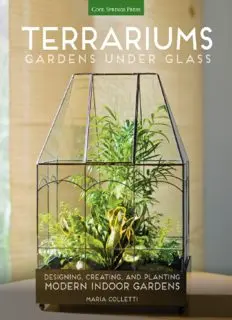
Table Of ContentTERRARIUMS
GARDENS UNDER GLASS
DESIGNING, CREATING, AND PLANTING
MODERN INDOOR GARDENS
MARIA COLLETTI
CONTENTS
INSPIRATION COMES IN MANY FORMS
CHAPTER 1: TERRARIUM DESIGN
How to Translate Nature into Terrarium Designs
Tropical Terrariums
Variations on a Fish Bowl
Woodland Flavor
Desert Landscapes
Seasonal Terrariums
CHAPTER 2: THE BASICS
Tools
Ingredients
Design Elements
CHAPTER 3: THE GLASS VESSELS
Fish Bowls, Footed Glass Vessels, and Cylinders
Lidded Cookie Jars and Apothecary Jars
Vintage Wardian Cases
Hanging Ceramic Planters, Glass Globes, and Teardrops
Cloche Displays and Lanterns
Cake Stands, Compote Dishes, and Footed Fruit Bowls
CHAPTER 4: GETTING STARTED
Step One: Create Drainage
Step Two: Create the Space Between
Drainage and Potting Mix
Step Three: Planting
Step Four: Add the Topdressing
Key Design Details
Step-By-Step Terrarium Building
Classic Fish Bowl
Traditional Lidded Jar
Vintage Wardian Case
Tillandsia Air Plant Lantern
Hanging Ceramic Planter
Hanging Glass Teardrop
Classic Hanging Glass Globe
Soilless Pebble Display
Explorer’s Still Life Cloche
Beach Life Terrarium
CHAPTER 5: THE PLANTS
Air Plants (Tillandsia)
Staghorn Fern
Cryptanthus
Ferns
Selaginella
Succulents
Living Stones (Lithops)
Unique Foliage Plants
Tropical Plants
CHAPTER 6: MODERN INDOOR GARDENING
All Things Moss
Japanese-Inspired Designs
Keshiki
Kokedama
Marimo Moss Balls
Floating Gardens
CHAPTER 7: MAINTENANCE
Start with Basic Plant Identification
Troubleshooting
Watering Methods
Sweating and Condensation
Pruning and Rebuilding
ACKNOWLEDGMENTS
DEDICATION
RESOURCE GUIDE
GLOSSARY
INDEX
MEET MARIA COLLETTI
INSPIRATION
COMES IN MANY FORMS
Just what is a terrarium? Terrariums
create an enclosed ecosystem that
mimics the natural world. Moisture
evaporates from the soil level and the
leaves of plants, then condenses on the
roof and walls of a glass vessel or
container. The condensed vapor then
drops down, replicating the natural
rain cycles that provide moisture for
our ecosystem and keep our planet
alive.
In 1829, Dr. Nathaniel B. Ward
(1791–1868), a London physician with
a passion for botany and nature,
realized the scientific principle behind what is now our modern-day terrarium. In
a closed bottle, Dr. Ward studied a sphinx moth in its chrysalis and found a fern
seedling growing. After four months’ time, without so much as a drop of water
from him, the seedling developed. Ward was amazed, and the concept for the
Wardian case was born. Ward could not have known how he would influence the
future of terrarium craft over a century later, but we appreciate his discovery
today.
Charles Darwin sailed on the ship HMS Beagle around the world from 1832
to 1836, including a trip to the Galapagos Islands off South America. In 1839, he
published findings that led to his “survival of the fittest” theory. This theory can
be boiled down to this: living things pass along the traits (or genes) that best
assist in the optimal survival of their species.
This modern-day Wardian case design is gloriously filled with palms, which are traditional conservatory plants.
Darwin and others brought back botanicals that were kept alive because the
explorers transported their finds from the jungles of far-away continents and
back to civilization in large glass jars. They had to keep these plant specimens
alive to study, draw, and catalog. They chose Dr. Ward’s method of enclosed
glass jars, which was actually perfect for exotic plant material that naturally lives
in hot, humid environments.
On my windowsill at home, I have started my own experiments. I have
On my windowsill at home, I have started my own experiments. I have
contained a Venus flytrap or a little creeping fig in a lidded jar. I wake up every
morning and peer into its small world to check on its survival. I may open the lid
and wipe out the excess moisture, and then close the lid. This amuses me, and I
think of myself as a naturalist who has brought home her exotic treasures to
grow and study under glass.
I have experimented with carnivorous plants, ferns, and tropical foliage
plants, and have also incorporated stones and moss. Now I have successful
outcomes, small worlds of all kinds, to share with you. Successful lidded
terrariums do not need watering or much maintenance, so you can enjoy them
even more.
Do you think Dr. Ward would be proud of how we have developed such
loveliness from his scientific beginnings?
The Roots of My Terrarium Obsession
It all started years ago in a place called The Shop in the Garden at The New
York Botanical Garden, where I work. At the time, we were selling unusual,
uniquely shaped home décor glass vessels. One duplicated an enormous 3-foot-
tall martini glass, complete with long stem. I started filling these “glasses” with
plants, and they sold!
Terrariums were not as popular or well known then. I kept experimenting,
using loads of different plants and scenarios until I found my own design
method. I learned which plants I could maintain well, and where the terrarium
craft was headed. This was before the air plant mania (Tillandsia) rose to its
present crescendo. Since that first design, I have created dozens of small-world
landscapes encased in glass. It excites me to think my creations are bringing joy
to others and exist out there as a small slice of botanical life.
I am a retailer first, but my perspective is that of a garden lifestyle retailer.
My perspective is unique in that I am always thinking: where can I get these
plants, this material, or these supplies? Do I have to have it shipped it to me, or
can I find it conveniently in my neighborhood?
So in addition to sharing my terrarium design and growing experience, I am
passing the results of my resource searches to you, the terrarium lover, the
terrarium designer, or the new terrarium hobbyist who says, “I want to try out a
new craft. I want a living thing near me where I can see it every day. Maybe I
need it to take up very little amount of my free time and space.”
This Venus fly trap (Dionaea species) lived in this jar for several years with no bugs to eat yet still survived and
grew.
MARIA’S INSIDER TIPS