Table Of ContentSystem Architecting
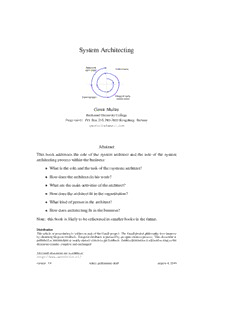
Apply and
Collect facts
earn credit
Integrate facts,
Communicate
create vision
GerritMuller
USN-SE
Hasbergsvei36 P.O.Box235,NO-3603Kongsberg Norway
[email protected]
Abstract
This book addresses the role of the system architect and the role of the system
architectingprocesswithinthebusiness:
• Whatistheroleandthetaskofthe(system)architect?
• Howdoesthearchitectdohiswork?
• Whatarethemainactivitiesofthearchitect?
• Howdoesthearchitectfitintheorganization?
• Whatkindofpersonisthearchitect?
• Howdoesarchitectingfitinthebusiness?
Note: thisbookislikelytoberefactoredinsmallerbooksinthefuture.
Distribution
ThisarticleorpresentationiswrittenaspartoftheGaudíproject. TheGaudíprojectphilosophyistoimprove
byobtainingfrequentfeedback. Frequentfeedbackispursuedbyanopencreationprocess. Thisdocumentis
publishedasintermediateornearlymatureversiontogetfeedback.Furtherdistributionisallowedaslongasthe
documentremainscompleteandunchanged.
AllGaudídocumentsareavailableat:
http://www.gaudisite.nl/
version:1.8 status:preliminarydraft January24,2023
Introduction
Thisbookbundlesthearticlesandintermezzo’sproducedbytheGaudíproject.
At this moment the book is in its early infancy. Most articles are updated
based on feedback from readers and students. The most up to date version of the
articles can always be found at [16]. The same information can be found here in
presentationformat.
Chapterscanbereadasautonomousunits. Thesequencechoosenhereismore
or less top down, hopping from one viewpoint to the next. On a regular base
a sidestep ("Intermezzo") is being made, either to describe a more fundamental
notion,ortoproposeamorechallengingpointofview.
Note: thisbookislikelytoberefactoredinsmallerbooksinthefuture.
System Architecture: The Silver
Bullet?
Unchangeable
Specifications
Avoid nasty
Certainty
Surprises
Unchangeable
Schedules
Avoid risks
0.1 Introduction
The expectation level with respect to processes in general and the system archi-
tecture process in particular can vary from skeptical to blind faith. The skeptics
haveexperiencedthathorriblespecificationsanddesignscanbepursuedunderthe
grandnameofArchitecture. Thefollowerswithblindfaithareattheoppositeend
ofthespectrum,theirbelieveinprocessesinhibitsthemfromseeingthelimitations
andconstraintsfromtheprocessesapplied.
ThecentralmessageofthisIntermezzois:
SilverBulletsdonotexist.
This Intermezzo intends to set realistic expectation levels with respect to the
System Architecture Process, and describes the ingredients for successful appli-
cation.
0.2 Why System Architecture?
SystemArchitectingisameanstocreatesystemsefficientandeffective,bysupplying
overview,byguardingconsistencyandintegrity,andbybalancing. Inotherwords
theSystemArchitecthelpsthedevelopmentteamtofinditswayinarathercomplex,
dynamicanduncertainworld.
Frompsychologicalpointofviewpeopleapplytheirownsurvivalmechanisms,
whentheyperceiveathreat. OneofthemostcommonsurvivalmechanismsisThe
QuestforCertainty,seesubsection0.2.1.
Unfortunately System Architecting will never remove all uncertainties, see
subsection 0.2.2. The application of a system architecture process can help in the
riskmanagement,amongstothersbyprevention,andbyminimizingimpact.
Successful application of system architecture is far from trivial, section 0.3
describeshowtheSystemArchitectureProcessshouldbeappliedtomeetthegoals
ofefficiencyandeffectively.
0.2.1 TheQuestforCertainty
This section provides a caricatural view on human behavior based on a free inter-
pretationoftheMaslowHierarchyofNeeds,asdiscussedforinstancein[7]. This
exaggeratedviewmatcheswiththesecurityneedsinthelowerMaslowHierarchy.
Note that less defensive behavior can be triggered by needs in the higher layers,
werewordssuchasadventurousenexplorativearebeingused.
The majority of people, including managers and engineers, have a need for
certainty. Theiridealistohavestable,unchangeablesetsofspecifications,schedules
et cetera. This (hopefully) isolates them from the nasty surprises of reality see
table1.
• incompetentpeople
• humanmistakes
• lackofcollaborationorsynergy
• misunderstandingormiscommunication
• changingmarkets
• fastmovingcompetition
• unforeseenphysical,chemical,mechanicalproperties
• mothernature(illnesses,floods)
Table1: NastySurprisesofReality
Unfortunately these nasty surprises are a fact of life. Our human capability to
controlthesephenomenaisquitelimited.
Risk management can help to be more robust. However risk management
certainlydoesnotremovethesephenomenaanditalsodoesnotreducetheconse-
quencestozero. Riskmanagementbalancesprobability,effect,andcost.
People with a need for certainty are willing to accept any method or process
whichpromisescertainty. Inotherwordscertaintyappearstobetheirpersonalkey
driver. It is better to rephrase this key driver as to avoid nasty surprises, which is
closertotheinternalmotivationattheonehandandwhichgivesahandlelateron
tomanagetheexpectations. Figure1visualizesthesedrivers.
GerritMuller UniversityofSouth-EasternNorway-NISE
SystemArchitecting page: iv
January24,2023 version:1.8
Unchangeable
Specifications
Avoid nasty
Certainty
Surprises
Unchangeable
Schedules
Avoid risks
Figure1: Personalkeydrivertoavoidnastysurprises
0.2.2 Disclaimer;SettingtheExpectationstoarealisticlevel
The Gaudí Project will not deliver a Plug-and-Play System Architecture Process.
Systemarchitectswhichhavereadallthearticlesandfollowedthecoursewillnot
automaticallybesuccessful.
TheGaudíprojectwilldeliveralargesetofconsistentbackgroundmaterialfor
system architects. This material ranges from process and architecture principles,
providinginsightandunderstanding,tomorespecifichow-to’swhichprovidemore
directlyapplicableguidelines.
The competent system architect will use the material by customizing it to the
specificproblemtobeaddressed. Atthesametimethesystemarchitectwillhave
tointeractwiththeenvironmenttosharethiscustomizedwayofworking.
Whenever the material is applied literal, this is a strong indication that the
organization and the system architect do not work explicit enough on the way of
working.
0.3 How: Critical Success Factors
Ingredientsforaneffectiveapplicationofasystemarchitectureprocessareshown
intable2.
No method or process will function without these critical success factors. A
processcannotbeusedassubstituteforknowhoworcommonsense.
0.3.1 Know-How
Thecoreofthesystemarchitectureworkisknow-how,rangingfrompuretechnology
know-howtoapplicationandbusinessknow-how. Activecontrolonabroadbasis
isaprerequisiteforasystemarchitect.
GerritMuller UniversityofSouth-EasternNorway-NISE
SystemArchitecting page: v
January24,2023 version:1.8
• Know-How
• CommonSense
• Pragmatics
• Criticalattitude
• Socialskills
• Drive
• Vision
Table 2: Critical Success Factors for an effective application of a System Archi-
tectureProcess
0.3.2 CommonSense
Most problems encountered during Product Creation require common sense to
solve them. Mechanistic approaches severely limit the solution space, resulting
incomplexsolutions. Systemarchitectsarecapableof"lateral"thinking,allowing
solutionsinpreviouslyunexpecteddirections.
0.3.3 Pragmatics
The holistic approach can easily derail in a sea of seemingly conflicting require-
mentsandviewpoints. Thesystemarchitectneedsasignificantamountofpragmatism
tobeselectiveandfocused,whilebeingholisticinthebackofhismind.
0.3.4 Criticalattitude
Cleardiagrams, tableswithfactsandsmoothpresentationsgivetheimpressionof
highqualityandincreasetheconfidence. Howeverthesesamediagrams,tablesand
presentations conceal the forgotten, misinterpreted, or underestimated facts. The
systemarchitectmustalwaysbealert,forinstancebyaskingquestionsasshownin
table3.
0.3.5 Drive
A good system architect has a passion for his architecture, it has an emotional
value.
Anarchitectwhichisworkingentirelyaccordingtothebook,obedientlygoing
throughthemotions,willproduceaclinicalarchitecturewithoutdriveorownership.
Goodarchitectureshaveanidentityofthemselves,whichoriginateinthedrive
ofthearchitect. Suchanarchitectureisanevolvingentity,whichisappreciatedby
thestakeholders.
GerritMuller UniversityofSouth-EasternNorway-NISE
SystemArchitecting page: vi
January24,2023 version:1.8
• Doweaddresstherightproblemorrequirement?
• Isthecustomer/useron-board?
• Isthisdesignadequate?
• Consiststheinputdatafromfacts,wishesorideas?
• Doweneedsomanypeoplefortheimplementation?
• Doesthisprocessororganizationfittheproblem?
Table 3: Critical Attitude: Examples of questions to be asked by the System
Architect
0.3.6 Vision
Thesystemarchitectneedstohaveavisiontobeabletoprovidedirection. Avision
enables an evolution of existing architectures to desired architectures. Having
vision is not trivial, it requires a good understanding of needs (the problem) and
means (the solution) plus the trends (opportunities and threats) in both needs and
means.
0.4 Summary
Theonesentencesummaryofthisintermezzois: Silverbulletsdonotexist. Table4
givesabullet-wisesummary.
• Mostpeoplewanttoavoidnastysurprises
• Mostpeoplearelookingforcertainty
• SilverBulletsdonotexist
• SystemArchitectureisnotagoldenbullet
• Critical Success Factors: Know-How, Common Sense, Pragmatics, Critical
attitude,DriveandVision
Table4: Summary
0.5 Acknowledgements
Hans Gieles suggested improvements to increase the cohesion and the red line in
thisIntermezzo.
Henk Obbink and Angelo Hulshout and many others pointed out that ”The
Golden Bullet” should have been ”The Silver Bullet”, which has been changed
GerritMuller UniversityofSouth-EasternNorway-NISE
SystemArchitecting page: vii
January24,2023 version:1.8
finally. Adriaan van den Brand pointed out the forgotten change of golden into
silver.
Eugene Ivanov pointed out that evolution aspects were missing. The result is
theadditionofvisionascriticalsuccessfactor.
Steve R. Nanning indicated unclarity in the abstract and criticized the too
negativephrasingoftheQuestforCertainty. StephenBoggessaddedaquestionto
the list in Section ”Critical Attitude”. Ning Lu added more surprises and critical
successfactors.
GerritMuller UniversityofSouth-EasternNorway-NISE
SystemArchitecting page: viii
January24,2023 version:1.8
Part I
Processes
Chapter 1
Process Decomposition of a
Business
customer
CustomerTechnology, Process,PRoadmapand People roadmapslanPnoBudgetsiBusinessnlicgDriversy P ProductarnoroadmapdcesBudget, plans PProduct NeedsNeeds and roand feedbackFeedbackducmt aCterreiaaltionNeeds and pPrFeedbackerInformationsoCaPeoplecleueTechnologyssstTeschnical Product sProcessoamlOrderDocumentationeser-lOogProduct-related riiProductsetprocessesincstepdro dP$$urcotiocPeopleneTechnologyssesSupportrProcessvice$$
People, Process, and Technology Management Process
1.1 Introduction
This chapter positions the system architecting process in a wider business scope.
Theobjectiveofthischapteristoprovidesystemarchitectsinsightinthebusiness
processesandespeciallyintheprocesseswheresystemarchitectsactivelycontribute.
Thefocusisoncompaniesthatcreatephysicalproducts. Othertypesofbusinesses,
such as solution providers, services, courseware, also need systems architecting.
Theprocessstructurewilldeviatesomewhatfromthestructurepresentedhere. See
Intermezzo“Products,Projects,andServices”foradiscussionontheprocessesin
theseotherbusinesses.
1.2 Process Decomposition
Thebusinessprocesscanbedecomposedin4mainprocessesasshowninFigure1.1.
Wehaveonpurposeignoredthesupportingandconnectingprocesses. Thissimpli-
fication will allow us to get a number of more fundamental insights in the main
processes.
Description:Mar 21, 2000 Abstract. This book addresses the role of the system architect and the role of the
system .. 14 Short introduction to basic “CAFCR” model. 88.