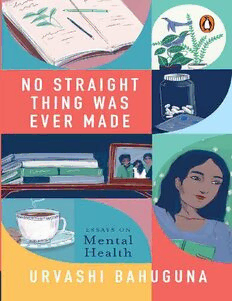
Table Of ContentURVASHI BAHUGUNA
NO STRAIGHT THING WAS EVER MADE
Essays on Mental Health
PENGUIN BOOKS
CONTENTS
Preface
1. No Straight Thing Was Ever Made
2. When You’re Very, Very Tired, You Can’t Throw Your Tired Away
3. Everything for This Beauty
4. Two Deer in the Headlights
5. Buoyancy
6. Louder than the Music
7. What Is Next Is What the Story Most Requires
8. Waiting for Sunbirds
9. In the Weeds
10. Ammahood
Notes
Appendix: Recommended Reading
Acknowledgements
Follow Penguin
Copyright
Advance Praise for the Book
‘These are dispatches from the dark side, from that shadowy land
called Depression, but oddly they are illuminating, powerful,
empowering. Everyone should read this book because we are never
very far from someone who is depressed, someone who is going
through something like this. I found myself saying, “Yes, yes, yes”
and I found myself crying and I found myself nodding as I read,
slowly, savouring it, not wanting it to end and wishing it were over, all
at once’—Jerry Pinto, author and poet
‘Lucid and wise, wrenching and shattering in its honesty, No Straight
Thing Was Ever Made explores the homeland of invisible illness
through ten remarkable essays on mental health. These beautiful
and true essays will change your perception of illnesses and
conditions that are so universal, and yet so rarely understood. This is
a moving and powerful memoir, a landmark collection of essays and
reflections from an exceptionally gifted writer who brings her
questioning intelligence to bear on every challenge she faces. It will
change your understanding of what it means to live with an invisible,
ever-present illness, and to hold on to your deepest sense of self
through every bend in the road’—Nilanjana Roy, journalist, literary
critic and author
‘Brave, lyrical essays, as much to do with coping as with the difficult
task of repair. A book we may all want to keep beside us, whatever
our relationship with the shadows’—Tishani Doshi, writer, dancer and
poet
For the therapists who turned my life around,
Madeleine who made me stronger,
Wendell who taught me to love both Márquez and popular culture,
And Aja and Badi
Preface
After six years of being immersed in the language of mental illness,
coping and recovery, I sometimes forget that I was once someone
who didn’t know what the various mental illnesses are or how
common some of them are. ‘Invisible illness’ is an umbrella term for
any medical condition that is not immediately noticeable by other
people. It includes but is not limited to cystic fibrosis, chronic pain,
chronic fatigue, irritable bowel syndrome, diabetes and mental
illnesses. I did not know what invisible illness was before I fell ill in
ways that were unfamiliar and opaque to me.
When I was diagnosed with major depressive disorder in February
2014 (and later with generalized anxiety disorder), it was about a
year and a half after I first began to notice that I was feeling poorly
mentally and emotionally. In the beginning, in late 2012 and early
2013, it appeared to be a temporary sadness, lack of interest and
loss of appetite that I could ascribe to passing circumstances—a
break-up; a fight with a friend; exhaustion with the university where
classes were routinely cancelled and professors frequently shuffled.
But even when those seasons passed, my state of mind remained
listless, tired and unwaveringly melancholy. In September 2013, I
was leaving for an MA in creative writing in England. I imagined that
once I arrived, a new life would replace those feelings with
enthusiasm and satisfaction.
Instead, I worsened in the coming months. As the year went
deeper into winter, I stayed in bed for most of the day. I struggled to
keep up with classwork. I second-guessed myself constantly,
wondering if the problem lay within me and whether I had made an
error in coming to England. Where I had believed myself to be
malleable and brave, I found myself wanting. I was often overcome
with anger and fought constantly with my then partner.
A classmate I was friends with recognized some of my symptoms
as depression and suggested I visit a general physician at the
university hospital. I did not think I qualified as someone who was
depressed. I was reluctant to venture anywhere at that time in my
life. Deep inertia marked my days. But the hospital was only a couple
minutes’ walk away, and I finally made an appointment. The
physician and I spoke for a long time.
After I was diagnosed with depression and given a low dose of
antidepressants, things became just a little easier. I did not know it at
the time, but a diagnosis and a prescription were preliminary steps
on the journey—not the end of it. It took me from early 2014 to early
2017 to come to a more stable place with regard to managing my
depression and anxiety. I had to learn how to better navigate
depressive episodes that could last days or weeks and how to more
effectively manage the formidable anxiety that could keep me from
performing the most basic and necessary tasks such as responding
to a work email or showering.
I left friends in restaurants and coffee shops because I could not
soothe the climbing anxiety inside me in those moments. I cried at
bus stops, in grocery stores, in libraries, on buses and planes. I
woke my mother up in the middle of the night because I was
physically unable to submit an assignment that I had completed, for
fear it was terrible. People around me had to contend with the
sudden and substantial dips in my moods and my irrational anxiety. It
took time and missteps, and gradually growing apart from some
people, to arrive at a new familial and social normal.
In February 2017, I went to an ER because my chest hurt for
hours from an extreme panic attack. I had not been on medication
for eighteen months at the time. I was proud of that because I
thought managing without medication suggested strength and
progress on my part. I would give up my medication without
consulting a psychiatrist every time I felt better, only to find myself in
another depressive episode after a few weeks or months. I felt
shame and an unshakeable sense of failure about continuing to
experience these symptoms. With a combination of time, therapy,
ongoing conversations with informed loved ones or those with similar
experiences, and regular medication, I learnt to see my symptoms as
the outcome of illness rather than a personal shortcoming, which
helped me become far more adept at riding the highs and lows
associated with these illnesses.
In part, I wrote these essays because I was surprised by the
complexity of recovery—the setbacks, the hit-or-miss success rate of
remedies and coping strategies. I had never imagined I would be ill
in this way, and I had been wholly unprepared for what recovery
would require of me. The determination and stomach for
repetitiveness it demands cannot be overstated. Of course, this is
not a definitive account of mental illness. It is merely my experience.
I was not, and by no means have become, perfect. Pre-existing
flaws, quirks, insecurities and baggage invariably intersect with
mental illnesses. They do not cause the illness, but they become
carriers for the symptoms. I have written about the way illness
permeates every aspect of my life, and I have written about the work
it has taken and continues to take to manage my mental health. I
have tried to be as real as possible about the challenges while also
being hopeful and positive because I have truthfully found both
difficulty and redemption on this path.
When I started drafting these essays in 2017, the words were an
extension of conversations I was already having with the people in
my life. I was trying to normalize for others what I had finally
normalized for myself. I explained to them in detail what therapy and
recovery involved. I casually mentioned I had a therapy appointment
or took my medication in front of them in a matter-of-fact way. I was
afraid of their responses, but I knew that we could either live with the
knowledge of the illness, or we could grow apart.
In the acknowledgements of her memoir, Educated, Tara Westover
wrote, ‘We are all more complicated than the roles we are given in
stories.’ This is certainly true of the people in these essays. I will not
presume to interpret the text for the reader, but I wish to make clear
at the outset that there are no villains in these stories.
This is not a memoir. The essays are arranged thematically rather
than chronologically. In these essays, I have written about the way
poor mental health has affected my relationships, my work, my
decisions and the way I view my body, as well as how I have
cultivated and become protective of better mental health for myself.
It is important to state that some of the issues and circumstances in
these pages may apply to anyone struggling with their mental health
—irrespective of what their diagnosis is or whether they have one. I
certainly do not want to suggest that mental health is a binary
between ill and well rather than a spectrum.
I have used the words ‘crazy’, ‘insane’, ‘idiot’, ‘ugly’ and ‘monster’
in reference to myself, to be truthful about how I often felt, in the
moments and periods described, before I reached a healthier
understanding of illness and myself. Harsh and skewed self-
perception is a defining trait of these illnesses. I would not refer to
myself or other people with mental illness in those terms in the
present.
I have included in this collection two early essays published in
2017 on family and fatigue, with slight amendments to the original
text. When I read my essays from a couple of years ago, I am struck
by how idealized the family in those pages is, how informed by a
moment in time when a wave of forgiveness and mutual
understanding had lent everything a soft glow. I was surprised by
how outdated, if still true, the poems about my old relationship in my
first collection of poems sounded, by how many new notes I have
discovered since in that old relationship.
Stories shift. Perspectives mellow, sharpen, become entirely
irrelevant. The poet Aditi Rao once told me, ‘When I need to