Table Of ContentNew observations of Anambra Waxbill Estrilda poliopareia
F. R. Roux? andD. Otobotekereb
Nouvelles observations de l’Astrild du Niger Estrilda poliopareia. L’Astrild du Niger EstriULi
poliopareia est une espece endemique au delta du Niger, au Nigeria, classee comme Vulnerable.
Prealablement aux observations des auteurs presentees ici, il n'existait que peu de mentions doc-
umentees, la derniere datant apparemment de janvier 1987. De mars 2001 a avril 2002, les
auteurs ont observe l’espece neuffois, en saison seche et en saison des pluies, en 12 localites du
delta (Tableau 1). Les astrilds ne se trouvaient jamais au dela d un kilometre d une riviere, mal-
gre la presence d’habitat qui semblait favorable plus a l’interieur. Ils etaient en groupes monospe-
cifiques ou mixtes (comprenant des Astrilds a joues oranges E. melpoda) comptant jusqu'a 50
individus, en couples ousolitaires. L’especese nourrissait de graines de plantes de milieux plus ou
moins perturbes et semblait tolerer la presence humaine. Les auteurs estiment que la population
compte au moins 500 individus. Pour evaluer l’impact des activites humaines sur cette popula-
tion, des donnees supplementaires sur sa biologie sont indispensables.
A
nambra Waxbill Estrildapoliopareia is a very it is more frequently treated as a distinct species
local and little-known Nigerian endemic that (White 1963, Elgood etal. 1994, Clement et aL
&
is classified as Vulnerable, with a population esti- 1993, Fry Keith 2004).
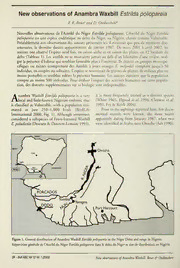
mated at just 250-1,000 birds (BirdLife Prior to the sightings reported here, few docu-
International 2000, Fig. 1). Although sometimes mented records were known, the most recent
considered a subspecies ofFawn-breasted Waxbill apparently dating from January 1987, when two
E.paludicola(Dowsett& Dowsett-Lemaire 1993), were identified atAsaba, nearOnitsha (Ash 1990).
Figure 1. GeneraldistributionofAnambraWaxbillEstrildapoliopareiaintheNigerDeltaandrangeinNigeria.
Repartitiongeneraledel’AstrildduNigerEstrildapoliopareiadansledeltaduNigeretairededistributionauNigeria
24-BullABCVol12No 1(2005) NewobservationsofAnambra Waxbill: Roux&Otobotekere
In March 1999, during the Niger Delta sequently pointed out that the species has a pale
Environmental Survey, the species was searched eye.
forinvainbyoneofus alongthesandbanks ofthe
Niger River atAsaba (Roux 1999). Habitat and behaviour
The species was never encountered more than 1
Observations km from riverbanks (and often less than 300 m
In the period March 2001-April 2002 we away), despite the occurrence ofsome apparently
observed Anambra Waxbill on nine dates in both favourablehabitat furtherinland. Itwas seen feed-
the dryand rainyseasons, at 12 differentlocalities ing on the small seeds of Kyllinga Fimbristylis
in the Niger Delta (Table 1). We first saw it on 1 Cerastium (on almost bare sandbank,s), Digitaria,
March 2001, when we noted four individuals andPanicum. Duringoursystematicsearchforthe
along the River Nun at Agaduma, north of species in April 2002, its presence appeared to be
Yenagoa (and c.135 km south ofthe 1987 record highly correlated with the presence ofthese seed-
at Asaba). All sites listed in Table 1 are situated bearing herbaceous plants. This explains the fre-
along the Nun River, in the eastern part of the quentoccurrence ofthe birds on sandbanks in the
Niger Delta, except for one at the Dodo River middle of the Nun River. Weeds in yam planta-
estuary (Fig. 2). tions were also exploited, sometimes by large
groups (of up to 30 in Agudama). According to
Field identification
our observations, elephant grass Pennisetum sp.
The following features were noted: was used for foraging only during flood periods
• small estrildid, similar in size and shape to (October-November): at this time ofthe year, the
Orange-cheeked Waxbill E. melpoda, but spikes ofthis verytall species (up to 3 m high) are
slightlymore heavilybuilt; fullydevelopedandwellabovethewater,whilethe
• bright red bill (but variable, somewhat less sandbanks are covered. In Tombia, most of our
bright in some); observations in October-Novemberwere made in
• no red spot on lores; this vegetation, with birds takingyoung seeds and
• bright red rump; flowers.
• brown tail; Pennisetum may also be important as a cover
• pale buffish breast, with a faintwhite throat. under which the nest is built. We observed a bird
The absence of a red loral spot excludes carrying grass stems within a dense stand of
female Red-billed Firefinch Lagonosticta senegala, Pennisetum, close to habitation. Pennisetum also
the only possible confusion species in the area. provides shelter, as does cassava plantations, in
Otherobservers (e.g. L. D. C. Fishpool) havesub-
Table 1.ObservationsofAnambraWaxbill Estrildapoliopareiabytheauthors in2001-2002.
Tableau 1. Observationsde I’Astrild du NigerEstrildapoliopareiaparlesauteursen2001-2002.
Date Locality/Localite Coordinates/ Numberofbirds/
Coordonnees Nombred’oiseaux
1 March2001 Agudama 30
8March2001 DodoRiverestuary 04°54’N05°27’E 19
28October2001 Tombia 04°59’N06°15’E 2
30October2001 Agudama 3+2+4+2
31 October2001 Akaibiri(southofTombia) 3
1 November2001 Polaku 6+2
29April2002 Tombia 04°59’N06°15’E 12+3+10
Sabagreia 1
30April2002 Okopuma 05°04’N06°16’E 1+4
Kaiama 05°06’N06°18’E 2+3+1+2
Ayakoroama 1
BetweenSabagreiaandOkopuma 05°04’N06°14’E 8+1+2+1
1 May2002 Yenagoa 04°55’N06°16’E 10
NewobservationsofAnambraWaxbill: Roux&Otobotekere BullABCVol12No 1(2005)-25
Figure2. Observations ofAnambraWaxbill EstrildapoliopareiaalongtheNun Rivermentioned in thetext: 1:Tombia
(Ekpetiama); 2:Akaibiri; 3:Agudama; 4: Polaku; 3: Sabagreia; 6: Okopuma; 7: Kaiama.
Observationsdel’AstrildduNigerEstrildapoliopareialelongde la riviere Nun mentionneesdans le texte.
which single birds were observed on several occa- been suggested that the species is likely to make
sions. short-distance movements following flooding in
Approximately 30% of encounters, including severe rainyseasons (BirdLife International 2000),
those oflarge groups, were made close to human our observations in Tombia, made at the end of
presence or activity: industrial fallow in Tombia, October, during the peak of flooding, appear to
house-yards in villages along the Nun River, hos- contradict this.
pital grounds in Yenagoa, and along tarred and We saw birds carrying nesting material on 30
untarred roads in Kaiama. April 2002, but no nestwas located. Afemale col-
Thewaxbillswere often observed in monospe- lected in June by Serle (1957) was coming into
cific or mixed groups (including Orange-cheeked breeding condition.
Waxbills) of up to 30 individuals, in pairs or
singly. When alone, they were easy to approach, Discussion
but large groups rapidly took flight. Flights were Between 29 April 2002 and 1 May 2002, we
rarely over a long distance, although some were recorded 50 AnambraWaxbills (Table 1). Most of
seen crossingthe Nun River, which is several hun- the localities visited during these three days are
dred metres wide at this point. Although it has sufficiently distant from each other to exclude
26-BullABCVol12No 1(2005) NewobservationsofAnambra Waxbill: Roux&Otobotekere
Figures 3-4.AnambraWaxbill /AstrildduNigerEstrildapoliopareia, NigerDelta, Nigeria (Guus Hak)
double counts. The total number ofbirds record- References
ed on 1 and 8 March 2001 was about the same. Ash J. S. 1990. Additions to the avifauna ofNigeria,
Given that (1) many sites where the species with notes on distributional changes and breeding.
was recordeddecades ago (e.g. Forcados,Anambra Malimbus 11:104-116.
Creek, Badagri) werenotvisitedbyus; (2) someof BirdLife International 2000. Threatened Birds ofthe
&
our observations appear to suggest that sandy World. Barcelona: Lynx Edicions Cambridge,
shores at estuaries may be a favoured habitat (see UK: BirdLife International.
records of8 March 2002, Dodo Riverestuary) not Clement, P., Harris, A. & Davis, J. 1993. Finches and
previously realised; and (3) that the number of Sparrows: An Identification Guide. London, UK:
Christopher Helm.
birds present at those sites that were surveyed R &
could be higher than noted here, we estimate that Dowsett, J. Dowsett-Lemaire, F. 1993.
Comments on the taxonomy ofsome Afrotropical
we did not record more than 10% ofthe popula-
tion. Ifcorrect, the total Anambra Waxbill popu- bird species. TauracoRes. Rep. 5: 323-389.
latiAonswtohuelsdpenciuemsbreerlieastmlaeaisntl3y0o0nbiwredes.ds ofmore ElgoNBoi.dr,,dsJS.hoHa.rf,lNaHingede,irgiRha.:amEA,.nJ.&AB.n,SnkoMitonaonterered,,ANC.h.ecMJk..-,li1Ns9ta9.s4o.Bn,OTAhU.e
or less disturbed habitats and does not appear to Check-list No. 4. Second edn. Tring: British
be intolerant ofhuman presence, food availability Ornithologists’ Union.
should not be drastically reduced in case of Fry, C. H. & Keith, S. (eds.) 2004. TheBirdsofAfrica.
anthropic disturbance. We therefore presume that Vol. 7. London, UK: ChristopherHelm.
the planned dredging ofthe Niger River will not Roux, F. R. 1999. The birds oftheNigerDelta. Lagos:
be detrimental to the species. However, without Niger DeltaEnvironmental Survey, SPDC.
precise data on its breeding biology, we are unable Serle, W. 1957. A contribution to the birds of the
to evaluate the impact ofhuman activities on the Eastern Region of Nigeria. Ibis 99: 371-418,
small population oftheAnambraWaxbill. 628-685.
White, C. M. N. 1963.A RevisedCheckListofAfrican
Acknowledgements
Flycatchers, Tits, Tree creepers, Sunbirds, White-eyes,
We thank all the inhabitants ofTombia Ekpetiama, Honey eaters, Buntings, Finches, Weavers and
particularly ChiefChristian Otobotekere, and those Waxbills. Lusaka: Govt. Printer.
ofLegtubene, for their assistance and interest in our
research. Without their hospitality, the work would aLycee frangais Louis Pasteur (Lagos), Consulat de
have been very much harder. We are also verygrate- France a Lagos, 128 bis rue de LUniversite, 75351
ful to Ron Demey who assisted us in finalising this Paris 07S.P, France.
paper. bInstituteofPollutionStudies, RiversState Universityof
ScienceandTechnology, PortHarcourt, Nigeria.
NewobservationsofAnambraWaxbill: Roux&Otobotekere BullABCVol12No 1(2005)-27