Table Of ContentuPhongolo Municipality
Annual Financial Statements
for the year ended June 30, 2012
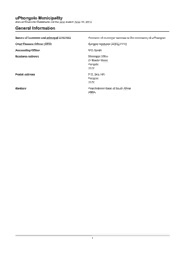
uPhongolo Municipality
Annual Financial Statements for the year ended June 30, 2012
General Information
Nature of business and principal activities Provision of municipal services to the community of uPhongolo
Chief Finance Officer (CFO) Bongani Ngobese (Acting CFO)
Accounting Officer M.E Zondo
Business address Municipal Office
61 Martin Street
Pongola
3170
Postal address P.O. Box 191
Pongola
3170
Bankers First National Bank of South Africa
ABSA
1
uPhongolo Municipality
Annual Financial Statements for the year ended June 30, 2012
Index
The reports and statements set out below comprise the annual financial statements presented to the uPhongolo Municipal
Council:
Index Page
Accounting Officer's Responsibilities and Approval 3
Statement of Financial Position 4
Statement of Financial Performance 5
Statement of Changes in Net Assets 6
Cash Flow Statement 7
Accounting Policies 8 - 19
Notes to the Annual Financial Statements 20 - 45
Appendixes:
Appendix A: Schedule of External loans
2
uPhongolo Municipality
Annual Financial Statements for the year ended June 30, 2012
Accounting Officer's Responsibilities and Approval
The accounting officeris required by the Municipal Finance Management Act (Act 56 of 2003), to maintain adequate
accounting records and is responsible for the content and integrity of the annual financial statements and related financial
information included in this report. It is the responsibility of the accounting officer to ensure that the annual financial
statements fairly present the state of affairs of the municipality as at the end of the financial year and the results of its
operations and cash flows for the period then ended. The external auditors are engaged to express an independent opinion on
the annual financial statements and are given unrestricted access to all financial records and related data.
The annual financial statements have been prepared in accordance with South African Statements of Generally Recognised
Accounting Practice (GRAP) including any interpretations, guidelines and directives issued by the Accounting Standards
Board.
The annual financial statements are based upon appropriate accounting policies consistently applied and supported by
reasonable and prudent judgements and estimates.
The accounting officeracknowledges that heis ultimately responsible for the system of internal financial control established by
the municipality and place considerable importance on maintaining a strong control environment. To enable the accounting
officer to meet these responsibilities, the accounting officer sets standards for internal control aimed at reducing the risk of
error or deficit in a cost effective manner. The standards include the proper delegation of responsibilities within a clearly
defined framework, effective accounting procedures and adequate segregation of duties to ensure an acceptable level of risk.
These controls are monitored throughout the municipality and all employees are required to maintain the highest ethical
standards in ensuring the municipality’s business is conducted in a manner that in all reasonable circumstances is above
reproach. The focus of risk management in the municipality is on identifying, assessing, managing and monitoring all known
forms of risk across the municipality. While operating risk cannot be fully eliminated, the municipality endeavours to minimise
it by ensuring that appropriate infrastructure, controls, systems and ethical behaviour are applied and managed within
predetermined procedures and constraints.
The accounting officeris of the opinion, based on the information and explanations given by management, that the system of
internal control provides reasonable assurance that the financial records may be relied on for the preparation of the annual
financial statements. However, any system of internal financial control can provide only reasonable, and not absolute,
assurance against material misstatement or deficit.
I certify that the salaries, allowances, and benefits of Councillors, as disclosed in note 24 of these financial statements are
within the upper limits of the framework envisaged in Section 219 of the Constitution, read with the Remuneration of Public
Office Bearers Act and the Minister of Cooperative Governance and Traditional Affairs determined in accordance with this Act.
The annual financial statements set out on pages 4 to 45, which have been prepared on the going concern basis, were
approved by the accounting officer on 31 August 2012 and were signed on its behalf by:
Accounting Officer
3
uPhongolo Municipality
Annual Financial Statements for the year ended June 30, 2012
Statement of Financial Position
Figures in Rand Notes 2012 2011
Restated
Assets
Current Assets
Inventories 9 133,347 216,223
Trade and other receivables 10 2,639,802 1,406,951
Consumer debtors 11 4,749,209 18,744,354
Assets held for sale 8 8,980,000 10,330,000
Cash and cash equivalents 12 16,175,298 15,408,694
32,677,656 46,106,222
Non-Current Assets
Investment property 2 88,094,749 88,094,749
Property, plant and equipment 3 103,760,578 68,609,261
Intangible assets 4 126,970 102,041
Loans and receivables 5 - 3,262,979
191,982,297 160,069,030
Total Assets 224,659,953 206,175,252
Liabilities
Current Liabilities
Instalment sale obligation 13 1,405,241 -
Trade and other payables 17 20,880,604 13,729,549
VAT payable 4,528,808 5,986,726
Unspent conditional grants and receipts 14 7,472,241 14,783,742
Current portion of external loans 16 1,059,097 1,005,631
35,345,991 35,505,648
Non-Current Liabilities
Instalment sale obligation 13 2,576,274 -
Retirement benefit obligation 6 2,530,143 2,403,344
Provisions 15 1,926,750 1,835,000
Long term portion of external loans 16 2,430,134 3,213,085
Revenue received in advance - Land sales 1,947,377 1,648,106
11,410,678 9,099,535
Total Liabilities 46,756,669 44,605,183
Net Assets 177,903,284 161,570,069
Net Assets
Accumulated surplus 177,903,284 161,570,069
4
uPhongolo Municipality
Annual Financial Statements for the year ended June 30, 2012
Statement of Financial Performance
Figures in Rand Note(s) 2012 2011
Restated
Revenue
Property rates 10,952,387 10,254,547
Service charges 19 23,233,567 19,444,256
Rental of facilities and equipment 415,521 437,123
Penalty Interest received- property rates 2,797,003 3,212,122
Public contributions and donations - 40,364
Licences and permits 3,162,865 2,985,530
Government grants & subsidies 20 82,224,388 55,504,922
Fees earned 115,573 131,851
Sundry income 544,529 307,925
Interest received from extenal investments 26 1,068,721 909,411
Total Revenue 124,514,554 93,228,051
Expenditure
Employee Related Cost 23 (29,409,264) (26,648,650)
Remuneration of councillors 24 (4,548,632) (4,219,738)
Depreciation and amortisation 27 (2,973,961) (2,717,995)
Finance costs 28 (752,118) (399,118)
Debt impairment 25 (24,526,197) (17,559,625)
Repairs and maintenance (1,197,597) (1,819,841)
Contracted services (6,470,503) (7,773,387)
General Expenses 21 (36,191,756) (29,722,687)
Total Expenditure (106,070,028) (90,861,041)
Loss on disposal of fixed assets (1,333,000) (1,829,867)
Fair value adjustments 16,610 2,397,000
Surplus for the year 17,128,136 2,934,143
5
uPhongolo Municipality
Annual Financial Statements for the year ended June 30, 2012
Statement of Changes in Net Assets
Accumulated Total net
Figures in Rand surplus assets
Opening balance as previously reported 158,218,428 158,218,428
Adjustments
Prior year adjustments 3,249,193 3,249,193
Restated balance at 30 June 2010 161,467,621 161,467,621
Changes in net assets
Reversal of prior years PAYE liability 334,197 334,197
Net income (losses) recognised directly in net assets 334,197 334,197
Surplus for the year 2,934,143 2,934,143
Total recognised income and expenses for the year 3,268,340 3,268,340
Adjustments to loan expenses 89,508 89,508
Adjustments to rent expenses 28,639 28,639
Adjustments to post retirement benifits 105,726 105,726
Properties sold in prior periods (2,212,857) (2,212,857)
Abacus opening balance adjustments 121,796 121,796
Intangable assets adjustment 1,383 1,383
Other adjustments 157,835 157,835
Write off of accounts with no movement (1,227,989) (1,227,989)
Correction of prior period's depreciation 54,489 54,489
Reversal of prior cheques 25,693 25,693
Debtors account subsequently not written off 300 300
Asset adjustment (310,415) (310,415)
Total changes 102,448 102,448
Opening balance as previously reported 159,656,456 159,656,456
Adjustments
Prior year adjustments (Refer to note 33) 1,913,613 1,913,613
Restated balance at 30 June 2011 161,570,069 161,570,069
Changes in net assets
Corrections of error adjustment (794,921) (794,921)
Net income (losses) recognised directly in net assets (794,921) (794,921)
Surplus for the year 17,128,136 17,128,136
Total recognised income and expenses for the year 16,333,215 16,333,215
Total changes 16,333,215 16,333,215
Balance at 30 June 2012 177,903,284 177,903,284
6
uPhongolo Municipality
Annual Financial Statements for the year ended June 30, 2012
Cash Flow Statement
Figures in Rand Note(s) 2012 2011
Cash flows from operating activities
Receipts
Sale of goods and services 37,882,366 33,569,506
Grants 82,224,388 55,504,922
Interest income 3,865,724 4,139,895
123,972,478 93,214,323
Payments
Employee costs (34,067,903) -
Suppliers (57,140,637) (63,497,438)
Finance costs (752,118) (399,118)
(91,960,658) (63,896,556)
Net cash flows from operating activities 30 32,011,820 29,317,767
Cash flows from investing activities
Purchase of property, plant and equipment 3 (38,009,439) (18,053,543)
Proceeds from sale of investment property 2 (1,350,000) 846,133
Purchase of other intangible assets 4 (67,057) (29,690)
Capitalised development costs 4 - 889
Movement in Housing debtors 3,262,979 -
Donated assets 17,000 (230,000)
Purchase of assets held for sale - (220,000)
Proceeds from sale of assets held for sale 1,350,000 -
Net cash flows from investing activities (34,796,517) (17,686,211)
Cash flows from financing activities
Repayment of eskom liability - (832,484)
Movement in long term portion of external loans (729,485) (709,999)
Movement in revenue received in advance - land sales 299,271 1,815,346
Finance lease payments 3,981,515 -
Net cash flows from financing activities 3,551,301 272,863
Net increase/(decrease) in cash and cash equivalents 766,604 11,904,419
Cash and cash equivalents at the beginning of the year 15,408,694 3,504,275
Cash and cash equivalents at the end of the year 12 16,175,298 15,408,694
7
uPhongolo Municipality
Annual Financial Statements for the year ended June 30, 2012
Accounting Policies
1. Presentation of Annual Financial Statements
The annual financial statements have been prepared in accordance with the effective Standards of Generally Recognised
Accounting Practice (GRAP) including any interpretations, guidelines and directives issued by the Accounting Standards
Board.
These annual financial statements have been prepared on an accrual basis of accounting and are in accordance with historical
cost convention unless specified otherwise. They are presented in South African Rand.
Accounting policies for material transactions, events or conditions not covered by the above GRAP standards have been
developed in accordance with paragraphs 7, 11 and 12 of GRAP 3. These accounting policies and the applicable disclosures
have been based on the South African Statements of Generally Accepted Accounting Practices (SA GAAP) including any
interpretations of such statements issued by the Accounting Standards Board.
The Minister of Finance has in terms of Government Gazette 31021 dated 9 May 2008, promulgated the implementation of the
new GRAP standards with effect from 1 July 2008. These GRAP standards replace the current GAMAP Standards. The
Financial Statements is compiled according to the new GRAP standards.
In terms of Section 89 (1)(b) of the PFMA, the Accounting Standards Board issued directive 3 to set the transitional provisions
and arrangement for high capacity municipalities to comply with the standards of GRAP. This directive is read in conjunction
with the relevant standard(s) of GRAP and are applied on or after the effective date of the applicable standard(s) of GRAP
Effective accounting standards that are applied considering the provisions in paragraphs .20 to .26 of the directive:
IFRS 7 (AC 144) - Financial Instruments: Disclosure, IAS 19 (AC 116) - Employee benefits, IAS 32 (AC 125) - Financial
Instruments: Presentation, IAS 36 (AC 128) - Impairment of Assets, IAS 39 (AC133) - Financial Instruments: Recognition and
Measurement
A summary of the significant accounting policies, which have been consistently applied to all the years presented, are
disclosed below.
1.1 Significant judgements and sources of estimation uncertainty
In preparing the annual financial statements, management is required to make estimates and assumptions that affect the
amounts represented in the annual financial statements and related disclosures. Use of available information and the
application of judgement is inherent in the formation of estimates. Actual results in the future could differ from these estimates
which may be material to the annual financial statements. Significant judgements include:
Post retirement benefits
The present value of the post retirement obligation depends on a number of factors that are determined on an actuarial basis
using a number of assumptions. The assumptions used in determining the net cost (income) include the discount rate. Any
changes in these assumptions will impact on the carrying amount of post retirement obligations.
The municipality determines the appropriate discount rate at the end of each year. This is the interest rate that should be used
to determine the present value of estimated future cash outflows expected to be required to settle the post retirement benefits.
Allowance for doubtful debts
On debtors an impairment loss is recognised in surplus and deficit when there is objective evidence that it is impaired. The
impairment is measured as the difference between the debtors carrying amount and the present value of estimated future cash
flows discounted at the effective interest rate, computed at initial recognition.
1.2 Investment property
Investment property is property (land or a building or part of a building or both) held to earn rentals or capital appreciation is
stated at cost less accumulated depreciation. Where an investment property is acquired at no cost, or for a nominal cost, its
cost is recognised at its fair value as at the date of acquisition. Investment properties are written down for impairment
where considered necessary.
Depreciation is calculated on cost, using the straight-line method over the useful life of the property .
8
uPhongolo Municipality
Annual Financial Statements for the year ended June 30, 2012
Accounting Policies
1.3 Property, plant and equipment
Property, plant and equipment are tangible non-current assets (including infrastructure assets) that are held for use in the
production or supply of goods or services, rental to others, or for administrative purposes, and are expected to be used during
more than one period.
The initial estimate of the costs of dismantling and removing the item and restoring the site on which it is located is also
included in the cost of property, plant and equipment, where the entity is obligated to incur such expenditure, and where the
obligation arises as a result of acquiring the asset or using it for purposes other than the production of inventories.
9