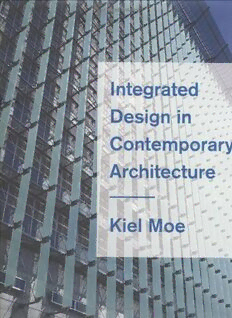
Table Of ContentIntegrated
Design
in
Contemporary
Architecture
Kiel Moe
1
Integrated Design in
Contemporary Architecture
Kiel Moe
princeton architectural press
new york
Published by
Princeton Architectural Press
37 East Seventh Street
New York, New York 10003
For a free catalog of books, call 1.800.722.6657.
Visit our web site at www.papress.com.
© 2008 Princeton Architectural Press
All rights reserved
Printed and bound in China
11 10 09 08 4 3 2 1 First edition
No part of this book may be used or reproduced in any manner
without written permission from the publisher, except in the context
of reviews.
Every reasonable attempt has been made to identify owners of
copyright. Errors or omissions will be corrected in subsequent
editions.
Editor: Lauren Nelson Packard
Designer: Arnoud Verhaeghe
Special thanks to: Nettie Aljian, Sara Bader, Dorothy Ball, Nicola
Bednarek, Janet Behning, Becca Casbon, Carina Cha, Penny
(Yuen Pik) Chu, Russell Fernandez, Pete Fitzpatrick, Wendy Fuller,
Jan Haux, Clare Jacobson, Aileen Kwun, Nancy Eklund Later,
Linda Lee, Laurie Manfra, Katharine Myers, Jennifer Thompson,
Paul Wagner, Joseph Weston, and Deb Wood of Princeton
Architectural Press —Kevin C. Lippert, publisher
Library of Congress Cataloging-in-Publication Data
Integrated design in contemporary architecture / Kiel Moe.—1st ed.
p. cm.
ISBN: 978-1-56898-745-3 (hardcover : alk. paper)
1. Sustainable architecture—United States. 2. Architecture—United
States—21st century.
NA2542.36.M64 2008
720—dc22
2008005145
Contents
06 Preface 180 Lavin-Bernick Center for University Life
Tulane University, New Orleans, Louisiana | vjaa
10 U.S. Federal Building 128 Seminar II Building at the Evergreen State College
San Francisco, California | Morphosis Olympia, Washington | Mahlum Architects
18 Manitoba Hydro Downtown Office Project 134 Milton Academy Science Building
Winnipeg, Manitoba | Kuwabara Payne McKenna Milton, Massachusetts | The Rose + Guggenheimer Studio
Blumberg Architects 142 Interdisciplinary Science and Technology
24 The Bank of America Tower at One Bryant Park Building 2
New York, New York | Cook + Fox Architects Arizona State University, Tempe, Arizona | richärd + bauer
30 Lovejoy Building 148 University of Arizona College of Architecture
Portland, Oregon | Opsis Architecture and Landscape Architecture
40 290 Mulberry Tucson, Arizona | Jones Studio
New York, New York | SHoP Architects 154 Sidwell Friends School, Middle School
46 The Clarence Renovation and Addition
Washington D.C. | Kieran|Timberlake Associates
Kingston, Ontario | Behnisch Architects and Next
Phase Studios 162 Technology Access Foundation
52 557/559 White Center, Lakewood, Washington | Miller|Hull
Partnership
Boston, Massachusetts | Utile
58 ddbc Model Residence One 168 Artists for Humanity EpiCenter
Boston, Massachusetts | Arrowstreet
Tucson, Arizona | ddbc: John Folan & Mary Hardin
64 ecoMOD 174 Pittsburgh Glass Center
Pittsburgh, Pennsylvania | Davis Gardner Gannon Pope
Charlottesville, Virginia | University of Virginia School
Architecture with Bruce Lindsey
of Architecture/John Quale
72 Chicago Residence 180 Gleneagles Community Center
West Vancouver, British Columbia | Patkau Architects
Chicago, Illinois | Wheeler Kearns Architects
82 New Residence at the Swiss Embassy 186 Water + Life Museums
Hemet, California | Lehrer + Gangi Design + Build
Washington, D.C. | Steven Holl Architects and
Rüssli Architekten 192 U.S. Border Patrol Station
90 Museum of Contemporary Art Murrieta, California | Garrison Architects
Denver, Colorado | Adjaye Assocciates 196 Fire Station 10
96 North Carolina Museum of Art Seattle, Washington | Weinstein A|U Architects and
Urban Designers
Raleigh, North Carolina | Thomas Phifer and Partners
104 The Glass Pavilion at the Toledo Museum of Art 202 Acknowledgments
Toledo, Ohio | Kazuyo Sejima + Ryue Nishizawa: sanaa
112 Crown Hall Renovation, Illinois Institute of 203 Photography credits
Technology
Chicago, Illinois | Krueck & Sexton Architects
Preface
example. The real complexity of architecture is in the cogent
organization and integration of these multivariate parameters,
directing its potential effects toward some larger end through
an architectural agenda.
Integrated design is typified by architects integrating
and practicing this complexity. Thus integrated design
involves not only deftly integrating the increasing complexity
of building production—an expanding list of consultants
and communications, increasingly complex building
technologies and envelopes, energy efficient techniques
and technologies, software, fabrication and construction
Sustainability and Integrated Design delivery methods, economic and ecological limits—but it also
formally incorporates and directs the behavior of complexity.
The concept of sustainability is an increasingly important Complexity in scientific thinking focuses upon systems that
issue for society, and it is becoming central to multiple self-organize or otherwise produce novel effects not evident
aspects of public and private life. Unfortunately, the concept in the initial conditions or state of a system. Familiar examples
of “sustainable architecture” has been applied and marketed include practices that either denigrate a milieu (ecological,
so freely that it is now a vague, if not unreliable, concept. economic, or social) versus practices that sponsor mutually
More importantly, this term does not indicate anything about beneficial and productive ends for multiple, simultaneous
how an architect might learn and practice architecture milieus. The difference between the two practice types is
differently in order to engage the complex factors and the degree to which the respective agencies acknowledge
principles that lead toward more sustainable building and integrate the complexities of the assemblage that
practices and better design. “Integrated design” is a term presupposes their work.
that characterizes what architects and architecture students Depending upon the context, integrated design may
do when they incorporate the energy, site, and climatic, mean that a building’s spatial, construction, energy, and
formal, construction, programmatic, regulatory, economic, systems logics are intertwined. It may also mean that a
and social aspects of a project as primary parameters for building is the product of new social relationships amongst
design. The result is often better building design and building architects, clients, developers, builders, communities, and
performance on account of a fundamental engagement consultants. Integrated design inevitably means many
with these multiple, often complex, contexts that condition things to different practices depending on the context,
contemporary architecture. In doing so, practitioners however, each form of integration promises new futures for
engender what could be more sustainable modes of practice. architecture and its constituencies. In all cases, it is apparent
If architecture becomes more sustainable, it is because its that architects are uniquely positioned to engage the
practices and buildings will have fundamentally become more systemic nature of integrated practices that will characterize
integrated. the new century. While architecture may not yet have overt
theories of integration, all complexity thinking requires
creativity, multiple variable problem-solving, spatial and
temporal thinking, the ability to visualize complex phenomena,
and the ability to articulate rich—if not simple—and appropriate
Complexity, Composition, and Integrated
solutions to complex information. These are all characteristics
Design evident in architectural education and are certainly evident in
the following projects and practices.
Contemporary architecture is characterized by a growing Another important theme from complexity thinking, in
awareness of its inherent complexities. While the notion all the following projects, is that the concept of context is
of complexity in architecture is occasionally expressed shifting to more comprehensive and productive applications
in complex building shapes, the actual complexity of that reflect the inherent complexity of architecture. No
architecture is difficult to apprehend visually. Rather than longer merely the adjacent real estate surrounding a project,
the composition of static objects, complexity in architecture each of the following projects emerges from a much more
can be more productively understood in terms of its conscientious understanding of the systemic yet idiosyncratic
own contingencies, performances, and potential effects. contexts of any project: physical, social, economical,
Any building project is contingent upon an idiosyncratic ecological, climatic, regulatory, and programmatic. Integrated
assemblage of theoretical, practical, ecological, economical, design fundamentally involves a strategic reconstructing of
political, social, and cultural parameters that presuppose the given, yet broadly defined, context(s) of a project.
the design and performance of architecture. Reflexively, The incorporation of architecture’s complex contexts
architecture in turn affects these parameters. The role of is central to integrated design and accordingly shifts what
architecture in the effectuation of sustainability is a prime constitutes the term “composition” in architecture. Until
6
recently, this term had always been dominated by the logic section where the dynamics of light, air, and heat are most
of a visual image. The logic of construction and its delivery, active. Some of the most compelling work in integrated
the logic of a high-performance building, or the logic of a design today occurs in thermodynamic figures that bear an
particular market condition, for instance, provide equally anomalous convergence of the maximal within the minimal:
potent and rigorous logics for composition alongside the each of the buildings in this book inevitably tend toward
role of visual logic. In the following buildings, it is clear that maximum performance with minimal means. The result is
what composes architecture materially and immaterially is buildings that are shaped as much by building physics as
a broadened understanding of context and the multivariate by any other traditional morphological agent, such as the
assemblage of factors and forces that compose buildings. In body, program, or style. If a seminal question of architectural
the following buildings, this understanding of “composition” form has been what gives a building its shape, that question
is particularly evident at the confluence of two salient aspects remains in integrated design.
of this expanded understanding of context: the energy One certain outcome of integrated design is a drastic
milieu of every building site and the social construction of minimization of power-operated convection-based heating,
architecture. ventilating, and air-conditioning (hvac) systems. Given that
contemporary hvac systems may absorb a third or even half
of a building’s budget and an equal portion of its energy
budget, the active architectural surfaces of a structural
solution inherently redirects budget, material, labor, energy,
Energy and Architecture design time, coordination, and maintenance away from
conventional hvac systems and toward the fabric of the
The premise of the following buildings is that energy, building itself, imbuing it with a more active role. In most
construction, and formal strategies should be inextricably of the following projects, there is a compelling tendency
interlocked. The morphology of each building’s composition to activate the embodied energy and composition of a
actively seeks to merge architectural intentions with structural solution as a key component of a building’s energy
constitutive parameters such as site, climate, energy performance. Aspects of integrated design collapse the
consumption, materials, and construction. Each can be layers of contemporary construction systems into more
understood as a material device that captures and channels poignant, performative, and fewer layers of construction.
specific energy paths. As such, these projects clearly Thermally active surfaces abound in these projects. The
illustrate a key characteristic of integrated design that Reyner Gleneagles Community Center is a prime example of this
Banham discerned in his 1969 The Architecture of the Well- trajectory. The ambitious modesty of the Lovejoy Building
tempered Environment between “power-operated solutions” and the Pittsburgh Glass Center are also examples of this
and “structural solutions.” Power-operated solutions tend to approach. The Glass Pavilion at the Toledo Museum of Art is
add ever more energy and yet another layer of construction a discrete example that strategically employs thermally active
to solve each problem that arises in the context of building surfaces to enable its transparency in its climate.
design. This approach characterizes building production In addition to the thermal activation of surfaces, the
in the second half of the twentieth century. During this full activation of the building envelope is another common
period, buildings became hermetically sealed, relied upon feature of these buildings. As opposed to the twentieth-
an increasingly layered approach to construction, and used century view of the building envelope as a static and
increasing amounts of energy to serve their occupants. hermetically sealed boundary, the building envelope in
This approach was once understandable given its, now- integrated design is a dynamic entity, an articulated device
distant, context of seemingly endless and relatively cheap that selectively captures and channels various forms of
energy sources. However, this is not a viable strategy for energy between the interior and exterior. This is evident in
architecture in our current professional, economical, social, several architectural strategies that capture energy, air, and
and ecological context. water available on each building site and channel them to
Alternatively, the structural solutions Banham where they are most productive. The Lavin-Bernick Center
distinguished inevitably merge energy and construction for Univeristy Life at Tulane University is a prime example of
strategies with architectural intentions as key determinants this thinking. The intensely developed building envelopes in
of architectural form. They are structural solutions because this book represent a catalog of techniques for managing
the physical configuration of the building form and the fabric the energy exchanges that occur in every building milieu.
of the building itself induce certain energy performances. In In their idiosyncratic ways, the New Residence at the
short, the energy and construction solutions are structured Swiss Embassy, the North Carolina Museum of Art, the
simultaneously. As such, these buildings are thermodynamic Sidwell Friends School, the Water + Life Museums, the
figures. In this type of compositional figuration, the behavior Chicago Residence, and the Museum of Contemporary Art
of immaterial building thermodynamics directly influences in Denver each use the building envelope to capture and
a building’s material morphology. These thermodynamic channel the dynamic solar energy system of their site to
figures are best understood and designed in a building’s activate the architecture and its energy systems. Similarly,
7
an analysis conducted during the renovation of Mies The Social Construction of Architecture
van der Rohe’s Crown Hall revealed that the operative
boundary of the original building’s energy strategy In integrated design, the distinction between power-
extended out to include the seasonal variations of Alfred operated solutions and structural solutions attains a new
Caldwell’s original deciduous landscape plan. In the Fire meaning beyond the energy strategies described above. In
Station 10 project, minimal energy strategies reinforce their own way, each of these projects shifts the power of
a fundamental program requirement of full operation for authorship beyond the twentieth-century myth of the singular
several days without utilities in the event of a disaster. As architect to thoroughly collaborative team structures that
such, integrated design envisions a building as a capture- reflect the multivariate contexts of a project. As such, there
and-channel device that directs the energy flows in any is an acknowledgment in integrated design of the social
building. In all cases, this results in architecture that is more construction of architecture that has not always been evident
productive and dynamic. in recent periods of architecture. In this book, there is an
Many of these energy and construction strategies explicit recognition that any building is a product of the social
are often referred to as “passive” or “natural” techniques. and technical contingencies that presuppose it. In each of
These misnomers are unfortunate and misguiding these buildings, it is apparent that social integration precedes
because such strategies are clearly active physically, technical integration. All technology is social before it is
thermodynamically, and conceptually in the buildings technical. The complexities of building production inevitably
included here. As the Milton Academy Science Building require the expertise of multiple constituencies for viable
and the Seminar II Building at the Evergreen State College and reliable solutions. Thus, the role of the architect has
both demonstrate, Banham’s notion of structural solutions clearly shifted from individual master to strategic organizer of
is at once a more accurate and reliable description of manifold, often disparate forms of knowledge and processes.
the energy strategies and approaches employed in these This is most evident in the complex network of consultants
buildings. It is precisely the activation of otherwise often- and experts that presuppose and engender large projects,
ignored material and energy systems that engenders the such as the Bank of America Tower at One Bryant Park and
integrated aspects of each building. Likewise, there is the Manitoba Hydro Downtown Office Project. Such projects
recognition of the decidedly non-natural state of a building inevitably have hundreds of individuals in dozens of areas
and a city that engenders a more reliable relationship to of expertise that help structure and shape the production of
the actual milieu and ecologies of a project. The south- these buildings. The emergence and incorporation of building
facing additions to the University of Arizona College of physics consultants such as Transsolar, atelier ten, and Arup
Architecture and Landscape Architecture integrate aspects have rapidly advanced integrated building practices, as
of the building and its landscape for certain performance, evident in numerous examples in this book. This recognition
emblematic, and didactic purposes. Successfully integrated of architecture’s social construction also fundamentally shifts
projects appear to emphasize the ecologies of buildings and the concept and activity of “composition” in architecture.
the building of ecologies less for their moralistic or rhetorical Certain software technologies are catching up to these
content, and more for their pragmatic content because social developments within the architecture, engineering, and
ecology’s concepts and vocabularies describe the dynamic construction industries. Building information modeling (bim),
spatial and temporal interactions of architecture in its for instance, promises to more intimately connect formerly
physical milieu. Ecology focuses equally on the performances disparate disciplines through streamlined communication
(properties and behaviors) and effects (social, aesthetic, and computation abilities. SHoP Architects’ optimization of a
ecological) of material-energy organizations such as masonry building envelope in Manhattan integrates a broad
landscapes, but increasingly at the urban and building scales range of software and production processes to execute this
as well. Similarly, the U.S. Border Patrol Station at Murrietta, new construction. Similarly, Morphosis uses bim on projects
California, integrates the physical and cultural landscape of such as the U.S. Federal Building in San Francisco to align
the border region through its physical construction and its its formal ambitions with economic, energy, and scheduling
control of air and light. While these approaches to energy parameters.
and construction are compelling, none are possible without In some cases, the technical aspects of integrated
a more overt recognition of the social construction of design overtly work to serve the social agendas of a project.
architecture. The Lavin-Bernick Center for University Life at Tulane
University uses its architecture and energy strategies to
leverage programmatic and social situations not possible
with a typical air-conditioned building in this climate. Similarly,
the Interdisciplinary Science and Technology Building 2
creates a courtyard microclimate with its raw and frank
construction systems to foster social interaction. In the
557/559 row houses, the energy and construction systems
are the pretext of an urban housing marketing strategy that
8
also aims to transform residential building practices as a pilot the physical milieu of a project. Energy field intensities
project. Another housing project, the Clarence, organizes always exist in gradients and, thus, the most accurate
a large housing development around a central courtyard, representational strategies document these fields with
overlapping aspects of its energy strategies with public some form of gradient information. This focus on the energy
space response. In the case of the Artists for Humanity milieu, rather than just its flows, also prompts an architect
EpiCenter, a large array of photovoltaic panels powers to visualize the entire milieu as the basis of an integrated
the building. Likewise, the material and energy strategies design, not just an isolated light or air flow. This helps identify
of the Technology Access Foundation minimize initial and other energy sources and sinks for a project. A sense of
operational costs. This allows the institution to plan and the total energy performance of a project from sun, wind,
direct their funding toward their social and artistic programs light, embodied energy, and life cycle analysis should be
rather than operational energy costs. part of the energy strategy of a project from the start. An
A number of architecture schools now have active accurate—both intuitively and quantitatively—understanding
design-build programs that combine academic research of the physics involved in a building’s physical milieu
and instruction-through-construction experience to build is essential to integrated design. The accuracy of early
affordable housing in neighboring communities. Two assumptions about energy and form will, and should, directly
compelling examples are included here. At the University affect the morphology of a building design. An early and
of Virginia School of Architecture, the ecoMOD project accurate understanding of these aspects are as important to
has developed four houses that focus on the research, integrated design as an operative understanding of structure,
design, construction, and evaluation of energy-efficient material costs, or program. The representational strategies
prefabricated housing types. Each house is the product of also play an essential role in visualizing these critical non-
cross-disciplinary seminars and design studios in which visual phenomena to the non-expert constituencies that fund,
the economic and ecological performance of the housing operate, occupy, and maintain an integrated design.
is designed with equal rigor. Similarly, a new non-profit
company directly associated with the College of Architecture
and Landscape Architecture at the University of Arizona
designs and implements affordable housing types in the
Tucson empowerment zones in a unique delivery strategy Conclusion
that includes the labors of students, local developers, and
builders. These academic programs no doubt point toward As canonical modernism—and even vestiges of the Beaux
increasing levels of integrated design in the future as these Arts—continues to recede as architecture moves into
architecture, engineering, planning, business, economics, this new century, it is critical that architecture construct
and environmental science students mature into advanced pedagogical and professional structures that position our
professional roles throughout the building industry, based on students and professionals to expand their engagement with
these robust experiential learning experiences. the integrated realities of practice in the new century. This
is vital for the advancement of the economical, ecological,
social, and formal basis of architecture, if not its mere
perpetuation. Integrated design is at the core of this new
vector in architecture. Architecture, however, has few, if
Representation any, theories of integration in its current discourse to direct
such integrated design efforts. Nonetheless, the buildings
One purpose of this book is to document the current included here provide ample built evidence of this type of
representational strategies for integrated design that thinking in practice. As in pragmatic thought, a theory of
underlie each of the included integrated practices. The book integration in architecture may be best discerned through
presents a range of representational strategies and styles experimentation and practice. Integration will be made,
that attempt to visualize both the physical systems and the designed. Although European examples are often cited as
non-visual phenomena in an integrated design. However, models of integrated design, the intent of this book is to
certain representational strategies more accurately reflect survey current approaches to integrated design practices
the thermodynamic and luminous principles active in the applicable to North American code, climate, and economic
performance of an integrated design. For example, a key contexts. This book provides twenty-eight examples of
distinction can be made between diagrammatic strategies integrated design that cut across building types, budgets,
that represent an energy flow as an arrow and those climates, and locales. Regardless of budget or program, each
that represent energy as gradient fields. Arrows can be project distills the increasing complexity of architecture’s
misleading. Although energy does flow, it always flows from a contingencies into coherent and integrated design.
field of high intensity to a zone of lower intensity. The vector
information is important to grasp, but the representation
of the intensity fields presents a more complete view of
9
U.S. Federal Building
San Francisco, California
Morphosis, Santa Monica, California
lead design architect: Morphosis simultaneously permitting views. The north side of the
Thom Mayne, Principal; Tim Christ, Project Manager; tower consists of vertically oriented solar control panels of
Brandon Welling, Project Architect; Project Team: laminated translucent glass. The vertical orientation is an
Linda Chung, Simon Demeuse, Marty Doscher,
appropriate strategy for the early morning and late afternoon
Rolando Mendoza, Eui-Sung Yi; Project Assistants:
solar loads for the orientation of this building surface. The
Caroline Barat, Gerald Bodziak, Crister Cantrell,
Delphine Clemenson, Todd Curley, Alasdair Dixon, translucent glass diffuses light and produces a compelling
Haseb Faqirzada, Chris Fenton, Arthur de Ganay, field surface treatment.
Dwoyne Keith, Sohith Perera, Kristine Solberg, The dimensions and configuration of the floor plan are
Natalia Traverso
driven by daylighting and ventilation concerns. The narrow
executive architect: Smith|Group: Carl Christiansen, floor plates of the upper levels of the building (levels 5
Project Manager; Jon Gherga, Project Architect;
through 18) have operable vents and windows that allow
Belinda Wong, Project Assistant
collaborative artists: James Turrell, Ed Ruscha, occupants to temper their environment. In the evenings, the
Rupert Garcia, Hung Liu, Raymond Saunders, building management system opens low supply-side vents
William Wiley for a night purging system. In this system, cool night air is
structural, mechanical, electrical, and plumbing drawn across the thermal mass of the ceiling, exchanging
engineer: Arup; Steve Carter, Project Manager
and evacuating heat energy from people and equipment
structural engineers: Bruce Gibbons, Steve Ratchye
mechanical engineer: Erin McConahey loads that accumulated there during the day. The air is then
natural ventilation modeling: Lawrence Berkeley exhausted through high exhaust-side vents. The building
National Laboratory is cool by the following morning when employees arrive.
landscape architect: Richard Haag Associates with jjr The exposed concrete ceiling is profiled specifically to
civil engineer: Brian Kangas Foulk
capture and pool heat in order to maximize the exchange
geotechnical engineer: Geomatrix
lighting consultant: Horton Lees Brogden Lighting
Design
signage: Kate Keating Associates
cost estimator: Davis Langdon
curtain wall: Curtain Wall Design and Consulting
blast consultant: Hinman Consulting Engineers
code consultant: Rolf Jensen & Associates
acoustics: Thorburn Associates
vertical transportation: Hesselberg, Keessee &
Associates
construction manager: Hunt Construction Group
general contractor: Dick Corporation, Morganti
General Contractors
The 605,000 square-foot U.S. Federal Building in San
Francisco activates its envelope and the fabric of the
building to radically lower its energy consumption, lower
its construction cost, and improve human comfort and
productivity. Each of these ambitions informs and amplifies
the formal goals of the project. Thus the project is
determined neither by isolated formal preoccupations nor
technical determinisms. Rather, this project productively
merges both agendas through its integrated approach.
A crumpled metal skin clads the south side of the
building. The perforated metal modulates solar loads
Ground floor plan
while appearing nearly transparent from the interior,
and engenders cross-ventilation strategies. The density opposite
South facade
of perforations blocks a controlled amount of light while
10