Table Of Content’
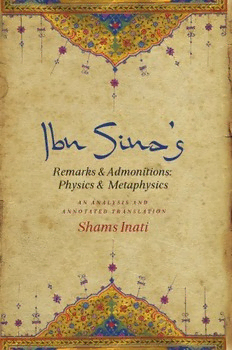
Ibn Sinas
Remarks & Admonitions:
Physics & Metaphysics
AN ANALYSIS AND
ANNOTATED TRANSLATION
Shams Inati
Ibn Sina’s Remarks and Admonitions:
Physics and Metaphysics
an analysis and
annotated translation
Shams Inati
Columbia University Press
New York
Columbia University Press
Publishers Since 1893
New York Chichester, West Sussex
cup.columbia.edu
Copyright © 2014 Columbia University Press
All rights reserved
Library of Congress Cataloging-in-Publication Data
Avicenna, 980–1037.
[Isharat wa-al-tanbihat. Part 2–3. English]
Ibn Sina’s Remarks and admonitions: physics and metaphysics: an analysis
and annotated translation/
Shams C. Inati.
pages cm
Includes bibliographical references and index.
ISBN 978-0-231-16616-4 (cloth: alk. paper) —ISBN 978-0-231-53742-1 (e-book)
1. Islamic philosophy—Early works to 1800. 2. Philosophy, Medieval.
3. Physics—Early works to 1800. 4. Metaphysics—Early works to 1800.
I. Inati, Shams Constantine. II. Title.
B751.I62E5 2014
181'.5—dc23 2013041367
Columbia University Press books are printed on permanent and durable acid-
free paper.
This book is printed on paper with recycled content.
Printed in the United States of America
c 10 9 8 7 6 5 4 3 2 1
References to Internet Web sites (URLs) were accurate at the time of writing.
Neither the author nor Columbia University Press is responsible for URLs that
may have expired or changed since the manuscript was prepared.
To my sister, Aminy Inati Audi, who has shared my pas-
sion for knowledge about the universe and the human
place in it and who has supported my intellectual efforts
and inspired me with her limitless determination, deep
wisdom, and boundless love for all things.
Contents
Preface 26
Analysis of the Text 1
PArT Two: PhYSICS 57
Prologue 59
First Class: on the Substance of Bodies
1. Delusion and Remark: On the Composition of Bodies 59
2. Delusion and Remark: Another Theory Concerning the
Composition of Bodies of Infinite Parts 60
3. Admonition: Evidence for the Unsoundness of the
Above Theories 61
4. A Follow-up: On the Infinity of the Imaginative Division
of Bodies 61
5. Admonition: Regarding Movement and Time as Also
Divisible to Infinity 62
6. Remark: Regarding the Difference Between That Which Is
Continuous in Itself and That Which Has the Capacity for
Continuity 62
viii—Contents
7. Delusion and Admonition: Concerning the Unity of the
Nature of Corporeal Extension in Itself 62
8. Delusion and Admonition: Concerning the Ways in Which
Disjunction Is Possible for That Which Is Continuous 63
9. Admonition: Concerning Why a Species for Which It Is
Possible to Have a Plurality of Individuals May Be
Obstructed from Having More Than One 63
10. A Follow-up: Concerning the First Matter as That Which
in Itself Has No Quantity and in Which Any Quantity
Can Subsist 64
11. Remark: Concerning the Evidence for the Finitude
of Distances 64
12. Remark: Concerning the Necessary Accompaniment
of Shape to Corporeal Extension 65
13. Delusion and Remark: Concerning the Cause of the Shape
of the Sphere 66
14. Admonition: Concerning the Cause of Position 67
15. Admonition: Concerning the Necessity of Form for
Position 67
16. A Follow-up: Conclusion Regarding the Necessity
of Corporeal Form for Matter 68
17. Admonition: Concerning Matter as Also Not Free from
Forms Other Than Corporeal Ones 68
18. Remark: Concerning the Fact That, in Addition to Matter,
There Is Necessity for External Determinants of the
Corporeal Form 69
19. Delusion and Admonition: On the Joining of Matter
and Form as Necessary for the Actual Subsistence
of Matter 69
20. Remark: On the Departure of Forms from One Matter
to Another 69
21. Remark: Concerning the Demonstration That the Corporeal
Forms Cannot Be Independent or Intermediary Causes
of Matter 70
Contents—ix
22. Delusion and Admonition: Refutation of the Claim
That Matter Is the Cause of the Existence of the Form 71
23. Remark: Concerning the Subsistance of Matter During
the Process of Form Substitution 71
24. Remark: Concerning the Priority of Form to Matter 71
25. Remark: On the Manner in Which Form Is Prior 72
26. Delusion and Admonition: Concerning the Priority in
Essence of the Cause to the Effect Despite the Temporal
Simultaneity of the Two 72
27. A Follow-up: The Inference to Be Drawn Regarding the
Similarity Between the Priority of the Form Which Is
Inseparable from Its Matter and That Which Is Separable 73
28. Admonition: The Priority of the Body to the Surface, the
Surface to the Line, and the Line to the Point 73
29. Admonition: On the Absence of the Interpenetration
of Corporeal Dimensions 74
30. Remark: Concerning Quantitative Distances Among
Disjoined Bodies 75
31. Admonition: On the Nonexistence of Void 75
32. Remark: On the Existence of Direction 75
33. Remark: Direction Is of a Sensible, Not an Intelligible Nature 76
34. Remark: Direction Is an Undivided Extremity of Dimension
and Toward Which Movement Can Be Made 76
35. Delusion and Admonition: Concerning the Concrete
Existence of Direction as Opposed to Its Conceptual Being 77
Second Class: on the Directions and
Their Primary and Secondary Bodies
1. Remark: Concerning the Directions That Change and Those
That Do Not 78
2. Remark: Concerning the Determination of the Position of
a Direction 78
3. Remark: Concerning the Body That Determines the Direction 79
x—Contents
4. A Follow-up: Concerning the Circularity of the Body That
Determines the Directions 80
5. Remark: Concerning the Undiversified Nature of the
Simple Body 80
6. Remark: Concerning the Circularity of the Shape of the
Simple Body 81
7. Admonition: Concerning the Propensity of a Body for Motion 81
8. Remark: Concerning the Necessity of the Natural Propensity
of a Body for the Violent Motion of That Body 82
9. A Reminder: Concerning the Divisibility of Time 83
10. Delusion and Admonition: Concerning the Assertion That
a Body Has Essentially a Place, a Position, and a Shape 83
11. Remark: Further Consideration of the Body’s Relation to
Its Place and Position 84
12. Remark: Concerning the Circular Motion of the Enveloping
Sphere 84
13. Admonition: Concerning the Relativity of This Possible
Change to an Internal Body 85
14. Admonition: Concerning the Manner in Which the Motion
of the Enveloping Sphere Is Measured 85
15. Remark: Concerning the Propensity for a Linear Motion
of Generable and Corruptible Beings 85
16. Delusion and Admonition: Concerning the Actual Linear
Motion of the Generable and Corruptible Beings 86
17. Remark: Concerning the Nature of the Enveloping Sphere
as Free from Linear Motion and from the Type of Generation
and Corruption of Other Bodies 86
18. Admonition: Concerning the Primary Bodily Qualities for
Acting and Reacting 87
19. Admonition: Concerning the Four Elements 88
20. Admonition: Concerning the Cause That Determines the
Place of the Elements 88
21. Admonition: Concerning the Common Matter of the
Four Elements 88
Contents—xi
22. Remark and Admonition: Concerning the Four Elements
as Primary Principles of Generation and Corruption in
Our World 89
23. Admonition: Concerning the Mixture of the Four Elements
and the Manner in Which Sublunary Beings Are Generated 90
24. Delusion and Admonition: Concerning Change in the
Qualities 90
25. Delusion and Admonition: Concerning the Source of
Combustion 91
26: A Small Point: Regarding the Nature of the Flame 92
27. Admonition: Concerning the Wisdom of the Maker in
Creating the Order of Mixtures 93
Third Class: on the Terrestrial
and Celestial Souls
1. Admonition: Proof for the Existence of the Soul Through
Intuition 94
2. Admonition: Concerning the Nonintermediary Manner in
Which the Soul Is Apprehended 94
3. Admonition: Regarding the Nonsensible Nature of the Soul 95
4. Delusion and Admonition: The Soul Is Not Asserted by the
Mediation of Its Acts 96
5. Remark: The Soul Is Not the Temperament of the Body,
but the Substance That Manages the Body 96
6. Remark: Regarding the Unity of the Soul and Its Relationship
to the Body 97
7. Remark: Concerning the Nature of Apprehension 98
8. Admonition: Concerning the Different Types of
Apprehension 98
9. Remark: Concerning the Internal Senses 99
10. Remark: Concerning the Rational Soul 101
11. Admonition: The Difference Between Thought and Intuition 103
12. Remark: Evidence for the Existence of the Saintly Power 103
xii—Contents
13. Remark: Evidence for the Existence of the Agent Intellect
and for the Possibility of Our Soul’s Conjunction with It 104
14. Remark: The Cause of Conjunction with the Agent Intellect 105
15. Remark: The Soul’s Preparedness for Receiving the
Intelligibles 105
16. Remark: Concerning the Immateriality of Intellectual
Substances 106
17. Delusion and Admonition: Concerning the Indivisibility of
That Which Apprehends the Intelligibles and the Divisibility
of That Which Apprehends the Sensibles 107
18. Delusion and Admonition: The Issue of Division with Regard
to the Intelligibles 108
19. Remark: To Intellect Is to Be Intelligible 108
20. Delusion and Admonition: Consideration of Intelligibility
with Regard to the Material Form 109
21. Delusion and Admonition: Denial of the Claim That
Individuality Is an Impediment to the Intelligibility of
the Quiddity 109
22. Admonition: Recapitulation 110
Supplement to the [Third] Class:
On Expositing the Movements Produced by the Soul
23. Admonition: A Preparatory Note 111
24. Remark: Powers of the Plant Soul 111
25. Remark: Movements Produced by the Animal Soul 112
26. Remark: Movements of Celestial Bodies 112
27. Premise: Concerning the Sensible and Intellectual
Volitions 113
28. Remark: Concerning the Intellectual Volition of the
Enveloping Sphere 113
29. Admonition: Concerning the Particular Volition 113
30. Rendezvous and Admonition: Movement Is Directed Toward
an Object Which the Mover Considers Good for It 114