Table Of ContentExploring the potential for
adopting alternative materials
to reduce marine plastic litter
Contact Details:
United Nations Environment Programme
P.O. Box 30552 - 00100 Nairobi, Kenya
Tel.: +254 20 762 1234
Fax: +254 20 762 3927
e-mail: [email protected]
www.unep.org
Exploring the potential for adopting alternative materials to reduce marine plastic litter
ISBN No: 978-92-807-3703-5
Job No: DEW/2177/NA
Published by the United Nations Environment Programme (UNEP), May 2018
Copyright © UNEP 2018
This publication may be reproduced in whole or in part and in any form for educational or non-profit services without special
permission from the copyright holder, provided acknowledgement of the source is made. UNEP would appreciate receiving
a copy of any publication that uses this publication as a source. No use of this publication may be made for resale or any
other commercial purpose whatsoever without prior permission in writing from the United Nations Environment Programme.
Applications for such permission, with a statement of the purpose and extent of the reproduction, should be addressed to the
Director, DCPI, UNEP, P.O. Box 30552, Nairobi 00100, Kenya.
Disclaimers
Mention of a commercial company or product in this document does not imply endorsement by UNEP or the authors. The use
of information from this document for publicity or advertising is not permitted. Trademark names and symbols are used in an
editorial fashion with no intention on infringement of trademark or copyright laws. The views expressed in this publication are
those of the author and do not necessarily reflect the views of the United Nations Environment Programme. We regret any errors
or omissions that may have been unwittingly made. © Images and illustrations as specified.
Citation: United Nations Environment Programme (2017). Exploring the potential for adopting alternative materials to reduce
marine plastic litter.
Cover Photos
Back Cover: Shutterstock/multiz12
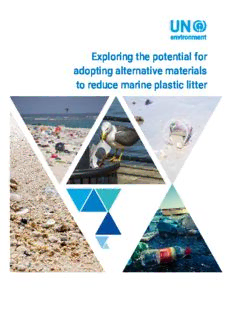
Front cover page: Right to left: Shutterstock, Shutterstock/ GParker, Shutterstock
Bottom right: Alain Bachellier
UN Environment
promotes environmentally
sound practices globally
and in its own activities. Our
distribution policy aims to reduce
UN Environment's carbon footprint.
Exploring the potential
for adopting alternative
materials to reduce marine
plastic litter
Acknowledgements: Aditi Gupta of Leaf Republic GmbH, Claire Mueller of Ananas Anam, Diana Ndungi
and pupils of the Thika Girls’ Karibaribi , Achenyo Idachaba of Mitimeth, Cosmos Githinji Karari , Brian
Bauer and José Manuel of Algramo, Safia Qureshi and Fleur of CupClub, Tom Chan and Dan of TrioCup,
Kikori Mor College and the Patrada Project, Evoware, Jeff Bates and Shane Boland of Ecovative Design,
Prof. Geoff Robson of Manchester University, Tara St James of Study-NY, Paul Gurbutt, Liz of Elephant
Box, Beth Williams of Turtle Bags, Jose Heredia-Guerrro, Diego and Fred from Bali-Boo, Daniel Zitomer
and Nick Benn of Marquette University, Anne Schauer-Gimenez of Mango Materials, Geoff of Friendly
Soap, Lise Honsinger of Skipping Rocks Lab, Aleksi Vesaluoma Richard Sullivan and Louis Johnston of
Mandin Collective, Tereza Dohnalova of MIWA, Stephen M. Roberts of Dell Corporation, Anke Domaske
of Qmilk, Atiya Livingston of ChopValue, Kate of Vegware Environmental, Sandra Adar of Little Cherry,
Hideshige Takada of Tokyo University of Agriculture and Technology, Liz Lund, Tom Kershaw, the
‘Bagmonster’, delegates at the UN SDG14 conference in June 2017 and delegates at the UNEA-3 in
December 2017.
Author: Peter Kershaw, Independent consultant – Marine Environmental Protection Norfolk, UK
Reviewers: Valeria Hidalgo-Ruz (Universidad Católica del Norte, Colegio San Adrian de Quilicura, Chile),
Peter Ryan (University of Cape Town), Evelyn Ongige and Susan Mutebi-Richards (UN Environment –
Gender), Kei Ohno (Secretariat of the Basel, Rotterdam and Stockholm Conventions), Aaron Vuola and
Heidi Savelli (UN Environment – Global Programme of Action), Nagwa El Karawy and Rula Qalyoubi
(UN Environment – Manama, Bahrain) and Claudia Giacovelli (UN Environment - International
R
E
T Environmental Technology Centre, Japan), Angeline Djampou (UN Environment-Science Division).
T
LI
C
TI Production team: Jinita Shah/ UNON/ PSS, Catherine Kimeu UNON/PSS
S
A
L
P Project manager: Joana Akrofi, Science Division
E
N
RI
A
M
E
C
U
D
E
R
O
T
S
L
A
RI
E
T
A
M
E
V
TI
A
N
R
E
T
L
A
G
N
TI
P
O
D
A
R
O
F
L
A
TI
N
E
T
O
P
E
H
T
G
N
RI
O
L
P
X
E
2
Glossary
Organisations and miscellaneous terms
Acronym/term Definition
ALDFG Abandoned, Lost or otherwise Discarded Fishing Gear
Biodegradable Biologically-mediated process involving the complete or partial converted
to water, CO /methane, energy and new biomass by microorganisms
2
(bacteria and fungi).
Compostable-domestic Capable of being biodegraded at low to moderate temperatures, typically
found in a domestic compost system
Compostable-industrial Capable of being biodegraded at elevated temperatures under specific
conditions and time scales
DECOIN Organisation for the Defence and Ecological Conservation of Intaq,
Equador
EI Environmental Impact Index
ESI Ecological Sustainability Index
EU European Union
FAO Food and Agriculture Organisation of the United Nations
GESAMP Joint Group of Experts on Scientific Aspects of Marine Environmental
Protection
IUPAC International Union of Pure & Applied Chemistry
LCA Life Cycle Analysis
NOAA National Oceanic and Atmospheric Administration
PEF Product Environmental Footprint
SDG Sustainable Development Goals
SWOT Analysis of Strengths, Weaknesses, Opportunities and Threats
UNDP United Nations Development Programme
UNEA United Nations Environment Assembly
UNEP United Nations Environment Programme
Naturally-occurring polymers and materials
Material Composition, derivation or process
Abaca/Manila hemp Cellulose, lignin & pectin from the inedible Banana (Musa textiliis)
Alginate/alginic acid Polysaccharide (copolymer of mannuronate and guluronate ) derived from
Brown seaweed (Phaeophyceae)
Alpaca wool Keratin fibre from the alpaca
Angora wool Keratin fibre from Angora rabbit
Araca Araca palm (Araca catechu), grown for the ‘betel’ nut
Bagasse Waste fibrous material from agricultural production
Bamboo Moso bamboo (Phyllostachys edulis) is most widely used species
Casein Protein fibre in milk
Cashmere Keratin fibre from Cashmere goats
3
Cellulose Naturally-occurring polysaccharide in plant cells
Chitin Naturally-occurring polyester in fungal cell walls and the exoskeleton of
crustacea (e.g. shrimps)
Coir Cellulose and lignin fibre from coconut outer shell
Cotton Cellulose fibre from the cotton plant (Gossypium sp.)
Cutin Waxy biopolyester in plant cuticles
Flax/linen Cellulose fibre from the flax/linseed plant (Linum usitatissimum)
Fibroin Protein fibre forming silk
Gluten Protein composite found in the endosperm of cereal crops, having
viscoelastic properties
Hemp Cellulose fibre from the hemp plant (Cannabis sativa)
Jute Cellulose and lignin fibres from the plant Corchorus sp.
Keratin Protein fibre forming wool
Kenaf Fibres obtained from the stems a species of the hibiscus (Hibiscus
cannabinus)
Kraft paper Paper manufactured using the kraft process, removing lignin and
maintaining long cellulose fibres for greater strength
R
E
T Lignin Naturally-occurring polymer used to form cell walls in wood and bark
T
LI
C Maize Species of large grain plant, also known as corn (Zea mays)
TI
AS Phyllosilicate Clay minerals with plate-like structure
L
P
E Piña Cellulose and lignin fibre from Pineapple leaf (Ananas comosus)
N
RI Piñatex™ Fabric made from pineapple leaves
A
M
E QMilch™ Casein fibre from soured cow’s milk
C
U Retting Process of extracting fibres from hemp, flax and coir by soaking in water
D
E
R and physical extraction
O
T Seagrass Marine species of flowering plant (angiosperms)
S
L
A Sheep’s wool Keratin fibre
RI
E
T Silk Fibroin fibre from the silk moth (Bombyx mori)
A
M
E Sisal Fibres obtained from a species of Agave (Agave sislana)
V
TI Staple fibre A fibre of a defined length (natural or cut to length synthetic fibre)
A
N
R Zein Maize protein
E
T
L
A
G
N Synthetic and semi-synthetic polymers and associated chemicals
TI
P
O Short form Composition/full name/function
D
A
R ABS Acrylonitrile butadiene styrene resin
O
L F Cellophane Semi-synthetic cellulose-based film
A
TI Cellulose acetate Semi-synthetic cellulose-based fibre or film
N
E
T BPA Bisphenol A
O
P
E Composite A material composed of two or more polymers or other substances
H
T
G EP Epoxy resin (thermoset)
N
RI EPS Expanded polystyrene
O
L
P Ingeo™ Fibre composed of PLA
X
E
Monomer The ‘building blocks’ making up a polymer
4
PA Nylon, Polyamide 4, 6, 11, 66
PAN Polyacrylonitrile, acrylic
PBDE Polybrominated diphenyl ethers – flame retardants
PBS Poly (butylene succinate)
PBSA Polybutylene succinate-co-butylene adipate
PBT Polybutylene terephthalate
PCBs Polychlorinated biphenols
PCL Polycaprolactone
PE Polyethylene
PE-LD Polyethylene low density
PE-LLD Polyethylene linear low density
PE-HD Polyethylene high density
PES Polyester
PET Polyethylene terephthalate
PHA Polyhydroxylkanoates
Phthalate Plasticiser
PLA Poly (lactic acid)
PMMA Poly (methyl) methacrylate
PP Polypropylene
PS Polystyrene
PTFE Polytetrafluroethylene
PU (PUR) Polyurethane
PVA Polyvinyl alcohol
PVC Polyvinyl chloride
Rayon Semi-synthetic cellulose-based fibre
Spandex Polyether-polyurea
TPS Thermoplastic starch
Viscose The most common form of rayon
5
Table of Contents
Glossary 3
Executive summary 13
1. Background 15
1.1 Marine litter as a global issue 15
1.2 The Response 16
1.3 Purpose and content of the report 17
2. Our relationship with plastic 19
2.1 Criteria for adopting plastics 19
2.2 Conventional plastics 21
2.3 Semi-synthetic biomass-based fibres and films 28
2.4 Microplastics 32
2.5 The plastics economy 33
3. Marine plastics and microplastics –the main culprits 39
3.1 The leakage of plastics to the ocean 39
3.2 Plastic litter on shorelines and beaches 41
3.3 Seabed litter 42
3.4 Micro-fibres in the ocean 45
R
E 4. Alternative materials - natural polymers/materials 47
T
T 4.1 Natural polymers and organic materials 47
LI
C 4.2 Plant-based polymers 48
TI 4.3 Animal-based polymers 52
S
A
L 4.4 Additional organic polymers 53
P
E 4.2 Case studies 53
N
RI
A 5. Alternative materials - biomass-based compostable bio-polymers 69
M
E 5.1 An introduction to compostable polymers 69
C
U 5.2 Starch-based polymers 71
D
E 5.3 Synthetic biomass-based polymers 75
R
O 5.4 Case studies 79
T
S
L
A 6. Alternative materials – re-usable objects 81
RI
E 6.1 Designed for re-use 81
T
A 6.2 Case studies 82
M
E
V
TI 7. Pursuing the sustainability goals - social, economic and environmental considerations 89
A
N 7.1 Agenda 2030 89
R
E 7.2 Towards a cradle-to-cradle approach 91
T
L 7.3 Life cycle analysis of natural materials and thermoplastics
A
G (conventional & biomass-based biopolymers) 96
N
TI 7.4 Alternative materials and the circular economy 104
P
O
D
A 8. Future trends and opportunities 107
R
O 8.1 Future trends in fibre production 107
F
L 8.2 Scope for developing the case studies 108
A
TI 8.3 The role of the Clean Seas Campaign 112
N 8.4 Encouraging the appropriate response 112
E
T
O
P
E 9. Conclusions and recommendations 114
H 9.1 Conclusions 114
T
G 9.2 Recommendations 115
N
RI
O
L References 117
P
X
E
6
List of Tables
Table 1.1 Presentation of a SWOT analysis ...........................................................................................................17
Table 2.1 SWOT analysis (Strengths, Weaknesses, Opportunities and Threats) of conventional
synthetic polymers. .................................................................................................................................19
Table 2.2 Typical applications by polymer, excluding fibres (adapted from Plastics Europe 2016) ..................22
Table 2.3 Synthetic polymer fibres and their applications ....................................................................................23
Table 2.4 Ranking of selected polymers based on the hazard classification component
monomers, based on Lithner et al. (2011), which should be consulted for more comprehensive
hazard rankings and explanation of the methods used. The hazard score for some
polymers will vary depending on the plasticiser used (e.g. PVC) or the incorporation of another
monomer (e.g. PAN) ...............................................................................................................................25
Table 2.5 Examples of common plastic additives, associated functions, potential effect and
status under the Stockholm Convention ................................................................................................26
Table 2.6 Definitions of degradation, biodegradation and compostable .............................................................28
Table 2.7 Semi-synthetic fibres and films: types, biomass source, manufacturing process and
common uses ..........................................................................................................................................30
Table 2.8 Semi-synthetic polymers with a qualitative assessment of biodegradable and
composting properties (based on reported observations, where available, otherwise estimated):
domestic composting C-d, industrial composting C-i, biodegradable B;
degradation rate: high H, medium M or low L; qualitative sustainability indicator:
blue high, medium purple, low red). .......................................................................................................31
Table 2.9 SWOT analysis (Strengths, Weaknesses, Opportunities and Threats)
of semi-synthetic cellulose-based fibres and films as a substitute for
conventional synthetic polymers. ...........................................................................................................32
Table 2.10 Characteristics of secondary microplastics: common polymers, typical applications
and potential for microplastic generation by shape category. .............................................................33
Table 2.10 Characteristics of secondary microplastics: common polymers, typical applications
and potential for microplastic generation by shape category. .............................................................34
Table 3.1 Common synthetic and semi-synthetic polymers and applications, together with their
tendency to float or sink in the aquatic environment, based on density difference
without additional floatation, such as a fishing float (modified from Joint Group
of Experts on Scientific Aspects of Marine Environmental Protection 2016). ....................................40
Table 4.1 Polymers and their occurrence in nature ...............................................................................................47
Table 4.2 Plant-based materials, polymer(s), plant source and common uses, together with
biodegradable and composting properties (based on reported observations,
where available, otherwise estimated): domestic composting C-d, industrial composting C-i,
biodegradable B; degradation rate: high H, medium M or low L; qualitative sustainability indicator:
blue high, medium purple, low red). .......................................................................................................49
Table 4.3 Commercially important natural fibres: data 2004 from Suddell (2009), 2014* from
FAOSTAT9, 2014^ from Food and Agricultural Organisation (2015), 2015 from
Food and Agricultural Organisation (2016) ; a value for 2013/14, b value for 2014/15
(adapted from Suddell 2009) ..................................................................................................................50
Table 4.4 SWOT analysis (Strengths, Weaknesses, Opportunities and Threats) of utilising plant
materials as a substitute for conventional synthetic polymers. ..........................................................50
Table 4.5 Examples of animal-based materials, polymer(s), animal source and common uses,
together with a qualitative indication of biodegradable and composting properties
(based on reported observations, where available, otherwise estimated):
domestic composting C-d, industrial composting C-i, biodegradable B; degradation rate:
high H, medium M or low L; qualitative sustainability indicator: blue high,
medium purple, low red). ........................................................................................................................52
Table 5.1 Definitions of degradation, biodegradation and compostable. ............................................................69
Table 5.2 Comparison of standards for industrial and home composting (from: Song et al. 2009) .................70
Table 5.3 Composition of different starches (from: Avérous and Halley 2009) ..................................................71
7
Table 5.4 SWOT analysis (Strengths, Weaknesses, Opportunities and Threats) of thermoplastic starch
production and use ..................................................................................................................................72
Table 5.5 Starch-based polymers, biomass source and common uses, together with biodegradable and
composting properties (based on reported observations, where available, otherwise estimated):
domestic composting C-d, industrial composting C-i, biodegradable B; degradation rate: high H,
medium M or low L; qualitative sustainability indicator: blue high, medium purple, low red). ...........75
Table 5.6 SWOT analysis (Strengths, Weaknesses, Opportunities and Threats) of PLA production
and use (based on: De Matos et al.2015). .............................................................................................77
Table 5.7 SWOT analysis (Strengths, Weaknesses, Opportunities and Threats) of PHA production
and use (based on: De Matos et al.2015). ............................................................................................78
Table 5.8 Starch-based polymers, biomass source and common uses, together with a qualitative
assessment of worst-case biodegradable and composting properties (based on reported
observations, where available, otherwise estimated): domestic composting C-d, industrial
composting C-i, biodegradable B; degradation rate: high H, medium M or low L; qualitative
sustainability indicator: blue high, medium purple, low red); the degree and rate of
decomposition will depend on the application, for example a bottle vs. thin agricultural film,
and the presence of additional co-polymers such as PCL. ..................................................................78
Table 6.1 SWOT analysis (Strengths, Weaknesses, Opportunities and Threats) of re-usable
materials as a substitute for conventional synthetic polymers. ..........................................................81
Table 7.1 SDG targets related to reducing marine plastics and encouraging the sustainable
development of alternatives to conventional plastic ............................................................................90
R Table 7.2 Summary of the Principles of Green Chemistry and Engineering, from Tabone et al. (2010) ...........92
E
T
T Table 7.3 (a) Qualitative indicators of sustainability for the production of textiles and other products
LI
C from biomass sources, from harvesting to the manufacturer. Indicators are based on
TI estimates of the relative environmental and human health impact, for a series of stages or
S
A
L characteristics in the production process, from sources cited in the text or by inference;
P
E where BLUE indicates high, PURPLE indicates medium and RED indicates low sustainability.
N
RI In addition, the relative importance or impact of each stage is assigned a value
A
M of low (L), medium (M) or high (H). (Cot = cotton, Org = organic, Hem = hemp, Lin = linen,
E Abac = abaca, Rami = ramie, Woo = wool, Sta = starch, TPS = thermoplastic starch,
C
U
D CP - composite, Ray = rayon). .................................................................................................................100
E
R Table 7.3 (b) Qualitative indicators of sustainability for the production of textiles and other products
O
T from biomass sources, during manufacture. Indicators are based on estimates of the relative
S
L environmental and human health impact, for a series of stages or characteristics in the production
A
RI process, from sources cited in the text or by inference; where BLUE indicates high, PURPLE indicates
E
T medium and RED indicates low sustainability. In addition, the relative importance or impact of each
A
M
stage is assigned a value of low (L), medium (M) or high (H). (Cot = cotton, Org = organic,
E
V Hem = hemp, Lin = linen, Abac = abaca, Rami = ramie, Woo = wool, Sta = starch,
TI
A TPS = thermoplastic starch, CP - composite, Ray = rayon). .................................................................101
N
ER Table 7.3 (c) Qualitative indicators of sustainability for the production of textiles and other
T
L products from biomass sources, during use and at the end-of-life. Indicators are based
A
G on estimates of the relative environmental and human health impact, for a series of stages or
N
TI characteristics in the production process, from sources cited in the text or by inference;
P
O where BLUE indicates high, PURPLE indicates medium and RED indicates low sustainability.
D
A In addition, the relative importance or impact of each stage is assigned a value of
R
O low (L), medium (M) or high (H). (Cot = cotton, Org = organic, Hem = hemp,
F
L Lin = linen, Abac = abaca, Rami = ramie, Woo = wool, Sta = starch,
A
TI TPS = thermoplastic starch, CP - composite, Ray = rayon). .................................................................102
N
TE Table 7.4 A comparison of rankings for PLA, PHA and a range of conventional polymers,
O
P based of Green Design and Life Cycle Analysis scores; from Tabone et al. 2010. .............................103
E
H Table 8.1 Qualitative assessment of the technical complexity, start-up costs, regional relevance
T
G (TR - tropical/sub-tropical, TE – temperate), possibility to scale up, advantages and
N
RI disadvantages of solution involving natural materials: L- low,
O
L M – medium, H- high; blue - most favourable, red - least favourable. ..................................................109
P
X
E
8
Description:Exploring the potential for adopting alternative materials to reduce marine plastic litter. ISBN No: 978-92-807-3703-5. Job No: DEW/2177/NA.