Table Of ContentDesigning Inclusive Pathways with Young Adults
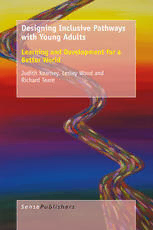
FRONT COVER PHOTOGRAPH
The Journey from Darkness to Light
The front cover is a photograph of an original painting by the young musician and
artist Anna Harcourt. The painting was conceived, painted and donated by the artist
as a tribute to the pioneering work undertaken by the people and organizations
featured in this book.
The painting depicts the challenging journey that marginalized young adults
can opt to take from exclusion and difficult personal circumstances to greater self-
reliance and optimism for the future. The colors in the pathway reflect their different
routes, and the many creative and innovative ways in which young people learn and
overcome obstacles through self-directed development and lifelong action learning.
Lifelong Action Learning (LAL) is a universal process that works in all cultures,
languages and contexts. As this book illustrates, young people learn with and from
each other and by reflecting on their progress. Later, they pass on their learning to
others in order to share their understanding of how to learn for life. The journey
is unique to each young adult but resolve is strengthened by learning coach or
mentor support and from journeying with others. These elements are integral to the
dynamic nature of LAL pathways designed with young adults, and the notion that
this ultimately contributes to a better world for all.
Designing Inclusive Pathways with Young Adults
Learning and Development for a Better World
Judith Kearney
Griffith University, Australia
Lesley Wood
North-West University, South Africa
Griffith University, Australia
and
Richard Teare
Global University for Lifelong Learning, California, USA
A C.I.P. record for this book is available from the Library of Congress.
ISBN: 978-94-6300-155-7 (paperback)
ISBN: 978-94-6300-156-4 (hardback)
ISBN: 978-94-6300-157-1 (e-book)
Published by: Sense Publishers,
P.O. Box 21858,
3001 AW Rotterdam,
The Netherlands
https://www.sensepublishers.com/
All chapters in this book have undergone peer review.
Cover image: The Journey from Darkness to Light, by Anna Harcourt
Printed on acid-free paper
All Rights Reserved © 2015 Sense Publishers
No part of this work may be reproduced, stored in a retrieval system, or transmitted
in any form or by any means, electronic, mechanical, photocopying, microfilming,
recording or otherwise, without written permission from the Publisher, with the
exception of any material supplied specifically for the purpose of being entered and
executed on a computer system, for exclusive use by the purchaser of the work.
TABLE OF CONTENTS
Foreword: How Inclusive Action Learning Pathways Contribute
to a Better World ix
Sarone Ole Sena
Acknowledgements xv
Reviewers’ Comments xvii
List of Tables xxi
List of Figures xxiii
List of Appendices xxv
List of Acronyms xxvii
Series Overview: Learning and Development for a Better World xxix
About the Authors xxxi
Chapter 1: Introduction to the Book 1
Introduction 1
Conceptual Framework 1
Rationale, Aims and Approach 5
Significance 5
Contents and Structure 6
Part 1: Excluded Young Adults
Chapter 2: Marginalization of Young Adults: A Global Perspective 11
Introduction 11
How Are Young People Faring? 12
Situational Constraints in Developing Regions/Countries 14
Situational Constraints in Developed Regions/Countries 18
Conclusion 21
Chapter 3: Youth Development: A Twenty-First Century Approach 25
Introduction 25
Alternative Education Programs 26
Improving the Technical, Marketable Skills of Youth 27
v
TABLE OF CONTENTS
The Shift to a More Holistic Approach to Youth Development 28
Action Learning as a Developmental Approach for Youth 30
Conclusion 33
Part 2: Designing Pathways with Young Adults
Chapter 4: Personal Viability: An Approach to Sustainable Micro Enterprise:
A Pathway from Papua New Guinea 39
Overview 39
Visualizing Prosperity 40
Pathway Design 40
Interview with Samuel Tam 41
Summary 46
Review Questions 48
Acknowledgements 48
Chapter 5: House of Joy: Community Living, Service and Social Enterprise:
A Pathway from Malaysia 49
Overview 49
The House of Joy Concept 49
Pathway Design 51
In Summary 51
Interview with Pastor Joseph 54
Interview with Bryan Taaey Kim Hui 55
Summary 57
Review Questions 58
Acknowledgements 58
Chapter 6: Mentoring Homeless Young Adults on the Journey
to Independent Living: A Pathway from the United Kingdom 59
Overview 59
Addressing the Relational Gap for Homeless Young Adults 60
Pathway Design 61
Interview with Josie Silva Clark 62
Summary 66
Review Questions 68
Acknowledgements 68
Chapter 7: Building Better Communities through Music and Media:
A Pathway from Uganda 71
Overview 71
Communities Speaking with One Voice Can Be Heard! 71
vi
TABLE OF CONTENTS
Interview with Simon Hill and Rob May 72
Indicative Pathway Design 77
Summary 80
Review Questions 80
Acknowledgements 81
Chapter 8: Designing Creative Projects with Young Adults: Peace-Building
in Lebanon: A Pathway from Lebanon 83
Overview 83
The Lebanese Context 84
Pathway Design 85
Fostering Personal Development 86
Reinforcing Technical Development 88
Pathway Mid-Point Reflections 89
Zeinab’s Observations 89
Zeinab’s Action Points 90
Corinne’s Observations 90
Norma’s Observations 91
Summary 92
Review Questions 93
Acknowledgements 93
Chapter 9: Changing Society from the Inside Out: Equipping Young Leaders
and Mentors: A Pathway from the Democratic Republic of Congo 95
Overview 95
The Impact of Conflict on the DRC: Challenges Facing the
Next Generation 96
Pathway Design 97
Interview with Heidi Bentley and Amy Cummings 100
Summary 105
Review Questions 105
Acknowledgements 106
Chapter 10: Young Adults with Purpose in Guatemala: A Pathway
from Guatemala 107
Overview 107
Challenging Environments, Changing Lifestyles 108
Pathway Design 108
The Role of the Mentor as a Tutor and Learning Coach 110
Personal and Technical Development 111
Interview with Jonathan Welford 113
Summary 115
vii
TABLE OF CONTENTS
Reflection and Concluding Comment by Kim Rojas, YAPG Mentor 116
Review Questions 116
Acknowledgements 116
Chapter 11: Ubunye: Providing Pathways for Youth Development
through the Community School: A Pathway from South Africa 119
Overview 119
Can a School Be the Learning Hub for the Wider Community? 119
Pathway Design 121
Interview with Bruce Damons 122
Summary 126
Review Questions 126
Acknowledgements 127
Chapter 12: MANA Community Mentoring: Strengthening Identity and
Positive Pathways for Pacific Youth: A Pathway from Australia 129
Overview 129
The MANA Concept 129
Pathway Design 130
Reflections from an Interview with Andrew Fa’avale, Director,
MANA Community Mentoring 132
Summary 136
Review Questions 137
Acknowledgements 137
Chapter 13: Conclusions 139
Introduction 139
Part I: Excluded Young Adults: What Are the Problems and Responses? 139
Part II: Designing Pathways with Young Adults: What Are the Possibilities? 141
A Generic Design Approach that Facilitates Lifelong Learning of
Young Adults 146
Endword 150
Index 199
viii
SARONE OLE SENA
FOREWORD
How Inclusive Action Learning Pathways Contribute to a Better World
My journey from Maasai community living to university professor and back again
to the village, with action learning and the Global University for Lifelong Learning
This year I am celebrating more than six decades of my own lifelong learning
journey. I was born among the Maasai of Kenya in 1949. The Maasai’s indigenous
education (informal, non-formal and formal) allows children to learn the family
traditions and customs as soon as they can understand them. Their mothers tell them
stories, riddles and proverbs, which they then tell to each other. They live mainly
on milk, with occasional meat dishes and vegetables, which their mothers and their
older sisters obtain from their agricultural neighbors. At about four years old, both
boys and girls have their two lower front teeth removed. This is a custom followed
by many African peoples. It is said to be a precaution against tetanus, a disease
which makes people clench their teeth so hard that they are unable to open their
mouths. If two of the teeth have been removed, he or she can be fed through the gap.
The disease is caused by an organism in the soil, particularly in places where cattle
graze. At the same time, holes are pierced in the tops and lower lobes of their ears,
and round sticks are pushed through the holes to widen them, so that their ear-lobes
are long enough to hold big ornaments when children grow up. A boy, as soon as
he is seven years of age, goes with his elder brothers or friends to learn how to herd
cattle. He learns about the best places for grazing cattle, sheep and goats, how to
look after calves and lambs in the bush, and to recognize his own family’s livestock.
His sister stays at home with her mother and female relations, helping to sweep the
house, milk the cows, sheep and goats, cook, draw water, scrape and sew skins, and
thread necklaces.
MAASAI ACTION LEARNING MEETS SCHOOL LEARNING
In 1955 when I was 6 years old, the elders selected me to attend the local school of
Ololulunga in Narok County, Kenya. Before going to school, I was taught the above
traditions and customs of the Maasai. The local school introduced myself and other
children in my class to reading, arithmetic and writing. The language of instruction
was KiMaasai and we lived in a Maasai village. School-going boys and girls at that
time lived either with their biological parents or their foster parents in houses built
ix