Table Of ContentARCHITECTURAL DESIGN
DESIGNING FOR
GUEST-EDITED BY
LORRAINE FARRELLY
THE THIRD AGE
ARCHITECTURE REDEFINED
FOR A GENERATION OF
‘ACTIVE AGERS’
02 / 2014
ARCHITECTURAL DESIGN
MARCH/APRIL 2014
ISSN 0003-8504
PROFILE NO 228
ISBN 978-1118-452721
1
IN THIS ISSUE
ARCHITECTURAL DESIGN
GUEST-EDITED BY DESIGNING FOR THE THIRD AGE:
LORRAINE FARRELLY
ARCHITECTURE REDEFINED FOR A
GENERATION OF ‘ACTIVE AGERS’
5 EDITORIAL 14 ‘Remember Who You Are Designing For’:
Helen Castle An Interview with Baroness Sally Greengross OBE
Baroness Sally Greengross and Helen Castle
6 ABOUT THE GUEST-EDITOR
Lorraine Farrelly 20 ‘New Aging’: Designing Architecture for All Ages
Matthias Hollwich and Matthew Hoff man
8 INTRODUCTION
Redefi ning, Reinventing and Realigning 28 Adapting to Global Change: Ageing,
Design for Demographic Change Urbanisation and Resilience
Lorraine Farrelly Francesca Birks and Katherine Prater
36 Designing for a Lifetime in New York and
Other US Cities
Jerry Maltz, Christine Hunter, Eric Cohen
and Susan Wright
46 Socially Inclusive Design in Denmark:
Th e Maturing Landscape
Terri Peters
54 Ageing in Suburbia: Designing for Demographic
Change in Australia and New Zealand
Mark Taylor and Laurie Buys
EDITORIAL BOARD
Will Alsop
Denise Bratton
Paul Brislin
Mark Burry
André Chaszar 36
Nigel Coates
Peter Cook
Teddy Cruz
Max Fordham
Massimiliano Fuksas
Edwin Heathcote
Michael Hensel
Anthony Hunt
Charles Jencks
Bob Maxwell
Jayne Merkel
Peter Murray
Mark Robbins
Deborah Saunt
Patrik Schumacher
Neil Spiller
Leon van Schaik
Michael Weinstock
Ken Yeang
Alejandro Zaera-Polo
2
108
‘Self-determined life in its entirety
is careful long-term planning, which
can only happen when ageing is
acknowledged as a state of human
existence, and as such deserves
preparation, anticipation and
excitement.’ — Matthias Hollwich
60 Housing for the Elderly: Th e 102 Customised ‘Care-Ready’ Living:
Changing Scenario in India A HAPPI-Inspired Design for
Radhika Vaidya and Anjali Raje Evolutionary Housing by Walter
Menteth Wren Architects
68 China’s Concealed Crisis Walter Menteth
Edward Denison and Guang Yu Ren
108 Sense-Sensitive Design for
74 Mediating Change: A Japanese Perspective the Ageing
on Adaptable Architecture Richard Mazuch
Robert Schmidt III and Toru Eguchi
112 New Visions: Re-imagine Ageing
80 Redesigning Domesticity: Creating RIBA Design Competition 2013
Homes for the Elderly Lorraine Farrelly
Sally Stewart
122 Wanted: Challenging Design
88 Regeneration for All Generations: Ideas for Ageing
Th e Queen Elizabeth Olympic Park Katherine Wilkinson
Kathryn Firth and Manisha Patel
126 Housing from 8 to 80:
94 ‘ Happy Meals’: Finding Happiness An 3 Ideas Project
with Hans Becker and the Lorraine Farrelly
Humanitas Care Model
David Birkbeck 136 COUNTERPOINT
Designing for an Earlier Age
Jayne Merkel
142 CONTRIBUTORS
112
3
ARCHITECTURAL DESIGN
1
MARCH/APRIL 2014
PROFILE NO 228
Editorial Offices
John Wiley & Sons
25 John Street
London WC1N 2BS
UK
T: +44 (0)20 8326 3800 All Rights Reserved. No part of this
publication may be reproduced, stored
Editor in a retrieval system or transmitted in
Helen Castle any form or by any means, electronic,
mechanical, photocopying, recording,
Managing Editor (Freelance) scanning or otherwise, except under the
Caroline Ellerby terms of the Copyright, Designs and
Patents Act 1988 or under the terms
Production Editor of a licence issued by the Copyright
Elizabeth Gongde Licensing Agency Ltd, 90 Tottenham
Court Road, London W1T 4LP, UK,
Prepress without the permission in writing of
Artmedia, London the Publisher.
Art Direction and Design Subscribe to 1 Subscription Offices UK
CHK Design: John Wiley & Sons Ltd
Christian Küsters 3 is published bimonthly and is Journals Administration Department
Sophie Troppmair available to purchase on both a 1 Oldlands Way, Bognor Regis
subscription basis and as individual West Sussex, PO22 9SA, UK
Printed in Italy by Printer Trento Srl volumes at the following prices. T: +44 (0)1243 843 272
F: +44 (0)1243 843 232
Prices E: [email protected]
Individual copies: £24.99 / US$45
Individual issues on 3 App Print ISSN: 0003-8504
for iPad: £9.99 / US$13.99 Online ISSN: 1554-2769
Mailing fees for print may apply
Prices are for six issues and include
Annual Subscription Rates postage and handling charges.
Student: £75 / US$117 print only Individual-rate subscriptions must be
Personal: £120 / U S$189 print and paid by personal cheque or credit card.
iPad access Individual-rate subscriptions may not
Institutional: £212 / US$398 print be resold or used as library copies.
or online
Institutional: £244 / US$457 All prices are subject to change
combined print and online without notice.
6-issue subscription on 3 App
for iPad: £44.99 / US$64.99 Rights and Permissions
Requests to the Publisher should be
addressed to:
Permissions Department
John Wiley & Sons Ltd
The Atrium
Southern Gate
Chichester
West Sussex PO19 8SQ
UK
F: +44 (0)1243 770 620
E: [email protected]
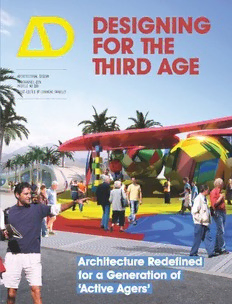
Front cover: Hollwich Kushner (HWKN), Boom
Palm Springs, Palm Springs, California, 2011.
© Hollwich Kushner (HWKN)
Inside front cover: Michael Maltzan Architecture,
New Carver Apartments, Los Angeles, California,
2009. © Iwan Baan
02 / 2014
44
EDITORIAL
Helen Castle
Ageing is perhaps one of the most pressing topics of our times. Most of the
articles in this issue open with gobsmacking statistics, highlighting the extent to
which the population of over-65s is growing exponentially – whether in the US,
Europe, Australia, India or China. The impact of an ageing population is felt on
the population as a whole and cuts across the entire physical environment. As
the retirement age retreats even further away from the horizon for those in work,
it also squeezes the career chances of younger people attempting to enter work.
Whereas opportunities for architectural design for the aged have conventionally
been confined to the highly standardised and uninspiring requirements of the
retirement or nursing home, most building types and the urban environment
as a whole now need to be reconsidered, modified or adapted to respond to
demographic change. Japan, which has the highest life expectancy in the world,
provides some key insights into what countries with a greater percentage of
older people and falling birth rate might look like. In fact Kunio Kitamura,
Head of the Japan Family Planning Association, has expressed the opinion that
the demographic crisis is currently so serious there that Japan ‘might eventually
perish into extinction’; last year was the first year in Japan that incontinence pads
outsold baby nappies.1 It seems no building type in Japan is exempt from the
needs of older people. Japan already has a prison population where over 20 per
cent of inmates are over 65. This has required that specialist prison blocks are
fitted out for older prison mates with handrails in the corridors.2
In developing and commissioning the content for this 2, a strong emphasis
was placed on presenting ageing as a positive and international issue in order
to engage a wide global audience of architects and students. The cover image by
New York architects Hollwich Kushner (HWKN) of their Boom Palm Springs
project consciously stretches the stereotypical notion of ageing in its vibrancy
and age and gender profiling. For the increase in the ageing population, which
the bulging baby-boom generation now brings, should be grasped as a unique
opportunity to develop new thinking and ideas around active ageing: to the
benefit of society and the environment as a whole. Key to this concept is the
‘Housing from 8 to 80’ student design competition that Guest-Editor Lorraine
Notes Farrelly and 2 launched asking students to design lifetime homes (see pp 126–
1. Abigail Haworth, ‘Generation
Sexless: What Happens to a 35). This holistic emphasis on ageing as an issue that cannot be severed from the
Country when its Young People
needs of the rest of the population has also been accommodated in the volume
Stop Having Sex? Japan is Finding
Out …’, The Observer Magazine, 20 by the invitation to architectural historian, critic and author Jayne Merkel to
October 2013, pp 22–9.
provide a Counterpoint (pp 136–41) that answers up on the side of the younger
2. ‘No Sex Please We’re Japanese’,
presented by Anita Rani, BBC2, 24 population. Could the need for affordable housing among young adults be greater
October 2013.
than if not equal to those of older generations? 1
Text © 2014 John Wiley & Sons Ltd. Image
© Illustration by Frances Castle
55
The Third Space, University of Portsmouth, 2010
The Third Space is a new social learning space for students at the
University of Portsmouth. The concept was designed by Lorraine
Farrelly working with the university’s Project Office.
66
ABOUT THE GUEST-EDITOR
LORRAINE FARRELLY
Lorraine Farrelly qualified as an architect through an academic
and then practice-based education. She began her academic
career at the University of Portsmouth, to where she later
returned initially as a design tutor before being appointed
Professor of Architecture and Design in 2011. This followed
a period in practice in London and Hampshire during which
she worked on projects ranging in scale from retail fit-outs to
housing and masterplanning. She initially taught part-time and
worked in practice, and this combination of practical experience
and education has been an important aspect of her professional
career, with both informing the other. Challenging the
evolving debate around architectural education nationally and
internationally requires a response to the expectations of the real
world, the client, other disciplines and society.
She has written many international papers as well as seven
books on architecture, urban design and interior design. Her
specific interest is housing and its relationship to the city.
She has been part of Design Review, a forum of appointed
professionals organised by planning authorities across the UK
to inform discussion about the quality of architecture and place
making and advise on strategic architectural and urban design
proposals. She has also written about educational environments
and their relationship to the university campus and the city
context. She is currently a consultant architect for, and part
of the management group of the University of Portsmouth’s
Project Office, an architectural consultancy under the umbrella
of the university’s School of Architecture, which provides
knowledge transfer, consultancy and research opportunities for
full-time and part-time staff and students, working on ‘live’
projects with ‘real’ clients. 1
Text © 2014 John Wiley & Sons Ltd.
Images © University of Portsmouth
77
REDEFINING, INTRODUCTION
By Lorraine Farrelly
REINVENTING
AND REALIGNING By 2035, more than a third of the UK
population will be over 60.1 In the US, over
the next four decades, the government’s
Administration on Aging department predicts
DESIGN FOR
that the ageing population will account for 1 in
5 US residents.2 And in China, the number of
the population over 60 is predicted to be 336
DEMOGRAPHIC million by 2030, a quarter of the population;3
coupled with the country’s one-child policy
implemented in the 1980s, this means that
there is a diminishing number of the population
CHANGE
to care for ageing parents and grandparents,
referred to as the ‘4:2:1 Paradigm’: four
grandparents, two parents and one child.4
All of this has social implications for
our responsibility for the elderly, while the
demographic shift also presents challenges
in terms of expectations for urban design,
housing and other built provision to
accommodate an ageing population. The
design of our urban centres needs to change
to encourage a more integrated way of living.
Suburbia needs to be redefi ned as a
new type of interstitial space. In the US, the
concept of retrofi tting and reinventing suburbia
has created new paradigms, as our residential
patterns change and more diverse housing
choices, or integrated living solutions, are
required. The ‘retrofi tting suburbia’ concept
was introduced by Ellen Dunham-Jones,
Professor of Architecture and Urban Design
at Georgia Tech in Atlanta. In her book with
June Williamson, Retrofi tting Suburbia, she
challenges existing preconceptions of the
city. One of the many concepts that Dunham-
Jones and Williamson put forward is the
future creation of integrated environments
for our society; accommodating a range
of different age groups is about adapting
places and spaces to their needs, as much as
adapting the city for different cultural groups.
Sustainable cities for all, inclusive of age,
can be achieved through re-inhabitation, re-
greening and redevelopment.5
How can visionary architectural solutions
Cover of Ellen Dunham-Jones and June Williamson’s
Retrofi tting Suburbia: Urban Design Solutions for Redesigning for living in sustainable cities accommodate
Suburbs, 2011
the change in population, reducing models of
The book describes the possibility for suburban developments to be
redesigned into more sustainable places, to evolve and respond to dependency for care and transport and creating
changing economic and social conditions.
8