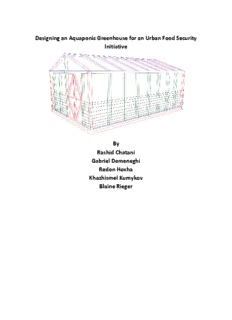
Table Of ContentDesigning an Aquaponic Greenhouse for an Urban Food Security
Initiative
By
Rashid Chatani
Gabriel Demeneghi
Redon Hoxha
Khazhismel Kumykov
Blaine Rieger
Designing an Aquaponic Greenhouse for an Urban Food Security
Initiative
An Interactive Qualifying Project
submitted to the Faculty of
WORCESTER POLYTECHNIC INSTITUTE
in partial fulfilment of the requirements for the
degree of Bachelor of Science
By
Rashid Chatani
Gabriel Demeneghi
Redon Hoxha
Khazhismel Kumykov
Blaine Rieger
Date:
30 April 2015
Report Submitted to:
Matt Feinstein
Worcester Roots Project
Professors Stephen McCauley and Lorraine Higgins
Worcester Polytechnic Institute
This report represents work of WPI undergraduate students submitted to the faculty as evidence of a
degree requirement. WPI routinely publishes these reports on its web site without editorial or peer
review. For more information about the projects program at WPI, see
http://www.wpi.edu/Academics/Projects.
Abstract
This project supported the Worcester Roots Project’s effort to build an aquaponic greenhouse at Stone
Soup Community Center by designing a greenhouse and prototyping a modular aquaponic growing
system. The team collaborated with Worcester Roots and Technocopia to develop a vision for the
greenhouse project, evaluate options and determine appropriate designs for the system. We proposed a
design for a wooden greenhouse with several growing systems using cheap, readily available materials,
and successfully built a prototype growing system that to be by a future cooperative incubated by
Worcester Roots. This project will enable growing local, fresh food in the City of Worcester and provide
a starting point for developing a cooperative food business.
1
Table of Contents
Abstract ...................................................................................................................................................... 1
Table of Contents ........................................................................................................................................ 2
Table of Figures ........................................................................................................................................... 3
1 Introduction ........................................................................................................................................ 4
2 Aquaponic Growing Systems and their Potential to Contribute to Urban Food Security .................... 5
3 Methods .............................................................................................................................................. 6
3.1 Assessing the Stakeholder’s Needs ............................................................................................. 7
3.2 Understanding Aquaponic Greenhouse Systems and Evaluating Design Options ....................... 7
3.3 Designing the Greenhouse System.............................................................................................. 8
3.4 Building Out Prototype Aquaponic Growing System ................................................................... 9
4 Findings ............................................................................................................................................... 9
4.1 Stakeholder’s Needs ................................................................................................................... 9
4.2 Design Considerations ............................................................................................................... 10
4.2.1 The Greenhouse Structure ................................................................................................ 10
4.2.2 The Aquaponic Growing System........................................................................................ 12
5 Proposed Aquaponic Greenhouse Design ......................................................................................... 14
5.1 The External Greenhouse Structure .......................................................................................... 14
5.1.1 Greenhouse Frame ............................................................................................................ 14
5.1.2 Greenhouse Floor .............................................................................................................. 15
5.1.3 Greenhouse Insulation ...................................................................................................... 15
5.1.4 Greenhouse Ventilation .................................................................................................... 15
5.1.5 Greenhouse Heating ......................................................................................................... 15
5.1.6 Greenhouse Internal Layout .............................................................................................. 16
5.2 The Aquaponic Growing System ............................................................................................... 16
5.2.1 Growing Bed and Stand ..................................................................................................... 16
5.2.2 Fish Tank and Water Circulation ....................................................................................... 18
5.3 Operating Schedule ................................................................................................................... 19
5.4 The Prototype Aquaponic System ............................................................................................. 20
6 Conclusion and Recommendations ................................................................................................... 21
Acknowledgements .................................................................................................................................. 24
Works Cited .............................................................................................................................................. 25
2
Table of Figures
Figure 1. The Aquaponic Cycle (Acquired from Worcester Roots
http://www.worcesterroots.org/projects-and-programs/youth-in-charge/) ............................................. 5
Figure 2. Project Overview .......................................................................................................................... 7
Figure 3. Possible greenhouses structure designs. Our final design uses the post-and-rafter style.
(Acquired from http://www.nafis.go.ke/vegetables/tomatoes/shapes-of-frames/) ................................ 10
Figure 4. The IBC Tote was recommended to be used as a fish tank ........................................................ 13
Figure 5. Greenhouse Design - Our design follows a post and rafter style, with insulation on the bottom
4ft. of the walls. ........................................................................................................................................ 14
Figure 6. Internal Layout for 22'x33' Greenhouse ..................................................................................... 16
Figure 7. Schematic for Growing Bed. Sized to be general purpose growing bed. .................................... 17
Figure 8. Schematic for bed stand. ........................................................................................................... 18
Figure 9. Full System Layout, incl. plumbing. The bed has two drains, a bell siphon and a larger
emergency drain to prevent over-filling. One tube extends from the fish tank to provide water into the
bed. ........................................................................................................................................................... 19
Figure 10 : Tentative Operating Schedule of Greenhouse ........................................................................ 20
Figure 11. Constructed Prototype. Left: Fish Tank; Right: Bed & Stand. Piping has not been cemented yet.
.................................................................................................................................................................. 21
3
1 Introduction
Access to fresh, healthy, and affordable food is a fundamental requirement for healthy living. As of 2013
in the United States 38.9% of low-income households and 14.3% of all households were considered
“food insecure” – meaning they did not have access to enough food for “active, healthy living” (Alisha
Coleman-Jensen C. G., 2014; Alisha Coleman-Jensen C. G., 2014). One of the manifestations of food
insecurity are food deserts – communities that have limited access to supermarkets or grocery stores
that often rely on fast food and convenience stores with a lack of healthy affordable food (USDA AMS,
n.d.).
Cities are becoming increasingly concerned with how food relates to the urban environment and are
encouraging the development of “sustainable food systems” that contribute to high quality
neighborhoods, meet the health and nutrition needs of residents, and promote environmental
sustainability (Koc, 1999).Food deserts and food insecurity are all signs of unsustainable food systems. A
community that does not have ready access to supermarkets nor is able supply itself with fresh food
cannot sustain its inhabitants. According to the data stipulated by the USDA, there are about five of
these communities here in Worcester, one of these communities is Main South.
Worcester Roots, the main sponsor of our project, in an effort to address food security as well as to
empower the local residents, has decided to build a greenhouse capable of providing fresh and
affordable food. Worcester Roots is a non-profit organization seeking “to create opportunities for
economic, social and environmental justice” (Worcester Roots, n.d.). In this effort, they lead local
projects to help clean their local areas, raise awareness for issues such as toxic soil and a just economy.
Worcester Roots supports the worker cooperative style of economy and incubates a number of
cooperative businesses (Worcester Roots, n.d.).
The goals of the greenhouse project was to design and construct a greenhouse and aquaponic growing
facility and start a pilot cooperative business running out of the greenhouse. With the project they seek
to empower local residents, provide a healthy, local food source for Worcester residents, and educate
members and local youth about greenhouse growing, aquaponics, and the cooperative businesses. The
organization has expressed its wish to have students from schools come in and learn about co-ops as
well as how a greenhouse works; these students would then take back that knowledge to their schools
and homes, spreading interest and knowledge. If the interest is widespread and the 3 year pilot is
successful, the organization has articulated that scaling up the greenhouse will be very high on their
priority list (Worcester Roots, n.d.). Possible expansions include expanding up to industrial scale
operations in warehouses throughout Worcester, or expanding out to individual residences with many
family sized productions.
The goal of our project was to assist Worcester Roots in their development of the pilot greenhouse
project and the cooperative greenhouse business by providing: technical support, research assistance
and insight into the social context associated with the project. We collaborated with partner
organizations, including Worcester Roots, Technocopia, and various other parties interested in the
greenhouse project and cooperative pilot to synthesize an open sourced design that will be easily
replicated by anyone having an interest in aquaponic systems.
We competed the project by conducting research in the Aquaponic field and comparing various
components for the creation of an Aquaponic system. From our research, we then produced complete
4
designs for both a greenhouse that fulfills Worcester Roots’ needs and a modular self-contained
aquaponic growing system that would be housed in the greenhouse, including the biological and
mechanical aspects of the system. We also produced a budget for the complete system build and
operating costs, and an operating schedule. We collaborated closely with Worcester Roots,
Technocopia and other experts throughout the project in order to ensure that the results and
deliverables are appropriate to the stakeholders needs. Finally, we worked out of the Technocopia
makerspace with assistance from Technocopia members, to produce a prototype aquaponic growing
system that will be used by Worcester Roots.
2 Aquaponic Growing Systems and their Potential to Contribute to
Urban Food Security
Aquaponics is a bio-integrated food system which allows for the production of both plants and animals
for consumption without requiring arable land. Aquaponics can be defined as the integration of
hydroponics – growing without soil – and aquaculture – fish farming. Plants situated on water beds are
grown with aquatic life, usually fish. The intricate design allows for the waste products of one biological
system to serve as nutrients for another (Wahl, 2010).
Figure 1. The Aquaponic Cycle (Acquired from Worcester Roots http://www.worcesterroots.org/projects-and-
programs/youth-in-charge/)
In aquaponics water is reflowed through the system circulating fish runoff and plant/algae matter, which
creates an efficient ecosystem that provides fertilization for the plants and cleans the water for the fish,
creating an extremely efficient system for growing.
Aquaponics recycles a lot of the raw materials put into the system and makes the process very efficient.
Aquaponics uses 90% less water than traditional farming, while simultaneously producing on average six
times more yield per square foot than traditional farming (Marklin, 2013). This is partly due to the
5
interior homeostasis that allows production in any type of climate zone. Plant growth is also drastically
increased as the threat of pest is reduced as plants are grown indoors, and the water is naturally
fortified by the fish. The lighting also plays a very important role in the growth efficiency as they are
hung vertically and used to simultaneously grow two areas of plants as opposed to one are. (Jason,
2012)
In addition to these farming benefits there are also environmental benefits to using aquaponics. Since
the process is regulated and the waste material is cycled, there is no harmful fertilizer run off into and
water sources such as water sheds and rivers. This greatly reduces the instances of water pollution that
arises as a misuse of fertilizers, this causes great damage to the aquatic life in these water bodies. (Jim,
2009).
Using aquaponic systems to enable growing food in urban environments provides the residents with
more sustainable, local food sources. Eliminating the waste of needing to transport food from long
distances, localized food production is a more sustainable and green way of providing a community with
food. As well, coupling the localized food production with a cooperative economy enables the residents
to not only have access to fresh food, but also gives them the power over their own food.
3 Methods
The end goal of this project was to help Worcester Roots develop a design for a greenhouse and growing
system to be built on at the Stone Soup Community Center, and provide information and a plan for
operating it. Our team developed a design for a greenhouse and growing system and worked with
Technocopia to build out a prototype growing system.
Our team developed the following objectives to meet our goals:
Assess the stakeholder’s needs
Develop an understanding of aquaponics and evaluate design options by investigating existing
literature, visiting greenhouses in the region, and consulting with experts.
Design greenhouse and growing system that fit Worcester Root’s needs (incl. cost estimate)
Build out prototype system
6
Sponsors Resources
Community
Locally Sourced Food Funding/Budget
Fresh Food Availability
Community Empowerment Community Outreach
Work Opportunities
Educational Outreach Workshop/Tools
Open Source Designs
Literature Review Interviews
Evaluate Options
Case Studies
Visits
Greenhouse Growing System Growing System
Design Design Prototype
Project Goals Sponsor’s Resources Team Resources Outcomes
Figure 2. Project Overview
3.1 Assessing the Stakeholder’s Needs
In order to fully understand the various stakeholder’s needs we participated in regular group meetings
at Worcester Roots and Technocopia to provide status updates, discuss design decisions, and steer the
course for the project. We met semi-regularly, starting with weekly meetings at the beginning of the
project, and later spreading out to weekly or monthly meetings as the project got underway. Early
meetings focused on identifying research areas and identifying the role of the IQP group in the greater
greenhouse project, while later meetings focused on refining an ongoing design and budget for the
greenhouse and growing system, and providing status updates. The project uses an email list for regular
communication and update that included all the sponsors and IQP group members and advisors, as well
as other interested parties.
3.2 Understanding Aquaponic Greenhouse Systems and Evaluating Design Options
To develop a strong understanding of both aquaponics and greenhouses we consulted the relevant
literature, considering both the technical and social aspects related to aquaponics. We investigated the
biological characteristics of aquaponics system, and evaluated the benefits and drawbacks that it poses.
We identified various components that would have to be used in an aquaponic system as well as in a
greenhouse, and researched each of the components individually to best assess the benefits and
7
drawbacks of each one. We also investigated the economic position of aquaponics and similar industries
in the United States (specifically hydroponics and aquaculture, the two “parts” of aquaponics). We
consulted numerous academic and industrial journals, as well as studies conducted by educational and
governmental institutions worldwide.
To further understand aquaponics, we read blogs of other people who built their own aquaponic
systems. Many hobbyists and professionals are eager to share their progress and designs in building
aquaponic system, and many of the components had do-it-yourself alternatives (such as water tanks)
that were documented by enthusiasts online.
We also visited three greenhouses to get a feel for the designs and operations. We first visited a local
Worcester greenhouse owned by Amanda Barker, and conducted an interview on how factors such as
ventilation and internal layout affects the growth of plants. We also visited WPI’s own greenhouse on
top of a campus building, it has automated heating systems and windows, which present some fatal
flaws, such as heating the greenhouse up in the winter and opening the windows when the internal
temperature heats a point, cooling the greenhouse again. The last visit was an aquaponic greenhouse in
Holyoke, Massachusetts, during this visit we discussed insulation, the design, and interior layout of their
aquaponic system to compare to ours.
To obtain further information on the design we interviewed Professor Alamo, a structural engineer, who
provided the team with valuable information about the design of the roof, walls, and foundation of the
building. When finalizing the greenhouse structural design contractors from JEMCO were presented with
draft schematics and consulted for revisions and recommendations.
3.3 Designing the Greenhouse System
The design of the greenhouse and aquaponic growing system was the major deliverable for the project.
It entailed extensive research and planning. The major tasks we completed as part of the design were:
Developing a structure and layout for a greenhouse
Designing a modular aquaponic growing system
Developing a budget for implementation of the entire system
Creating an operating schedule
Using knowledge gained from our research and consolation with experts and practitioners, we
developed and iterated our designs, going back-and-forth between designing and consulting with the
sponsors, experts, and our research. Additional information about the greenhouse structure was found
through intensive research on blogs, web stores, scientific journals, and research published by
universities and institutions, as well as interviews with pertinent engineers and scientists in the field. To
design the system itself we used CAD programs such as SolidWorks to develop schematics. These
schematics also proved useful in communicating our designs with the sponsors and consultants.
In order to determine prices of pre-made materials such as pre-made water tanks and piping, local
suppliers were surveyed. For pre-owned materials, such as 55-gallon drums and 1000L water tanks
Craigslist (craigslist.com) and eBay (ebay.com) were surveyed in the local area. While these listing are
temporary, they represent the rough actual price of locally sourced materials. A bill of quantities was
made to keep track of all known and unknown quantities and costs. The bill of quantities along with the
8
Description:design the system itself we used CAD programs such as SolidWorks to develop schematics. These . http://www.nafis.go.ke/vegetables/tomatoes/shapes-of-frames/) prevent moist, molds, and humidity in general during the winter.