Table Of ContentD E S I G N I N G A
S C H O O L L I B R A R Y
M E D I A C E N T E R
F O R T H E F U T U R E
S E C O N D E D I T I O N
R O L F E R I K S O N A N D C A R O L Y N M A R K U S O N
Designing a school library MeDia cenTer
for The fuTure
seconD eDiTion
rolf erikson and carolyn Markuson
american library association
chicago 2007
While extensive effort has gone into ensuring the reliability of information appearing in this
book, the publisher makes no warranty, express or implied, on the accuracy or reliability of the
information, and does not assume and hereby disclaims any liability to any person for any loss
or damage caused by errors or omissions in this publication.
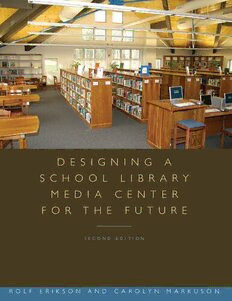
Cover photo of the Bruce and Patrice Buxton Library at Falmouth Academy courtesy of
Susan D. Moffat.
Composition in Janson and Tekton MM by ALA Editions using InDesign CS on a PC platform.
The paper used in this publication meets the minimum requirements of American National
Standard for Information Sciences—Permanence of Paper for Printed Library Materials, ANSI
Z39.48-1992.
Library of Congress Cataloging-in-Publication Data
Erikson, Rolf.
Designing a school library media center for the future / Rolf Erikson
and Carolyn Markuson. — 2nd ed.
p. cm.
Includes bibliographical references and index.
ISBN-13: 978-0-8389-0945-4 (alk. paper)
ISBN-10: 0-8389-0945-0 (alk. paper)
1. Instructional materials centers—United States—Design and construction.
2. Instructional materials centers—United States—Automation. 3. School libraries—
United States—Design and construction. 4. School libraries—United States—Automation.
I. Markuson, Carolyn Bussian. II. Title.
Z675.S3E75 2007
027.80973—dc22 2006037644
Copyright © 2007 by the American Library Association. All rights reserved except those which may
be granted by Sections 107 and 108 of the Copyright Revision Act of 1976.
ISBN-10: 0-8389-0945-0
ISBN-13: 978-0-8389-0945-4
Printed in the United States of America
11 10 09 08 07 5 4 3 2 1
Contents
List of Figures vii
Foreword, by Ross J. todd ix
Preface xi
Acknowledgments xiii
1 seeing the Big Picture: What to expect and When to expect It 1
The Process 1
2 Working successfully with Key Players:
the Art of Communication 6
The Librarian’s Role 6
Developing Working Relationships 7
Communication Tips 8
3 Planning Your Program: It’s never too soon! 10
4 Planning for technology: the essential Ingredients 13
The Challenge of Technology 14
A Connectivity Primer 15
Electrical Requirements 18
Heating, Ventilating, and Air Conditioning (HVAC) 18
Telephone and Fax 18
Theft Prevention 18
Library Media Center Classroom 19
Small-Group Study Rooms 19
Videoconferencing and Distance Learning Classroom 19
LCD Projectors and Interactive Whiteboards 20
Mixed-Platform Challenges 21
Data-Driven Decision Making (D3M) and Data Warehousing 21
Planning and Uncertainty 21
iii
iv Contents
5 Planning space Allocation: An Integrated Approach 22
Initial Considerations 22
Location of the Library 23
Library Entrances 23
Functional Areas 23
The Print Collection 24
Seating Capacity 25
Technology Requirements 25
Descriptive Specifications 26
Spatial Relationships Diagram 26
6 Creating a Functional Interior: Zone and Furniture Plans 29
Zone Plans 29
Furniture Plans 30
A High School Library Furniture Plan 39
Serving Multigrade Populations 40
The Result of Exemplary Planning 41
7 Creating an Inviting Interior: Furnishings 45
Furniture Selection 45
Sources for Furniture 46
Criteria for Purchasing Furniture 47
Key Features 48
Use of Color 59
A Final Word about Furniture Selection and Evaluation 60
8 Creating a Comfortable Interior: Lighting,
Acoustics, Mechanical Design, and ergonomics 61
Lighting 61
Acoustics 66
Mechanical Design 67
Ergonomics 68
9 Creating a Green Interior: sustainability 70
10 Making the Library Accessible: An Inclusive Approach 72
Americans with Disabilities Act 72
Signage 74
Learning Styles 76
Safety Issues 77
Contents v
11 Buying What You Want: specifications and Bid Documents 79
Specifications 80
General Conditions 81
12 the Final Phases: Construction, Delivery, Installation,
and Moving In 82
Construction 82
Delivery and Installation of Furniture and Equipment 83
Moving In 84
Celebrate 84
13 Combining Facilities: Joint school-Public Libraries 85
Difficulties 86
Advantages 86
Case Study: Conceptual Design for a Joint-Use Library 87
Challenges 89
14 Conclusion: Building on the experience of others 90
Appendixes 93
A Common Architectural Symbols 93
B Suggested Space Allocations and Adjacencies 94
C Sample Area Data Form 97
D General Information on Shelving 99
e Recommended Chair and Table Heights 100
F Sample Furniture Specification 101
G Sources of Furniture and Fixtures 103
H Useful Websites 106
selected Readings 109
Index 113
FIGuRes
1-1 The Process of School Library Media Center Design 2
4-1 Distance Learning Classroom 20
5-1 Calculating Book Collection Space Needs 25
5-2 Bubble Diagram for a High School Library 27
6-1 Zone Plan for a High School Library 31
6-2 Development of a Zone Plan for a High School Library 32
6-3 Sloped-Top Reference Shelves 34
6-4 Study and Instruction Area in a High School Library 36
6-5 Use of Movable Wall Systems to Create a Small-Group
Study Room 37
6-6 Lounge Seating Area in a High School Library 37
6-7 Lounge Seating in a Middle School Library 38
6-8 Reading Nook in an Elementary School Library 38
6-9 Furniture Plan for a High School Library 39
6-10 Built-in Study Carrels, The Park School 40
6-11 Built-in Reading Cubbies, The Park School 40
6-12 Furniture Plan, Vinalhaven School 41
6-13 Library Interior, Vinalhaven School 41
6-14 Furniture Plan, Ground Floor: Colegio Los Nogales,
Bogotá, Colombia 43
7-1 Avoid Sharp Edges 48
7-2 End Panels 49
7-3 End Panel 49
7-4 Metis Shelving System 50
7-5 Custom Canopy Top 51
7-6 “If you twist your neck and squint, you can read the spines.” 51
vii
viii Figures
7-7 Alcott Table 52
7-8 Turner Chair 53
7-9 Piretti Xylon Chair 53
7-10 Arborline Side Chair 53
7-11 Mission Three-Position Chair 54
7-12 Ithaca Two-Position Chair 54
7-13 Archer Lounge Chair 54
7-14 Gotham Lounge Chair 55
7-15 American Classics Lounge Chair 55
7-16 Zuma Task Chair 55
7-17 Body Form Children’s Chair 57
7-18 Primaries Children’s Chairs 57
7-19 Eurobib Tricolore Browser Table and Chairs 57
7-20 Lunella Stackable Soft Seating 58
7-21 Children’s Reading Table 58
10-1 Height-Adjustable Table 74
10-2 Small-Group Study Room/Lounge Seating 77
13-1 Conceptual Design for a Joint-Use Library 88
FoReWoRD
Considerable research evidence shows that school libraries are vital to
students’ education. This research, which spans almost four decades,
demonstrates that many factors contribute to the establishment and
operation of effective school libraries that support student learning and
achievement. These factors include adequate and appropriate information
resources, state-of-the-art information technology infrastructure, and, most
importantly, essential pedagogical leadership in enabling students to learn in
complex information environments.
The fusion of print and electronic information environments now places
considerable responsibility on learners to navigate this complex and often
ambiguous information space, to locate pertinent information, to make judg-
ments about the quality of the information, to make sense of the multiple per-
spectives, and to construct their own understanding of their chosen topics. If
school libraries are to be effective transformational spaces where students are
empowered to synthesize myriad pieces of information into personal know-
ing, and not merely information depositories, then it is increasingly impor-
tant that school leaders, including school librarians, grapple with how to
design and provide learning environments in school libraries that best foster
the development of deep knowledge and deep understanding and that enable
students to succeed and achieve through their schooling.
Well-designed learning environments in education settings take into
account many factors: they are learner-centered, safe, comfortable, accessible,
flexible, and equitable. The challenge of designing the school library to meet
these dimensions as well as to be a multidimensional, whole-school learn-
ing space able to meet diverse information needs, learning styles, learning
tasks, and instructional approaches needs considerable and careful thought.
The learner must be at the heart of a well-designed school library. Although
information sources, information services, and information technology are
essential components of the school library and need deliberate consideration
in the design process, they are not the center of the library.
A well-designed library facility is important, for multiple reasons. A well-
designed school library facilitates an effective library program. Conversely, a
poorly designed facility can impede a program’s effectiveness and success. A
well-designed library provides both an aesthetically compelling and an intel-
lectually engaging place for students that motivates them to be in the library,
ix