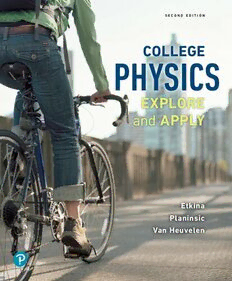
Table Of Contentsecond edition
COLLEGE
PHYSICS
EXPLORE
and APPLY
Etkina
Planinsic
Van Heuvelen
This page intentionally left blank
M00_LINI4360_FM_pi-xvi.indd 4 31/05/14 9:57 AM
CONVERSION FACTORS PHYSICAL CONSTANTS
Length Gravitational coefficient on Earth g 9.81 N kg
1 in. = 2.54 cm Gravitational constant G 6.67 *>10-11 N#m2 kg2
1 m = 39.4 in. = 3.28 ft Mass of Earth 5.97 * 1024 kg >
1 mi = 5280 ft = 1609 m Average radius of Earth 6.38 * 106 m
1 km = 0.621 mi Density of dry air (STP) 1.3 kg m3
1 angstrom Å = 10-10 m Density of water (4 °C) 1000 kg m3
>
1 light-year 1ly2 = 9.46 * 1015 m Avogadro’s number NA 6.02 * 1>023 particles (g atom)
Volume 1 2 Boltzmann’s constant kB 1.38 * 10-23 J K
#
Gas constant R 8.3 J mol K
1 liter = 1000 cm3 >
Speed of sound in air (0°) 340 m s
1 gallon = 3.79 liters Coulomb’s constant kC 9.0 *>>109 N#m2 C2
Speed Speed of light c 3.00 * 108 m s >
1 mi h = 1.61 km h = 0.447 m s Elementary charge e 1.60 * 10-19 C>
Mas>s > > Electron mass me 9.11 * 10-31 kg = 5.4858 * 10-4 u
Proton mass mp 1.67 * 10-27 kg = 1.00727 u
1 atomic mass unit u = 1.660 * 10-27 kg Neutron mass mn 1.67 * 10-27 kg = 1.00866 u
(Earth exerts a 2.205-lb force on an object with 1 kg mass)
1 2 Planck’s constant h 6.63 * 10-34 J#s
Force
1 lb = 4.45 N POWER OF TEN PREFIXES
Work and Energy Prefix Abbreviation Value
# #
1 ft lb = 1.356 N m = 1.356 J Tera T 1012
1 cal = 4.180 J Giga G 109
1 eV = 1.60 * 10-19 J Mega M 106
1 kWh = 3.60 * 106 J Kilo k 103
Hecto h 102
Power
Deka da 101
#
1 W = 1 J s = 0.738 ft lb s
Deci d 10-1
#
1 hp U.S.>= 746 W = 550> ft lb s Centi c 10-2
1 hp 1metr2ic = 750 W > Milli m 10-3
Pres1sure 2 Micro μ 10-6
1 atm = 1.01 * 105 N m2 = 14.7 lb in2 Nano n 10-9
= 760 mm Hg Pico p 10-12
> >
1 Pa = 1 N m2 Femto f 10-15
>
SOME USEFUL MATH
Area of circle (radius r) pr2 Trig definitions:
sin u = (opposite side) (hypotenuse)
Surface area of sphere 4pr2
cos u = (adjacent side) (hypotenuse)
Volume of sphere 4 pr3 tan u = (opposite side)>(adjacent side)
3 >
Quadratic equation: >
0 = ax2 + bx + c,
-b { b2 - 4ac
where x =
22a
A00_ETKI1823_02_SE_FEP.indd 2 07/11/17 6:04 PM
Brief Contents
Mechanics
PART 1
1 Introducing Physics 1
2 Kinematics: Motion in One Dimension 13
3 Newtonian Mechanics 51
4 Applying Newton’s Laws 84
5 Circular Motion 118
6 Impulse and Linear Momentum 147
7 Work and Energy 176
8 Extended Bodies at Rest 217
9 Rotational Motion 251
VIBRATIONS AND WAVES
PART 2
10 Vibrational Motion 284
11 Mechanical Waves 315
GASES AND LIQUIDS
PART 3
12 Gases 352
13 Static Fluids 386
14 Fluids in Motion 415
THERMODYNAMICS
PART 4
15 First Law of Thermodynamics 441
16 Second Law of Thermodynamics 476
ELECTRICITY AND MAGNETISM
PART 5
17 Electric Charge, Force, and Energy 500
18 The Electric Field 535
19 DC Circuits 572
20 Magnetism 616
21 Electromagnetic Induction 649
OPTICS
PART 6
22 Reflection and Refraction 685
23 Mirrors and Lenses 712
24 Wave Optics 751
25 Electromagnetic Waves 784
MODERN PHYSICS
PART 7
26 Special Relativity 813
27 Quantum Optics 847
28 Atomic Physics 880
29 Nuclear Physics 921
30 Particle Physics 957
A00_ETKI1823_02_SE_FEP.indd 3 07/11/17 6:04 PM
This page intentionally left blank
M00_LINI4360_FM_pi-xvi.indd 4 31/05/14 9:57 AM
Help students learn physics
by doing physics
Dear Colleague,
Welcome to the second edition of our textbook College Physics: Explore and Apply and its
supporting materials (MasteringTM Physics, the Active Learning Guide (ALG), and our Instructor’s
Guide)—a coherent learning system that helps students learn physics by doing physics!
Experiments, experiments… Instead of being presented physics as a static set of established
concepts and mathematical relations, students develop their own ideas just as physicists
do: they explore and analyze observational experiments, identify patterns in the data, and
propose explanations for the patterns. They then design testing experiments whose outcomes
either confirm or contradict their explanations. Once tested, students apply explanations and
relations for practical purposes and to problem solving.
A physics tool kit To build problem-solving skills and confidence, students master proven
visual tools (representations such as motion diagrams and energy bar charts) that serve as
bridges between words and abstract mathematics and that form the basis of our overarching
problem-solving strategy. Our unique and varied problems and activities promote 21st-century
competences such as evaluation and communication and reinforce our practical approach with
photo, video, and data analysis and real-life situations.
A flexible learning system Students can work collaboratively on ALG activities in class
(lectures, labs, and problem-solving sessions) and then read the textbook at home and solve
end-of-chapter problems, or they can read the text and do the activities using Mastering
Physics at home, then come to class and discuss their ideas. However they study, students will
see physics as a living thing, a process in which they can participate as equal partners.
Why a new edition? With a wealth of feedback from users of the first edition, our own
ongoing experience and that of a gifted new co-author, and changes in the world in general
and in education in particular, we embarked on this second edition in order to refine and
strengthen our experiential learning system. Experiments are more focused and effective, our
multiple-representation approach is expanded, topics have been added or moved to provide
more flexibility, the writing, layout, and design are streamlined, and all the support materials
are more tightly correlated to our approach and topics.
Working on this new edition has been hard work, but has enriched our lives as we’ve explored
new ideas and applications. We hope that using our textbook will enrich the lives of your
students!
Eugenia Etkina
Gorazd Planinsic
Alan Van Heuvelen
“This book made me think deeper
and understand better.”
— student at Horry Georgetown Technical
College
A01_ETKI1823_02_SE_FM.indd 1 01/11/17 5:23 PM
A unique and active learning approach
promotes deep and lasting
UPDATED!
Observational
Experiment
Tables and Testing
Experiment Tables:
Students must make
observations, analyze
data, identify patterns,
test hypotheses, and
predict outcomes.
Redesigned for clarity
in the second edition,
these tables encourage
students to explore
science through active
discovery and critical
thinking, constructing
robust conceptual
understanding.
NEW! Digitally
Enhanced Experiment
Tables now include
embedded videos in the
Pearson eText for an
interactive experience.
Accompanying questions
are available in Mastering
Physics to build skills
essential to success in
physics.
A01_ETKI1823_02_SE_FM.indd 2 01/11/17 5:23 PM
conceptual understanding of physics
and the scientific process
“I like that the experiment tables...
explain in detail why every step
was important.”
—student at Mission College
EXPANDED! Experiment videos and photos created
by the authors enhance the active learning approach.
Approximately 150 photos and 40 videos have been added to the
textbook, as well as embedded in the Pearson eText, and
scores more in the Active Learning Guide (ALG).
A01_ETKI1823_02_SE_FM.indd 3 01/11/17 5:23 PM
A wealth of practical and consistent
guidance, examples, and opportunities
A four-step problem-solving
approach in worked examples
consistently uses multiple representations
to teach students how to solve complex
physics problems. Students follow
the steps of Sketch & Translate,
Simplify & Diagram, Represent
Mathematically, Solve &
Evaluate to translate a problem
statement into the language of physics,
sketch and diagram the problem, represent
it mathematically, solve the problem, and
evaluate the result.
Physics Tool Boxes focus on a
particular skill, such as drawing a motion
diagram, force diagram, or work-energy
bar chart, to help students master the key
tools they will need to utilize throughout
the course to analyze physics processes and
solve problems, bridging real phenomena
and mathematics.
“It made me excited to
learn physics! It has a
systematic and easy-to-
understand method for
solving problems.”
—student at State University of
West Georgia
A01_ETKI1823_02_SE_FM.indd 4 01/11/17 5:24 PM
for practice help develop confidence
and higher-level reasoning skills
NEW! Problem types
include multiple choice
with multiple correct
answers, find-a-pattern
in data presented in a
video or a table, ranking
tasks, evaluate statements/
claims/explanations/
measuring procedures,
evaluate solutions, design
a device or a procedure
that meets given criteria,
and linearization problems,
promoting critical thinking
and deeper understanding.
“It helps break down the
problems, which makes them
look less daunting when
compared to paragraphs
of explanations. It is very
straightforward.”
—student at Case Western Reserve
University
A01_ETKI1823_02_SE_FM.indd 5 01/11/17 5:24 PM